Last updated: May 2026
A near miss reporting culture is not built by telling workers to report more. It is built when workers believe reporting is easy, safe, and worth their time. If crews think a report will lead to blame, paperwork, or silence, they will keep close calls to themselves.
Quick Answer
- Culture is trust: Workers report when they believe the response will be fair and useful.
- Simplicity matters: If reporting is hard, it will be skipped during busy work.
- Follow-up matters more: Crews need to see what changed because they reported.
- Supervisors set the tone: Their first reaction can either grow reporting or shut it down.
Why near misses go unreported
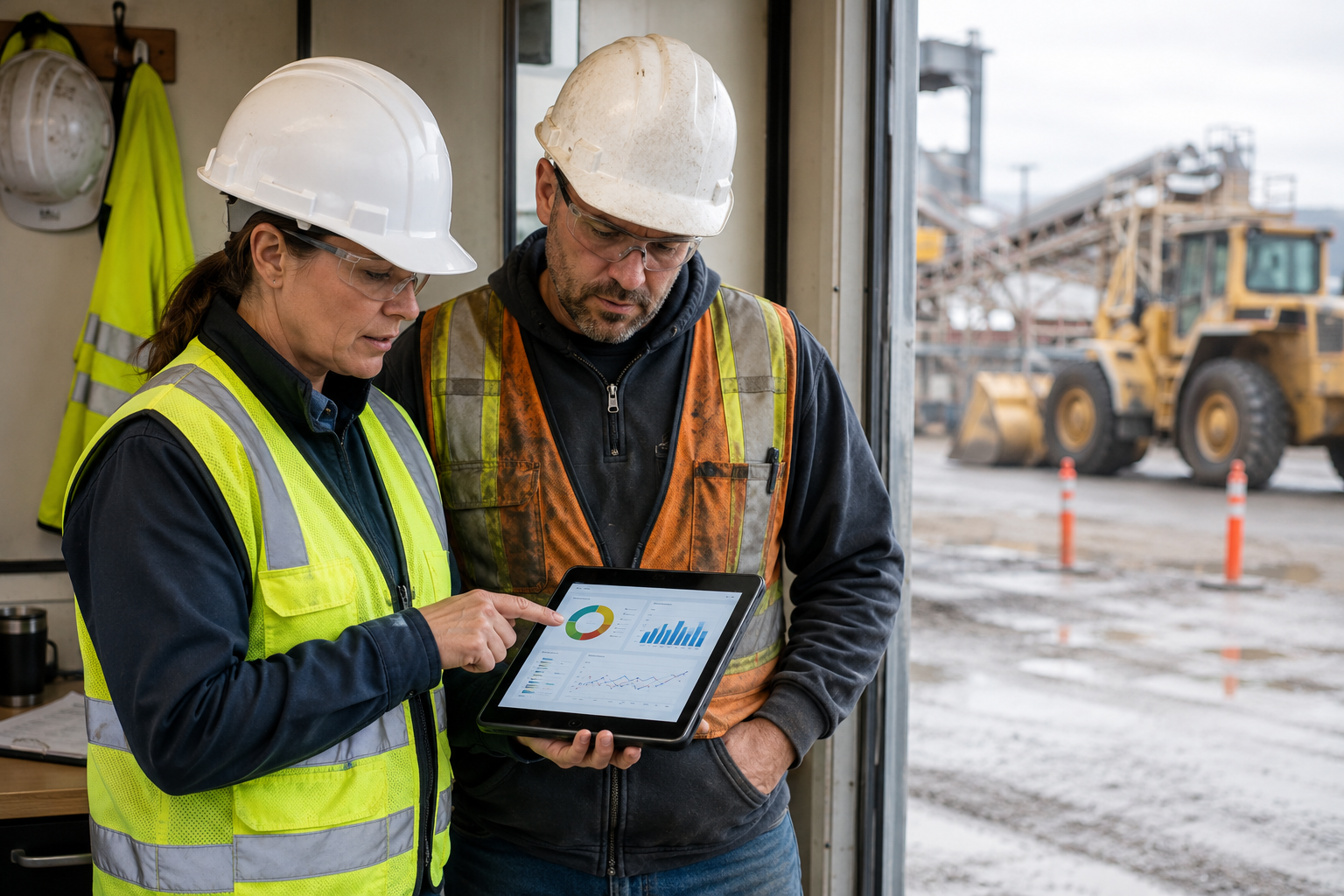
Most workers understand when something was a close call. The problem is not always awareness. The problem is friction and fear. Workers may think reporting will slow the job down, create paperwork, get someone in trouble, make them look careless, or disappear into a system where nothing changes.
If that is the experience, under-reporting is predictable. The organization may believe it has few near misses, but the field is only filtering what leadership gets to see. For the overall program structure, use the near miss reporting guide.
The five foundations of a near miss reporting culture
| Foundation | What it looks like in practice |
|---|
| No-blame response | The first response is curiosity and control, not discipline. |
| Simple reporting | Workers can submit quickly from the field with photos and plain language. |
| Visible follow-up | Crews hear what changed because of the report. |
| Supervisor coaching | Supervisors thank workers, clarify facts, and assign practical action. |
| Leadership review | Managers review trends and remove recurring barriers. |
Still relying on memory after close calls?
If near misses live in text messages, notebooks, or verbal updates, patterns disappear fast. Start your 30-day free trial and make reporting easier for supervisors and crews in the field.
Start Your 30-Day Free Trial →
Start with the supervisor reaction
The supervisor's first sentence after a near miss report matters. If the response is "why were you doing that?" or "we do not have time for this," the worker learns not to report next time. If the response is "thanks for raising it; let us make it safe and understand what happened," the worker learns reporting is acceptable.
Supervisors do not need to ignore unsafe behaviour. They need to separate learning from blame. Start by controlling the hazard and gathering facts. If there is willful violation or reckless behaviour, manage that through the right process. Do not make blame the default response to every close call.
Make reporting easier than ignoring it
A reporting process that requires long forms, desktop access, or multiple approvals will fail in the field. Workers should be able to submit the basics quickly: what happened, where, what could have happened, and a photo if useful. Supervisors and safety teams can complete classification, investigation, and corrective action details afterward.
Use the near miss report template to keep intake practical. Use the near miss vs hazard page to help workers understand what belongs in the system.
Show workers what changed
The fastest way to kill reporting is silence. If workers submit near misses and never hear back, they assume no one cares. Every meaningful report should close with a visible outcome: the walkway was cleared, the traffic plan changed, the tool tether rule was reinforced, the equipment was repaired, the lift plan was revised, or the hazard was removed.
That feedback does not have to be complicated. A short toolbox talk can be enough: "A close call was reported near the loading area. We changed the pedestrian route and added a spotter requirement. Thanks to the crew for reporting it before someone was hurt." For ideas, use the near miss toolbox talk.
Train with real examples
Workers report better when they can picture what counts. Use realistic examples from your work: reversing equipment, dropped objects, slips, energy isolation, suspended loads, sharp edges, chemical exposure, and line-of-fire events. Avoid generic posters that do not look like the job.
The near miss examples at work page gives supervisors scenario language they can use in morning meetings. Pair examples with one question: "Where could this happen here today?" That turns training into prevention.
Do not weaponize near miss KPIs
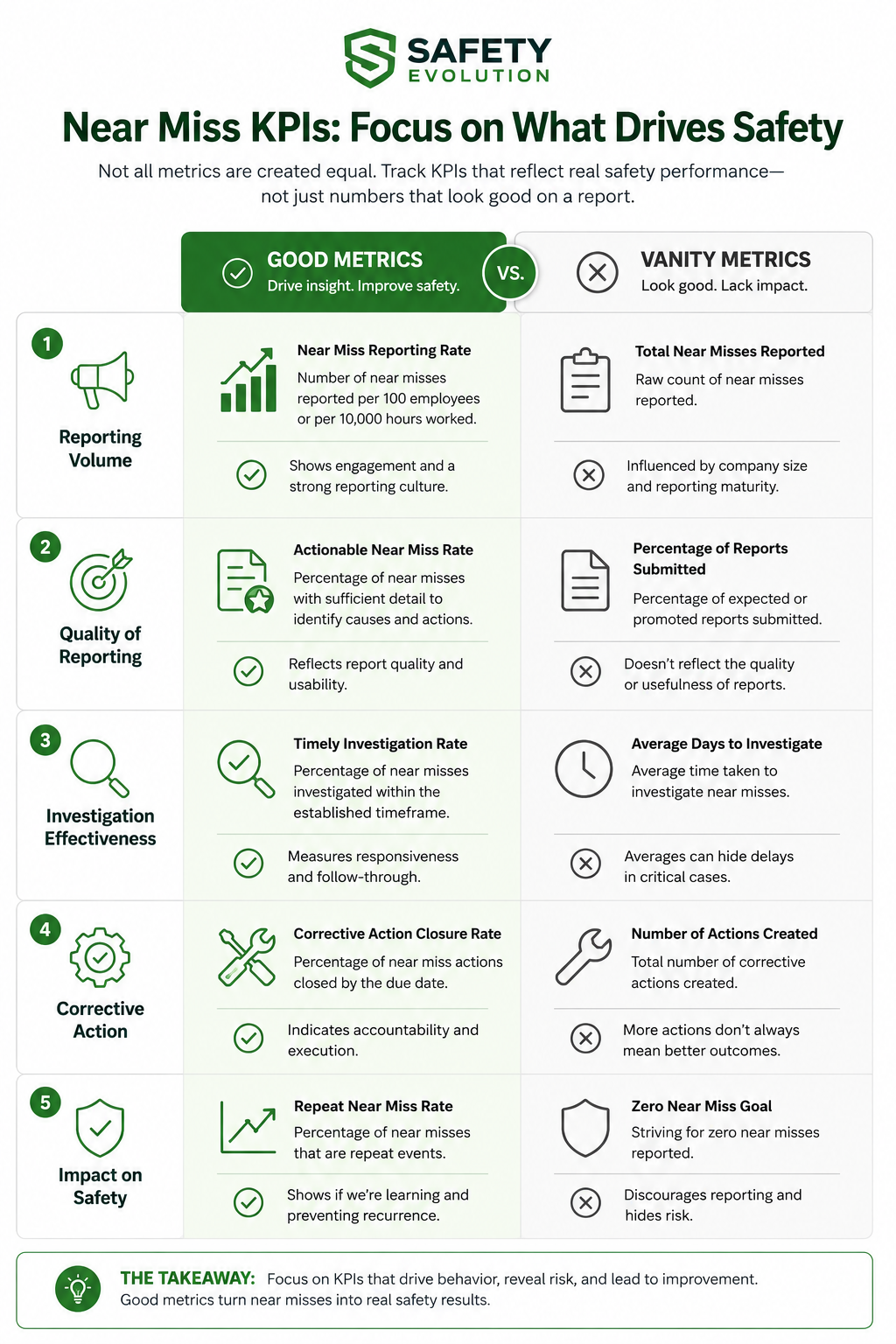
KPIs can support culture or damage it. If managers pressure crews for a quota of near miss reports, the team may submit low-quality reports just to hit a number. If managers punish crews with high reporting volume, reports will drop. The better approach is to review volume with context: potential severity, repeat themes, corrective action closeout, and participation.
For a balanced dashboard, use our guide to near miss KPIs. High-potential events should also be separated from general volume using the high-potential near miss criteria.
Build reporting into daily work
A strong reporting culture does not rely on one annual campaign. It shows up in daily habits. Supervisors ask about close calls during pre-job meetings. Workers know how to report from the field. Safety managers review trends. Corrective actions are visible. Leadership asks what the organization learned, not just how many days it has been since an injury.
That daily rhythm matters because near misses are easy to forget. If reporting is not part of the workflow, the moment passes and the learning disappears.
How leadership can support the culture
- Thank teams for reporting serious close calls before injury occurs.
- Fund corrective actions instead of only asking for more awareness.
- Review overdue actions and remove barriers.
- Ask what controls failed, not who can be blamed.
- Share cross-site learning when the same risk could exist elsewhere.
- Recognize useful reporting quality, not just report quantity.
How to recover from low trust
If workers already distrust the process, do not launch another slogan. Start with one visible improvement. Pick a common close call category, ask crews what makes it hard to report, simplify the form, and close the next few actions quickly. Then communicate what changed. Trust rebuilds when workers see repeated proof that reporting leads to useful action.
If a serious close call occurs, use the near miss investigation process to show that the organization can learn without immediately blaming the person closest to the event.
What to measure while culture improves
Culture change should show up in the data, but not always as fewer reports. In the early stages, near miss volume may increase because workers are finally reporting what they used to keep quiet. That is not a failure. Watch for better report quality, more worker participation, faster corrective action closeout, and more discussion of close calls in toolbox talks.
Over time, the goal is not simply more reports. The goal is better visibility, stronger controls, and fewer repeat exposures. If the same near miss appears every month, the system is collecting information but not yet learning from it.
30-day culture improvement sprint
- Pick one common near miss theme, such as mobile equipment, slips, or dropped objects.
- Explain the theme in one short toolbox talk using real examples.
- Make the reporting path obvious and mobile-friendly.
- Thank workers publicly for useful reports.
- Close the first few corrective actions quickly and visibly.
- Review the results with supervisors at the end of the month.
This kind of focused sprint is often more effective than a broad campaign that tells everyone to report more but changes nothing about the experience of reporting.
Want better near miss reporting without more admin drag?
When reporting is clunky, supervisors skip it and crews stop believing it matters. Use Safety Evolution to capture close calls, assign follow-up, and keep the learning visible.
Start Your 30-Day Free Trial →
Frequently Asked Questions
What is a near miss reporting culture?
It is an environment where workers report close calls early because they trust the response, understand the process, and see that reports lead to useful action.
Why do workers avoid reporting near misses?
Common reasons include fear of blame, paperwork, time pressure, lack of feedback, and a belief that nothing will change.
How can supervisors improve near miss reporting?
Supervisors can thank workers, control the hazard, ask neutral questions, simplify reporting, assign follow-up, and share what changed.
Should companies reward near miss reporting?
Recognition can help if it focuses on quality and learning. Avoid quotas or incentives that encourage low-quality reports or hide serious risk.
Get Weekly Safety Insights
Regulation updates, toolbox talk ideas, and compliance tips. One email per week.