Last updated: April 2026
You have a safety program. You have the binders, the toolbox talk schedule, the FLHA forms. Your COR audit went fine. But your crew still takes shortcuts on scaffolding, your near-miss reports sit at zero (not because your sites are perfect, but because nobody files them), and the same corrective actions keep showing up quarter after quarter. Improving safety culture means changing what your crew actually does on site, not just what your written program says they should do. Here is how to close that gap.
This is not a list of generic tips. These are the strategies that move a contractor from a Dependent safety culture (rules followed because the supervisor enforces them) to an Independent and Interdependent culture (people making safe choices because they believe in it).
⚡ Quick Answer
- Start here: Safety culture improvement starts with leadership. If the owner treats safety as a cost centre, the crew will too.
- Biggest lever: Near-miss reporting. A site with zero near-miss reports does not have zero hazards. It has a trust problem.
- Timeline: Behavioural shifts in 6 to 12 months with consistent effort. Deep culture change takes 2 to 5 years.
- Measure it: Track leading indicators (near-miss reports, safety observations, training completion) not just lagging indicators (injury rates).
- Framework: Use the Bradley Curve to identify your current stage and target the next one.
Why Is Safety Culture So Hard to Change?
Most contractors try to improve safety culture by adding more rules. More procedures, more forms, more mandatory training hours. The crew responds by getting better at paperwork, not better at safety. That is the compliance trap: you can have a perfect written program and still have a crew that takes shortcuts the moment supervision turns their back.
Culture is resistant to change because it lives in habits, peer norms, and unspoken agreements. If the veteran crew lead has been doing something a certain way for 15 years and never got hurt, no toolbox talk is going to change his mind overnight. The only thing that changes behaviour is when the social environment changes: when peers hold each other accountable, when leadership models the behaviour they expect, and when reporting hazards is rewarded instead of punished.
Here is the blunt truth: if your safety culture is not improving, the problem is almost always leadership, not the workers. Workers mirror what they see. If the foreman skips the FLHA when the schedule is tight, the crew learns that FLHAs are optional when it matters most.
How to Assess Your Current Safety Culture
Before you can improve, you need an honest baseline. Not your COR audit score (that measures your system, not your culture). Not your injury rate (that is a lagging indicator that tells you what already went wrong). You need to measure what people actually believe and do.
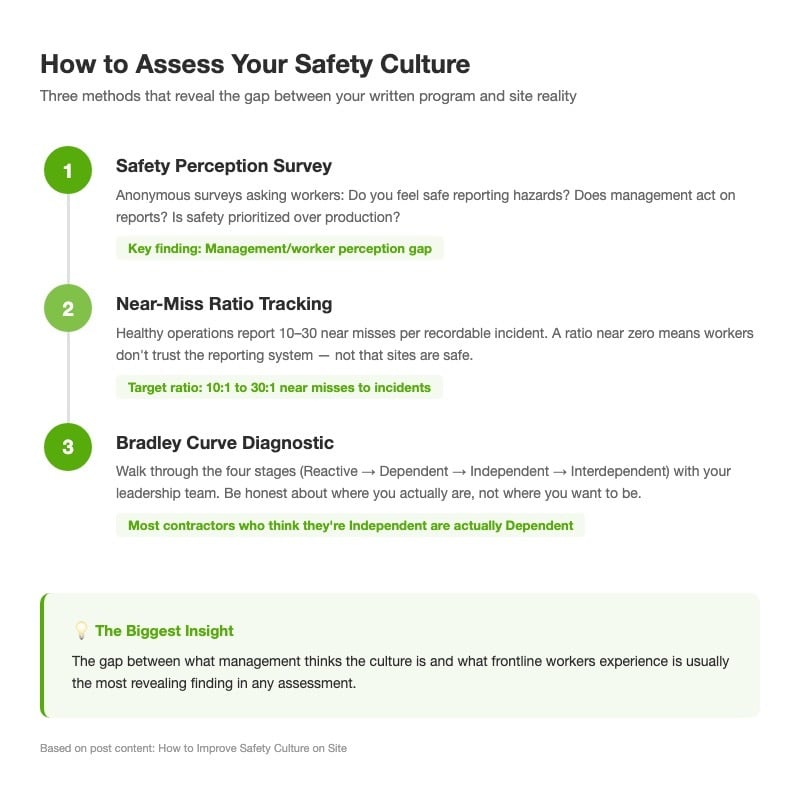
Run a safety perception survey. Ask workers anonymous questions about whether they feel safe reporting hazards, whether they trust management to act on reports, whether they believe safety is genuinely prioritized over production. The gap between what management thinks the culture is and what frontline workers experience is usually the most revealing finding.
Check your near-miss reporting rate. A healthy operation generates 10 to 30 near-miss reports for every recordable incident. If your ratio is closer to 1:1 or worse (zero near misses), your workers are either not recognizing hazards or not reporting them. Both are culture problems. For a deeper dive into using near misses as culture indicators, see our safety culture assessment guide.
Use the Bradley Curve as a diagnostic. Walk through the four stages with your leadership team. Be honest about which stage describes your current reality. Most contractors who think they are Independent are actually early Dependent: the system works, but only because specific people enforce it.
Need an Honest Assessment of Your Safety Culture?
Know your safety culture needs work but not sure where to start? SE AI compares your written program to what actually happens on your sites.
Get Early Access to SE AI →
12 Strategies That Actually Improve Safety Culture
1. Make Leadership Visible
Safety culture starts at the top. When the owner or project manager shows up at toolbox talks, reviews FLHAs, and participates in site safety walks, the crew sees that safety is not just a department. It is a company value. Safety leadership is the single biggest predictor of culture change.
2. Fix Your Near-Miss Reporting System
Near misses are free lessons. Every unreported near miss is a warning you ignored. The two biggest barriers to reporting are fear of consequences and the belief that nothing will change. Fix both: guarantee no disciplinary action for reporting hazards, and visibly act on every report within 48 hours. Post the corrective actions where the crew can see them.
3. Run Effective Toolbox Talks
Toolbox talks are the most underused culture tool in construction. Most contractors treat them as a 5-minute checkbox exercise. Instead, make them a 15-minute conversation where the crew identifies hazards specific to today's work. Ask questions. Let workers share close calls. Use your toolbox talk program as a daily culture reinforcement, not just documentation.
4. Empower Stop-Work Authority
Every worker on your site should have the authority to stop a task they believe is unsafe, without fear of retaliation or production pressure. This sounds obvious. In practice, most workers on construction sites have never actually stopped a task because they worried about the reaction. Test this: ask your newest apprentice if they would feel comfortable stopping a pour because they noticed an unsafe condition. Their answer tells you more about your culture than your COR score does.
5. Conduct Behaviour-Based Safety Observations
Behaviour-based safety (BBS) observations are structured, non-punitive observations of work practices. The observer watches a task, notes safe and at-risk behaviours, and has a conversation with the worker immediately. The conversation is the point, not the form. BBS shifts the focus from "did someone get hurt?" to "are we working safely right now?"
6. Redesign Your Orientation Process
A worker's first day on site sets the tone. If your orientation is a 30-minute video and a signature on a form, you are teaching new hires that safety is a checkbox. Effective orientations include site-specific hazard walkthroughs, introductions to the crew (so the new worker knows who to go to), and hands-on demonstrations of critical procedures.
7. Track Leading Indicators
Lagging indicators (injury rates, lost-time claims) tell you what already went wrong. Leading indicators tell you what is about to go wrong. Track: near-miss reporting rate, safety observation count, training completion rate, corrective action closure time, and safety meeting attendance. When leading indicators drop, injuries follow 3 to 6 months later. For more on measurement frameworks, see our guide to safety culture frameworks.
8. Address Production Pressure Directly
Most safety culture failures happen when production pressure overrides safety decisions. When the schedule is tight, the concrete needs to be poured today, and cutting a corner saves 30 minutes. If your culture cannot survive schedule pressure, it is not culture. It is convenience. Address this directly: have leadership publicly acknowledge that missing a deadline is acceptable if the alternative is an unsafe condition. Then back it up when it happens.
9. Recognize Safe Behaviour
Most safety programs are designed to catch people doing things wrong. Flip it. Recognize workers who report hazards, who stop tasks, who help coworkers correct unsafe conditions. This does not need to be elaborate. A public acknowledgment at the next toolbox talk, a note from the project manager, or a simple "thank you for stopping that" from the foreman. Recognition reinforces the behaviour you want to see.
10. Investigate Incidents as Learning Opportunities
Most contractors investigate incidents to find someone to blame. That approach guarantees your workers will hide the next one. Use your incident investigation process to find root causes, not scapegoats. Share the findings openly. The goal is systemic improvement, not individual punishment. When workers see that investigations lead to better conditions (not write-ups), reporting goes up.
11. Build Peer Accountability
The ultimate sign of a mature safety culture is peer accountability: workers correcting each other without being asked. This cannot be mandated. It develops naturally when leadership models it, when reporting is safe, and when the crew genuinely cares about each other. Start small: pair experienced workers with new hires. Create buddy systems for high-risk tasks. Celebrate instances where peer intervention prevented a hazard.
12. Use Safety Culture Training
Technical safety training (fall protection, confined space, WHMIS) teaches skills. Safety culture training teaches attitudes and behaviours: how to have a safety conversation, how to intervene when you see something unsafe, how to give and receive feedback without conflict. Both are necessary. Most contractors invest heavily in technical training and almost nothing in the human side.
Common Mistakes That Stall Culture Change
Treating it as a project with an end date. Culture change is continuous. If you "launch a safety culture initiative" and expect results in 90 days, you will be disappointed. Culture is built through sustained, consistent effort over years.
Blaming the workers. "Our workers just do not care about safety" is the most common excuse. It is also almost always wrong. Workers respond to their environment. If the environment rewards shortcuts and punishes reporting, that is exactly what you will get.
Relying on consequences alone. Discipline has a place, but if your entire safety system is built on punishment, you are building fear, not culture. Fear produces compliance when watched and risk-taking when not.
Changing everything at once. Pick two or three changes from this list. Implement them consistently for 6 months. Measure the results. Then add more. Trying to transform your entire culture overnight overwhelms the crew and management alike.
Ignoring subcontractors. Your safety culture is only as strong as the weakest crew on your site. If your subcontractors operate under different safety standards, your culture has a hole in it. Include subcontractors in safety orientations, toolbox talks, and reporting systems.
Ready to Close the Gap Between Your Program and Your Culture?
Tried toolbox talks, new policies, and more training but nothing sticks? SE AI identifies the specific breakdowns between your program and your crews.
Get Early Access to SE AI →
Frequently Asked Questions
How long does it take to improve safety culture?
You can see behavioural changes within 6 to 12 months with consistent leadership commitment and visible system changes. Deep culture change (moving from Dependent to Independent or Interdependent on the Bradley Curve) typically takes 2 to 5 years of sustained effort. The key is consistency: sporadic initiatives do not build culture.
What is the biggest factor in safety culture improvement?
Leadership commitment is consistently the biggest predictor of safety culture improvement. When the owner, project manager, or site superintendent visibly prioritizes safety in daily decisions (not just in policies), the crew follows. Workers take their cues from leadership behaviour, not leadership memos.
How do you measure safety culture improvement?
Track leading indicators: near-miss reporting rates (should increase as trust builds), safety observation counts, training completion rates, and corrective action closure times. Compare safety perception survey results over time. Lagging indicators (injury rates, lost-time claims) will follow, but they are trailing measures that reflect past culture, not current efforts.
Why do near-miss reports matter for safety culture?
Near-miss reports are the leading indicator of both safety culture health and future incident risk. A site that generates 10 to 30 near-miss reports for every recordable incident has a culture of open reporting and hazard awareness. A site with zero near-miss reports does not have zero hazards; it has workers who do not trust the system enough to report them.
Can you improve safety culture without spending a lot of money?
Yes. The most impactful culture changes are behavioural, not financial. Leadership visibility at toolbox talks, fixing the near-miss reporting process, recognizing safe behaviour, and giving workers genuine stop-work authority cost almost nothing but require real commitment. Technology and formal training programs help, but they amplify culture change that leadership has already started.
Get Weekly Safety Insights
Regulation updates, toolbox talk ideas, and compliance tips. One email per week.