Last updated: April 2026
You are filling out a bid package and the GC wants proof of "first aid certification" for your crew. Sounds simple until you realize there are at least seven different types of first aid certification in Canada. Emergency first aid. Standard first aid. OFA Level 1. OFA Level 2. OFA Level 3. CPR Level A, B, C, and HCP. Advanced first aid. And they all sound similar enough to make your head spin.
We work with contractors who run into this confusion weekly. The certification system in Canada is a patchwork of national programs (Red Cross, St. John Ambulance) and provincial systems (WorkSafeBC's occupational first aid, Alberta's OHS Code classifications). This guide lays out every level, what it covers, and which one your crew actually needs.
⚡ Quick Answer
- Emergency First Aid (EFA): 1-day course. CPR, AED, severe bleeding, shock. Basic life-threatening response only.
- Standard First Aid (SFA): 2-day course. Everything in EFA plus bone injuries, head/spinal, poisoning, medical emergencies, secondary assessment.
- OFA Level 1 / Basic First Aid (BC): 1-day occupational course. WorkSafeBC-recognized for low-to-moderate hazard workplaces.
- OFA Level 2 / Intermediate First Aid (BC): 2-day occupational course. Required for moderate-to-high hazard sites with more workers.
- OFA Level 3 / Advanced First Aid (BC): 10-day occupational course. Required for high-hazard, remote, or large worksites in BC.
- CPR Level C: Adult, child, and infant CPR plus AED. The most common level paired with first aid courses.
- For most contractors: Standard first aid with CPR Level C is the baseline. Construction and industrial sites often need OFA Level 2 or higher depending on province and hazard level.
- Behind on first aid actions? Start your 30-day free trial to track training, records, and corrective actions in one place.
First aid certification in Canada spans two main streams: general first aid through national providers (Red Cross, St. John Ambulance, Heart & Stroke) and occupational first aid through provincial systems (WorkSafeBC, Alberta OHS). Each stream has multiple levels with different training hours, scopes, and workplace applications. For contractors, the challenge is knowing which certifications actually satisfy your provincial requirements and which ones are a waste of money. This guide breaks down every level so you can match the right certification to your crew, your province, and your jobsite risk level.
What Are the Main First Aid Certification Streams in Canada?
First aid certification in Canada splits into two main streams: general first aid (offered by national providers like Red Cross and St. John Ambulance) and occupational first aid (province-specific workplace programs). Understanding the difference is critical because they serve different purposes and may not be interchangeable.
General first aid certifications (emergency and standard) are offered nationwide and are recognized broadly. They cover universal first aid skills. Occupational first aid certifications are designed specifically for workplace hazards and are governed by provincial regulators. In BC, that is the WorkSafeBC occupational first aid system. In Alberta, the OHS Code specifies requirements that can be met by approved general or occupational certifications.
The confusion comes when a contractor assumes a general first aid certificate satisfies their provincial occupational requirements, or vice versa. Sometimes it does. Sometimes it does not. Province matters. Hazard level matters. Crew size matters.
Emergency First Aid: What It Covers
Emergency first aid is the entry-level certification. It is a one-day course (6.5 to 8 hours) that covers how to respond when someone's life is in immediate danger.
Topics covered:
- CPR for adults (Level A) or adults, children, and infants (Level C)
- Automated External Defibrillator (AED) use
- Choking response (conscious and unconscious)
- Severe bleeding control
- Shock management
- Scene assessment and calling EMS
Who needs it: Workers in low-hazard workplaces with small crews. In many provinces, emergency first aid satisfies the minimum requirement for workplaces with fewer than 10 workers and low hazard ratings. It is also adequate for workers who are NOT the designated first aid attendant but need basic emergency skills.
Cost: $80 to $120 depending on provider and location.
Standard First Aid: What It Covers
Standard first aid is a two-day course (14 to 16 hours) that builds on emergency first aid with a much broader skill set.
Everything in emergency first aid, plus:
- Head and spinal injury management
- Bone, joint, and muscle injuries (fractures, dislocations, sprains)
- Wound care and bandaging
- Burns (thermal, chemical, electrical)
- Poisoning and substance exposure
- Diabetic emergencies
- Seizures
- Asthma and severe allergic reactions (anaphylaxis)
- Heat and cold emergencies (hypothermia, heat stroke)
- Secondary assessment (head-to-toe patient survey)
- Multiple casualty management
Who needs it: Designated first aid attendants in most medium-to-high-hazard workplaces. If you run a construction crew of 10 or more, at least one person on site per shift should have standard first aid. Most GCs require it. Many provincial regulations require it for your hazard class.
Cost: $130 to $200 depending on provider. Recertification (before expiry) costs $75 to $120 for one day.
For a direct comparison of standard and emergency, read our standard vs emergency first aid guide.
CPR Levels: A, B, C, and HCP
CPR certification is bundled with most first aid courses, but the level of CPR varies. Here is what each level means:
| CPR Level | Covers | Typical Pairing |
|---|
| Level A | Adult CPR + AED | Sometimes paired with emergency first aid |
| Level B | Adult + child CPR + AED | Less common; some specialized courses |
| Level C | Adult + child + infant CPR + AED | Standard pairing with standard first aid. Most broadly accepted. |
| Level HCP (Health Care Provider) | Level C + bag-valve mask, two-rescuer CPR | Required for healthcare workers, paramedics, OFA Level 3 |
For workplace first aid: CPR Level C is the standard. It is included in almost all standard first aid courses and is the level most provincial regulators and GCs expect to see. Level A is acceptable for some emergency first aid certifications, but Level C gives you broader coverage and is more widely accepted.
If your crew works around children or in environments where infant emergencies are possible (rare in construction, but relevant for some industrial settings), Level C covers all scenarios.
Not sure if your first aid readiness would hold up in a real emergency?
See training gaps, expiring certificates, and missing documentation before they become incidents.
Start Your 30-Day Free Trial →Occupational First Aid (OFA) Levels: BC's System Explained
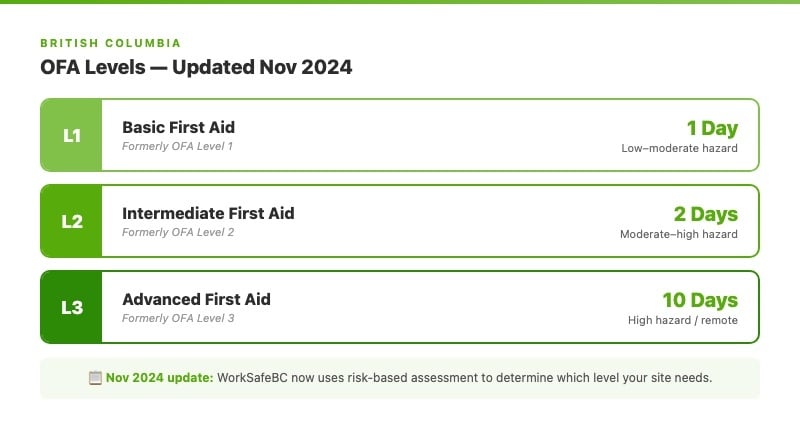
British Columbia has its own occupational first aid system managed by WorkSafeBC. As of November 1, 2024, WorkSafeBC updated the terminology, but the levels remain functionally the same:
| New Name (2024+) | Old Name | Duration | Scope | Valid For |
|---|
| Basic First Aid | OFA Level 1 | 1 day (8 hours) | CPR, AED, wound care, basic life support | 3 years |
| Intermediate First Aid | OFA Level 2 | 2 days (16+ hours) | Basic + spinal injury, splinting, secondary survey, oxygen administration | 3 years |
| Advanced First Aid | OFA Level 3 | 10 days (80 hours) | Intermediate + IV therapy, medication administration, advanced airway management, triage | 3 years |
OFA Level 3 (Advanced First Aid) is essentially a pre-hospital care certification. It is required for high-hazard worksites in BC with large crews or remote locations where paramedic response times exceed 20 minutes. Construction sites, forestry operations, mining sites, and oil and gas facilities in remote BC often require at least one OFA Level 3 attendant.
If your crew works in BC, you cannot substitute a Red Cross standard first aid certificate for an OFA Level 2 or 3 requirement. They are different programs. The BC first aid requirements guide breaks down exactly which level your worksite needs based on the WorkSafeBC hazard rating and worker count.
Alberta's First Aid Certification Requirements
Alberta does not have its own OFA-equivalent system. Instead, the Alberta OHS Code (Part 11, Schedule 2) specifies first aid requirements by hazard level and crew size, and accepts certifications from approved training agencies.
Alberta's classification system uses three first aider types:
- Emergency first aider: Holds an emergency first aid certificate. Required for low-hazard workplaces with small crews.
- Standard first aider: Holds a standard first aid certificate. Required for medium and high-hazard workplaces with 10+ workers.
- Advanced first aider: Holds an advanced first aid certificate (40+ hours). Required for high-hazard workplaces with large crews or remote locations.
For most Alberta construction contractors, standard first aid is the working minimum for designated first aiders. Advanced first aid becomes necessary on remote sites or large industrial projects.
Which Level Does Your Industry Need?
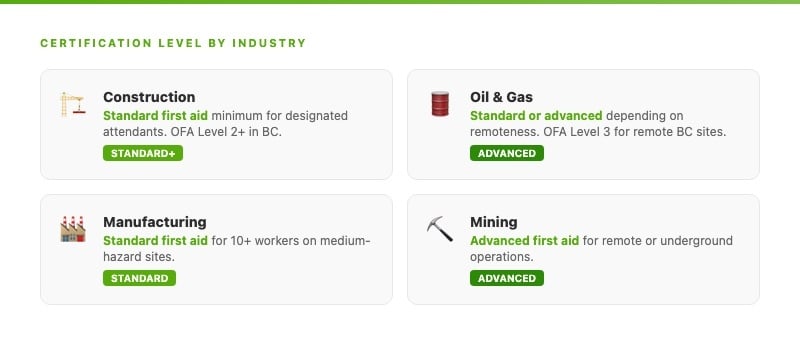
Most contractors think they need a simple answer. The honest truth is it depends on three factors: your province, your hazard level, and your crew size. Here is a general guide:
| Industry | Typical Minimum for Designated First Aider | When You Need More |
|---|
| Commercial construction | Standard first aid + CPR Level C | OFA Level 2+ in BC; Advanced in remote Alberta sites |
| Residential construction | Emergency or standard first aid + CPR Level C | Standard if 10+ workers per shift |
| Oil and gas | Standard first aid + CPR Level C minimum | OFA Level 3 or advanced for remote/turnaround work |
| Manufacturing | Standard first aid + CPR Level C | Advanced for chemical exposure or remote facilities |
| Mining | OFA Level 2+ in BC; Advanced in Alberta | OFA Level 3 for underground or remote operations |
| General trades (HVAC, plumbing, electrical) | Standard first aid + CPR Level C | Higher levels if working on industrial sites |
If your crew works across multiple provinces or on different types of sites, standard first aid with CPR Level C is the universally safe starting point. It meets minimum requirements in most situations and is the most commonly requested certification in bid packages.
For a comprehensive look at what every Canadian workplace needs to comply with, read the complete guide to workplace first aid requirements.
Common Mistakes Contractors Make with First Aid Levels
Mistake 1: Assuming "first aid" is one thing. A GC asks for "valid first aid certification." You send workers through emergency first aid because it is the cheapest and fastest option. The GC actually expected standard first aid with CPR Level C. Now you are rebooking training. Ask the GC to specify the exact level before you spend the money.
Mistake 2: Using BC certifications in Alberta (or vice versa). WorkSafeBC's OFA certificates are specific to BC's regulatory system. Alberta does not recognize "OFA Level 2" as a classification. Alberta recognizes certificates from approved training agencies. If your crew moves between provinces, confirm that your certificates are accepted in each jurisdiction.
Mistake 3: Ignoring the hazard assessment. The first aid level you need is not determined by what you think your site needs. It is determined by a formal workplace first aid assessment that considers hazard type, crew size, and distance to medical facilities. If you have not completed a workplace first aid assessment, you are guessing. And guessing is a compliance risk.
Mistake 4: Not tracking different expiry dates for different levels. A worker with standard first aid (3-year expiry) and a separate advanced first aid certificate (different expiry date) creates a tracking challenge. If you have workers with multiple certifications, track each one independently. Use a training matrix or a safety management system that handles multiple certification types per worker.
Still chasing first aid records across files and inboxes?
Centralize corrective actions and proof so your next review is predictable.
Start Your 30-Day Free Trial →Frequently Asked Questions
What is the difference between first aid Level C and standard first aid?
Level C refers to the CPR component, not the first aid course itself. CPR Level C covers adult, child, and infant CPR plus AED training. Standard first aid is a 2-day comprehensive first aid course that typically includes CPR Level C. So "standard first aid with CPR Level C" means you get both the full first aid certification and the comprehensive CPR certification.
Is OFA Level 1 the same as emergency first aid?
They are similar in scope but not identical. OFA Level 1 (now called Basic First Aid by WorkSafeBC) is a BC-specific occupational certification with content tailored to workplace emergencies. Emergency first aid is a national certification from providers like Red Cross and St. John Ambulance. Both are one-day courses covering basic life support. WorkSafeBC specifies which certificates are accepted for each workplace classification.
How long does it take to get OFA Level 3?
OFA Level 3 (now called Advanced First Aid by WorkSafeBC) is a 10-day course, typically 80 hours of instruction. It includes a written exam and practical exam. The pass rate is lower than basic or intermediate courses due to the clinical skills involved. Plan for two full weeks away from work per attendant.
Can I use a Red Cross certificate instead of OFA in BC?
It depends on your workplace requirements. WorkSafeBC accepts certain Red Cross and St. John Ambulance certificates as equivalent to basic first aid (OFA Level 1) for some workplace classifications. However, for workplaces that require intermediate or advanced first aid, you typically need the WorkSafeBC-recognized occupational certificate. Always check WorkSafeBC's list of accepted certificates for your specific situation.
What first aid certification do I need to bid on construction work?
Standard first aid with CPR Level C is the most commonly required certification for construction bid packages. Some large-scale or remote projects may require OFA Level 2 or advanced first aid for designated first aid attendants. Always check the GC's specific requirements in the bid documents. Having standard first aid with CPR Level C for your key crew members puts you in compliance for most situations. Read our complete first aid training guide for contractors for more details.
Get Weekly Safety Insights
Regulation updates, toolbox talk ideas, and compliance tips. One email per week.