Last updated: April 2026
A worker gets a chemical splash in the eye from a concrete sealer. You run to the first aid kit, tear it open, and find bandages, gauze, and a cold pack. No eye wash solution. No squeeze bottle. Nothing that helps with a chemical eye exposure. The nearest plumbed eye wash station is in the permanent building across the lot, 4 minutes away. You needed it within 10 seconds.
Construction sites create hazards that standard office-grade first aid kits were never designed to handle. Burns from welding and cutting. Eye injuries from grinding and chemical exposure. Crush injuries from heavy equipment. Falls from height. Electrocution. A first aid kit with bandages and antiseptic wipes is a starting point, not a solution.
⚡ Quick Answer
- Basic first aid kit: Required on every site. Contents depend on province and crew size. See our first aid kit checklist for province-specific requirements.
- Eye wash: Required where chemical splash or dust hazards exist. Portable eye wash bottles for immediate use; plumbed stations for ongoing exposure risk areas.
- AED (Automated External Defibrillator): Mandatory on Ontario construction sites (20+ workers, 3+ month project) as of January 1, 2026. Recommended best practice everywhere else.
- Burn kit: Critical for sites with welding, cutting, hot work, or chemical exposure. Includes burn gel, non-stick dressings, and cooling bandages.
- Trauma supplies: Tourniquets, pressure bandages, and hemostatic agents for severe bleeding emergencies on high-hazard sites.
- Behind on first aid actions? Start your 30-day free trial to track training, records, and corrective actions in one place.
Construction sites require specialized first aid supplies that go beyond what a standard workplace first aid kit provides. The combination of high-hazard work, remote locations, extreme temperatures, and industry-specific injury types means your first aid setup needs to match the actual risks on your site, not just the minimum regulatory checklist. This guide covers the essential supplies, equipment, and station setup that construction contractors need to handle the injuries that actually happen on jobsites.
Why Construction Sites Need More Than a Basic First Aid Kit
Construction sites rank among the highest-hazard workplaces in Canada, with injury types that require specialized first aid equipment beyond what a standard workplace kit provides. The most common construction injuries include cuts and lacerations, falls, struck-by incidents, burns, eye injuries, and musculoskeletal injuries. A Type 1 (Basic) first aid kit handles cuts and minor wounds. It does not handle a thermal burn from a cutting torch, a chemical splash from industrial adhesive, or a cardiac arrest from electrocution.
Provincial regulators recognize this. That is why first aid requirements for construction sites are more extensive than for offices or retail. Your workplace first aid assessment will identify the specific hazards on your site and the supplies needed to address them. Here is what to expect beyond the basic kit.
Eye Wash Stations and Portable Eye Wash
Eye injuries are one of the most common and most preventable injuries on construction sites. Grinding, cutting, drilling, chemical handling, and concrete work all create eye hazards.
When You Need Eye Wash
- Any area where chemicals, acids, or caustic materials are used or stored
- Grinding, cutting, and welding stations
- Concrete mixing and pouring areas
- Painting and coating application areas
- Dust-heavy environments (demolition, excavation)
Types of Eye Wash Equipment
| Type | Best For | Cost Range | Key Requirement |
|---|
| Portable squeeze bottle (500 mL to 1 L) | Immediate first response, mobile workers | $15 to $40 each | Replace after use or expiry (typically 2 to 3 years) |
| Gravity-fed eye wash station | Fixed work areas without plumbing | $200 to $600 | Minimum 15 minutes of continuous flow. Refill after use. |
| Plumbed eye wash station | Permanent facilities, high-risk areas | $400 to $2,000 installed | Tepid water, 15 minutes of continuous flow, within 10 seconds of hazard. |
The 10-second rule: Where chemical splash hazards exist, an eye wash station should be within 10 seconds of walking distance from the hazard. That is roughly 17 metres (55 feet). Portable bottles should be carried by workers handling chemicals in the field.
A portable eye wash bottle costs $15. A workplace eye injury costs thousands in medical treatment, lost time, and WCB claims. Keep portable eye wash in every first aid kit and at every workstation where dust or chemicals are present.
AEDs (Automated External Defibrillators)
Sudden cardiac arrest can happen on any construction site. Electrocution, heat stress, and underlying health conditions are all risk factors. An AED can increase survival rates from under 10% to over 70% when used within the first few minutes.
Where AEDs Are Required
- Ontario (mandatory): As of January 1, 2026, O. Reg. 157/25 requires AEDs on construction sites with 20 or more workers regularly employed and projects expected to run 3 months or more. Ontario also offers an AED reimbursement program to offset costs.
- BC: Not currently mandated for construction, but WorkSafeBC recommends them as best practice. Many GCs require them on larger projects.
- Alberta: Not mandated, but increasingly expected by GCs and prime contractors as part of site safety requirements.
AED Costs and Maintenance
AED units cost $1,500 to $3,000 for the unit itself. Electrode pads need replacement every 2 to 5 years ($50 to $150). Batteries last 4 to 7 years ($200 to $400 replacement). Total cost of ownership over 5 years is roughly $2,000 to $4,000. For a device that can save a life in the first 3 minutes of cardiac arrest, the cost is trivial.
AEDs are designed for non-medical use. They provide voice instructions and will not deliver a shock unless the patient's heart rhythm requires it. Minimal training is needed, and most first aid courses now include AED training.
Not sure if your first aid readiness would hold up in a real emergency?
See training gaps, expiring certificates, and missing documentation before they become incidents.
Start Your 30-Day Free Trial →Burn Kits
Standard first aid kits include basic burn dressings, but construction sites with hot work (welding, cutting, brazing), electrical work, or chemical handling need dedicated burn supplies.
What a Construction Burn Kit Should Include
- Burn gel sachets or tubes (water-based, for immediate cooling)
- Non-stick burn dressings (assorted sizes)
- Cooling burn bandages
- Sterile saline for irrigation
- Cling film or food wrap (for covering burns during transport)
- Large sterile gauze pads
Key burns on construction sites:
- Thermal burns: Welding, cutting torch, hot surfaces, steam. Apply burn gel immediately, cover with non-stick dressing, and cool with running water if available.
- Chemical burns: Concrete (alkaline), solvents, adhesives, cleaners. Flush with water for at least 20 minutes. Remove contaminated clothing. Do not apply burn gel to chemical burns until the chemical is fully flushed.
- Electrical burns: Often more severe internally than they appear on the surface. Treat the entry and exit wounds, monitor for cardiac issues, and get the worker to a hospital. These always require medical follow-up.
Trauma Supplies for High-Hazard Sites
On high-hazard construction sites (demolition, heavy equipment, structural steel, excavation), the risk of severe bleeding from crush injuries, amputations, or deep lacerations is real. Basic first aid kits are not designed for these scenarios.
Trauma Supply Add-Ons
- Tourniquets (CAT or SOFTT-W): For severe limb bleeding that cannot be controlled with direct pressure. Modern tourniquets are safe and effective when applied correctly. Include them in your first aid kit and ensure your first aiders know how to use them. Cost: $30 to $50 each.
- Pressure bandages (Israeli bandage style): For wound compression when direct pressure alone is not enough. Cost: $10 to $20 each.
- Hemostatic gauze (QuikClot or Celox): Gauze impregnated with clotting agents for severe wounds. Packed into deep wounds to accelerate clotting. Cost: $30 to $50 per packet.
- Chest seals: For penetrating chest wounds (rebar, falling objects). Vented chest seals allow air to escape while preventing air from entering the chest cavity. Cost: $15 to $25 each.
These supplies are not required by provincial regulation for most construction sites, but they are increasingly considered best practice for high-hazard operations. If your crew works on structural steel, demolition, or heavy equipment projects, talk to your first aid attendants about whether these additions make sense for your risk profile.
Oxygen Equipment
If your site requires an advanced first aid attendant (OFA Level 3 in BC, or advanced first aider in Alberta), oxygen administration equipment may be required. This includes:
- Portable oxygen unit with regulator
- Non-rebreather masks
- Nasal cannulas
- Bag-valve mask (BVM)
Oxygen equipment is only used by trained advanced first aid attendants. Do not stock oxygen equipment without having a certified attendant on site who knows how to use it.
How to Organize Your Construction Site First Aid Station
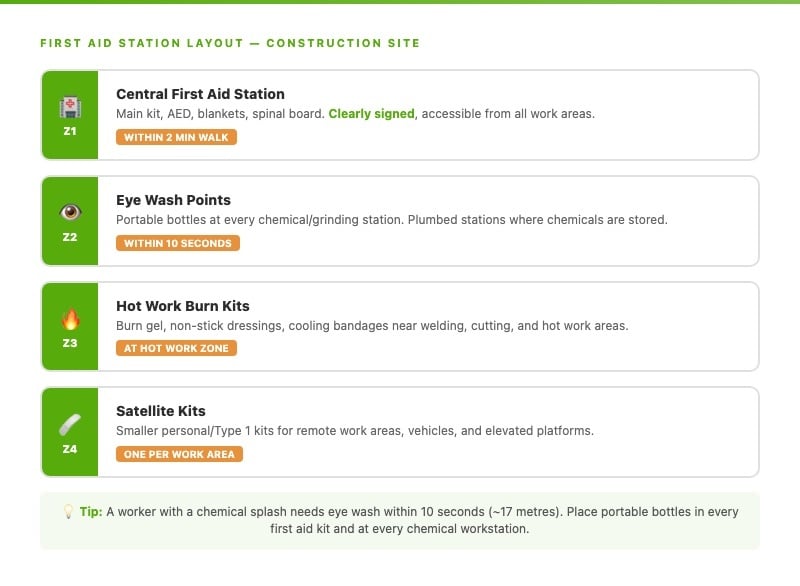
Having the right supplies is half the battle. Organizing them so your first aider can find what they need in 30 seconds under pressure is the other half.
- Central first aid station: Located in the site trailer or a clearly marked, accessible location. Contains the primary first aid kit, first aid records, and emergency contact information.
- Satellite kits: Smaller kits placed at remote work areas (upper floors, excavation zones, far side of the site). Each satellite should have the basic kit contents plus any hazard-specific supplies for that area.
- Vehicle kits: Every work vehicle should carry at least a personal first aid kit. Vehicles used to transport workers to remote areas should carry a full basic or intermediate kit.
- Eye wash stations: At every chemical handling area and grinding/cutting station. Portable bottles in worker tool belts where mobile chemical work happens.
- AED: Central location, clearly marked, within 3 minutes of any work area. Consider a second unit on large or multi-level sites.
Label everything. Use the standard white cross on green background for first aid locations. Post a site map showing first aid kit locations, AED location, eye wash stations, and emergency assembly points. Include this in your site-specific safety orientation.
If you want help setting up a comprehensive first aid and safety program for your site, Safety Evolution's safety consulting team can assess your site, recommend the right equipment, and build a maintenance schedule.
Review your construction site first aid supplies at the start of every new project phase, not just at the beginning of the project. As work transitions from foundation to framing to finishing, the hazard profile changes and your first aid supplies should change with it. Concrete and excavation phases need more trauma supplies. Finishing phases with solvents and adhesives need more eye wash and burn supplies. A supply setup that was appropriate during demolition may be inadequate during electrical rough-in.
Still chasing first aid records across files and inboxes?
Centralize corrective actions and proof so your next review is predictable.
Start Your 30-Day Free Trial →Frequently Asked Questions
Are eye wash stations required on construction sites in Canada?
Eye wash is required wherever workers are exposed to chemical splash or dust hazards. This includes concrete work, painting, chemical application, grinding, and cutting. Provincial regulations require eye wash to be accessible within 10 seconds of the hazard. Portable eye wash bottles satisfy this requirement for mobile work areas.
How much does an AED cost for a construction site?
AED units range from $1,500 to $3,000. Replacement pads cost $50 to $150 every 2 to 5 years. Replacement batteries cost $200 to $400 every 4 to 7 years. Total 5-year cost of ownership is approximately $2,000 to $4,000. Ontario offers an AED reimbursement program for construction sites under the new O. Reg. 157/25 requirements.
What first aid supplies should be in every construction vehicle?
Every construction work vehicle should carry at least a personal first aid kit (CSA Z1220-17 Type P) with adhesive bandages, sterile gauze, disposable gloves, antiseptic wipes, and tape. Add a portable eye wash bottle if the vehicle is used for chemical transport or field work. Vehicles used as crew transport to remote sites should carry a basic or intermediate kit.
Do construction sites need a first aid room?
It depends on your province, crew size, and site classification. In BC, WorkSafeBC requires a first aid room for high-risk workplaces with a certain number of workers. In Alberta, OHS Code Part 11 specifies when a first aid room is required based on worker count and hazard level. In Ontario, WSIB Regulation 1101 requires a first aid room for workplaces with 200 or more workers per shift. For most mid-size construction sites, a designated first aid area (clean, heated, private) within the site trailer is sufficient. Check the workplace first aid requirements for your province.
Get Weekly Safety Insights
Regulation updates, toolbox talk ideas, and compliance tips. One email per week.