Last updated: April 2026
You have a crew of 15. A GC just told you every worker needs a valid first aid certificate before they step on site next Monday. You pull up Google and immediately hit a fork in the road: standard first aid or emergency first aid. One takes two days. The other takes one. The price difference is $50 to $80. And you have no idea which one your province actually requires.
We help contractors sort this out every week. The short answer: it depends on your province and your jobsite risk level. The longer answer saves you from booking the wrong course and wasting a day of lost wages per worker.
⚡ Quick Answer
- Emergency First Aid: 1-day course (6.5 to 8 hours). Covers CPR, AED, choking, severe bleeding, and shock. Typically includes CPR Level A or C.
- Standard First Aid: 2-day course (14 to 16 hours). Covers everything in Emergency plus head/spinal injuries, bone/joint injuries, poisoning, diabetic emergencies, asthma, allergic reactions, and secondary assessment.
- Cost: Emergency runs $80 to $120. Standard runs $130 to $200. Prices vary by provider and province.
- Certificate validity: Both are valid for 3 years in most provinces.
- The real question: Your province and your workplace risk level determine which one you need. Many construction and industrial sites require standard first aid for at least some crew members.
- Behind on first aid actions? Start your 30-day free trial to track training, records, and corrective actions in one place.
Standard first aid and emergency first aid are two distinct certification levels in Canada, each with different training hours, scope of skills, and workplace compliance requirements. Standard first aid is a two-day course (14-16 hours) covering a broad range of injuries and medical emergencies. Emergency first aid is a one-day course (6.5-8 hours) focused only on life-threatening situations. Which one your crew needs depends on your province, your hazard level, and the number of workers on shift. Getting this wrong means paying for training that does not satisfy your legal requirements, or worse, having an attendant on site who is not trained for the injuries your crew actually faces.
What Is the Difference Between Standard and Emergency First Aid?
Emergency first aid is a one-day course covering life-threatening emergencies only: CPR, AED use, choking, severe bleeding, and shock management. It teaches your crew how to keep someone alive until paramedics arrive. That is the scope. Nothing more.
Standard first aid is a two-day course that covers everything in emergency first aid plus a much wider range of injuries and medical emergencies. Head injuries, spinal injuries, bone fractures, poisoning, diabetic emergencies, seizures, asthma attacks, severe allergic reactions, and wound care. It also includes a secondary assessment: how to do a head-to-toe check on an injured worker when the situation is not immediately life-threatening but still needs attention.
Think of it this way: emergency first aid teaches your crew to react when someone is dying. Standard first aid teaches them to react when someone is dying AND when someone is hurt but conscious and talking. On a construction site, that second category happens far more often.
Both courses include CPR certification. Emergency first aid typically pairs with CPR Level A (adult only) or Level C (adult, child, and infant). Standard first aid almost always pairs with CPR Level C. If your workplace has any chance of children being present, or if you want the most comprehensive certification, CPR Level C is the standard to aim for.
Which Certificate Does Your Province Require?
This is where most contractors get tripped up. Provincial regulations do not use the same language, and what counts as "adequate" first aid coverage varies by jurisdiction.
British Columbia
BC overhauled its first aid requirements effective November 1, 2024. WorkSafeBC now uses a risk-based assessment system with three levels of first aid certification: basic (1 day, formerly OFA Level 1), intermediate (2 days, formerly OFA Level 2), and advanced (10 days, formerly OFA Level 3). The level you need depends on your workplace hazard rating, number of workers, and distance from a hospital.
For most construction sites in BC with moderate to high hazard ratings, at least one worker with intermediate or advanced first aid certification is required. Emergency first aid (Red Cross/SJA) and standard first aid (Red Cross/SJA) are separate certifications from the WorkSafeBC occupational first aid system. WorkSafeBC accepts certain equivalencies, but you need to check the BC first aid requirements carefully. Do not assume a Red Cross standard first aid certificate automatically satisfies WorkSafeBC requirements for your specific workplace.
Alberta
Alberta OHS Code Part 11 and Schedule 2 outline first aid requirements based on the number of workers per shift and the hazard level of the workplace. For low-hazard workplaces with 1 to 9 workers, an emergency first aider is the minimum. For medium and high-hazard workplaces (which includes most construction sites), a standard first aider or advanced first aider is required depending on crew size. Once you have 10 or more workers on a medium or high-hazard site, you need at least one standard first aider.
For contractors running crews on Alberta construction sites, standard first aid is almost always the right call. Emergency first aid alone will not meet the requirements for most jobsite configurations.
Ontario
Ontario uses WSIB Regulation 1101 to set first aid requirements. WSIB recently updated their program terminology: Basic First Aid is equivalent to Emergency First Aid, and Intermediate First Aid is equivalent to Standard First Aid. The requirements scale with the number of workers per shift. Construction projects with 6 to 15 workers need at least one person with a valid first aid certificate. Projects with 16 to 199 workers need at least one person with a standard (intermediate) first aid certificate plus additional first aiders.
Not sure if your first aid readiness would hold up in a real emergency?
See training gaps, expiring certificates, and missing documentation before they become incidents.
Start Your 30-Day Free Trial →What Do Most Contractors Get Wrong?
Most contractors think "first aid is first aid" and book the cheapest, fastest option for the whole crew. That is a mistake that can cost you a lot more than the $50 you saved per person.
Here is what actually happens: you send 12 workers through emergency first aid at $90 each. Total cost: $1,080 plus a full day of lost production. Two weeks later, a safety auditor walks your site and flags that your hazard level requires standard first aid coverage. Now you need to pull at least two or three workers off the job for another full day of training. You are paying for the course again, losing another day of wages, and the auditor has already written the finding into your file.
The smarter move is to get your designated first aid attendants (the workers who will actually be responsible for responding to incidents) through standard first aid from the start. Then fill out the rest of your crew with emergency first aid if the regulations allow it for your situation. This is a tiered approach, and it is what most experienced safety coordinators recommend.
How Much Does Each Course Cost?
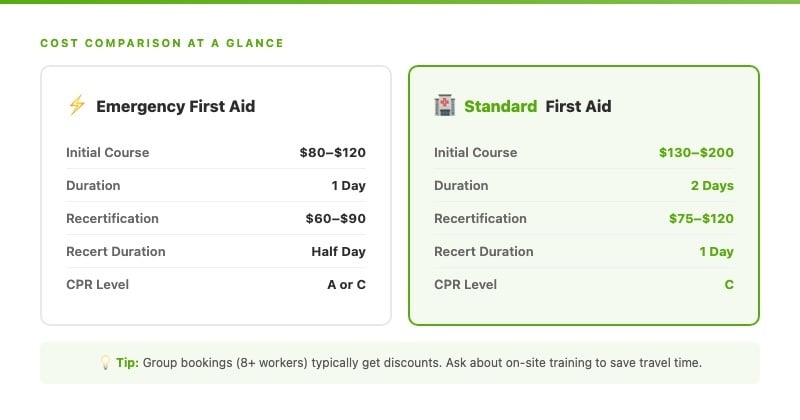
| Course | Duration | Typical Cost Range | CPR Level Included |
|---|
| Emergency First Aid + CPR/AED Level C | 1 day (6.5 to 8 hours) | $80 to $120 | Level A or C |
| Standard First Aid + CPR/AED Level C | 2 days (14 to 16 hours) | $130 to $200 | Level C |
| Standard First Aid Recertification | 1 day (6 to 8 hours) | $75 to $120 | Level C |
| Emergency First Aid Recertification | Half day (4 to 6 hours) | $60 to $90 | Level A or C |
Costs vary by provider and region. Group bookings for 8 or more workers typically get a discount. Some providers offer on-site training, which eliminates travel time. If you are running a crew of 15 or more, ask about bringing the instructor to your shop or site.
Standard vs Emergency: When to Choose Each
Use this as a decision guide based on your actual situation:
Choose emergency first aid when:
- Your province allows it for your workplace classification and crew size
- You are a low-hazard workplace (office, retail, small warehouse) with fewer than 10 workers
- You already have designated first aid attendants with standard or higher certification, and you need basic coverage for the rest of the crew
- You need a quick certification for a new hire who will not be the designated first aider
Choose standard first aid when:
- You work in construction, oil and gas, manufacturing, or mining
- Your crew size is 10 or more workers per shift
- Your jobsite is more than 20 minutes from a hospital
- You need a designated first aid attendant for the site
- Your province requires it based on your hazard assessment (most medium and high-hazard sites)
- You want the most broadly accepted certification for multi-province work
If you are a contractor working across provinces, standard first aid with CPR Level C is the safest bet. It meets or exceeds requirements in most jurisdictions and shows GCs you take safety seriously when they review your bid package.
What About Recertification?
Both certificates are valid for 3 years in most provinces. Recertification courses are shorter and cheaper than the original course. Standard first aid recertification is typically one day. Emergency first aid recertification is typically a half day.
Here is the catch: you must recertify before your certificate expires. If you let it lapse, you have to take the full course again. No exceptions. Set a reminder for 2.5 years after the certification date, not 3 years. That gives you a buffer to schedule training without rushing.
For a detailed breakdown of expiry timelines and province-specific renewal rules, read our complete guide to workplace first aid requirements in Canada.
How to Track Certifications Across Your Crew
The hardest part is not getting the certification. It is tracking 15, 30, or 50 certificates with different expiry dates across a crew that changes every few months.
Spreadsheets work until they do not. One missed expiry and you have a worker on site without valid certification. If an incident happens that day, you have a compliance problem that no amount of paperwork can fix after the fact.
Build a system now. A simple training matrix with worker names, certificate types, issue dates, and expiry dates. Set calendar alerts for 90 days before each expiry. If you want to eliminate the manual tracking entirely, Safety Evolution's training management system tracks certifications, sends automated expiry reminders, and gives you a single dashboard showing which workers are current and which are about to lapse.
Still chasing first aid records across files and inboxes?
Centralize corrective actions and proof so your next review is predictable.
Start Your 30-Day Free Trial →Frequently Asked Questions
Is standard first aid harder than emergency first aid?
Standard first aid covers more material over two days instead of one, but the exam format is similar. The pass rate for standard first aid is high. The additional content focuses on injuries and medical emergencies you are likely to encounter on a worksite, so the extra day is practical, not academic.
Can I upgrade from emergency to standard first aid without retaking the full course?
Some training providers offer a one-day "bridge" or upgrade course that takes you from emergency to standard first aid without repeating the content you already know. Not all providers offer this. Check with your provider before registering for the full two-day standard course.
Does standard first aid include CPR Level C?
Yes. Standard first aid courses in Canada almost always include CPR Level C and AED training. CPR Level C covers adult, child, and infant CPR. This is the most comprehensive CPR level and the most broadly accepted for workplace requirements across provinces.
How long is a standard first aid certificate valid?
Standard first aid certificates are valid for 3 years in most Canadian provinces. CPR certification is recommended to be renewed annually, though the first aid certificate itself lasts 3 years. You must recertify before it expires or you will need to retake the full course. Read our first aid training guide for contractors for the full breakdown.
Which first aid certificate do GCs require for bid packages?
Most GCs in construction require proof that your designated first aid attendants hold standard first aid with CPR Level C as a minimum. Some high-risk projects or remote sites may require occupational first aid (OFA) Level 2 or higher. Check your GC's safety requirements before bidding. Standard first aid with CPR Level C is the safest baseline for multi-project contractors.
Get Weekly Safety Insights
Regulation updates, toolbox talk ideas, and compliance tips. One email per week.