Last updated: March 2026
Your crew is 40 feet up on scaffolding when a worker collapses. Somebody yells for help. The foreman grabs his phone, but who does he call first? Where's the nearest AED? Which hospital has a trauma unit? Nobody knows, because nobody wrote it down.
That scenario plays out more often than you'd think on Canadian construction sites. And when it does, the difference between a close call and a tragedy comes down to one thing: whether your emergency response plan actually works, or whether it's just a binder collecting dust in the trailer.
We help contractors build and maintain safety programs every week. The emergency response plan is one of the most commonly failed elements in COR audits, and it's almost never because the contractor doesn't care. It's because they treated the ERP like a checkbox instead of a living document. Here's how to get it right.
⚡ Quick Answer: Construction Emergency Response Plans
- What: A written plan that identifies potential site emergencies and outlines exactly how your crew responds, including who does what, where they go, and who gets called
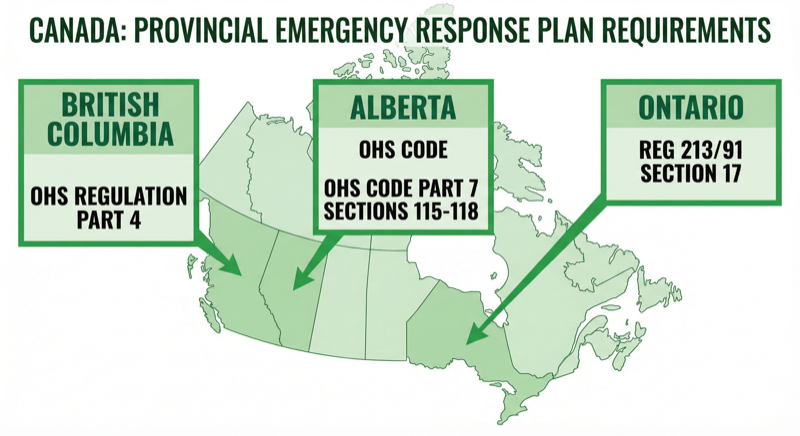
- Legal requirement: Every Canadian province requires employers to have an ERP under OHS legislation (Alberta OHS Code Part 7, BC OHS Regulation Part 4, Ontario Reg. 213/91 s.17)
- COR/SECOR: Emergency response is a dedicated audit element. Auditors check for documentation, worker awareness, assigned roles, and drill records
- Common gap: Generic template plans that aren't site-specific. Auditors and inspectors catch this immediately
- Timeline to build: A solid, site-specific ERP takes 2 to 4 weeks to develop properly, including a hazard assessment, role assignments, and at least one drill
What Is a Construction Emergency Response Plan?
A construction emergency response plan (ERP) is a written document that identifies potential emergencies on a construction site and outlines the specific procedures, roles, and resources needed to respond safely. It's not a generic safety policy. It's a site-specific action plan that tells every worker exactly what to do when something goes wrong.
Think of it this way: your safety program is the playbook. Your ERP is the page you flip to when everything hits the fan. It covers fires, medical emergencies, structural collapses, chemical spills, severe weather, utility strikes, and anything else that could put your crew or the public at risk.
Every province in Canada requires some version of an ERP under occupational health and safety legislation. In Alberta, the OHS Code Part 7 spells it out in detail. In BC, WorkSafeBC's OHS Regulation Part 4 covers emergency preparedness. In Ontario, Regulation 213/91 requires constructors to establish written emergency procedures for every project. The specifics vary by province, but the core requirement is the same: you need a written plan, your workers need to know it, and you need to practice it.
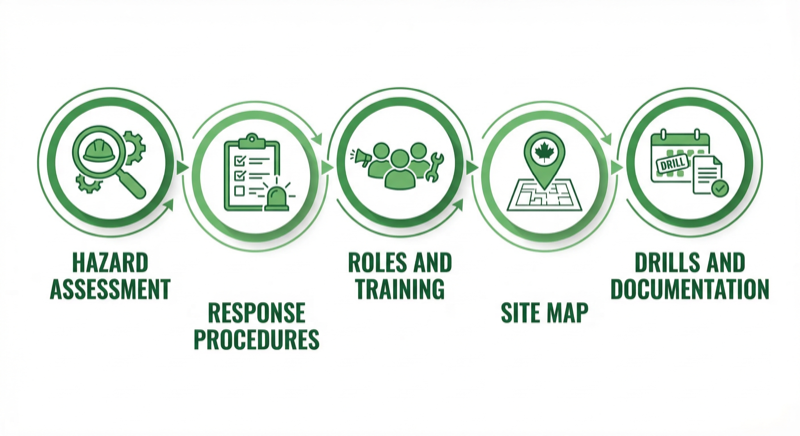
What Does an Emergency Response Plan Need to Include?
Most contractors think their ERP just needs a list of phone numbers and a map to the hospital. They're wrong.
Alberta's OHS Code Section 116 is one of the most detailed requirements in Canada, and it gives you a solid framework regardless of your province. Your ERP must include:
- Identification of potential emergencies specific to your site (not a generic list copied from a template)
- Procedures for each identified emergency including step-by-step response actions
- Emergency equipment locations and procedures for fire extinguishers, spill kits, AEDs, first aid supplies
- Training requirements for emergency response, including who needs what level of training
- Emergency facility locations including the nearest hospital with trauma capability, urgent care, and poison control
- Fire protection requirements specific to the site and the work being done
- Alarm and communication systems covering how you alert workers, what the signals mean, and backup communication methods
- First aid services including kits, trained first aiders, and transport procedures
- Rescue and evacuation procedures with primary and secondary routes, muster points, and headcount procedures
- Designated rescue and evacuation workers who are trained and identified by name
That last point trips up a lot of contractors. You can't just assume "somebody will handle it." The plan needs named individuals with assigned roles, and those people need training specific to the emergencies you've identified.
How Does an ERP Fit Into COR and SECOR Audits?
If you're pursuing COR or SECOR certification, your emergency response plan isn't just a legal requirement. It's a scored element in your audit.
In Alberta, ACSA's COR audit tool includes a dedicated emergency response element. Auditors evaluate whether you have a documented plan, whether workers know their roles, whether emergency equipment is accessible and maintained, and whether you've conducted drills. The SECOR evaluation also includes an emergency response element.
In BC, BCCSA's COR program similarly expects documented emergency procedures as part of your overall health and safety management system.
Here's what auditors actually look for:
- Documentation: Is the plan written, current, and site-specific?
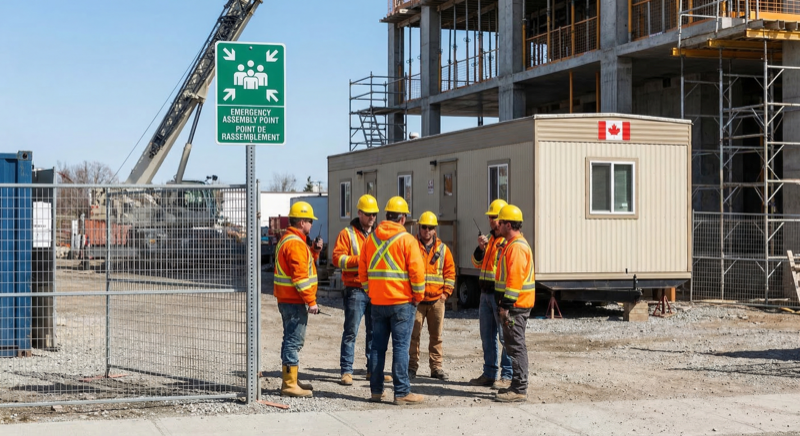
- Worker awareness: Can workers describe the emergency procedures during interviews? Do they know their muster point?
- Roles assigned: Are designated emergency response workers identified and trained?
- Drills: Have you conducted and documented emergency drills? When was the last one?
- Equipment: Is emergency equipment where the plan says it is? Is it inspected and maintained?
The blunt truth? Most COR audit failures on emergency response don't happen because the contractor has no plan. They happen because the plan exists in a binder that nobody has opened since the last audit. The auditor asks a worker where the muster point is, and the worker shrugs. That's a fail. For a deeper look at how to prepare for the full audit, read our guide to passing your COR audit.
An Untested ERP Fails When Your Crew Needs It Most
SE-AI checks your emergency response plan for missing procedures, unassigned roles, and gaps that would surface during an incident or audit.
Get Early Access →
How Do You Build a Site-Specific Emergency Response Plan?
A proper ERP starts before anyone sets foot on site. Here's the process that actually works:
Step 1: Conduct a site-specific hazard assessment
Walk the site. Identify every potential emergency based on the actual work happening there. A high-rise concrete pour has different risks than a residential renovation. A site next to a rail line has different evacuation challenges than one in an industrial park. Your field-level hazard assessments feed into this, but the ERP hazard assessment is broader; it covers the whole site, not just a single task.
Common construction emergencies to plan for:
- Worker injury (falls, struck-by, caught-between, electrocution)
- Fire or explosion
- Structural collapse or trench cave-in
- Chemical spill or hazardous substance release
- Severe weather (lightning, extreme cold, high winds, flooding)
- Utility strike (gas line, electrical, water main)
- Vehicle or equipment incident
- Medical emergency (heart attack, heat stroke, allergic reaction)
- Violence or security threat
Step 2: Define response procedures for each emergency
For each scenario, write out: who does what, in what order. Be specific. "Call 911" is not a procedure. A procedure looks like this:
- Worker witnesses collapse: shout for help and stay with the injured worker
- Nearest worker calls 911 and provides site address, access point, and nature of emergency
- Designated first aider responds with the site first aid kit (located at the main trailer)
- Site supervisor notifies the project manager and clears the immediate area
- A designated worker meets emergency services at the site entrance and guides them in
- Site supervisor conducts headcount at muster point if evacuation is triggered
That level of detail is what separates a plan that saves lives from one that just fills a binder.
Step 3: Assign roles and train your people
Identify by name who fills each emergency role: incident commander (usually the site supervisor), first aiders, fire wardens, communications lead, muster point coordinator. Backup names for every role, because people take days off and change sites.
Then train them. Not a 10-minute toolbox talk; actual scenario-based training. Your designated rescue workers need hands-on practice with the equipment they'll use. For more on first aid training requirements, see our contractor's guide. And if you need ready-made safety meeting material to reinforce emergency procedures with your whole crew, grab our free toolbox talk package with 50+ topics.
Step 4: Map the site
Create a physical site map showing: muster points, first aid stations, fire extinguisher locations, AED locations, emergency exits, access routes for emergency vehicles, utility shutoff locations, and hazardous material storage areas. Post this map at the site entrance, in the trailer, and at each muster point.
Step 5: Run a drill and document it
An ERP you've never tested is a guess, not a plan. Run at least one full evacuation drill before major work begins, and repeat at intervals appropriate to your project duration. Document who participated, what went well, what didn't, and what you changed as a result. That documentation is exactly what COR auditors want to see.
What Are the Most Common Emergency Response Plan Gaps?
After reviewing hundreds of safety programs, here are the gaps we see most often:
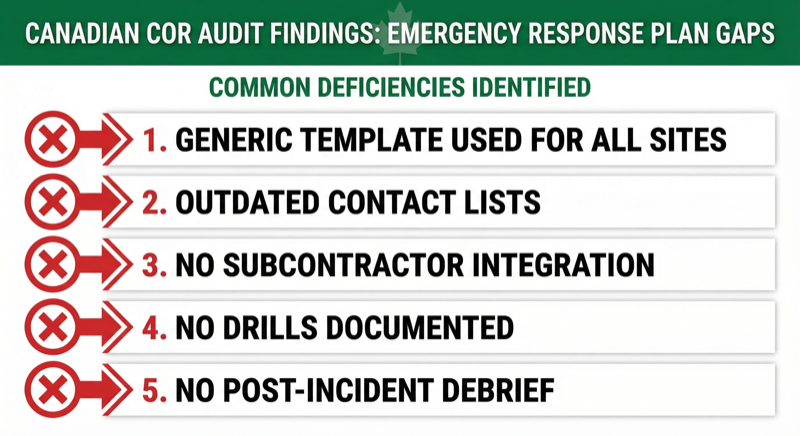
Generic templates used across every site. Your office in Calgary doesn't face the same emergencies as your pipeline crew in northern Alberta. Yet many contractors use the same ERP template for both. Auditors and OHS inspectors spot this instantly. Every site needs its own version.
Outdated contact lists. The hospital number goes to a fax machine. The project manager's cell number belongs to someone who left the company six months ago. Contact lists need to be reviewed and updated every time there's a personnel change and at least monthly on active sites.
No subcontractor integration. On multi-trade sites, the prime contractor's ERP needs to account for every subcontractor on site. Do the subs know the muster points? Have they been oriented to the emergency procedures? Are their workers included in your headcount system?
Drills never happen. "We'll do a drill next month" turns into next quarter, then next year. Meanwhile, your crew turns over, new workers start, and nobody has practiced the plan. Provincial OHS legislation requires training exercises at intervals that maintain competency. That means more than once a year on most construction sites.
No post-incident debrief process. When something does happen, the immediate crisis gets handled, but nobody sits down afterwards to review what worked and what didn't. Every real emergency and every drill should trigger a documented debrief and, if needed, an update to the plan. If you need a framework for post-incident reviews, our free incident report and investigation kit walks you through the process step by step.
First aid coverage gaps. Alberta OHS requires adequate first aid based on your workforce size and distance from a hospital. Many contractors underestimate how many trained first aiders they need, especially on remote sites. One first aider for a 30-person crew isn't enough if that person is on the other end of the site when something happens.
What Are the Provincial Legal Requirements?
Every Canadian province requires employers to have emergency response procedures. Here's how the major provinces approach it:
Alberta
Alberta's OHS Code Part 7 (Sections 115 to 118) provides one of the most detailed frameworks in Canada. Employers must establish an ERP for any emergency requiring rescue or evacuation, involve affected workers in developing it, and keep it current. The plan must include all 10 elements listed in Section 116. Designated rescue and evacuation workers must receive training that includes simulated exercises. For the full picture of Alberta's OHS requirements for contractors, see our Alberta OHS construction guide.
British Columbia
WorkSafeBC's OHS Regulation Part 4 covers emergency preparedness requirements. Employers must develop emergency procedures in consultation with their joint health and safety committee or worker representative. As of February 2025, amendments to Part 5 broadened emergency planning requirements for hazardous substances, including mandatory written chemical inventories with locations and quantities (BC OHS Reg 5.99).
Ontario
The Construction Projects Regulation (O. Reg. 213/91, Section 17) requires the constructor to establish written procedures for emergencies on every project. Workers must have ready access to two-way communication systems for emergencies.
Saskatchewan, Manitoba, and other provinces
Each province has its own OHS legislation with emergency preparedness requirements. Saskatchewan's OHS Regulations require emergency response plans. Manitoba's Workplace Safety and Health Regulation has similar provisions. The core elements are consistent across Canada: identify hazards, write procedures, train workers, practice the plan.
Regardless of your province, if you're pursuing COR certification, the certifying partner's audit tool (ACSA in Alberta, BCCSA in BC, SCSA in Saskatchewan) will evaluate your emergency response procedures against both the legal requirements and the COR standard.
Would Your Emergency Response Plan Hold Up During a Real Incident?
SE-AI analyses your emergency response documentation for completeness. It flags missing site-specific procedures, roles without assigned personnel, communication plans with gaps, and ERP elements that do not meet provincial OHS or COR requirements.
Get Early Access to SE-AI →
How Do You Keep Your ERP Current?
Building the plan is only half the battle. Construction sites change constantly: new phases start, new trades mobilize, equipment moves, site layout shifts. Your ERP has to keep up.
Review and update your ERP:
- At the start of every new project phase or major scope change
- When new subcontractors mobilize to site
- After any personnel changes (especially designated emergency responders)
- After every drill or real emergency (incorporate lessons learned)
- At least monthly on active construction sites
- Whenever site layout changes affect evacuation routes, muster points, or equipment locations
Keep a revision log on the front page of the plan. Date every update. That paper trail proves to auditors that your plan is a living document, not a one-time creation.
If you're using paper-based systems, this gets tedious fast. That's one reason many contractors are moving to digital safety management systems that make updates, distribution, and version control automatic.
How Does Safety Evolution Help?
Safety Evolution works as a done-for-you safety department for construction contractors across Canada. We don't just hand you a template and wish you luck. We build site-specific emergency response plans as part of your overall safety management system, train your crew, and make sure the documentation holds up under a COR audit.
If you are not sure whether your current ERP meets provincial requirements or COR standards, SE-AI can check your emergency response documentation and flag exactly where the gaps are.
Frequently Asked Questions
Is an emergency response plan legally required on construction sites in Canada?
Yes. Every Canadian province requires employers to have emergency response procedures under their OHS legislation. In Alberta, the OHS Code Part 7 (Sections 115 to 118) specifically requires an ERP for emergencies involving rescue or evacuation. In Ontario, Regulation 213/91 requires written emergency procedures for every construction project. BC, Saskatchewan, Manitoba, and other provinces have equivalent requirements. Beyond legal compliance, COR and SECOR audits evaluate your ERP as a scored element.
How often should you update a construction emergency response plan?
At minimum, review your ERP at the start of each project phase, when subcontractors mobilize, after any emergency or drill, and whenever the site layout changes. On active construction sites, a monthly review is recommended. Alberta's OHS Code requires employers to keep the ERP "current," which means it must reflect actual site conditions, not last month's layout.
What happens if you fail the emergency response element in a COR audit?
A low score on the emergency response element can pull your overall audit score below the passing threshold. In Alberta, you need 80% overall to achieve COR certification through ACSA. If you fail, you'll receive an action plan with specific items to address before re-audit. Common fixes include conducting documented drills, updating the plan to be site-specific, and ensuring workers can describe emergency procedures during interviews.
Can you use the same emergency response plan for every construction site?
No. A generic template used across all sites is one of the most common COR audit findings. Each site has different hazards, layouts, access points, nearby hospitals, and worker counts. You can use a standard template as a starting framework, but the plan must be customized with site-specific details: muster point locations, emergency equipment placement, evacuation routes, local emergency contacts, and hazards unique to that project.
How long does it take to create an emergency response plan for a construction site?
A thorough, site-specific ERP typically takes 2 to 4 weeks to develop, including the site hazard assessment, writing procedures, assigning roles, mapping the site, and conducting at least one drill. If you already have a strong safety program with templates and trained personnel, you may be able to adapt and deploy a plan faster. For contractors building their first ERP from scratch, working with a safety consultant like Safety Evolution can accelerate the process significantly.
Do subcontractors need their own emergency response plan?
It depends on the site structure. On multi-trade projects, the prime contractor or constructor typically maintains the overall site ERP, and all subcontractors must follow it. However, subcontractors should also have their own company-level ERP for their specific operations. The key is coordination: every worker on site, regardless of employer, must know the site-specific emergency procedures, muster points, and alarm signals. This should be covered during the site safety orientation. If you need a structured onboarding process, download our construction safety orientation package.
Get Weekly Safety Insights
Regulation updates, toolbox talk ideas, and compliance tips. One email per week.