Last updated: March 2026
You got into construction to build things, not to memorize legislation. But here you are, running a crew in Alberta, and every GC wants to know if your safety program is compliant. OHS shows up unannounced. Your WCB premiums keep climbing. And somewhere in the back of your mind, you know there is a 200-page Act you probably should have read by now.
At Safety Evolution, we help Alberta contractors build safety programs that hold up to audits, inspections, and the daily grind of real job sites. We see the same confusion every week: contractors who do not know where the Act ends and the Code begins, who mix up their reporting obligations, and who find out about prime contractor duties the hard way.
This guide breaks down the Alberta Occupational Health and Safety Act, Code, and Regulation in plain English. No legal jargon. No filler. Just the stuff you actually need to know to keep your crew safe, stay compliant, and stop worrying about what you might be missing.
⚡ Quick Answer: Alberta OHS Requirements for Construction
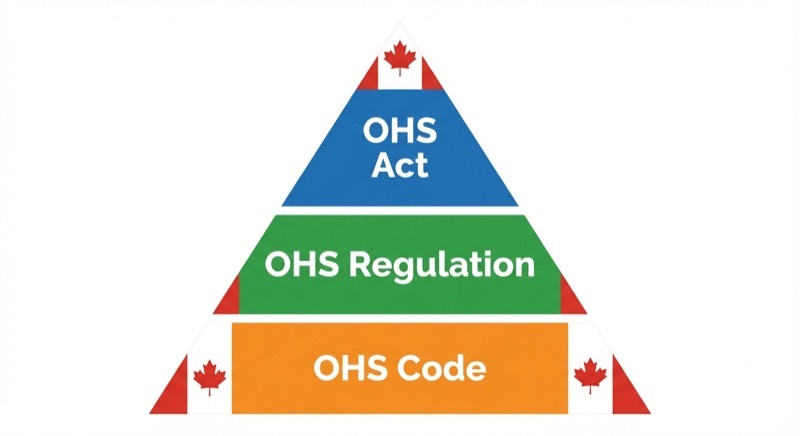
- Framework: Three layers: the OHS Act (overarching law), OHS Regulation (administrative rules), and OHS Code (technical standards)
- Key obligations: Employers must ensure worker health and safety, conduct hazard assessments, report serious incidents, provide training and supervision
- Prime contractor: Required on every construction site with 2 or more employers
- Penalties: Up to $500,000 per offence, plus $30,000/day for continuing violations; up to 6 months imprisonment
- COR connection: A Certificate of Recognition (COR) earns up to 20% off your WCB premiums through the PIR program
What Is the Alberta OHS Regulatory Framework?
Alberta's occupational health and safety system is built on three interconnected pieces of legislation: the OHS Act, the OHS Regulation, and the OHS Code. Together, they set out the rules that every employer, worker, contractor, and site owner must follow on provincially regulated work sites in Alberta.
Most contractors think these are one thing. They are not. Understanding which document does what saves you from chasing the wrong requirements and wasting hours reading sections that do not apply to your situation.
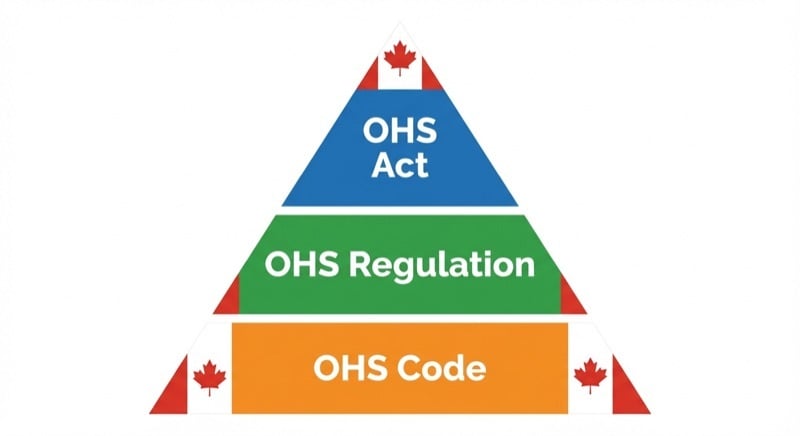
The OHS Act (SA 2020, c O-2.2)
The OHS Act is the overarching law. It came into effect on December 1, 2021, replacing the older version. Think of it as the "who is responsible and what happens when things go wrong" document. It defines:
- General duties for employers, workers, supervisors, prime contractors, owners, and suppliers
- Health and safety committee and representative requirements
- The right to refuse dangerous work
- Incident reporting obligations
- Compliance and enforcement powers (inspections, orders, stop-work orders)
- Offences and penalties
The OHS Regulation (AR 191/2021)
The Regulation fills in the administrative details: definitions, notification requirements, and rules that support the Act. It deals with things like how to designate a prime contractor, what qualifies as a "construction work site," and administrative penalty structures.
The OHS Code
The OHS Code is where it gets technical. This is the document your crew interacts with daily, whether they know it or not. It covers specific safety requirements across 41 parts, including fall protection, confined spaces, scaffolding, electrical safety, personal protective equipment, and much more. Updates to the OHS Code went fully into effect on March 31, 2025, aligning Alberta with current national standards and best practices.
If you are building a health and safety management system for your company, you need to address requirements from all three documents. The Act tells you what you must do. The Code tells you how to do it.
What Are Your Obligations as an Alberta Construction Contractor?
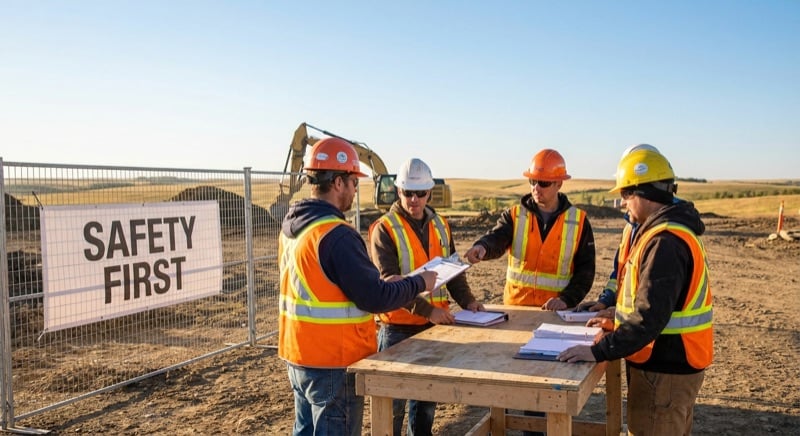
The OHS Act assigns duties to several "work site parties." As a contractor, you likely wear multiple hats: employer, and possibly prime contractor. Here is what each role requires.
Employer Duties (Section 3 of the Act)
Every employer in Alberta must, as far as reasonably practicable:
- Ensure the health, safety, and welfare of workers and other people at or near the work site
- Ensure workers are aware of their rights and duties under OHS legislation
- Establish, as far as reasonably practicable, a system or process to ensure compliance with OHS legislation
- Ensure workers are adequately trained for their tasks
- Ensure workers are supervised by a competent person
- Conduct and document hazard assessments
- Cooperate with the health and safety committee or representative
- Not take discriminatory action against a worker who raises safety concerns or refuses dangerous work
That last point is one many contractors overlook. If a worker reports a hazard or refuses dangerous work and you discipline them for it, you are breaking the law. Full stop.
Prime Contractor Duties (Section 4 of the Act)
Here is where construction gets its own rules. Every construction work site in Alberta with two or more employers must have a prime contractor. If the person who controls the site (typically the property owner or GC) does not designate a prime contractor in writing, they become the prime contractor by default.
The prime contractor must:
- Establish a system or process to ensure all work site parties comply with OHS legislation
- Coordinate health and safety activities between multiple employers
- Ensure no person is exposed to uncontrolled hazards arising from the activities of the various employers
- Comply with all applicable OHS requirements themselves
Here is the blunt truth: if you are a subcontractor and the GC has not formally designated a prime contractor in writing, ask. Get it in writing. We have seen situations where a sub assumed the GC was the prime, the GC assumed the property owner was the prime, and when OHS showed up, nobody could produce the documentation. Everybody got orders.
If you are managing your safety documentation on paper, that kind of gap is easy to miss. Safety Evolution builds audit-ready safety programs that track exactly these kinds of requirements so nothing falls through the cracks.
Worker Duties (Section 5 of the Act)
Workers are not off the hook. Under the Act, every worker must:
- Take reasonable care to protect their own and others' health and safety
- Cooperate with their employer and other workers for health and safety purposes
- Use or wear required protective equipment
- Report unsafe conditions, acts, or non-compliance to their employer or supervisor
- Report any injury or illness that may be work-related
Alberta OHS Officers Check Documentation First During Investigations
SE-AI checks your safety program against Alberta OHS requirements and flags documentation gaps before an officer does.
Get Early Access →
Does Your Company Need a Joint Health and Safety Committee?
This is one of the most commonly confused requirements in Alberta. Part 2 of the OHS Act sets out the rules for health and safety committees (HSC) and health and safety (HS) representatives.
Here is how it works:
- 20 or more regularly employed workers: You must establish a joint health and safety committee (JHSC) with at least 4 members, half representing workers
- 5 to 19 regularly employed workers: You must designate a health and safety representative from among the workers
- Fewer than 5 regularly employed workers: No committee or representative is required by default, though a Director can order one
Important note for construction sites with a prime contractor: the JHSC and HS representative requirements typically apply to each employer individually at their own work site. On a construction site with a prime contractor, the prime contractor's coordination system may satisfy some of these requirements, but OHS Directors can still direct any employer to establish a committee.
If your company has 20 or more workers, you also must establish and implement a formal health and safety program. That is not optional. It is the law. And it is also a core element of COR certification in Alberta, which we will get to shortly.
Need help getting your JHSC off the ground? Check out our guide to starting a Joint Health and Safety Committee.
What Incidents Must Be Reported to Alberta OHS?
Section 33 of the OHS Act spells out what must be reported. This is not about every bumped knee or paper cut. These are serious events, and the reporting obligation falls on the prime contractor or, where there is no prime contractor, the employer.
You must report to an OHS Director as soon as possible if any of the following occur at your work site:
- A fatality
- A serious injury or illness (hospitalization, loss of consciousness, fracture of a major bone, amputation, loss of sight, or any injury likely to cause death)
- An unplanned or uncontrolled explosion, fire, or flood that caused or could have caused serious injury
- The collapse or upset of a crane, derrick, or hoist
- The collapse or failure of a structural component of a building or structure
The key phrase here is "as soon as possible." Not the next morning. Not after the paperwork is sorted. As soon as it happens, pick up the phone and call the OHS Contact Centre: 780-415-8690 (Edmonton) or 1-866-415-8690 (toll-free).
After reporting, you must also preserve the scene. Do not disturb anything at the location of the incident except to attend to injured persons, prevent further harm, or protect property. An OHS officer may need to investigate.
Following the initial report, the prime contractor or employer must prepare a written report detailing the circumstances and any corrective actions taken. A solid incident investigation process is essential here, and it is one of the areas we see contractors struggle with the most.
Not sure your incident reporting process would hold up to an OHS investigation? SE-AI can check your incident reporting documentation and flag the gaps that would surface during an Alberta OHS investigation.
What Is the Right to Refuse Dangerous Work in Alberta?
Part 3 of the OHS Act gives every worker in Alberta the right to refuse work they believe on reasonable grounds constitutes an undue hazard to their health, safety, or the health and safety of others.
This is not a suggestion. It is a legal right, and any employer who retaliates against a worker for exercising it is committing an offence under the Act.
Here is how the process works:
- The worker reports the refusal to their employer or supervisor immediately, explaining the specific hazard they believe exists
- The employer investigates the reported hazard in the presence of the worker (and the HS representative or JHSC member, if applicable)
- The employer takes action to resolve the hazard, or explains to the worker why the work is safe
- If the worker still believes the hazard exists, an OHS officer can be contacted to investigate and make a determination
During the investigation, the refusing worker must be assigned reasonable alternative work and continue to receive wages and benefits. You cannot dock their pay, send them home without pay, or penalize them in any way.
Most contractors think this will never happen on their site. Then it does, and they scramble. Having a documented procedure for work refusals in your safety manual is cheap insurance. Better yet, having FLHAs and toolbox talks that catch these hazards before someone has to refuse is the real solution. Download our free toolbox talk package with 50+ topics to help your crew identify and address hazards before they escalate.
How Does Alberta OHS Enforce Compliance?
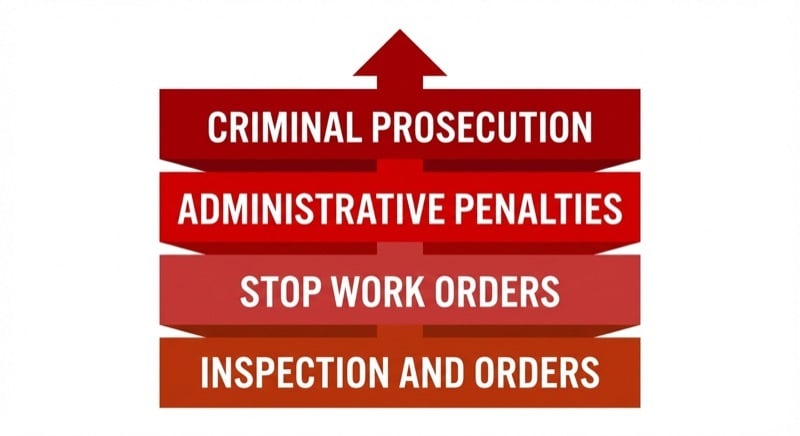
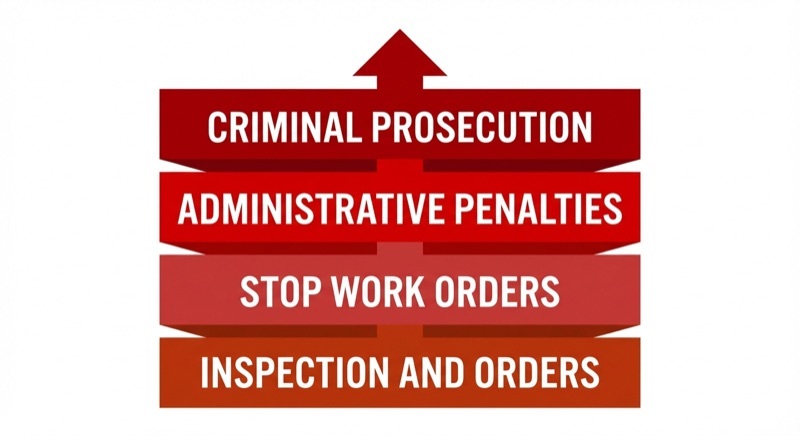
Alberta OHS enforces compliance through a graduated system. Understanding the escalation ladder helps you know what is at stake.
Inspections and Orders
OHS officers can enter any work site at any reasonable time to conduct an inspection. They do not need your permission or a warrant. If they find non-compliance, they can issue compliance orders requiring you to fix the problem within a specified timeframe.
Stop-Work Orders
If an OHS officer believes a condition at your work site poses an immediate danger, they can issue a stop-work order. This shuts down all or part of your operation until the hazard is resolved. For construction contractors, a stop-work order on a time-sensitive project is devastating. It delays your schedule, costs you money daily, and puts your reputation with the GC at risk.
In 2024, a Calgary company received a $5,000 administrative penalty for continuing work while a stop-work order was in place. The fine was the least of their problems. The reputational damage lasted much longer.
Administrative Penalties
OHS can issue administrative penalties to any regulated party: employers, workers, contractors, suppliers, and prime contractors. These are financial penalties intended as a deterrent, separate from the criminal prosecution process.
Criminal Prosecution
For serious offences, Alberta can prosecute under Part 9 of the OHS Act. The penalties are severe:
- First offence: Up to $500,000 fine and/or up to 6 months imprisonment
- Continuing offences: An additional $30,000 per day the violation continues
- Subsequent offences: Up to $1,000,000 fine and/or up to 12 months imprisonment
These are not hypothetical numbers. In 2025, 26 companies were convicted of OHS violations in Alberta. Fines ranged from $2,000 to $86,000 for individual cases. When someone gets hurt on your site and OHS finds you were not compliant, the consequences are real and public. Alberta publishes all convictions online for anyone to see, including GCs evaluating your next bid.
Preparing for an OHS audit or inspection? Our guide to 3 strategies to pass your next safety audit covers practical steps to make sure your program is inspection-ready.
How Do COR and the PIR Program Connect to Alberta OHS Requirements?
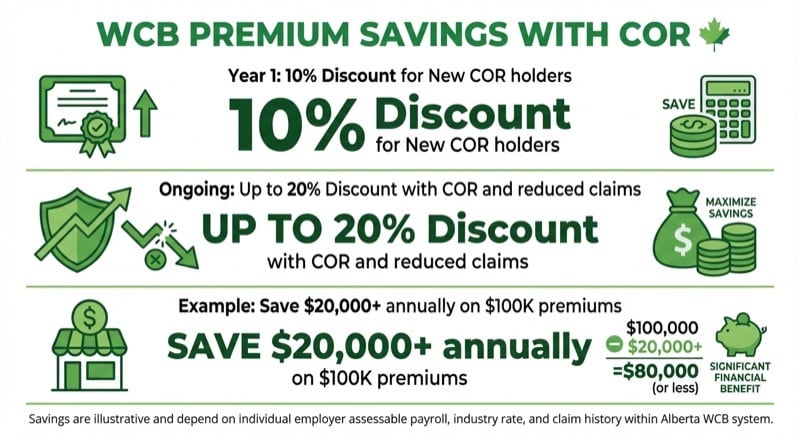
The OHS Act sets the floor. COR raises the bar and rewards you for it.
A Certificate of Recognition (COR) is a voluntary certification that demonstrates your company has implemented a health and safety management system meeting Alberta government standards. It goes beyond basic OHS compliance to include elements like management leadership, hazard assessment, training, inspections, incident investigation, and emergency response.
Here is why COR matters for Alberta construction contractors:
GC Requirements
Most general contractors in Alberta will not let you on site without a COR or SECOR. It is a pre-qualification requirement for the majority of commercial, industrial, and institutional construction projects. No COR, no bid. That is the reality for most trades and subcontractors working in Alberta.
WCB Premium Discounts Through PIR
The Partnerships in Injury Reduction (PIR) program, jointly administered by WCB Alberta and the Government of Alberta, offers WCB premium incentives to employers who maintain a COR and reduce their claims costs. The discount structure works like this:
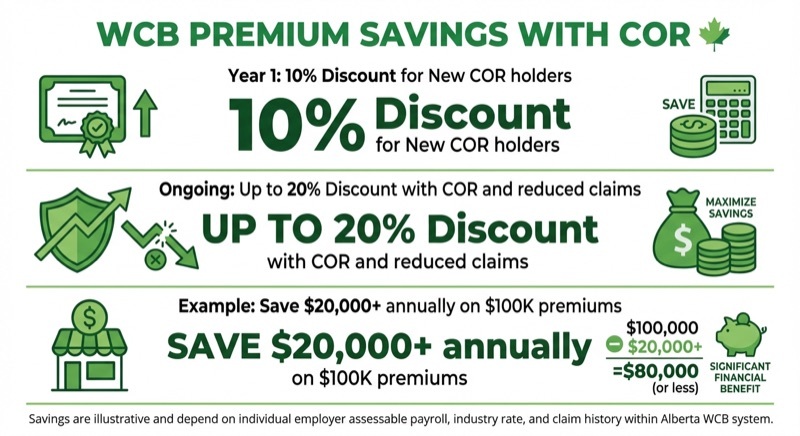
- COR holders are automatically eligible for PIR refunds
- New COR holders receive a 10% premium incentive in their first year
- Employers who maintain COR and reduce claims below predicted targets can earn up to 20% off their industry premium rate
For a construction company paying $100,000 or more in WCB premiums annually, a 20% discount is $20,000 back in your pocket. Over three to five years, that adds up fast. And it is money that goes directly to your bottom line, not to covering claims.
WCB calculates your premium rate using your claims experience from the previous three years. Investing in a strong safety program today directly impacts your premiums for years to come.
If you are not yet COR certified, our comprehensive guide to COR certification in Alberta walks through the entire process. Smaller operations with fewer workers may qualify for SECOR certification instead.
What Does Alberta OHS Compliance Look Like Day to Day?
Legislation and penalties are one thing. The daily reality of running a compliant construction operation is another. Here is what good looks like on the ground:
- Hazard assessments before every shift. FLHAs are not just paperwork to satisfy the GC. They are a legal requirement under the OHS Code. Your crew identifies hazards, assesses risk, and documents controls before work begins.
- Regular toolbox talks. Short, focused safety conversations that keep hazards top of mind. The OHS Code does not prescribe a frequency, but COR audit standards expect them regularly. Our ultimate toolbox talk guide gives you 365 topics so you never run out of material.
- Documented inspections. Equipment, PPE, work areas. The OHS Code requires specific inspections for fall protection equipment, scaffolding, excavations, and more. Learn how to build a solid inspection program with our guide to developing equipment inspections in 5 easy steps.
- Worker orientation and training records. Every worker must receive orientation before starting work. The OHS Code specifies training requirements for tasks like confined space entry, fall protection, and operating specific equipment. Our free construction orientation package gives you a head start.
- Incident reporting and investigation. Not just the serious ones that go to OHS. Internal near-miss reporting catches problems before they become fatalities.
The contractors who get this right do not treat safety as a bolt-on to their operations. They build it into how they work every day. And the ones who struggle with it typically have one thing in common: they are trying to do it all themselves, on top of running crews, managing bids, and keeping projects on schedule.
That is exactly why Safety Evolution exists as a done-for-you safety department. We build your program, control your documents, verify daily forms, and package everything for GC submittals and audits. You run the crew. We handle the safety system.
Common Mistakes Alberta Contractors Make With OHS Compliance
After working with contractors across Alberta, we see the same mistakes repeatedly:
- Assuming the GC handles everything. The GC may be the prime contractor, but that does not remove your employer duties. You are still responsible for your workers, your hazard assessments, and your training records.
- Not documenting hazard assessments. Doing the assessment verbally is not enough. The OHS Code requires documentation. If there is no paper trail (or digital trail), it did not happen.
- Delaying incident reports. "As soon as possible" means as soon as possible. Not after the shift. Not after you talk to your lawyer. Delay creates legal exposure and shows OHS you are not taking it seriously.
- Ignoring the JHSC requirement. Once you hit 20 workers, the committee is mandatory. We have seen contractors with 30 employees who did not know they needed one.
- Treating the safety manual as a shelf ornament. A binder that nobody opens does not make you compliant. Your program needs to be active, documented, and verifiable.
How Safety Evolution Can Help
Look, we get it. You did not start a construction company to become a safety regulation expert. But the reality in Alberta is clear: OHS compliance is not optional, COR is becoming table stakes, and the penalties for getting it wrong are getting bigger every year.
Safety Evolution is not a consultant who hands you a binder and wishes you luck. We are your safety department. We build your safety management system from scratch if needed, or we fix the one you have. We handle the documentation, track the training, manage your daily forms, prep your COR audit materials, and make sure your program actually works when OHS comes knocking.
Our clients include electrical contractors, mechanical firms, civil construction companies, and general contractors across Alberta. We understand the industry because we work in it every day.
Would Your Safety Program Survive an Alberta OHS Investigation?
SE-AI analyses your safety documentation against Alberta OHS Act and OHS Code requirements. It flags missing incident reporting procedures, incomplete hazard assessments, and documentation gaps that would surface during an OHS officer investigation.
Get Early Access to SE-AI →
Frequently Asked Questions
What are the Alberta OHS requirements for construction contractors?
Alberta construction contractors must comply with the Occupational Health and Safety Act, OHS Regulation, and OHS Code. Key requirements include ensuring worker health and safety, conducting hazard assessments, providing adequate training and supervision, reporting serious incidents to OHS as soon as possible, and designating a prime contractor when two or more employers work on the same construction site. Employers with 20 or more workers must also establish a joint health and safety committee and implement a formal health and safety program.
What are the penalties for OHS violations in Alberta?
Penalties for OHS violations in Alberta can be severe. For a first offence, fines can reach up to $500,000, with up to 6 months imprisonment. Continuing offences carry an additional $30,000 per day. Subsequent offences can result in fines up to $1,000,000 and up to 12 months imprisonment. Alberta OHS can also issue administrative penalties and stop-work orders. In 2025, 26 companies were convicted of OHS violations in the province.
When is a prime contractor required on an Alberta construction site?
A prime contractor is required on every construction work site in Alberta where two or more employers are involved in work. The person in control of the work site (typically the property owner or general contractor) must designate the prime contractor in writing. If no designation is made, the person in control of the site becomes the prime contractor by default. The prime contractor is responsible for coordinating health and safety activities between all employers on site.
What incidents must be reported to Alberta OHS?
Under Section 33 of the OHS Act, the following must be reported to an OHS Director as soon as possible: fatalities, serious injuries or illnesses (including hospitalization, fractures, amputations, or loss of sight), unplanned or uncontrolled explosions, fires, or floods that caused or could have caused serious injury, the collapse or upset of a crane, derrick, or hoist, and the collapse or failure of a structural component of a building or structure. The scene must be preserved until an OHS officer authorizes its release.
How does COR certification help with Alberta OHS compliance?
A Certificate of Recognition (COR) demonstrates that your company has implemented a health and safety management system that meets or exceeds Alberta government standards. While COR is voluntary, it goes well beyond basic OHS compliance and covers management leadership, hazard assessment, training, inspections, incident investigation, and emergency response. COR holders are eligible for WCB premium discounts of up to 20% through the Partnerships in Injury Reduction (PIR) program. Most general contractors in Alberta also require COR as a pre-qualification for bidding on projects.
Can a worker refuse unsafe work in Alberta?
Yes. Under Part 3 of the Alberta OHS Act, every worker has the right to refuse work they believe on reasonable grounds constitutes an undue hazard to their health and safety or the health and safety of others. The employer must investigate the reported hazard, and the worker must be assigned reasonable alternative work at the same wages and benefits during the investigation. Employers are prohibited from retaliating against workers who exercise this right.
Note: This guide provides general information about Alberta OHS requirements for construction contractors as of March 2026. OHS legislation, regulations, and enforcement practices may change. Always verify current requirements with the Alberta government's official OHS resources or consult a qualified professional for advice specific to your situation. Requirements may vary based on your specific operations, work site conditions, and applicable regulations.
Get Weekly Safety Insights
Regulation updates, toolbox talk ideas, and compliance tips. One email per week.