Last updated: March 16, 2026
You brought on a sub to handle mechanical work on a commercial build. Their crew showed up, started cutting, and within two hours an OHS officer was on site asking for their safety documentation. They had nothing. No FLHAs, no orientation records, no proof of training. The stop-work order hit your project, not theirs. You lost three days and had to explain to the GC why progress stalled.
That story plays out on Canadian construction sites every week. And here's the part that stings: the sub's safety failure became your problem. We help contractors build subcontractor management systems that prevent exactly this situation, and the pattern is always the same: good companies hire subs they trust, skip the paperwork, and pay for it later.
⚡ Quick Answer: Subcontractor Safety Management
- What: A system for vetting, onboarding, monitoring, and documenting the safety performance of every subcontractor on your worksite
- Why it matters: As a prime contractor or GC, you are legally responsible for coordinating safety across all employers on your site, including your subs
- Key components: Prequalification, site orientation, ongoing monitoring, documentation, corrective action process
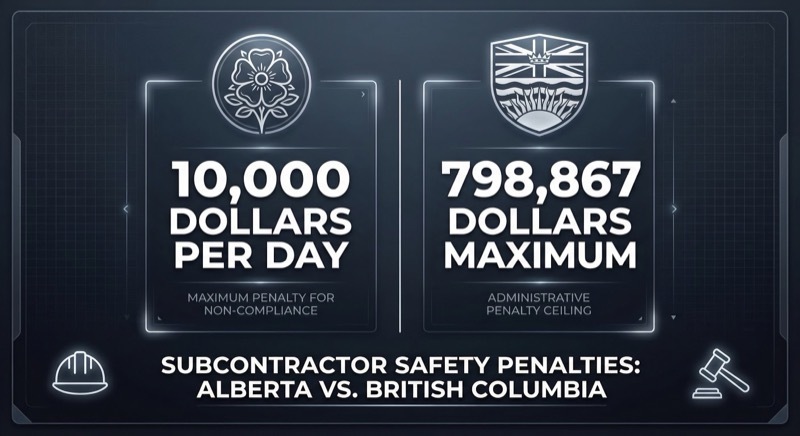
- Legal exposure: In Alberta, OHS penalties reach $10,000 per offence per day. In BC, WorkSafeBC penalties can exceed $700,000
- COR connection: Subcontractor management is an audited element in your COR certification
- Free Resource: Download our Construction Health & Safety Manual.
What Is Subcontractor Safety Management?
Subcontractor safety management is the process of selecting, onboarding, monitoring, and documenting the safety performance of every subcontractor working on your project. It covers everything from verifying a sub's COR status before they bid, to reviewing their FLHAs on site, to pulling them off the job when they don't meet your standards.
Most contractors think subcontractor safety management means collecting a certificate of insurance and a COR letter at the start of the project. They're wrong. Those documents prove your sub had a safety program at some point. They tell you nothing about whether that program is actually running on your site today.
The real work happens after the contract is signed: daily check-ins, orientation verification, toolbox talk participation, hazard assessment reviews, and having the backbone to shut down a sub's crew when they cut corners. That's the difference between a system on paper and one that actually keeps people safe.
Why Are You Responsible for Your Subcontractor's Safety?
Here's the blunt truth that catches a lot of GCs off guard: if a sub's worker gets hurt on your site, the regulator is coming to talk to you first.
In every Canadian province, the prime contractor (or the controlling employer on a multi-employer worksite) has a legal duty to coordinate health and safety activities across all employers on site. That includes your subcontractors, their workers, and anyone else who sets foot on the project.
In Alberta, the OHS Act defines the prime contractor as the person responsible for coordinating, organizing, and overseeing health and safety activities of multiple employers on a single worksite. If you're the GC running the site, you're the prime contractor by default unless someone else has been designated in writing. Administrative penalties in Alberta reach $10,000 per offence per day the violation continues.
In BC, WorkSafeBC holds the prime contractor responsible for coordinating the health and safety activities of all employers at a multiple-employer workplace. The statutory maximum penalty in 2025 is $798,867.87. That number isn't theoretical: WorkSafeBC regularly issues six-figure penalties to prime contractors for failing to manage subcontractor safety.
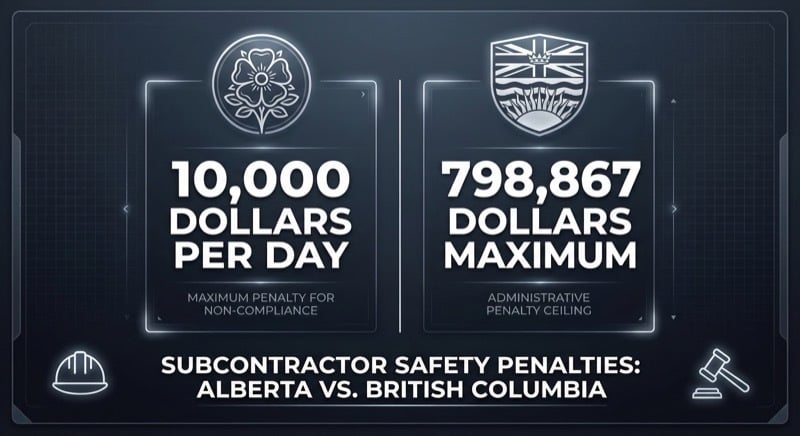
The legal principle across both provinces is the same: you can delegate the work, but you cannot delegate the responsibility. If your sub's worker falls because they weren't wearing a harness, the investigation will ask whether you had a system to verify that your subs were following fall protection requirements. "We trusted them" is not a defence.
And it goes beyond fines. A serious incident on your site can trigger a stop-work order that shuts down the entire project. If you're managing a build with six trades on site, one sub's safety failure can cost every contractor on the job money and time. That's the ripple effect most people don't think about until it happens.
Not sure if your subcontractor management system is audit-ready? analyses your current subcontractor records and flags the gaps before an auditor or inspector finds them.
How Does Subcontractor Management Affect Your COR?
If your company holds or is pursuing a Certificate of Recognition (COR), subcontractor management isn't optional. It's a scored element in your audit.
The ACSA COR audit instrument (Alberta's certifying partner for construction) includes contractor management as a dedicated element. Auditors will look for your contractor management policy, your bidding and selection process, contractor records, project meeting minutes that include sub participation, orientation records for contractors, and contractor orientation logs.
To earn your COR, you need a minimum of 80% overall with no less than 50% on each individual element. If your subcontractor management element scores below 50%, it will sink your entire audit regardless of how well you score everywhere else.
This means you need documented proof that you:
- Have a written process for selecting and evaluating subcontractors
- Orient every subcontractor to your site and your safety program
- Monitor their safety performance throughout the project
- Keep records of everything: orientations, inspections, meetings, corrective actions
Not sure how your current program would hold up under audit? can show you exactly where the gaps are. Safety Evolution builds audit-ready contractor management systems for companies just like yours.
Need a Complete Safety Program?
Stop starting from scratch. Download our Free Construction Health & Safety Manual to get compliant fast.
Download the Free Manual →
How Do You Build a Subcontractor Safety Management System?
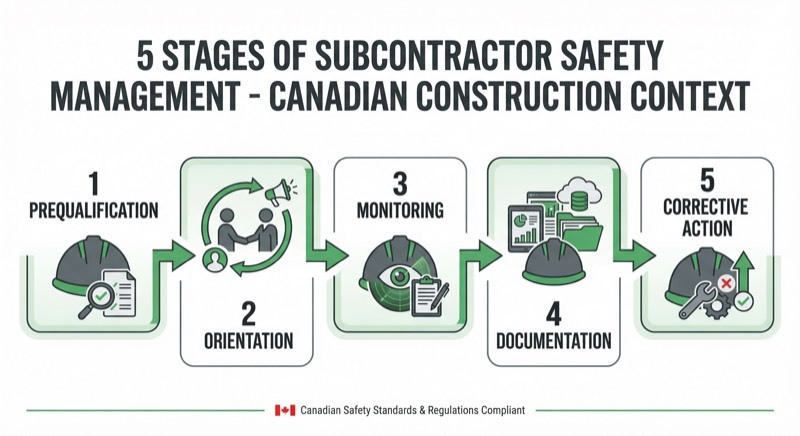
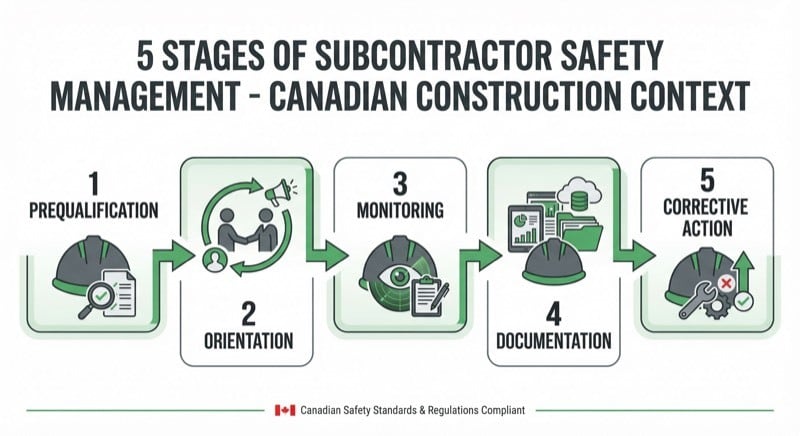
A subcontractor safety management system has five stages. Each one sounds straightforward, but the friction is in the details. Let's walk through what actually happens at each stage and where most contractors get tripped up.
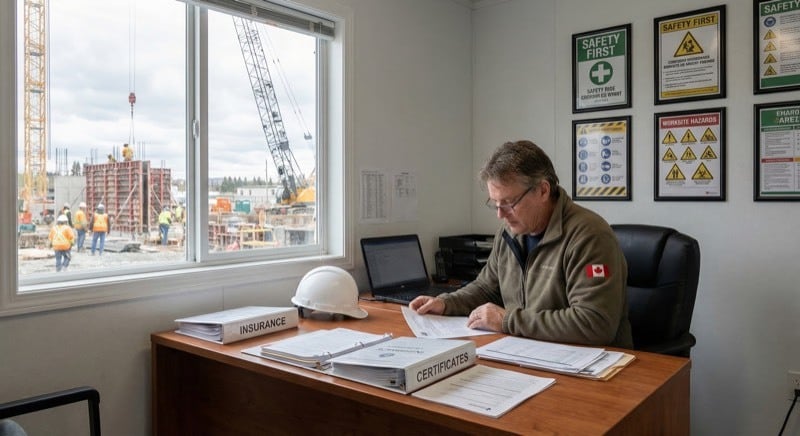
Stage 1: Prequalification (Before the Contract)
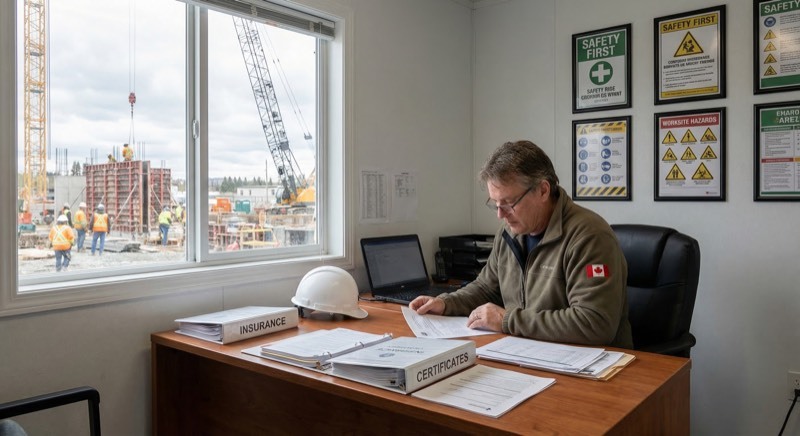
Prequalification is where you separate the subs who have a real safety program from the ones carrying a binder they printed off the internet three years ago. This happens before any contract is signed.
At minimum, you should be collecting and verifying:
- COR or SECOR letter: verify it's current (not expired), and confirm the company name matches exactly
- WCB clearance letter: confirms they're registered and in good standing. In Alberta, you can verify online through WCB Alberta. In BC, use WorkSafeBC's online clearance tool.
- Certificate of insurance: verify adequate coverage limits and that the policy is current
- Safety program documentation: request their safety policy, hazard assessment procedures, training matrix, and incident records
- Safety statistics: TRIR (Total Recordable Incident Rate) and EMR (Experience Modification Rate) for the past 3 years. A sub with a TRIR above 3.0 should trigger a deeper conversation.
- Prequalification platform status: if you work in oil and gas or with large GCs, your subs may need to be active on ISNetworld, Avetta, or ComplyWorks
Here's where it gets real: a 20-person drywall sub in Edmonton showed up to bid on a commercial interior job last year. COR letter looked clean. Insurance was current. But when the GC asked for their last three incident reports and their training matrix, there was a two-week delay and then silence. They didn't have them. The program on paper existed, but the program in practice didn't. The GC moved on.
That's exactly the scenario prequalification is designed to catch. Not just "do you have a certificate," but "can you prove your program is actually running?"
If you want to track your subs' safety metrics alongside your own, Safety Evolution's platform lets you manage safety KPIs across your entire operation, including subcontractor performance.
Stage 2: Orientation and Onboarding
Every subcontractor, from the foreman to the newest apprentice, must go through your site-specific orientation before they touch a tool. This is not negotiable, and it's the step that gets skipped most often when schedules are tight.
Your subcontractor orientation — and if your company is pursuing COR certification, these records are scored during your audit should cover:
- Site-specific hazards (what's different about this project)
- Emergency procedures: muster points, first aid locations, reporting process
- Your safety rules and expectations: PPE requirements, hot work permits, confined space procedures
- Communication protocols: who they report to, how to raise safety concerns
- FLHA requirements: your process, your forms, your expectations for completion before work starts each day
- Consequence for non-compliance: what happens if their crew violates your safety requirements
Document every orientation with a sign-off sheet. pulls orientation records together so you can verify compliance for any worker, any sub, any date. Record the date, the person oriented, and the topics covered. If you can't prove someone was oriented, the orientation didn't happen as far as any regulator or auditor is concerned.
Safety Evolution has a free construction safety orientation package you can use as a starting template. It covers the core elements and gives your subs something to reference after the orientation is done.
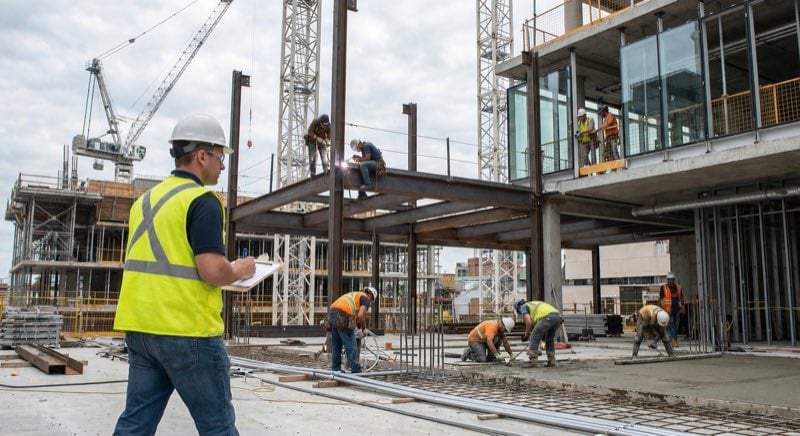
Stage 3: Ongoing Monitoring
This is where most subcontractor management systems fall apart. The prequalification was done. The orientation happened. And then everyone went back to building, and nobody checked whether the sub's crew was actually doing what they said they'd do.
Ongoing monitoring means:
- Daily FLHA reviews: are your subs completing field-level hazard assessments every day, before they start work? Spot-check them. Read them. Are they identifying real hazards or just checking boxes?
- Toolbox talk participation: your subs should be running their own toolbox talks or attending yours. Get attendance records. If your subs need ready-made material, Safety Evolution offers a free toolbox talk package with 50+ topics they can start using immediately.
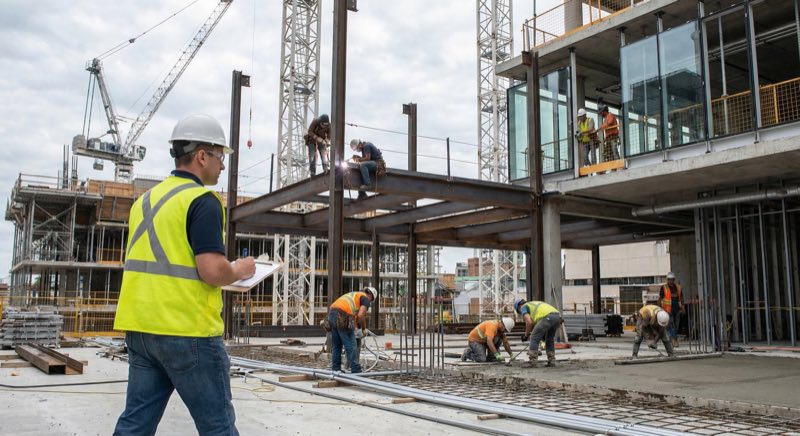
- Site inspections: walk the site specifically looking at subcontractor work areas. Check PPE compliance, housekeeping, equipment condition, barricade integrity.
- Safety meeting participation: your subs' supervisors should attend your weekly safety meetings. If they don't show up, that tells you something about their priorities.
- Incident and near-miss reporting: are your subs reporting incidents and near misses, or are you only hearing about them when someone ends up at the clinic?
The uncomfortable reality is that monitoring takes time, and nobody has extra time on a construction site. But here's the math: a 30-minute daily walk-through of your sub's work areas costs you 2.5 hours a week. A stop-work order costs you days. An incident investigation costs you weeks. Pick which one you'd rather spend your time on.
Stage 4: Documentation and Record-Keeping
If it isn't written down, it didn't happen. That's not just a saying; it's how regulators, auditors, and lawyers operate.
Your subcontractor management documentation should include:
- Prequalification records for every sub (COR letters, insurance, WCB clearance, safety stats)
- Signed orientation records for every sub worker on site
- Copies of (or access to) their daily FLHAs
- Toolbox talk attendance records
- Site inspection reports that include sub work areas
- Meeting minutes from safety meetings where subs participated
- Corrective action records: what was found, what was required, what was done, and by when
- Any stop-work actions or removals from site, with written justification
The contractors who stay out of trouble aren't the ones who never have a sub slip up. helps you track that paper trail. They're the ones who can show a paper trail proving they had a system, they enforced it, and they acted when issues came up. That's what protects you in an investigation.
Going digital makes this dramatically easier. Safety Evolution's digital safety forms let you and your subs complete FLHAs, inspections, and orientation records on a phone, with automatic filing and instant access when an auditor or officer asks to see them.
Stage 5: Corrective Action and Consequences
This is the stage that separates a real subcontractor management system from a filing exercise. When a sub's crew isn't meeting your safety requirements, you need a clear escalation process.
A typical escalation looks like this:
- Verbal warning: immediate correction on site. Document the conversation.
- Written notice: formal letter to the sub's management documenting the issue, the expected correction, and the timeline.
- Work stoppage: pull the sub's crew off the affected task until the issue is resolved. Document it.
- Removal from site: for repeated or serious violations, remove the sub from the project entirely. This should be supported by your contract terms.
Here's the part most contractors avoid: actually using these steps. It's easy to write a corrective action policy. It's hard to shut down a framing crew on day three of a tight schedule because their foreman isn't doing FLHAs. But that's exactly the moment your subcontractor management system either means something or doesn't.
Make sure your subcontract agreements include clear language about safety expectations and your right to stop work or remove a sub for non-compliance. If it's not in the contract, you have a much harder conversation when the time comes.
What Does a Good Subcontractor Management Checklist Look Like?
Here's a practical checklist you can start using this week:
Before the contract:
- ☐ Verify COR/SECOR status (current, correct company name)
- ☐ Obtain WCB clearance letter
- ☐ Verify insurance coverage and limits
- ☐ Request safety program documentation
- ☐ Review TRIR and EMR for past 3 years
- ☐ Include safety expectations in contract language
Before they start work:
- ☐ Complete site-specific orientation for all sub workers
- ☐ Collect signed orientation acknowledgments
- ☐ Verify training certifications (fall protection, confined space, WHMIS, etc.)
- ☐ Review sub's site-specific safety plan
- ☐ Confirm FLHA process and expectations
During the project:
- ☐ Spot-check FLHAs daily
- ☐ Include sub work areas in site inspections
- ☐ Verify toolbox talk completion
- ☐ Include sub supervisors in safety meetings
- ☐ Document and follow up on corrective actions
- ☐ Review incident and near-miss reports
Project close-out:
- ☐ Evaluate sub's overall safety performance
- ☐ Document lessons learned
- ☐ Update prequalification records for future projects
What Are the Most Common Mistakes in Managing Subcontractor Safety?
After working with contractors across Alberta and BC, we see the same mistakes over and over:
1. Collecting certificates but never checking the work. monitors ongoing compliance across all your subs, not just the certificate date. A COR letter is a snapshot of a point in time. It doesn't tell you whether that sub's crew is doing FLHAs this morning on your site. Prequalification is the starting line, not the finish.
2. Treating orientation as a one-time event. Site conditions change. New hazards emerge. A sub who was oriented in week one may be working in a completely different area by week six. Orientation should be a living process, not a one-and-done sign-off.
3. Not including subcontractor management in your health and safety management system. Many contractors have solid internal safety programs but no formal process for managing the subs who make up half their workforce on any given project.
4. Avoiding difficult conversations. Telling a sub's foreman that his crew needs to stop work because their FLHAs aren't getting done is uncomfortable. Explaining to a GC why a sub's worker fell through unprotected floor openings is worse.
5. No contract language around safety. If your subcontract agreement doesn't include clear safety expectations, consequences for non-compliance, and your right to stop work, you're setting yourself up for a dispute when you need to enforce your standards.
How Safety Evolution Helps Contractors Manage Subcontractors
Safety Evolution isn't a consulting firm that hands you a binder and wishes you luck. We act as your done-for-you safety department: building your subcontractor management program, setting up your prequalification process, creating your orientation materials, and giving you digital tools to track everything in real time.
Our clients use Safety Evolution to:
- Build audit-ready subcontractor management programs that meet COR requirements
- Run digital FLHAs and inspections across their own crews and their subs
- Track training certifications and expiry dates for every worker on site, including sub workers
- Generate the documentation trail that protects you in an investigation or audit
- Prepare for COR audits with confidence that your contractor management element will score
We work with contractors across Canada, with deep expertise in Alberta and BC regulatory requirements. If managing your subs' safety feels like a second full-time job, that's because it is. Let us take it on.
and see exactly where your subcontractor management gaps are before an auditor or officer finds them first. Your safety data already has the answers.
Stop Babysitting Subcontractor Paperwork
Chasing subs for orientations, insurance certs, and daily FLHAs is a massive bottleneck. Automate subcontractor compliance with Safety Evolution so you know who is cleared to work before they even step on site.
30-Day Free Trial
Frequently Asked Questions
Who is legally responsible for subcontractor safety on a construction site in Canada?
The prime contractor (typically the general contractor) is legally responsible for coordinating health and safety activities across all employers on a multi-employer worksite. In Alberta, this is defined under the OHS Act. In BC, it falls under the Workers Compensation Act. Even if you hire subcontractors with their own safety programs, the prime contractor retains the duty to coordinate and oversee safety across the entire site.
What documents should I collect from subcontractors before they start work?
At minimum, collect a current COR or SECOR letter, WCB clearance letter, certificate of insurance with adequate coverage, safety program documentation, and safety statistics (TRIR and EMR) for the past three years. In addition, verify that all sub workers have the required training certifications for the work they'll be performing, such as fall protection, confined space, and WHMIS.
Is subcontractor management part of the COR audit?
Yes. The ACSA COR audit instrument in Alberta includes contractor management as a scored element. Auditors review your contractor management policy, selection process, contractor orientation records, and project meeting minutes showing sub participation. You need a minimum of 50% on each element and 80% overall to earn your COR. A weak subcontractor management element can fail your entire audit.
What are the penalties for failing to manage subcontractor safety?
Penalties vary by province. In Alberta, OHS administrative penalties can reach $10,000 per offence per day the violation continues. In BC, WorkSafeBC's statutory maximum penalty for 2025 is $798,867.87. Beyond fines, consequences include stop-work orders, project delays, increased insurance premiums, and potential criminal liability in cases of serious injury or death.
How often should I monitor my subcontractors' safety performance on site?
Daily monitoring is the standard for active construction sites. This includes spot-checking FLHAs, walking sub work areas during inspections, and reviewing toolbox talk completion. Weekly safety meetings should include sub supervisors. Formal documented inspections of sub work areas should happen at least weekly, with more frequent checks during high-risk activities like working at heights, hot work, or confined space entry.
Can I remove a subcontractor from my site for safety violations?
Yes, and your right to do so should be clearly stated in your subcontract agreement. A typical escalation process starts with a verbal warning and documented correction, moves to a written notice, then work stoppage for the affected task, and finally removal from site for repeated or serious violations. Having this process documented in your contract protects you legally and sets clear expectations from the start.
Get Weekly Safety Insights
Regulation updates, toolbox talk ideas, and compliance tips. One email per week.