Last updated: March 2026
You just landed a bid with a major GC. The contract is signed, your crew is ready, and then you get the email: "Please submit your site-specific safety plan before mobilization."
Your stomach drops. You have a safety program. You even have COR. But a site-specific safety plan? For this particular project? That is a different document entirely, and most contractors do not have one ready to go. We help contractors build these plans every week at Safety Evolution, and the number one problem we see is companies trying to submit their general safety manual and hoping nobody notices.
They notice. Every time.
⚡ Quick Answer: Site-Specific Safety Plan
- What: A project-specific document that outlines hazards, controls, emergency procedures, and safety responsibilities for a single worksite
- When you need one: When a prime contractor, GC, or project owner requires it before mobilization (increasingly standard on mid-to-large projects)
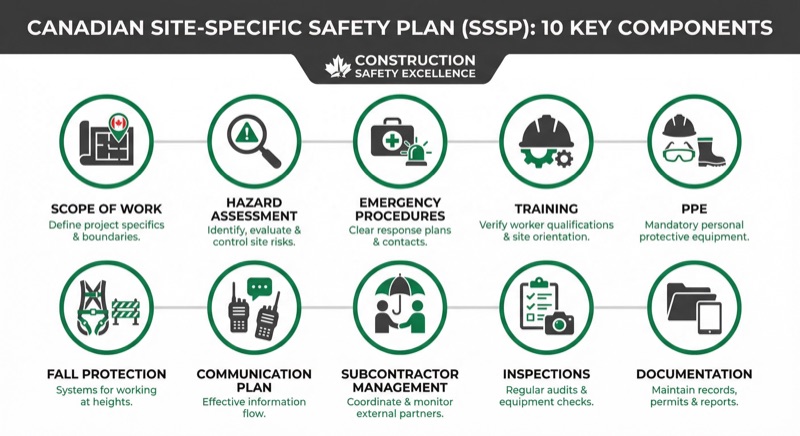
- What it includes: Scope of work, site hazards, emergency procedures, training requirements, PPE, fall protection, communication plan, subcontractor management
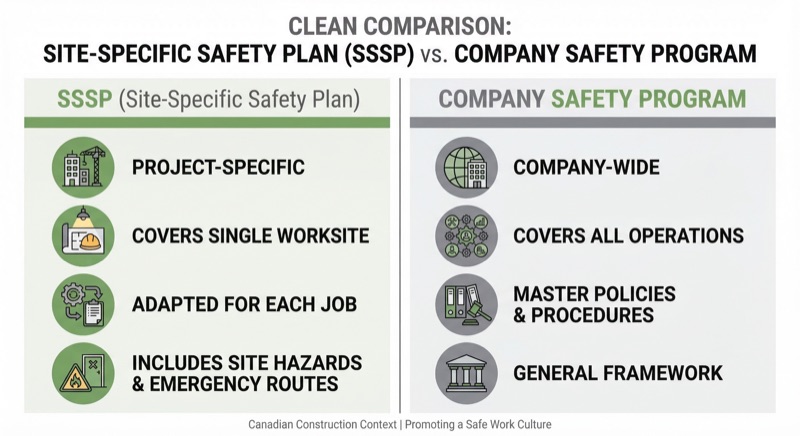
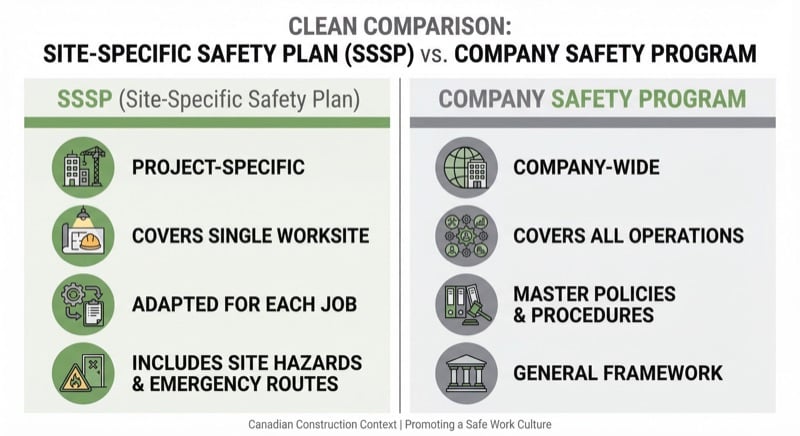
- How it differs from your safety program: Your safety program is company-wide. Your SSSP is project-specific, adapted for each site's unique hazards and requirements
- Time to build: 2-5 days for a thorough plan, depending on project complexity
- Free Resource: Download our Construction Health & Safety Manual.
A site-specific safety plan (SSSP) is a written document that identifies the unique hazards, controls, emergency procedures, and safety responsibilities for a single construction project or worksite. It is not your company safety manual with a different cover page. It is a living document built around the specific risks, conditions, and requirements of the project you are about to start.
This guide covers everything you need to build one that actually holds up: what goes in it, when you need one, how it connects to your overall safety program, and the mistakes that get contractors rejected before they ever set foot on site.
Why Do You Need a Site-Specific Safety Plan?
Here is the blunt truth: most contractors treat SSSPs as a box to check. They download a template, fill in the blanks, and submit it without thinking about whether it actually reflects the job they are doing. Then they wonder why the GC sends it back with redlines, or worse, why OHS shows up on site and finds gaps between what the plan says and what the crew is actually doing.
A site-specific safety plan exists because every project is different. The hazards on a 3-storey commercial build in downtown Vancouver are nothing like the hazards on a pipeline tie-in during a turnaround in northern Alberta. Your company safety program covers the general rules. Your SSSP covers what those rules look like in practice on this specific site, with this specific crew, doing this specific scope of work.
There are three main situations where you will need one:
1. Prime Contractor Requirements
In most Canadian provinces, the prime contractor is responsible for coordinating health and safety on a multi-employer worksite. In Alberta, the OHS Act requires the prime contractor to establish a system to ensure all worksite parties comply with OHS legislation. In BC, WorkSafeBC places similar coordination duties on the prime contractor. In practice, this means the prime contractor will require every sub on site to submit a site-specific safety plan before mobilization. If you are working as a subcontractor on any project with multiple trades, expect this requirement. For a deeper look at what prime contractors are responsible for, see our guide on prime contractor responsibilities in BC.
2. GC Bid Packages
Many general contractors now include SSSP requirements directly in their bid packages. You will see language like "Contractor shall submit a site-specific safety plan within 10 business days of contract award" or "Safety plan must be reviewed and approved by the GC safety department prior to mobilization." If you cannot produce a credible plan quickly, you risk delaying mobilization or losing the contract entirely.
3. Owner and Client Requirements
Major project owners, particularly in oil and gas, utilities, and institutional construction, have their own safety requirements that go beyond what provincial regulations mandate. Companies like TC Energy, for example, require a detailed Project/Site Specific Safety Plan (P/SSSP) from every prime and general contractor. These owner requirements often include specific templates, additional documentation, and pre-approval processes.
If you are not sure whether your next project requires an SSSP, the safe answer is: build one anyway. A solid site-specific safety plan protects your crew, satisfies your client, and gives you documentation to point to if anything goes sideways.
Not sure if your current safety program would hold up to a GC's SSSP requirements? against typical GC prequalification standards and flag exactly where the gaps are.
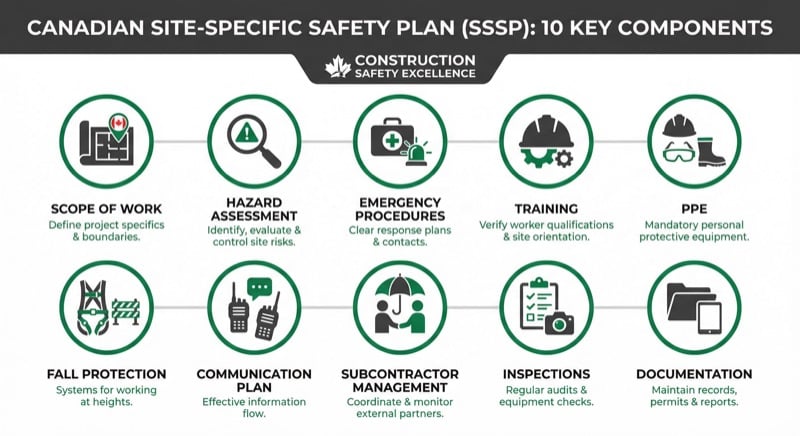
What Goes in a Site-Specific Safety Plan?
This is where most contractors get stuck. They know they need a plan, but they are not sure what level of detail is expected. Here is the breakdown of what a comprehensive SSSP should include, section by section.
1. Project Scope of Work
Start with the basics: what work is being done, where, and for how long. Include the project name, location, client name, contract number, expected start and end dates, and a description of the work scope. This section sounds simple, but it sets the context for everything that follows. If your scope says "electrical rough-in" but your crew is also pulling cable tray at height, your fall protection section needs to reflect that. Be specific.
2. Site Hazard Assessment
This is the core of the plan. Walk the site (or review the site plans if you have not mobilized yet) and identify every hazard your crew will face. Think beyond the obvious. Yes, working at height is a hazard. But what about the overhead crane that the structural steel crew is running on the floor above you? What about the shared access road with heavy equipment traffic? What about the soil conditions if you are doing any excavation work?
For each hazard, document the control measures you will use: elimination, substitution, engineering controls, administrative controls, and PPE. This is not a place for vague language. "Workers will be safe" is not a control measure. "All workers within 10 feet of an unprotected edge will use a personal fall arrest system anchored to a rated anchor point" is a control measure. For guidance on building a thorough hazard assessment, check out our guide on conducting a field-level hazard assessment.
3. Emergency Procedures
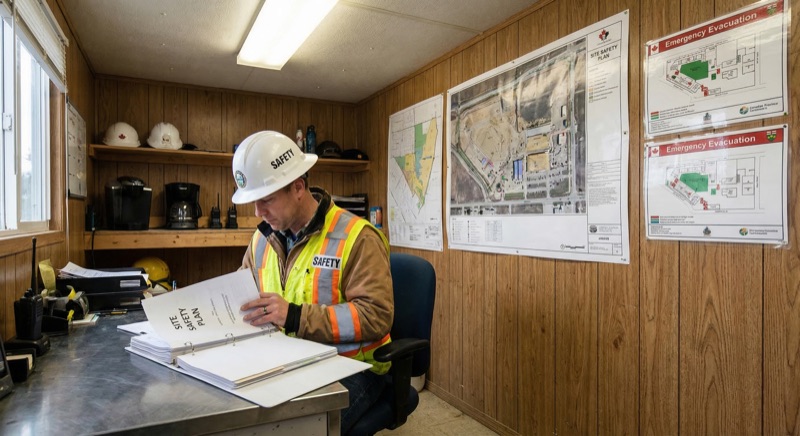
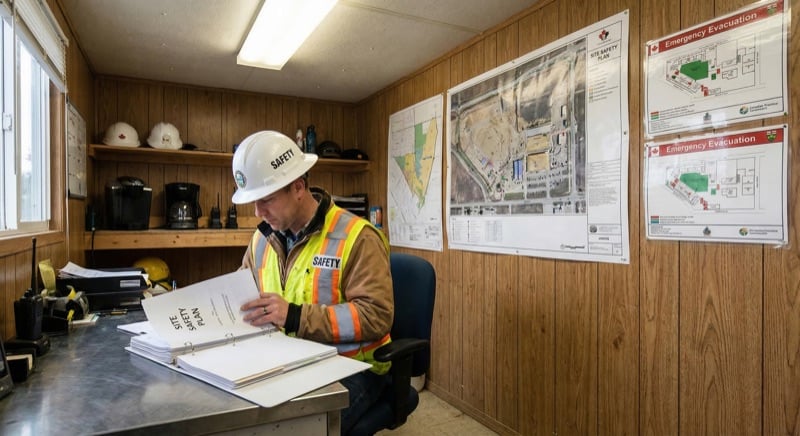
Every SSSP needs a site-specific emergency response plan. This means: the address and GPS coordinates of the site, directions to the nearest hospital and medical clinic, a site evacuation map showing muster points, the names and phone numbers of your site first aiders, the location of first aid kits and AEDs, the emergency notification chain (who calls whom), and procedures for specific emergencies relevant to the project (fire, chemical spill, structural collapse, medical emergency, severe weather).
Most contractors think they can just reference their company emergency plan here. You cannot. The emergency plan in your general safety program does not include this site's muster point, this hospital's address, or this project's specific emergency contacts. Your SSSP emergency section must be tailored to the actual project location. For more detail on building emergency response plans, talk to your safety coordinator or reach out to a professional safety company that can help you build site-specific emergency procedures.
4. Training Requirements
Document every training requirement for the project. This typically includes: mandatory safety orientation (both company and site-specific), trade-specific certifications (e.g., journeyman tickets, crane operator certification), safety-specific training (fall protection, confined space entry, WHMIS, first aid), and any client or owner-required training. Include a matrix showing which roles require which training, and how you will verify currency before workers start on site. This is also where you document your site-specific safety orientation program, which every worker must complete before starting work on the project. If you need a ready-made framework for that orientation process, our construction safety orientation package gives you a complete structure to adapt for each project.
5. PPE Requirements
Go beyond the standard "hard hat, safety glasses, steel toes" minimum. What PPE is required for specific tasks on this project? If your crew is doing hot work, what fire-resistant clothing is required? If you are working near overhead activities, do you need face shields? Is hearing protection required in certain areas of the site? Document the minimum PPE requirements for general site access, plus any additional requirements for specific tasks or zones.
6. Fall Protection Plan
If any work on the project involves heights (and on most construction projects, it does), your SSSP needs a dedicated fall protection section. In most Canadian jurisdictions, fall protection is required when a worker could fall 3 metres (10 feet) or more, though this threshold can vary. Your fall protection plan should cover: the types of fall protection systems to be used (guardrails, personal fall arrest systems, travel restraint, safety nets), anchor point locations and ratings, equipment inspection procedures and schedules, rescue procedures in the event of a fall arrest, and worker training requirements specific to the fall protection systems being used. This section should be detailed enough to stand on its own. For a complete walkthrough, refer to our guide on building a fall protection plan in Canada.
7. High-Risk Activity Procedures
Depending on your scope of work, you may need dedicated sections for:
- Hot work: welding, cutting, grinding near combustible materials. Include permit procedures, fire watch requirements, and hot work zone setup.
- Confined space entry: tanks, vaults, manholes, trenches deeper than 1.2 metres. Include atmospheric testing procedures, entry permits, rescue plans, and attendant requirements.
- Excavation and trenching: soil classification, shoring and sloping requirements, underground utility locates, and access/egress provisions.
- Crane and rigging operations: lift planning, critical lift procedures, signal person requirements, and exclusion zones.
- Lockout/tagout: energy isolation procedures for maintenance or service work on powered equipment.
Not every project will require all of these sections. The point is that your SSSP should reflect the actual work being done. If your scope includes confined space entry but your SSSP does not mention it, that is a red flag for any GC or auditor reviewing the plan.
8. Communication Plan
How will safety information flow on this project? Document: the frequency and format of toolbox talks (daily, weekly, or per-task), how FLHAs will be completed and reviewed, the process for reporting hazards and near misses, how safety bulletins and alerts will be communicated to workers, radio channels or other communication methods for emergency situations, and the schedule for safety meetings between your team and the GC's safety department.
Clear communication is especially critical on multi-employer worksites where multiple trades are working in overlapping areas. If you need ready-to-use toolbox talk content for your crew, our free toolbox talk package covers 50+ construction-relevant topics.
9. Subcontractor Management
If you are managing subcontractors on the project, your SSSP must include: how you will pre-qualify subcontractors (COR/SECOR requirements, safety stats, insurance), the process for reviewing and approving sub safety plans, how you will orient subs to your site-specific requirements, the monitoring and enforcement process for sub compliance, and the escalation process for safety violations. For a comprehensive approach to managing subcontractor safety, see our subcontractor safety management guide.
10. Inspections and Documentation
Document your inspection schedule: what will be inspected, how often, by whom, and how findings will be tracked and corrected. This typically includes daily site inspections, weekly formal inspections, equipment pre-use inspections, and any regulatory inspection requirements. Also document how you will maintain records: FLHAs, toolbox talk sign-off sheets, training records, inspection reports, incident reports, and corrective actions. Your incident investigation process should be clearly defined, including who leads the investigation, what forms are used, and how corrective actions are tracked to completion. If you need a framework for that, our incident report and investigation kit provides a complete system. During a COR maintenance audit, these records are exactly what the auditor will want to see.
Need a Complete Safety Program?
Stop starting from scratch. Download our Free Construction Health & Safety Manual to get compliant fast.
Download the Free Manual →
How Does an SSSP Differ from Your Safety Program?
This is the question that trips up most contractors, and it is the reason so many SSSPs get rejected.
Your company safety program is your master document. It covers your overall health and safety management system: your policies, your general procedures, your training framework, your incident reporting process, and your commitment to compliance. It applies to everything your company does, on every site, every day. If you hold COR or SECOR certification, your safety program is the foundation that got you certified.
Your SSSP is different. It takes the principles from your master program and applies them to a specific project. Think of it this way: your safety program says "we will conduct hazard assessments before starting work." Your SSSP says "on this project, the specific hazards are X, Y, and Z, and here is exactly how we will control them."
Here is a practical comparison:
| Element |
Company Safety Program |
Site-Specific Safety Plan |
| Scope |
All company operations |
Single project or worksite |
| Hazard assessment |
General hazard categories |
Site-specific hazards with specific controls |
| Emergency procedures |
General emergency response framework |
Site address, nearest hospital, muster points, site-specific contacts |
| Training |
Company training requirements |
Project-specific training matrix with role requirements |
| Duration |
Ongoing, reviewed annually |
Project duration, updated as conditions change |
| Audience |
All company employees |
Project team, GC, subcontractors, owner |
The biggest mistake we see? Contractors who print their 200-page safety manual, slap a project-specific cover page on it, and call it an SSSP. A GC safety coordinator can spot this in 30 seconds. And if OHS visits the site and finds a generic plan that does not reflect the actual hazards on the ground, that is a compliance issue, not just a paperwork problem.
How to Adapt Your Master Program for Each Project
The good news: you do not need to build a site-specific safety plan from scratch for every project. If you have a solid safety program in place, your SSSP is an extension of it.
Here is the practical process we use with our clients at Safety Evolution:
- Start with your master program as the backbone. Your policies, general procedures, and management system structure stay the same. These are the "what we do" elements.
- Conduct a pre-project hazard assessment. Visit the site, review the project plans, and identify every hazard specific to this project. Talk to the GC about site conditions, shared spaces, and coordination requirements.
- Customize the high-risk sections. Pull the relevant sections from your master program (fall protection, confined space, hot work, excavation) and adapt them with project-specific details: actual anchor point locations, specific confined spaces to be entered, designated hot work areas.
- Build the emergency response section from scratch. This section cannot be copied from your master program. Every detail must be site-specific: the address, the hospital route, the muster points, the site contacts.
- Create the project training matrix. Map every role on the project to the specific training required, including any client-mandated training. Verify all certifications are current before mobilization.
- Review against the GC's requirements. Compare your draft SSSP to whatever the GC has specified. Many GCs provide a template or a checklist of required sections. Make sure you have addressed every item.
- Get it reviewed by someone who was not involved in writing it. Fresh eyes catch gaps. If your safety coordinator wrote it, have your site superintendent review it. If you wrote it yourself, have another supervisor read it.
The whole process should take 2-5 days for a well-organized company. If it is taking you weeks, your master program probably has gaps that are making the customization harder than it needs to be.
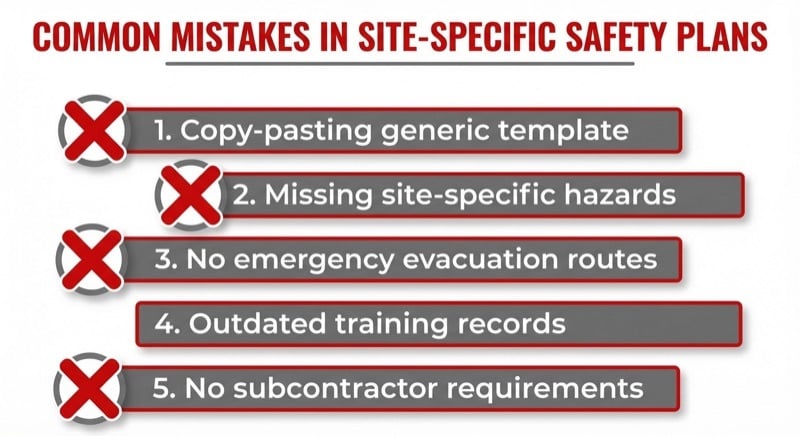
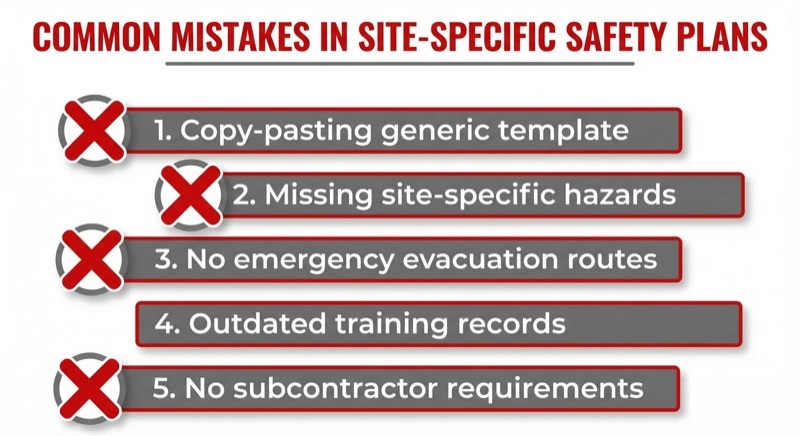
What Are the Most Common SSSP Mistakes?
After reviewing hundreds of site-specific safety plans from contractors of all sizes, here are the mistakes we see over and over again:
1. Copy-Pasting a Generic Template
The most common mistake, and the most obvious one to catch. A site-specific safety plan that refers to "the worksite" instead of naming the actual project, lists generic hazards that do not match the scope of work, or includes sections for work you are not doing (like confined space entry on a roofing job) tells the reviewer you did not actually think about this project.
2. Missing Site-Specific Emergency Information
If your emergency section says "call 911 and proceed to the designated muster point" without specifying where the muster point is, what the site address is for the 911 dispatcher, or how to get to the nearest hospital, it is incomplete. This is the section that matters most if something goes wrong, and it is the section most contractors skimp on.
3. No Connection Between Hazards and Controls
Listing hazards is not enough. Every hazard needs a specific control measure. "Working at heights" is a hazard. "100% tie-off using full body harness and 6-foot shock-absorbing lanyard connected to rated anchor points as identified on the attached site plan" is a control. If your SSSP lists 15 hazards and zero controls, it is a hazard inventory, not a safety plan. Start with our guide to field-level hazard assessments to see what effective hazard-to-control mapping looks like.
4. Outdated or Missing Training Records
Your SSSP can have a perfect training matrix, but if you cannot produce the actual training records when the GC or an auditor asks for them, the plan is just paper. Maintain a project-specific training binder (or better yet, a digital system) with copies of every certificate, ticket, and orientation sign-off for every worker on site. Our construction safety orientation package gives you the framework to standardize your training documentation.
5. No Plan for Subcontractors
If you are managing subs on the project and your SSSP does not mention how you will pre-qualify, orient, monitor, and enforce safety with those subs, there is a major gap. Subcontractor incidents can be attributed to the prime contractor. This is not a section you want to leave blank.
6. Writing It and Forgetting It
An SSSP is a living document. When the scope changes, when new hazards are identified, when the schedule shifts, the plan needs to be updated. We have seen contractors submit a perfect SSSP at the start of a 12-month project and never touch it again, even after the scope changed three times. That is a liability, not a plan.
We worked with a 22-person mechanical contractor in Edmonton who nearly lost a major shutdown contract because of mistake number one. They had a solid company safety program with COR certification, but when the GC asked for a site-specific safety plan, their safety coordinator pulled the company manual, changed the header, and sent it over. The GC's safety department flagged it within 24 hours: the emergency section listed the company office address instead of the plant site, the hazard assessment did not mention any of the chemical exposure risks specific to the shutdown scope, and there was no mention of the confined space entries that were a core part of the job. They had 48 hours to produce a real SSSP or lose the contract. That is the kind of scramble that a proper process prevents.
If any of these mistakes sound familiar, you are not alone. Most contractors we work with started in the same place. and identify the gaps in your current SSSP process before your next bid depends on it.
How Does Your SSSP Connect to COR Maintenance Audits?
If your company holds COR certification, your site-specific safety plans are audit evidence. During a COR maintenance audit, auditors will look at how your company identifies and controls hazards on specific projects. A well-maintained SSSP demonstrates that your hazard assessment process is not just a policy on paper; it is something you actually do on every project.
Specifically, your SSSPs support several COR audit elements:
- Hazard assessment: Your project-specific hazard assessments show you are identifying and controlling hazards at the site level, not just in a boardroom.
- Emergency response: Site-specific emergency plans demonstrate your emergency preparedness is real and current.
- Training: Project training matrices and sign-off records prove your workers are competent for the work they are doing.
- Inspections: Completed site inspection records show your monitoring and compliance processes are active.
- Subcontractor management: Documentation of sub pre-qualification, orientation, and monitoring shows you are managing third-party risk.
When we work with contractors preparing for COR audits, one of the first things we review is their SSSPs. It is often where the gaps show up fastest: a company might have a great safety manual but weak project-specific documentation. If your COR audit is coming up and your SSSPs are not up to standard, that is something to address now, not the week before the auditor arrives. Learn more about maintaining your certification in our COR certification guide.
Building a Site-Specific Safety Plan That Actually Works
The difference between a plan that sits in a binder and a plan that actually keeps your crew safe comes down to three things:
- Specificity. Every section reflects the actual project, not a generic template. If someone reads your SSSP, they should be able to identify the project without looking at the cover page.
- Ownership. Someone on the project team owns the plan. They update it when conditions change, they review it with the crew during orientation, and they make sure the documentation matches what is happening on the ground.
- Integration. The SSSP is not a standalone document that lives in a drawer. It connects to your daily FLHAs, your toolbox talks, your inspection reports, and your incident investigations. When your crew fills out an FLHA every morning, they are implementing a piece of the SSSP. When you run a toolbox talk on fall protection before starting work at height, that is the SSSP in action.
If you are building your first SSSP, or if you have been submitting generic plans and want to raise your standard, start with the sections outlined in this guide. Adapt your master safety program for each project. Get specific about hazards, controls, and emergency procedures. And keep the document alive throughout the project.
If that sounds like more work than your team can handle alongside running the actual project, that is exactly the problem Safety Evolution solves. We build audit-ready safety programs and site-specific safety plans for contractors across Canada. Our team handles the documentation, the hazard assessments, and the COR audit prep so you can focus on the work.
Build Site-Specific Plans in Minutes, Not Hours
Creating a new SSSP from scratch for every project kills your week. Safety Evolution lets you template your core programs and customize them for the site instantly, keeping you compliant and ready to break ground.
30-Day Free Trial
Frequently Asked Questions
What is the difference between a site-specific safety plan and a safety program?
A safety program is your company-wide health and safety management system that covers all operations, policies, and procedures across every project. A site-specific safety plan (SSSP) is a project-specific document that adapts your general program to the unique hazards, emergency procedures, training requirements, and conditions of a single worksite. Think of the safety program as your playbook and the SSSP as your game plan for a specific project.
When is a site-specific safety plan required in Canada?
While not always explicitly mandated by provincial regulations as a standalone document, SSSPs are effectively required whenever a prime contractor, general contractor, or project owner demands one as a condition of the contract. In practice, most mid-to-large construction projects in Alberta, BC, and across Canada require subcontractors to submit an SSSP before mobilization. Provincial OHS legislation does require employers to assess and control site-specific hazards, which an SSSP formalizes.
How long does it take to create a site-specific safety plan?
For a company with a well-developed master safety program, creating a project-specific SSSP typically takes 2-5 business days, depending on the complexity of the project and the scope of work. Companies without a strong master program may need significantly longer, as they are building foundational elements at the same time as the project-specific content.
Can I use the same site-specific safety plan for every project?
No. The entire point of a site-specific safety plan is that it reflects the unique hazards, conditions, and requirements of each project. Reusing the same plan across projects is one of the most common mistakes contractors make. You can and should use a consistent template structure, but the content, particularly hazard assessments, emergency procedures, and training requirements, must be customized for each job.
Does having a site-specific safety plan help with COR certification?
Yes. Well-maintained SSSPs provide strong evidence for several COR audit elements, including hazard assessment, emergency preparedness, training, inspections, and subcontractor management. COR auditors want to see that your safety management system is not just a manual on a shelf but something actively implemented on each project. SSSPs are one of the best ways to demonstrate that.
How often should a site-specific safety plan be updated?
An SSSP should be treated as a living document and updated whenever project conditions change. This includes changes to the scope of work, the introduction of new hazards, changes to the project schedule or phases, new subcontractors coming on site, or after a significant incident or near miss. At minimum, conduct a formal review at the start of each major project phase.
Get Weekly Safety Insights
Regulation updates, toolbox talk ideas, and compliance tips. One email per week.