Health & Safety Program
Calculate Your OSHA Dart Rate!
DART rate formula, 2024 benchmarks, and how to read your OSHA 300 log for DART cases. Understand what separates DART from TRIR.
Track these 8 safety metrics to lower your TRIR, DART, and EMR. Formulas, 2024 benchmarks, and a 30-minute monthly review framework for contractors.
Last updated: April 2026
You pull up your safety numbers before a prequalification deadline and realize you're not sure which ones actually matter. TRIR is on the ISNetworld form. DART shows up on bid packages. EMR affects your insurance premium. But which metrics tell you whether your safety program is working before someone gets hurt?
Safety metrics are quantitative measures that track workplace safety performance across two categories: lagging indicators that measure past outcomes and leading indicators that predict future risk. Tracking both gives contractors the numbers they need for bids and insurance while catching problems before they become injuries.
Safety metrics stopped being optional the moment clients started asking for them on every bid package.
General contractors set TRIR thresholds for subcontractors. ISNetworld, Avetta, and ComplyWorks require TRIR, DART, and EMR documentation for prequalification. Your experience modification rate directly determines what you pay for workers' compensation insurance every year.
But the business case goes beyond compliance. Contractors who track the right metrics catch drift early: inspections getting skipped, corrective actions piling up, the same hazards appearing job after job. Catching that drift at month two instead of month eight is the difference between a coaching conversation and an OSHA citation.
If your safety program produces a binder nobody opens until audit season, these metrics turn it into a system that actually protects people and wins work. For a deeper dive on audit readiness, see our guide on strategies to pass your next safety audit.
Most contractors only track lagging indicators: TRIR, DART, EMR. These tell you what already happened. Tracking only lagging indicators is like driving a truck using only the rearview mirror.
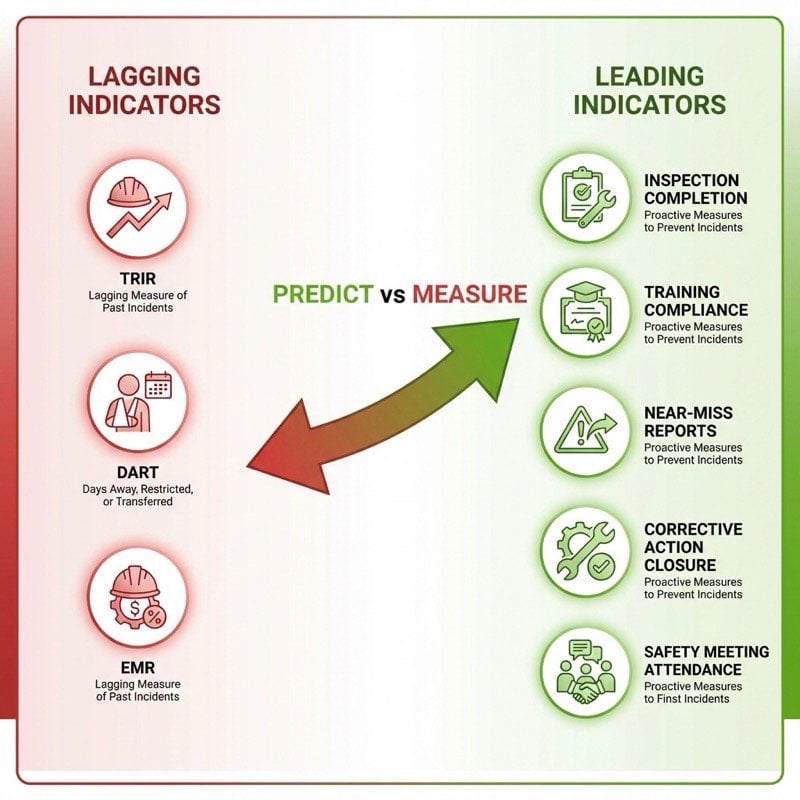
Lagging indicators measure outcomes after the fact. An injury happened, a claim was filed, a day was lost. They are essential for benchmarking, prequalification, and insurance, but they cannot prevent the next incident.
Leading indicators measure the activities that prevent incidents. Inspections completed, near misses reported, corrective actions closed, training current. These numbers tell you whether your safety system is functioning before something goes wrong.
The contractors with the best safety records track both. Their lagging indicators (TRIR, DART, EMR) look good because their leading indicators (inspections, training, corrective actions) are consistently strong. The metrics reinforce each other.
Here is how the two types work together: a spike in incomplete inspections (leading) often precedes a rise in recordable incidents (lagging) by 60 to 90 days. If you are only watching TRIR, you will not see the problem until someone is already hurt.
These eight metrics are the ones that make the biggest difference for contractors because they are practical to track, they show early warning signs, and they directly affect your ability to win work.
Type: Lagging indicator
TRIR (Total Recordable Incident Rate) measures the number of OSHA-recordable injuries and illnesses per 100 full-time workers over a given period. It is the most commonly requested safety metric on prequalification forms and bid packages.
Formula: TRIR = (Number of Recordable Incidents x 200,000) / Total Hours Worked
The 200,000 figure represents 100 employees working 40 hours per week for 50 weeks per year (OSHA interpretation, 2016).
2024 benchmark: The construction industry average TRIR was 2.3 per 100 full-time equivalent workers, down from 2.4 in 2023 (Bureau of Labor Statistics, 2024 data).
Why contractors track it: Many general contractors will not hire subcontractors with a TRIR above their threshold. ISNetworld and Avetta require it. It is the scoreboard, but it does not tell you what to fix next.
For the complete calculation walkthrough and free calculator, see our guide to calculating TRIR and try our free TRIR calculator.
Type: Lagging indicator
DART (Days Away, Restricted, or Transferred) rate measures the number of incidents serious enough to result in time away from work, restricted duties, or a job transfer per 100 full-time workers.
Formula: DART Rate = (DART Cases x 200,000) / Total Hours Worked
2024 benchmark: The national all-industry DART rate was 1.4 per 100 FTE, down from 1.5 in 2023 (National Safety Council, 2024 data).
Why it matters: DART tells you how many incidents were serious enough to affect the worker's ability to do their job. A low TRIR with a high DART rate means most of your incidents are severe. DART is increasingly requested on prequalification forms alongside TRIR.
For the full DART calculation walkthrough, see our DART rate guide.
Type: Lagging indicator
Experience Modification Rate (EMR) is an insurance metric that compares your company's workers' compensation loss experience to the average for businesses of similar size in your industry. It is calculated by the National Council on Compensation Insurance (NCCI) or your state rating bureau.
Benchmark: An EMR of 1.0 is the industry average. Below 1.0 means your loss experience is better than average and you pay lower premiums. Above 1.0 means worse than average and higher premiums.
Financial impact: The difference between an EMR of 0.80 and 1.20 on a base premium of $100,000 is $40,000 per year. For contractors with large payrolls, EMR swings can mean hundreds of thousands in annual premium differences.
Key detail: The NCCI formula weighs the frequency of claims more heavily than their severity (NCCI, ABCs of Experience Rating). Five small claims will damage your EMR more than one large claim of the same total cost.
For a deep dive on what drives EMR and how to lower it, see our complete EMR guide and our EMR in construction guide.
Type: Leading indicator
Near misses are the earliest warning signal your safety program produces. If nobody is reporting near misses, it does not mean you have zero risk. It means your crews are not reporting.
What to track monthly:
Contractor tip: Make reporting easy. A two-page paper form guarantees underreporting. A 30-second digital report from a phone gets you real data.
Type: Leading indicator
Inspections are one of the strongest leading indicators because they show whether supervisors are actively looking for hazards in the field, not just waiting for something to go wrong.
What to track monthly:
Contractor tip: Short inspections done consistently beat long inspections nobody completes. A 10-minute daily walkthrough catches more than a 2-hour monthly audit. See our guide on developing equipment inspections in 5 steps.
Type: Leading indicator
This is one of the most important monthly metrics because it answers a simple question: when we find a hazard, does it actually get fixed?
What to track monthly:
Contractor tip: If you only track one leading indicator, track corrective action closure. Open corrective actions are future incidents waiting for a date. A pile-up of overdue actions is one of the clearest predictors of an upcoming recordable.
Type: Leading indicator
Training compliance shows whether your workforce is current on the certifications and competencies that prevent injuries and citations. It is also one of the first things auditors check.
What to track monthly:
Priority training areas for most contractors:
Type: Leading indicator
Behavior observations help you see what is happening in the field between inspections. They capture both safe behaviors (what is working) and at-risk behaviors (what needs coaching) before they lead to incidents.
What to track monthly:
For more on setting up an observation program, see our guide on behavior-based safety observations.
A simple monthly cadence:
The goal is consistency, not perfection. A contractor who reviews these numbers every month for a year will have a fundamentally better safety program than one who scrambles to compile everything the week before an audit.
For contractors bidding on work with general contractors, owner-operators, or in prequalification systems, safety metrics are not just internal scorecards. They are gatekeepers.
Prequalification platforms like ISNetworld, Avetta, and ComplyWorks require TRIR, DART, and EMR history. Many general contractors set hard thresholds: if your TRIR is above their cutoff, your bid does not get reviewed regardless of price or capability.
EMR and insurance premiums: Your experience modification rate directly multiplies your base workers' compensation premium. An EMR of 0.85 means you pay 15% less than the industry baseline. An EMR of 1.15 means you pay 15% more. Over a three-year policy period, this compounds into significant dollars.
Contractors who consistently track leading indicators (inspections, corrective actions, training) see their lagging numbers improve over 12 to 18 months, which flows directly into lower EMR and better prequalification scores. The metrics are connected. Improving one category improves all of them.
For more on how safety performance affects your bottom line, see our guide on top OSHA violations in 2025 and how to avoid them.
Stop building safety reports in spreadsheets. Safety Evolution pulls inspections, incidents, training hours, and TRIR into a live dashboard — so you spot trends before they become violations.
Start 30-Day Free Trial →The construction industry average TRIR was 2.3 per 100 full-time equivalent workers in 2024, according to the Bureau of Labor Statistics. A TRIR below 2.0 is generally considered good for construction. Many general contractors set prequalification thresholds between 1.0 and 2.0 depending on the project risk level.
TRIR counts all OSHA-recordable incidents (any case requiring medical treatment beyond first aid, days away, restricted work, or transfer). DART counts only the more serious cases: those resulting in days away from work, restricted duty, or job transfer. DART is always a subset of TRIR. A company can have a TRIR of 3.0 but a DART of 1.0 if most incidents only required medical treatment.
EMR is a multiplier applied directly to your base workers' compensation premium. An EMR of 1.0 means you pay the industry average rate. An EMR of 0.80 means you pay 20% less. An EMR of 1.30 means you pay 30% more. For a contractor with a $200,000 base premium, the difference between an EMR of 0.80 and 1.30 is $100,000 per year. EMR is calculated using three years of loss data by the NCCI or your state rating bureau.
Lagging indicators measure outcomes that have already occurred: injuries, illnesses, lost workdays, insurance claims. TRIR, DART, and EMR are lagging indicators. Leading indicators measure the proactive activities that prevent incidents: safety inspections completed, near misses reported, corrective actions closed, training completion rates. Effective safety programs track both types because leading indicators predict where lagging indicators are headed.
Review leading indicators (inspections, corrective actions, training) monthly at minimum. Review lagging indicators (TRIR, DART) monthly or quarterly depending on your workforce size. Calculate EMR annually when your rating bureau issues it. For contractors with 50 or more employees, monthly reviews of all metrics take about 30 minutes and consistently outperform annual-only reviews in preventing incidents.
Get Weekly Safety Insights
Regulation updates, toolbox talk ideas, and compliance tips. One email per week.
DART rate formula, 2024 benchmarks, and how to read your OSHA 300 log for DART cases. Understand what separates DART from TRIR.
EMR directly affects your workers comp premium and bid eligibility. Learn how it is calculated, what a good EMR is, and how to lower yours.
Learn how to calculate your Total Recordable Incident Rate (TRIR), what the OSHA formula is, and what a good TRIR score means for contractors.