Last updated: March 26, 2026
You have a crew of 12 standing around a half-built commercial building at 6:45 AM. In fifteen minutes, they will be working at height, cutting steel, and running power tools. The question is not whether something could go wrong. The question is whether your crew talked about what could go wrong before it happens.
That conversation is a toolbox talk. And if you are not running them, you are gambling with people's lives and your business.
A toolbox talk (also called a safety talk, tailgate talk, or pre-shift safety briefing) is a short, informal safety meeting held at the worksite before work begins. It typically lasts 5 to 15 minutes and focuses on a single safety topic relevant to that day's work. The goal is simple: make sure everyone on the crew understands the hazards they will face and how to control them.
⚡ Quick Answer
- What: A toolbox talk is a short (5-15 minute) safety meeting held before work starts, focused on one specific hazard or topic
- Who runs them: Site supervisors, foremen, safety coordinators, or any competent worker
- How often: Daily or weekly, depending on your jurisdiction and project requirements
- Why they matter: They reduce incidents, satisfy OSHA (US) and provincial OHS (Canada) training requirements, and keep safety front-of-mind for your crew
- Free resource: Download 52 free construction toolbox talks to cover an entire year
What Does "Toolbox Talk" Actually Mean?
The name comes from the idea of gathering around the toolbox before a shift. In practice, it means pulling your crew together at the start of the day, picking one safety topic, and spending a few minutes making sure everyone is on the same page.
You will hear different names depending on the industry and region:
- Toolbox talk or toolbox meeting (construction, most common in Canada and the US)
- Tailgate talk or tailgate meeting (common on road construction and utility projects)
- Safety talk or safety briefing (general industry)
- Pre-shift meeting or start-up meeting (oil and gas, manufacturing)
Regardless of the name, the format is the same. One topic. Five to fifteen minutes. Everyone participates.
Toolbox talks are different from formal safety meetings, which tend to be longer, more structured, and held less frequently (monthly or quarterly). Toolbox talks are informal, practical, and tied to the specific work happening that day.
Why Are Toolbox Talks Important?
Most contractors think toolbox talks are just a compliance checkbox. They are wrong.
A crew in Red Deer lost two days of work after a laborer put a nail through a buried gas line. The FLHA for that day listed "underground utilities" as a hazard. But nobody talked about it out loud. Nobody pointed at the locates. The FLHA was filled out and filed, and then everyone went back to autopilot.
Toolbox talks break autopilot. That is their real purpose.
Here is what they actually do when you run them properly:
- Force hazard awareness before the work starts. Reading a hazard on a form is not the same as hearing your foreman say it out loud and asking if you understand it.
- Create a two-way conversation about safety. Workers who speak up in a toolbox talk are more likely to speak up when they see something wrong on site.
- Build a documentation trail. If OHS or OSHA shows up, a signed toolbox talk log proves your crew was trained on the hazard. Without it, you have nothing.
- Reduce incident rates. Companies that hold regular toolbox talks consistently report lower TRIR (Total Recordable Incident Rate). It is not magic. It is repetition.
- Satisfy regulatory requirements. Both OSHA in the United States and provincial OHS legislation in Canada require employers to provide safety instruction to workers. Toolbox talks are the most practical way to meet that obligation.
Want to understand the deeper case for toolbox talks? Read our full breakdown: Why Are Toolbox Talks Important for Safety?
How to Run a Toolbox Talk in 5 Steps
Running a toolbox talk is not complicated. But doing it well takes intention. Here is a step-by-step process that works for construction, oil and gas, manufacturing, and general industry.
Step 1: Pick a Relevant Topic
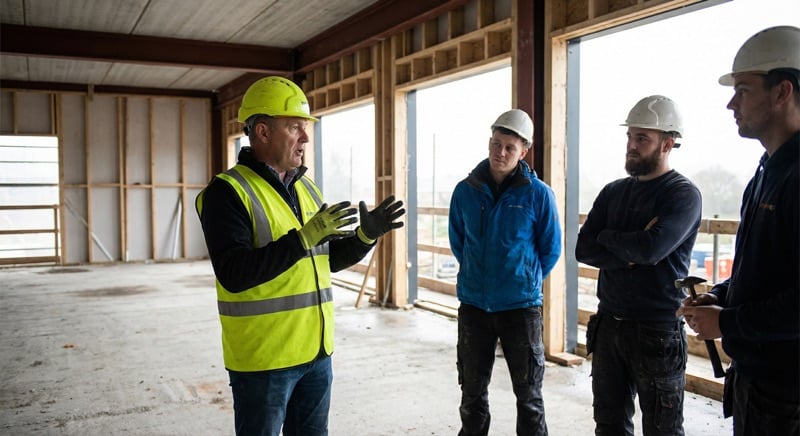
The topic should connect to the work happening that day. If your crew is working at height, talk about fall protection. If it is the first hot day of the season, talk about heat stress. If you just had a near miss with electrical, talk about electrical safety.
The worst toolbox talks are the ones where you read a random topic from a binder that has nothing to do with what is happening on site. Workers tune out immediately.
Need topic ideas? We have published ready-to-use toolbox talk guides on dozens of subjects, including housekeeping, PPE, 125 summer topics, and 18 winter topics. You can also download our free 52-week construction toolbox talks PDF package for a full year of pre-written talks.
Step 2: Keep It Short (5-15 Minutes)
Five minutes is ideal. Ten is fine if the topic is complex. Fifteen is the absolute maximum. Anything longer and you have lost your audience. Construction crews are not sitting in a conference room. They are standing on gravel in steel-toed boots at 7 AM. Respect their time.
Step 3: Make It a Conversation, Not a Lecture
The single biggest mistake supervisors make is reading a sheet of paper word-for-word while the crew stares at their phones. A toolbox talk should be a conversation. Ask questions. Get people talking.
Try: "Has anyone here ever seen a pinch point injury? What happened?" That gets more engagement than reading a definition of pinch points from a manual.
Step 4: Connect It to Today's Work
After covering the general topic, tie it back to the specific tasks planned for that day. "We talked about ladder safety. Today we are setting up extension ladders on the south wall. Who has checked the ground conditions over there?"
Step 5: Document It
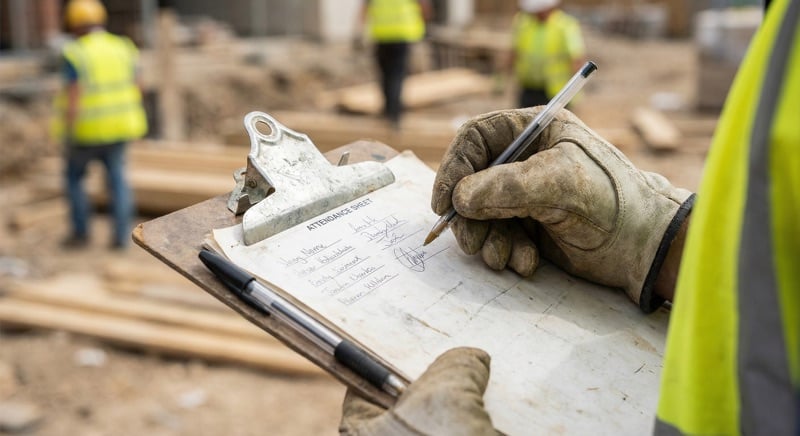
Record the topic, date, presenter, and who attended. Have everyone sign in. This is not bureaucracy. This is your proof that training happened. free 52 Construction Toolbox Talks PDF package includes sign-in sheets and tracking templates you can use to document every talk, every crew, every week. If there is an incident and the regulator asks what training your crew received, a signed toolbox talk attendance sheet is your evidence.
You can use a simple toolbox meeting form or template, or go digital with safety management software that tracks attendance automatically.
Need a Full Year of Toolbox Talks Without Last-Minute Scramble?
Download 52 ready-to-run toolbox talks with scripts, discussion prompts, and sign-in sheets so supervisors can run consistent talks every week.
Download the 52 Toolbox Talks PDF →
What Makes a Good Toolbox Talk Topic?
Not all topics are created equal. The best toolbox talk topics share three qualities:
- Relevant to the current work. A talk about confined space entry is pointless if nobody is going into a confined space that week.
- Specific enough to be actionable. "Be safe" is not a topic. "How to inspect your fall arrest harness before each use" is a topic.
- Short enough to cover in 5-10 minutes. You are not delivering a training course. You are reinforcing one specific behavior or hazard awareness.
Here are examples of strong toolbox talk topics by category:
General Safety
Seasonal Topics
High-Risk Activities
Construction-Specific
For a year's worth of ready-to-use topics, download our free 52 Construction Toolbox Talks PDF package. Each talk includes a script, discussion questions, and a sign-in sheet.
Toolbox Talk Regulatory Requirements
Here is the blunt truth that most safety websites will not tell you: in most jurisdictions, "toolbox talks" are not explicitly named in legislation. No regulation says "you must hold a toolbox talk." What the regulations do require is that employers provide workers with information, instruction, and supervision to protect their health and safety. Toolbox talks are the most practical and widely accepted way to meet that obligation.
United States: OSHA Requirements
OSHA does not have a specific standard titled "Toolbox Talks." However, multiple OSHA standards require employers to train workers on specific hazards, and toolbox talks are a recognized method for delivering that training.
Key OSHA standards that toolbox talks help satisfy:
- 29 CFR 1926.21(b)(2): Requires employers to instruct each employee on the recognition and avoidance of unsafe conditions and the regulations applicable to their work environment.
- 29 CFR 1926.503: Fall protection training requirements for construction.
- 29 CFR 1910.1200: Hazard Communication Standard (HazCom) training.
- 29 CFR 1926.1153: Respirable crystalline silica training requirements.
OSHA inspectors look for documented evidence that workers received hazard-specific training. A signed toolbox talk attendance record with the topic, date, and attendee signatures satisfies this. free 52 Construction Toolbox Talks PDF package includes practical sign-in and documentation templates that help you build an audit-ready record. For a deeper dive into OSHA-specific toolbox talk requirements and free resources, see our OSHA Toolbox Talks Guide.
Canada: Provincial OHS Requirements
In Canada, workplace safety is regulated at the provincial level, which means requirements vary by province. However, every province requires employers to provide workers with adequate safety instruction and training.
Key provincial frameworks:
- Alberta: The Occupational Health and Safety Act and OHS Code require employers to ensure workers are trained in hazard identification and control. Alberta's COR (Certificate of Recognition) program specifically evaluates whether employers conduct regular safety communications, including toolbox talks.
- British Columbia: WorkSafeBC's Occupational Health and Safety Regulation requires employers to provide information and instruction to workers. The BCCSA (BC Construction Safety Alliance) publishes free toolbox talk resources for construction employers.
- Ontario: The Occupational Health and Safety Act (Section 25) requires employers to provide information, instruction, and supervision. The IHSA (Infrastructure Health and Safety Association) publishes an extensive library of safety talks for construction, transportation, and utilities.
- Saskatchewan: The SCSA (Saskatchewan Construction Safety Association) publishes free toolbox talk resources and requires regular safety communications as part of COR certification.
For a province-by-province breakdown of toolbox talk requirements and free official resources, read our Toolbox Talks in Canada: Province-by-Province Requirements guide.
How Often Should You Hold Toolbox Talks?
The honest answer: it depends on your work and your jurisdiction.
Daily toolbox talks are standard practice on active construction sites, oil and gas projects, and any work involving high-risk activities (working at heights, confined spaces, energized electrical). If the hazards change every day, the safety conversation should happen every day.
Weekly toolbox talks are more common in manufacturing, warehousing, and general industry where hazards are more consistent.
Project-specific toolbox talks should happen whenever a new task, piece of equipment, or hazard is introduced, regardless of your regular schedule.
GCs (general contractors) often require daily toolbox talks from subcontractors as a condition of the contract. If you are bidding on work, check the GC's safety requirements. Missing toolbox talk documentation is one of the fastest ways to get kicked off a project.
Who Should Give Toolbox Talks?
Most people assume the safety coordinator or safety manager should deliver every toolbox talk. That is a mistake for two reasons. First, your safety person cannot be on every site every morning. Second, toolbox talks carry more weight when they come from the person running the crew.
The best toolbox talk presenters are:
- Site supervisors and foremen who know the day's work and the crew's strengths and weaknesses
- Experienced workers who can speak from personal experience about a specific hazard
- Safety coordinators for topics requiring specialized knowledge (WHMIS, hazardous materials, regulatory changes)
Rotating presenters keeps talks fresh and gives workers ownership of safety on site. A framer who shares a story about a near miss with a nail gun will connect with the crew more than a safety coordinator reading from a sheet.
Common Toolbox Talk Mistakes (and How to Fix Them)
After working with hundreds of contractors across North America, here are the mistakes we see most often:
Reading word-for-word from a script
The script is a guide, not a teleprompter. Use bullet points. Talk to your crew like human beings. If you cannot explain the topic in your own words, you do not understand it well enough to teach it.
Picking topics that are irrelevant to today's work
A toolbox talk about forklift safety on a framing site is a waste of everyone's time. Match the topic to the hazards your crew will actually face that day.
Doing the same five topics on repeat
If your crew hears "wear your PPE" every Monday for six months, they will stop listening by week three. Rotate topics. Use seasonal themes. Cover near misses and lessons learned from real incidents. Our free toolbox talk library has dozens of options to keep things fresh.
Not documenting attendance
If it is not documented, it did not happen. Period. Every toolbox talk needs a sign-in sheet or digital record. free 52 Construction Toolbox Talks PDF package gives you structured tracking sheets so you can record topic, date, and attendance every time. This protects you during audits, COR assessments, and incident investigations.
Making it a one-way lecture
If nobody asks a question or shares an observation, the talk failed. Ask open-ended questions. "What hazards do you see on site today?" is better than "Any questions?"
Toolbox Talks vs. Safety Meetings: What Is the Difference?
People confuse these constantly. Here is the simple breakdown:
| |
Toolbox Talk |
Safety Meeting |
| Length |
5-15 minutes |
30-60 minutes |
| Frequency |
Daily or weekly |
Monthly or quarterly |
| Location |
On site, at the work area |
Office, boardroom, or lunch room |
| Format |
Informal, conversational |
Formal, agenda-driven |
| Topics |
One specific hazard or behavior |
Multiple topics, incident reviews, policy updates |
| Presenter |
Foreman, supervisor, or crew lead |
Safety manager or coordinator |
Both serve a purpose. Toolbox talks handle the daily, tactical safety awareness. Safety meetings handle the bigger picture: incident trends, policy changes, training updates, and program reviews. The best safety programs use both.
Free Toolbox Talk Resources
You do not need to write every toolbox talk from scratch. Here are free resources to get you started:
From Safety Evolution
Industry Associations
- IHSA (Ontario) - free safety talks for construction, electrical, and transportation: ihsa.ca
- BCCSA (British Columbia) - free toolbox talks for BC construction employers: bccsa.ca
- SCSA (Saskatchewan) - toolbox talk library: scsaonline.ca
- CPWR (United States) - construction safety training resources: cpwr.com
For a complete list of provincial toolbox talk resources in Canada, see our province-by-province guide. For OSHA-specific topics and free PDFs, check out our OSHA Toolbox Talks guide.
Start Free and Get 52 Toolbox Talks Ready to Use
Start your 30-day free trial and get 52 toolbox talks ready to run, with scripts and attendance tracking your supervisors can use immediately.
Start Your 30-Day Free Trial →
Frequently Asked Questions
What are toolbox talks?
Toolbox talks are short, informal safety meetings held at the worksite before work begins. They typically last 5 to 15 minutes and cover one specific safety topic, such as fall protection, PPE use, or working in extreme weather. The goal is to remind workers about hazards they will face that day and how to control them. They are also called safety talks, tailgate talks, or pre-shift safety briefings.
Are toolbox talks required by OSHA?
OSHA does not have a specific regulation mandating toolbox talks by name. However, OSHA standards like 29 CFR 1926.21(b)(2) require employers to instruct workers on hazard recognition and avoidance. Toolbox talks are a widely accepted and documented method for meeting these training requirements. OSHA inspectors look for evidence that workers received hazard-specific instruction, and signed toolbox talk records satisfy this.
How long should a toolbox talk last?
A toolbox talk should last between 5 and 15 minutes. Five minutes is ideal for a focused single-topic talk. Complex topics like confined space entry or fall protection may need 10 to 15 minutes. Anything longer risks losing your audience. Keep it short, specific, and relevant to the day's work.
How often should toolbox talks be held?
On active construction sites and high-risk projects, daily toolbox talks are standard practice and often required by GCs. In manufacturing and general industry, weekly talks are more common. Additional talks should be held whenever new tasks, equipment, or hazards are introduced. Check your provincial OHS requirements (in Canada) or OSHA standards (in the US) for specific guidance in your jurisdiction.
Who can give a toolbox talk?
Anyone with competent knowledge of the topic can give a toolbox talk. Site supervisors, foremen, and crew leads are the most common presenters because they understand the day's work and the crew. Experienced workers can present on topics where they have hands-on expertise. Safety coordinators typically handle specialized topics like WHMIS, regulatory changes, or incident reviews. Rotating presenters keeps talks fresh and builds crew ownership of safety.
What is the difference between a toolbox talk and a safety meeting?
Toolbox talks are short (5-15 minutes), informal, and held daily or weekly on site. They cover one specific topic related to the day's work. Safety meetings are longer (30-60 minutes), more formal, and held monthly or quarterly. Safety meetings cover multiple topics, including incident reviews, policy changes, and program updates. Most safety programs use both: toolbox talks for daily hazard awareness and safety meetings for broader program management.
Get Weekly Safety Insights
Regulation updates, toolbox talk ideas, and compliance tips. One email per week.