Last updated: April 2026
Your crew is working a commercial framing job in Houston. An OSHA compliance officer walks onto your site, clipboard in hand. She asks your foreman one question: "What safety training did your crew receive this morning?" If he cannot point to a signed toolbox talk record for that day, you have a problem. Not a "maybe we should do better" problem. A citation-and-fine problem.
OSHA does not use the phrase "toolbox talk" anywhere in 29 CFR. But the training requirements scattered across dozens of OSHA standards add up to one reality: if you are not running regular, documented safety talks on your jobsite, you are exposed.
OSHA toolbox talks are short, documented safety briefings that help contractors meet OSHA's hazard-specific training requirements under standards like 29 CFR 1926.21, 1926.503, and 1910.1200. They are the most practical way to prove your workers received instruction on the hazards they face every day.
⚡ Quick Answer
- Are toolbox talks required by OSHA? Not by name, but OSHA requires documented hazard-specific training that toolbox talks directly satisfy
- Key standards: 29 CFR 1926.21(b)(2) (construction training), 29 CFR 1926.503 (fall protection), 29 CFR 1910.1200 (HazCom)
- Frequency: Daily on active construction sites; at minimum before new tasks or hazard exposures
- Documentation: Topic, date, presenter name, and attendee signatures. No signature = no proof
- Free resource: Download our free 52 Construction Toolbox Talks PDF package to keep your talks relevant, fast, and consistent.
Does OSHA Require Toolbox Talks?
This is the most common question contractors ask, and the answer is more nuanced than most safety websites will admit.
OSHA does not have a single standard that says "you must hold toolbox talks." The term does not appear in 29 CFR 1926 (Construction) or 29 CFR 1910 (General Industry). But that distinction is mostly academic, because here is what OSHA does require:
- 29 CFR 1926.21(b)(2) - Safety Training and Education: "The employer shall instruct each employee in the recognition and avoidance of unsafe conditions and the regulations applicable to his work environment to control or eliminate any hazards or other exposure to illness or injury."
- 29 CFR 1926.503 - Fall Protection Training: Requires training for each employee exposed to fall hazards, including recognizing fall hazards and the procedures for using fall protection systems.
- 29 CFR 1910.1200 - Hazard Communication (HazCom): Requires training on chemical hazards, SDS (Safety Data Sheets), and labeling for any worker who may be exposed.
- 29 CFR 1926.1153 - Respirable Crystalline Silica: Requires employers to provide training on silica exposure risks, controls, and medical surveillance.
- 29 CFR 1926.502 - Fall Protection Systems: Training on proper use, inspection, and limitations of fall arrest systems.
The practical translation: OSHA requires you to train workers on specific hazards before they face those hazards, and to document that training. Toolbox talks are the industry-standard method for doing exactly that.
During inspections, OSHA compliance officers ask for training records. A signed toolbox talk attendance sheet with the topic, date, and signatures is accepted documentation. Without it, you are relying on "we told them verbally," which OSHA does not accept.
Need Ready-to-Run Talks for OSHA?
Download ready-to-use toolbox talks with scripts and sign-in sheets so supervisors can run consistent weekly talks without scrambling.
Download the 52 Toolbox Talks PDF →OSHA Toolbox Talk Topics That Cover the Most-Cited Standards
Instead of running dozens of disconnected talks, anchor your schedule to the standards that produce the most citations. Run one focused talk per category, then repeat based on site conditions.
- Fall protection (1926.501): trigger heights, harness checks, guardrail limits, leading-edge controls. (fall protection guide)
- Hazard communication (1910.1200): SDS use, label recognition, chemical storage, worker right-to-know. (GHS pictograms reference)
- Ladders and scaffolding (1926.1053 / 1926.451): setup angles, inspection ownership, access controls, load limits.
- Respiratory protection (1910.134): fit-test currency, respirator selection, medical requirements, care and storage.
- LOTO and hazardous energy (1910.147): authorized/affected roles, isolation sequence, verification before work.
- Electrical exposure controls: temporary power checks, GFCI testing, and damaged-cord removal. (electrical toolbox talk)
Need ready scripts? Download the free 52-week toolbox talks package.
OSHA Penalties for Missing Safety Training
Most contractors think of toolbox talks as a "nice to have." They are wrong. Missing safety training documentation is one of the most common reasons for OSHA citations, and the fines are not small.
OSHA's current penalty structure (updated annually for inflation):
- Serious violation: Up to $16,131 per violation
- Willful or repeated violation: Up to $161,323 per violation
- Failure to abate: Up to $16,131 per day beyond the abatement date
Here is what "per violation" means in practice. If OSHA finds that 8 workers on your site did not receive fall protection training, that is 8 separate violations. At $16,131 each, a single missing toolbox talk topic could cost you $129,048. And that is before you factor in the cost of a stop-work order, project delays, and the reputational damage with your GC.
The cheapest insurance against these fines is a 5-minute toolbox talk with a sign-in sheet. There is no simpler compliance investment in construction.
OSHA Toolbox Talk Topics by Season
Seasonal rotation works best when each quarter has one weather hazard, one operational hazard, and one human-factor topic.
- Spring: trench/excavation shifts, severe-weather response, post-winter equipment checks.
- Summer: heat stress prevention, hydration planning, UV exposure controls, high-heat scheduling.
- Fall: low-light visibility, changing weather emergency prep, fall-protection refresher cadence.
- Winter: cold stress controls, slip prevention, winter driving and travel-risk talks.
Use this seasonal map with the 52-week toolbox talk package so every month has documented coverage.
How to Document OSHA Toolbox Talks Properly
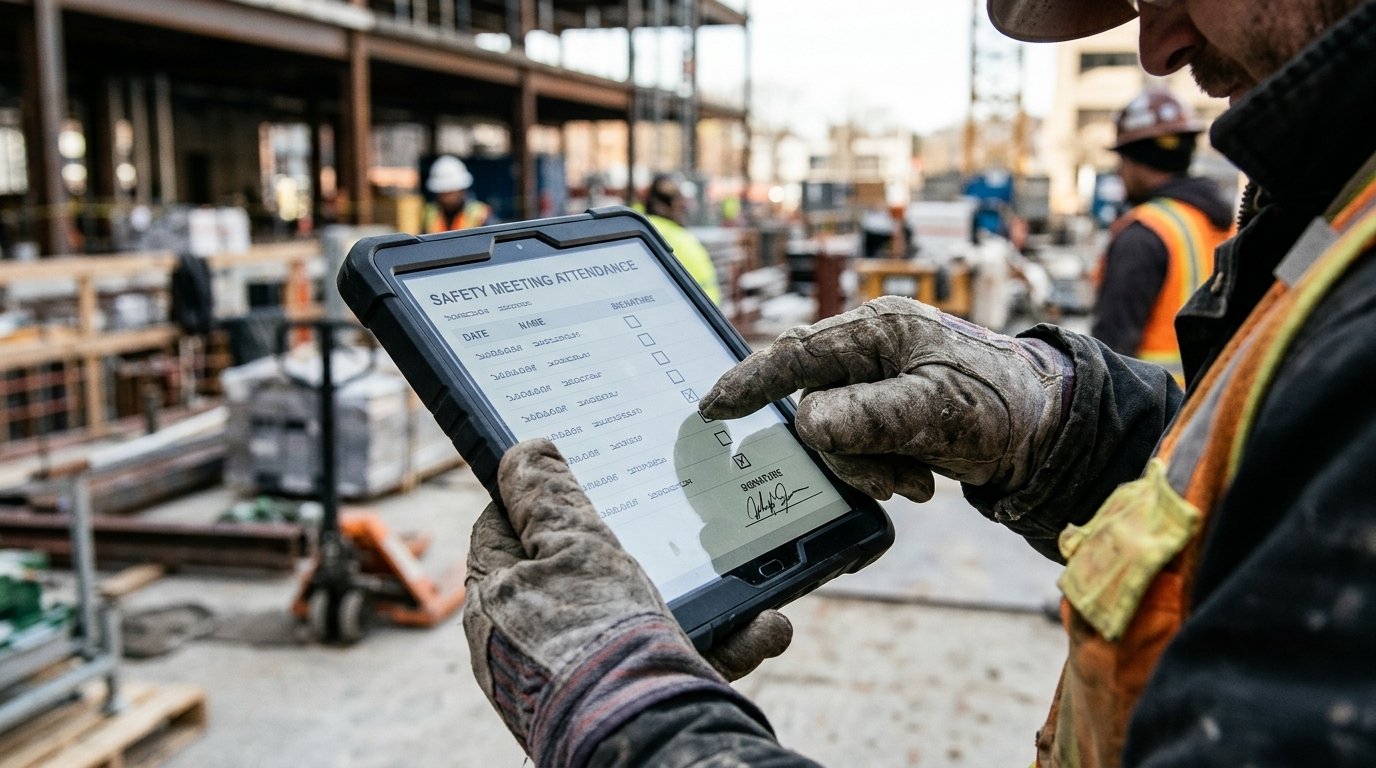
Documentation is where most contractors fall short. You ran the talk. Your crew was there. Everyone heard it. But if the only proof is your memory, OSHA treats it as if the training never happened.
Every documented toolbox talk should capture four things:
- Session identity: date/time and specific OSHA-relevant topic.
- Proof of delivery: presenter name plus attendee names/signatures.
- What was covered: key points or script used for the talk.
- Follow-up actions: questions raised and any corrective actions assigned.
Keep these records for at least three years. Some OSHA standards (like lead and asbestos) require training records to be maintained for the duration of employment plus 30 years. When in doubt, keep everything.
You can use a simple paper sign-in sheet, a toolbox meeting form template, or digital safety software that timestamps attendance automatically.
Free OSHA Toolbox Talk Resources
You do not need to write every talk from scratch. Here are trusted free resources:
From Safety Evolution
From Government and Industry
- CPWR (Center for Construction Research and Training): Free toolbox talks aligned with OSHA construction standards - cpwr.com
- OSHA.gov: Training requirements guidance by standard - osha.gov
- State OSHA programs: States with their own OSHA plans (California Cal/OSHA, Washington L&I, Oregon OSHA) often publish additional free training materials
Building an OSHA-Compliant Toolbox Talk Program
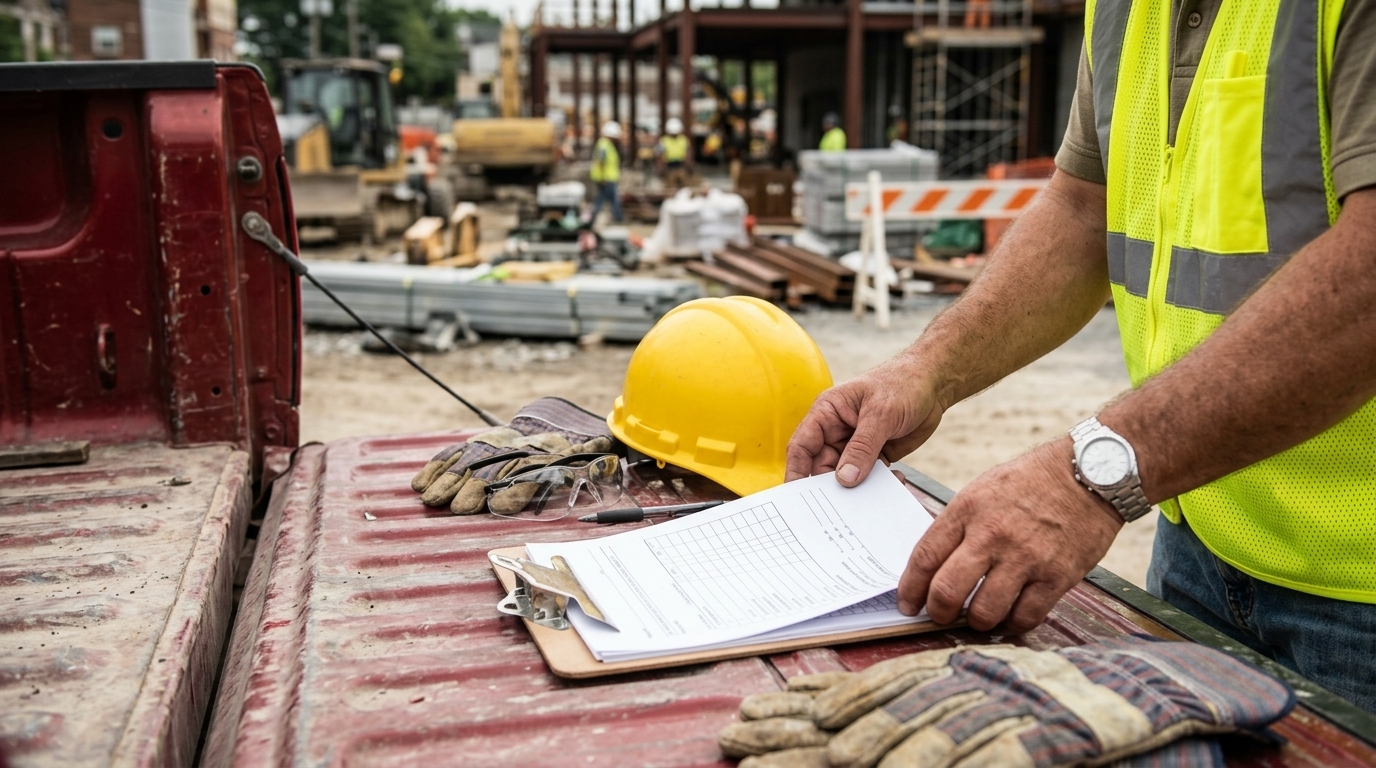
Running a toolbox talk once in a while is not a program. Here is how to build a system that keeps you compliant and actually keeps your crew safer:
1. Map Your OSHA Training Requirements
Start with the OSHA standards that apply to your work. Construction? You need fall protection, scaffolding, electrical, excavation, and HazCom at minimum. General industry? HazCom, LOTO, machine guarding, and PPE. List every standard that requires training, and make sure your toolbox talk schedule covers each one at least once per quarter.
2. Create a 52-Week Schedule
Plan your topics in advance. Align them with seasonal hazards (heat stress in summer, cold stress in winter), project phases (excavation topics during site prep, fall protection during framing), and OSHA's annual focus areas. A 52-week schedule ensures you cover all required topics without repeating the same five talks every month.
3. Train Your Presenters
Your foremen and supervisors need to know how to deliver a toolbox talk effectively. The talk should be a conversation, not a reading. Provide them with scripts as a guide but encourage them to use their own words and real examples from the jobsite.
4. Digitize Your Records
Paper sign-in sheets get lost, damaged, or stuffed in a truck console and forgotten. Digital records with timestamps, GPS location, and electronic signatures are easier to maintain and harder to dispute during an OSHA inspection. Safety management software can automate the entire process.
5. Review and Improve
After an incident or near miss, check whether the hazard was covered in a recent toolbox talk. If not, add it to the schedule. If it was covered but the incident happened anyway, the talk may need to be more specific or more interactive. Use incident data to drive your toolbox talk program forward.
For a comprehensive overview of what toolbox talks are and how they fit into a complete safety program, read our pillar guide: What Are Toolbox Talks? The Complete Guide.
30-day toolbox talk rollout plan for contractors
Week 1
Standardize topic categories by current site hazards and create a fixed weekly delivery cadence.
Week 2
Enforce attendance capture and supervisor signoff for every talk, including corrective actions for missed talks.
Week 3
Audit topic quality against active jobsite hazards and replace generic talks with task-specific briefings.
Week 4
Review completion rates, missing signatures, and open corrective actions, then lock in monthly oversight ownership.
Start Free and Get 52 Toolbox Talks Ready to Use
Start your 30-day free trial and get 52 toolbox talks ready to run, with scripts and attendance tracking your supervisors can use immediately.
Start Your 30-Day Free Trial →Frequently Asked Questions
Are toolbox talks required by OSHA?
OSHA does not specifically require "toolbox talks" by name. However, OSHA standards such as 29 CFR 1926.21(b)(2) require employers to instruct workers on hazard recognition and avoidance. Toolbox talks are the most widely accepted method for meeting these documented training requirements. During inspections, OSHA compliance officers accept signed toolbox talk records as evidence of training.
How often does OSHA require toolbox talks?
OSHA does not specify a frequency for toolbox talks. However, standards require that workers receive training before exposure to specific hazards. In practice, this means daily toolbox talks on active construction sites where hazards change regularly, and at minimum before any new task or hazard exposure. Most general contractors require daily pre-shift toolbox talks from subcontractors.
Where can I find free OSHA toolbox talks?
Safety Evolution offers a free 52-week construction toolbox talks PDF package covering fall protection, PPE, electrical safety, weather hazards, and more. CPWR (cpwr.com) provides free construction-specific talks. OSHA.gov publishes training guidance documents by standard. State OSHA programs in California, Washington, and Oregon also publish free toolbox talk materials.
What should an OSHA toolbox talk include?
An OSHA-compliant toolbox talk should include: a specific topic tied to a relevant OSHA standard (e.g., "Fall Protection: Harness Inspection"), the date and time, the presenter's name, key points discussed, attendee names and signatures, and any questions raised. Keep talks to 5-15 minutes and tie the topic to the actual work being performed that day.
How long should I keep OSHA toolbox talk records?
OSHA's general record-keeping requirements under 29 CFR 1904 require training records to be maintained for at least 3 years. However, some substance-specific standards (lead, asbestos, silica) require records for the duration of employment plus 30 years. As a best practice, keep all toolbox talk records for at least 5 years, and indefinitely for any talks related to hazardous substance exposure.
Get Weekly Safety Insights
Regulation updates, toolbox talk ideas, and compliance tips. One email per week.