Toolbox Talks
Fire Safety Toolbox Talk
Ready-to-use fire safety toolbox talk script covering fire extinguisher types, the PASS method, hot work hazards, and evacuation procedures.
Download this free back-to-school toolbox talk for construction crews. Covers school zone speeds, school bus laws, and protecting cyclists.
Last updated: April 2026
Every August and September, millions of children head back to school. That means school buses are back on the roads, kids are biking and walking through neighborhoods, and traffic around school zones picks up fast. For construction crews who drive to jobsites, operate vehicles near residential areas, or work close to schools, this is a real safety topic that deserves a dedicated toolbox talk.
A back-to-school toolbox talk takes five to ten minutes and can prevent a life-changing incident. In this guide, we cover what to include, how to deliver it, and specific talking points you can read aloud at your next safety meeting.
You might think school zone safety is only a concern for parents and school staff. It is not. Construction workers regularly drive company trucks, operate heavy vehicles near schools, and set up worksites in residential areas. During the back-to-school season, the risk of a vehicle-pedestrian incident goes up for everyone on the road.
Here are the facts that make this topic worth covering:
Covering this in a toolbox talk sets a clear expectation: when you are behind the wheel of a company vehicle, you slow down near schools and watch for children. Period.
Need Ready-to-Run Talks for Back to School?
Download ready-to-use toolbox talks with scripts and sign-in sheets so supervisors can run consistent weekly talks without scrambling.
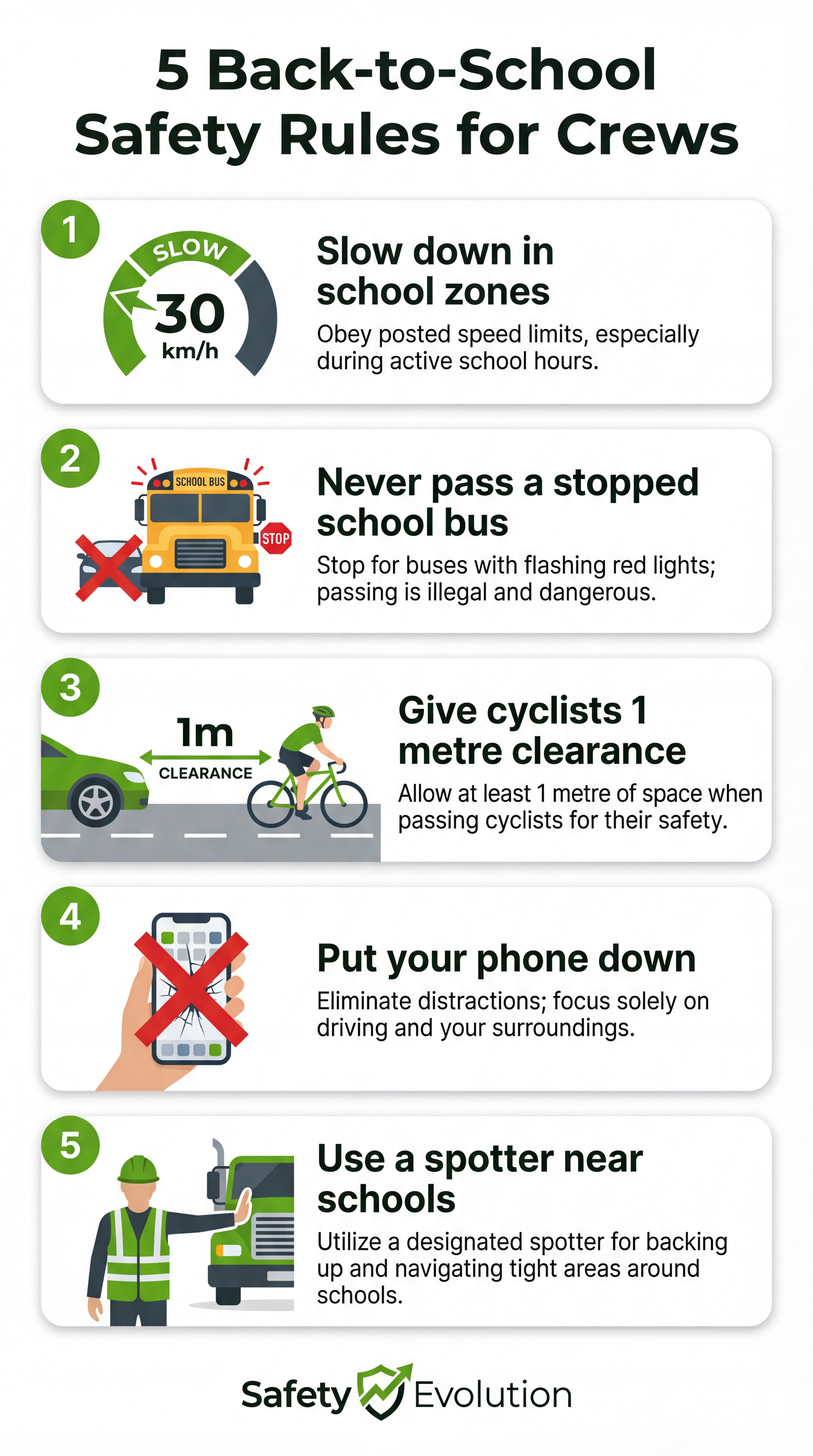
Download the 52 Toolbox Talks PDF →A strong back-to-school safety talk covers three areas: school zones, school buses, and sharing the road with young cyclists and pedestrians. Here is a breakdown of each section with talking points you can use directly.
School zones have reduced speed limits that are enforced on school days. Many cities have added playground zones with year-round reduced speeds as well. Here is what to remind your crew:
If your crew commutes through school zones on the way to jobsites, remind them that the speed reduction is not optional. Speeding fines in school zones are heavily enforced and often doubled. Check your local regulations for demerit impacts on commercial licences.
School buses deserve their own section in this talk because the rules are specific and the consequences of getting them wrong are catastrophic.
Share a real-world example during your talk. Ask the crew if anyone has had a close call near a school bus. Personal stories make the message stick.
Back-to-school season means more children walking and biking on roads, sidewalks, and paths near your jobsite or along your commute route. Young cyclists are especially unpredictable. They may swerve suddenly, fail to signal, ride against traffic, or pull out from behind parked cars without looking.
Cover these driving rules with your crew:
For crews who operate larger vehicles like dump trucks and concrete mixers, blind spots are even more of a concern. A child on a bicycle can be completely invisible in the blind spot of a heavy vehicle. Remind operators to do a full check before turning or backing up.
Like any effective toolbox talk, this one should be short, direct, and interactive. Here is a simple structure:
If your crew is working on or near school property, or if your jobsite is on a street where children walk to and from school, there are additional precautions to take beyond the standard toolbox talk.
A back-to-school talk pairs well with several related safety topics. Consider scheduling these in the same week or rotating them throughout September:
Bundling related topics keeps your crew thinking about safety beyond just one quick talk. For a full year of toolbox talk topics, check our comprehensive topics list.
Every toolbox talk, including this one, needs to be documented. Safety regulators require proof that workers received safety information. At a minimum, you need to record the date and time of the talk, the topic covered, the name of the person who delivered the talk, the attendance list with signatures, and any follow-up actions.
OSHA requires employers to train workers on recognized hazards, including driving hazards for workers who operate vehicles. Documented toolbox talks serve as evidence of due diligence and compliance with the general duty clause.
Provincial OHS authorities across Canada require employers to ensure that workers are informed of workplace hazards. Documented safety meetings are a standard requirement for maintaining COR (Certificate of Recognition) or SECOR compliance.
If you want to keep it simple, here are talking points you can read directly to your crew at the start of shift:
"Good morning, team. School is back in session this week, so we need to talk about road safety near schools. Here are three things I need everyone to do:
First, slow down in school zones. The speed limit drops, and the fines are doubled if you get caught. More importantly, kids are unpredictable. They run out between cars, they ride bikes without looking, and they do not always follow the rules of the road.
Second, never pass a stopped school bus. If the red lights are flashing and the stop arm is out, you stop. No exceptions. It does not matter which direction you are coming from.
Third, give cyclists extra room. Pass slowly, leave at least a metre of space, and check your mirrors before opening your door.
Let us all get home safe this week. Does anyone have questions?"
Start Free and Get 52 Toolbox Talks Ready to Use
Start your 30-day free trial and get 52 toolbox talks ready to run, with scripts and attendance tracking your supervisors can use immediately.
Start Your 30-Day Free Trial →A back-to-school toolbox talk should cover three main areas: school zone speed limits and rules, school bus safety laws (including when you must stop), and sharing the road with young cyclists and pedestrians. Keep the talk under ten minutes and focus on actionable reminders.
Schedule it during the last week of August or the first week of September, before school starts in your area. If your crew works near schools or in residential neighborhoods, repeat the key points again in mid-September when routines are still forming.
OSHA requires employers to train workers on recognized hazards, including driving hazards for workers who operate vehicles as part of their job. While OSHA does not mandate a specific "back-to-school" talk, covering driving safety near schools falls under the general duty clause and demonstrates due diligence.
Five to ten minutes. The goal is a focused reminder, not a full training session. Cover the three key areas (school zones, buses, and cyclists), share one real-world example, and end with a clear takeaway. Document attendance for your records.
Penalties vary by jurisdiction but typically include fines ranging from $400 to $2,000, demerit points on your licence, and possible licence suspension for repeat offenders. In some provinces and states, the vehicle owner can be fined even if they were not driving at the time.
Ready-to-use fire safety toolbox talk script covering fire extinguisher types, the PASS method, hot work hazards, and evacuation procedures.
Discover 10 essential safety practices for construction sites to prevent accidents, ensure compliance, and protect workers.
Nobody thinks about food safety on a construction site until half the crew is sick. This toolbox talk covers the real risks of eating on site.