Last updated: April 2026
A worker collapses on site. No warning. One second he is walking, the next he is on the ground. Three people are standing over him. Nobody is doing anything because nobody remembers what to do first.
This is the moment where the ABCs of first aid either save a life or do not. Not because the technique is complicated. It is not. But because in the chaos of a real emergency, people freeze unless they have a simple framework drilled into them: Airway. Breathing. Circulation. In that order. Every time.
⚡ Quick Answer
- A = Airway: Is the airway open? Tilt the head back, lift the chin, check for obstructions.
- B = Breathing: Is the person breathing? Look for chest rise, listen for breath sounds, feel for air on your cheek. 10 seconds maximum.
- C = Circulation: Is there a pulse? Is there severe bleeding? Start CPR if no pulse. Control bleeding if present.
- CAB order: For suspected cardiac arrest (adult who collapsed suddenly), current guidelines prioritize Compressions first (CAB: Compressions, Airway, Breathing) because getting blood flowing quickly is the priority.
- For safety managers: Every first aid attendant on your site should be able to run through ABC assessment in under 30 seconds. If they cannot, they need refresher training.
- Free resource: Download our free 52 Construction Toolbox Talks PDF package to keep your talks relevant, fast, and consistent.
The ABCs of first aid (Airway, Breathing, Circulation) are the foundational assessment method every first aid attendant uses to evaluate a casualty in the critical first seconds of an emergency. For safety managers on construction and industrial sites, the ABC method is not just training content. It is the framework that determines whether your first aid attendants can actually keep someone alive during the minutes between an incident and paramedic arrival. This guide covers the method, the common mistakes that happen under pressure, and how to make sure your crew can execute it when it matters.
What Does ABC Stand for in First Aid?
ABC in first aid stands for Airway, Breathing, and Circulation. It is a systematic assessment method used to evaluate and treat life-threatening conditions in the order that matters most. Without an open airway, breathing is impossible. Without breathing, circulation stops. Without circulation, the brain starts dying within 4 to 6 minutes.
The ABC method was developed decades ago for medical professionals and has been adapted for first aiders worldwide. It gives non-medical responders a clear, repeatable sequence to follow in any emergency. On a construction site at 6:30 AM when someone is unconscious and you have 60 seconds before EMS dispatch even picks up the phone, a clear sequence is the difference between a useful response and a panicked one.
Not sure if your first aid readiness would hold up in a real emergency?
See training gaps, expiring certificates, and missing documentation before they become incidents.
Start Your 30-Day Free Trial →A = Airway: The First Check
If the airway is blocked, nothing else matters. A person with an obstructed airway will lose consciousness within minutes and die within 4 to 6 minutes without intervention.
How to Check and Clear the Airway
- Check for responsiveness. Tap the person's shoulders firmly and shout: "Hey, can you hear me?" If no response, call for help and call 911 immediately.
- Position the person on their back (unless you suspect a spinal injury, in which case use a jaw thrust without moving the neck).
- Head-tilt, chin-lift. Place one hand on the forehead and two fingers under the bony part of the chin. Tilt the head back gently. This lifts the tongue off the back of the throat, which is the most common cause of airway obstruction in an unconscious person.
- Look in the mouth. If you can see a visible obstruction (food, blood, vomit, debris), carefully remove it with a finger sweep. Do not blindly sweep the mouth.
On a construction site, the most common airway hazards are:
- The tongue falling back in an unconscious worker (most common)
- Vomit or blood in the airway after a fall or head injury
- Dust, debris, or construction material in the mouth/throat
- Swelling from an allergic reaction or chemical inhalation
B = Breathing: The Second Check
Once the airway is open, check for breathing. This takes no more than 10 seconds.
The Look-Listen-Feel Method
- Look: Watch for chest rise and fall. Is the chest moving?
- Listen: Put your ear close to the person's mouth and nose. Can you hear breath sounds?
- Feel: Can you feel air on your cheek?
You have 10 seconds for this assessment. Do not spend 30 seconds trying to decide. If you are unsure whether the person is breathing normally, treat them as if they are not breathing and begin CPR.
If the person is breathing: Place them in the recovery position (on their side with the top knee bent forward and the head supported). This prevents the tongue from blocking the airway and allows fluids to drain. Monitor breathing continuously until EMS arrives.
If the person is NOT breathing: Begin rescue breaths if you are trained and have a CPR pocket mask or barrier device. Two breaths, watching for chest rise. Then move to C (Circulation).
C = Circulation: The Third Check
Circulation means blood flow. Two things can stop circulation: the heart stops pumping (cardiac arrest) or blood is leaving the body faster than it can circulate (severe hemorrhage).
Check for Pulse
Place two fingers on the side of the neck (carotid artery) and feel for a pulse. Check for no more than 10 seconds. If you cannot find a pulse or are unsure, begin CPR.
Start CPR If Needed
- 30 compressions, 2 breaths. Push hard and fast in the centre of the chest (at least 5 cm deep for adults, rate of 100 to 120 compressions per minute).
- Use an AED as soon as one is available. Turn it on and follow the voice prompts. AEDs are designed for non-medical users and will only deliver a shock if the heart rhythm requires it.
- Do not stop CPR until EMS takes over, an AED tells you to stop, or the person starts breathing normally.
Control Severe Bleeding
If the person has a pulse but is bleeding severely, controlling the bleeding becomes the immediate priority:
- Apply direct pressure with a sterile dressing or the cleanest material available
- If direct pressure does not control the bleeding, apply a tourniquet above the wound (limb injuries only)
- Do not remove blood-soaked dressings. Add more dressings on top.
- Keep the person warm and lying down to prevent shock
ABC vs CAB: When the Order Changes
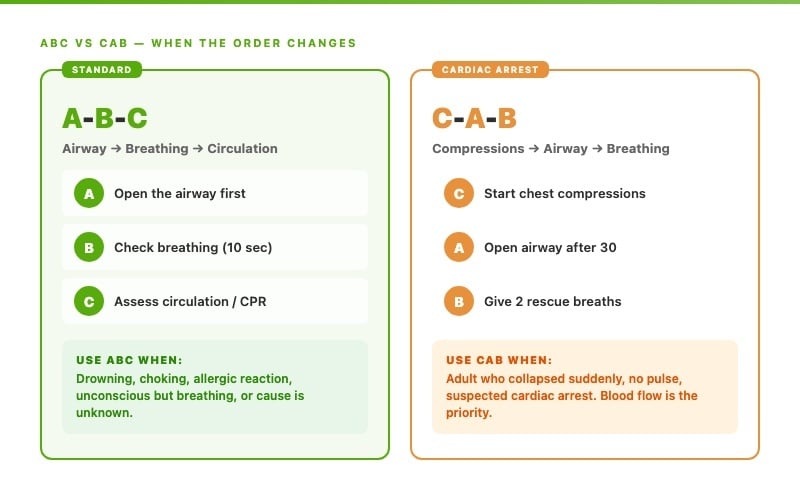
Here is something that trips people up: current CPR guidelines from the Heart and Stroke Foundation (Canada) and the American Heart Association recommend CAB (Compressions, Airway, Breathing) for adult cardiac arrest.
Why the change? When an adult collapses from cardiac arrest, the blood still has oxygen in it. Getting that oxygenated blood flowing to the brain immediately through chest compressions is more important than stopping to open the airway and give rescue breaths first. Every second of delay in compressions reduces survival odds.
When to use CAB (Compressions first):
- Adult who collapsed suddenly and is not breathing normally
- Suspected cardiac arrest (electrocution, sudden collapse with no obvious trauma)
- Any adult who is unresponsive with no pulse
When to use ABC (Airway first):
- Drowning or near-drowning (the problem is lack of oxygen, not heart failure)
- Choking victim who has lost consciousness
- Infant or child emergencies (cardiac arrest in children is usually caused by a breathing problem, not a heart problem)
- Any situation where the airway is clearly obstructed
For safety managers running construction sites: teach your crew both. The default for an adult who collapses without warning is CAB. The default for trauma, drowning, or choking is ABC. The key is to start doing something immediately rather than standing around debating which letter comes first.
The Recovery Position: What to Do When They Are Breathing
Not every emergency requires CPR. If your worker is unconscious but breathing normally, the recovery position protects the airway and prevents choking on vomit or blood.
How to Place Someone in the Recovery Position
- Kneel beside the person.
- Place the arm nearest you at a right angle to the body, elbow bent, palm up.
- Bring the far arm across the chest and hold the back of their hand against the cheek nearest you.
- With your other hand, grasp the far knee and pull it up until the foot is flat on the ground.
- While holding their hand against their cheek, pull on the far knee to roll the person toward you onto their side.
- Adjust the top leg so the knee is bent at a right angle to stabilize the position.
- Tilt the head back slightly to keep the airway open.
- Monitor breathing continuously.
Exception: Do not use the recovery position if you suspect a spinal injury (fall from height, struck-by incident, vehicle collision). Keep the person still and stabilize the head and neck until EMS arrives, unless the airway is compromised and you must reposition to maintain breathing.
Applying the ABCs on a Jobsite: Real Scenarios
Scenario 1: Worker falls from a ladder (3 metres). Scene is safe. Worker is on the ground, not moving. Check responsiveness: no response. Call 911. Suspect spinal injury, so use jaw thrust instead of head-tilt. Airway is clear. Check breathing: shallow but present. Do NOT move the worker. Monitor breathing, keep them warm, wait for EMS. Document the incident in your first aid records.
Scenario 2: Electrician is found unconscious near an open panel. First: ensure the power source is isolated. Do not touch the worker until you are sure the circuit is de-energized. Once safe, check responsiveness: no response. Call 911. No obvious trauma, suspected electrocution. Check pulse: none. Start CAB: 30 compressions, open airway, 2 breaths. Send someone for the AED. Continue CPR until AED arrives or EMS takes over.
Scenario 3: Worker is conscious but has a deep cut on the forearm from a saw. ABC check: airway is fine (they are talking), breathing is fine, circulation is the issue. Apply direct pressure with sterile gauze. Elevate the arm. If bleeding does not stop with direct pressure, apply a pressure bandage. If the wound is arterial (bright red, spurting), consider a tourniquet. Call for medical transport.
Common ABC Mistakes on Jobsites
Mistake 1: Skipping the scene safety check. Before you touch the worker, check that the scene is safe. Downed power lines, confined space atmosphere, falling debris. If the scene is not safe, you do not go in. You call 911 and wait. A dead rescuer helps nobody.
Mistake 2: Spending too long on assessment. Each step (airway, breathing, circulation) should take 10 seconds maximum. If you are spending 30 seconds trying to find a pulse, you are wasting time. When in doubt, start CPR. CPR on someone who does not need it is far better than no CPR on someone who does.
Mistake 3: Moving a trauma patient. Unless the airway is compromised or the scene is dangerous, do not move someone with a suspected head, neck, or spinal injury. On construction sites, falls from height are the most common cause of spinal injury. Immobilize and wait for EMS.
Mistake 4: Not calling 911 first. ABC assessment and calling 911 should happen simultaneously. Point to someone and say: "You, call 911 now." Then start your assessment. Do not finish the entire ABC check before calling. Time kills.
For a full walkthrough of first aid procedures and requirements specific to your worksite, read our complete guide to workplace first aid requirements.
Still chasing first aid records across files and inboxes?
Centralize corrective actions and proof so your next review is predictable.
Start Your 30-Day Free Trial →Frequently Asked Questions
What are the ABCs of first aid?
ABC stands for Airway, Breathing, and Circulation. It is a systematic method for assessing and treating life-threatening conditions in order of priority. First, ensure the airway is open. Second, check for breathing. Third, check for circulation (pulse and severe bleeding). This sequence is taught in all standard and emergency first aid courses in Canada.
What is the difference between ABC and CAB in first aid?
ABC (Airway, Breathing, Circulation) prioritizes opening the airway first. CAB (Compressions, Airway, Breathing) prioritizes chest compressions first. Current Heart and Stroke Foundation guidelines recommend CAB for adult cardiac arrest because getting blood flowing immediately improves survival. ABC is still used for choking, drowning, and pediatric emergencies where the primary problem is airway or breathing.
How long do you check for breathing in the ABC assessment?
Check for breathing for no more than 10 seconds. Use the look-listen-feel method: look for chest rise, listen for breath sounds, feel for air on your cheek. If after 10 seconds you are unsure whether the person is breathing normally, treat them as not breathing and begin CPR. Spending too long on assessment costs lives.
When should you use the recovery position?
Use the recovery position when a person is unconscious but breathing normally and you do not suspect a spinal injury. The recovery position keeps the airway open and prevents choking on vomit or blood. Do not use it if you suspect a head, neck, or spinal injury (fall from height, struck by an object) unless the airway is compromised and you must reposition to maintain breathing.
Do safety managers need first aid certification?
While safety managers are not always legally required to be the designated first aider, most employers expect them to hold at least standard first aid with CPR Level C. As the person coordinating emergency response on site, a safety manager who cannot perform ABC assessment or CPR is a liability. Most provincial regulations require at least one certified first aider per shift, and the safety manager is often the most practical choice. See our first aid training guide for contractors for certification recommendations by role.
Get Weekly Safety Insights
Regulation updates, toolbox talk ideas, and compliance tips. One email per week.