Last updated: April 2026
It is 11 PM and you just realized your site needs another certified first aider by Monday. Google shows you can get a first aid certificate online in two hours for $29.99. Problem solved, right?
Not even close. That $29.99 online certificate will get rejected by your provincial regulator, your GC, and your insurance company. And you will have wasted time and money your crew cannot afford.
We see this mistake every month. A contractor books the cheapest, fastest online course, hands the certificate to a GC or an auditor, and gets told it is not valid. The worker then has to take a real course anyway, costing double the time and money. Here is how to avoid that.
⚡ Quick Answer
- Online-only first aid certificates: NOT accepted by WorkSafeBC, Alberta OHS, WSIB (Ontario), or most provincial regulators for workplace compliance
- Blended learning (online theory + in-person practical): Accepted by most provinces and is growing in popularity. Theory is completed online at your own pace; hands-on skills are tested in person.
- Fully in-person: Always accepted. The traditional option. Standard first aid is 2 days. Emergency first aid is 1 day.
- Cost: In-person and blended courses cost $80 to $200 depending on level. Avoid any course under $50 that claims to be fully online.
- Best option for contractors: Blended learning saves classroom time while keeping the hands-on component regulators require. Or go fully in-person for maximum flexibility in scheduling.
- Behind on first aid actions? Start your 30-day free trial to track training, records, and corrective actions in one place.
Getting first aid certified in Canada requires hands-on training with a practical skills evaluation. No fully online course is accepted by any Canadian province for workplace compliance. The options that do work are in-person classroom courses (the traditional route) and blended learning courses (online theory plus in-person skills session). The cost, time commitment, and scheduling flexibility vary significantly between providers and formats. This guide covers what is actually accepted, what is not, and how to get your crew certified without wasting time or money on courses that will not hold up to an audit.
Why Online-Only First Aid Certificates Are Not Accepted
Canadian provincial regulators require a hands-on practical skills assessment as part of first aid certification. You cannot learn CPR from a video. You cannot prove you can apply a pressure bandage through a multiple-choice quiz. You cannot demonstrate proper AED placement without actually touching a training unit.
This is not a bureaucratic technicality. It is a safety issue. When someone is bleeding on a construction site, the first aider needs muscle memory and practiced technique. Reading about it online is not the same as doing it with an instructor watching.
The online-only courses you see advertised for $29 to $50 are typically awareness courses or personal knowledge certifications. They may be fine for a babysitter who wants basic knowledge or a parent who wants peace of mind. They are not valid for workplace compliance in any Canadian province.
Provincial regulations on this point:
- BC (WorkSafeBC): Requires training from an approved provider with practical skills evaluation. Online-only courses are not recognized.
- Alberta (OHS Code): Requires first aid training from an approved training agency. Alberta OHS allows blended learning (online theory + in-person practical) but not online-only.
- Ontario (WSIB): Requires certification from a WSIB-approved training partner. Online-only certificates do not meet Regulation 1101 requirements.
What Is Blended First Aid Training?
Blended training is the middle ground that actually works. You complete the theoretical portion online (anatomy basics, injury recognition, emergency protocols) at your own pace. Then you attend a shorter in-person session for hands-on skills practice and testing.
For standard first aid, blended learning typically looks like this:
- Online portion: 6 to 8 hours of self-paced modules (can be spread over several days)
- In-person portion: 1 day (6 to 8 hours) for practical skills, scenarios, and exam
Compare that to the traditional fully in-person standard first aid course at 2 full days. Blended learning cuts your classroom time in half, which means less time away from the jobsite. Your workers complete the theory on evenings or weekends, then come in for one day of practical training.
For a crew of 15, that is 15 person-days of production saved compared to the traditional 2-day course. At an average construction worker wage, that adds up fast.
Safety Evolution's training courses include options for both blended and in-person formats, with instant certificate issuance and expiry tracking built in.
How to Choose a Training Provider
Not all training providers are equal, and choosing the wrong one can leave you with a certificate that your province does not recognize. Here is what to check:
1. Check Provincial Approval
Your training provider must be approved by the relevant provincial body:
- BC: WorkSafeBC maintains a list of approved first aid training agencies. Check their website before booking.
- Alberta: Alberta OHS accepts training from providers approved by recognized certifying bodies (St. John Ambulance, Canadian Red Cross, and other accredited agencies).
- Ontario: WSIB has a list of approved training organizations. The major ones are St. John Ambulance, Canadian Red Cross, and Heart and Stroke Foundation.
2. Verify the Certificate Type
Confirm that the course provides the specific certificate your workplace first aid requirements demand. A "first aid awareness" certificate is not the same as a "standard first aid" certificate. The course name, certification level, and CPR level should all match what your provincial regulation requires.
3. Ask About Hands-On Components
Any legitimate course includes physical practice with mannequins, bandages, splints, and AED trainers. If the provider cannot tell you where the in-person portion takes place, that is a red flag.
Not sure if your first aid readiness would hold up in a real emergency?
See training gaps, expiring certificates, and missing documentation before they become incidents.
Start Your 30-Day Free Trial →Step-by-Step: Getting Your Crew Certified
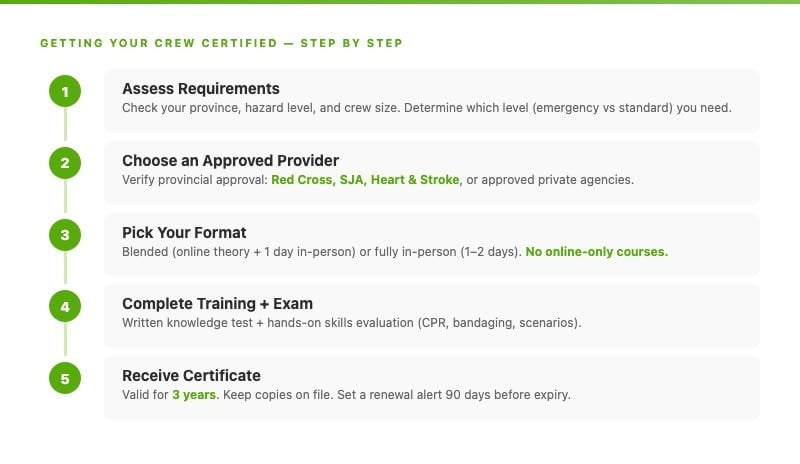
Here is the process for getting your crew properly certified with minimum production downtime:
- Complete your workplace first aid assessment. Before you book training, you need to know what level of certification your site requires. Your province, hazard level, crew size, and distance to a hospital determine this. If you have not done a workplace first aid assessment, start there.
- Determine how many first aiders you need per shift. Provincial regulations specify minimums based on worker count. You want at least one more than the minimum to cover absences and turnover.
- Choose the right certification level. Emergency, standard, or occupational first aid. See our first aid certification levels guide for help deciding.
- Select a provincially approved training provider. Check provincial regulator websites for approved providers.
- Book the training format that works for your crew. Blended learning minimizes time off site. On-site group training eliminates travel. Weekend courses avoid weekday production loss.
- Collect and file certificates immediately. Record issue dates, expiry dates, and certificate numbers. Set 90-day advance reminders for recertification.
- Build the renewal into your safety calendar. Do not wait until a certificate expires. Recertification courses must be completed while the certificate is still valid.
Cost Comparison: Online vs Blended vs In-Person
| Format | Time Away From Work | Cost Per Person | Accepted by Regulators? |
|---|
| Online-only (awareness) | 2 to 4 hours | $29 to $50 | No. Not valid for workplace compliance. |
| Blended (online + in-person practical) | 1 day in classroom + self-paced online | $100 to $180 | Yes. Accepted in most provinces. |
| Fully in-person | 2 days for standard; 1 day for emergency | $80 to $200 | Yes. Always accepted. |
| On-site group training (provider comes to you) | Same as in-person, no travel time | $100 to $180 per person (8+ minimum) | Yes. Same certification. |
The cheapest option (online-only) is also the only one that does not work. When you factor in the cost of retaking a valid course after the online certificate gets rejected, it is the most expensive option of all.
On-Site Group Training: The Smart Move for Larger Crews
If you have 8 or more workers who need certification, bring the instructor to your shop or site. On-site group training eliminates travel time, lets you train during a planned slow day, and often comes with a group discount.
Most major providers (St. John Ambulance, Red Cross, and private agencies) offer on-site training. For construction contractors running crews of 15 or more, this is almost always the most cost-effective option when you account for lost production time.
Some providers also offer evening and weekend courses. If pulling workers off the job during the week is not an option, a Saturday standard first aid course keeps your crew productive during billable hours.
What About First Aid Instructor Certification?
If you run a larger operation (50+ workers across multiple sites) and are constantly cycling through first aid certifications, it may be worth having someone in-house become a certified first aid instructor. First aid instructor courses run 3 to 5 days and cost $500 to $1,200 depending on the provider.
The math works like this: if you are sending 20 workers per year to external first aid courses at $150 each, that is $3,000 in course fees alone, plus 40 person-days of travel and classroom time. An in-house instructor can train your crew on your schedule, at your location, for the cost of supplies and the instructor's time.
This is not practical for most small contractors. But if you are running 3 or more active sites with 50+ total workers, it is worth running the numbers.
Scheduling Tips to Minimize Production Downtime
The biggest hidden cost of first aid training is not the course fee. It is the lost production from pulling workers off the job. Smart contractors plan certification around natural work gaps.
Schedule training during seasonal slowdowns, between project phases, or on days when weather would shut down outdoor work anyway. For crews in BC and Alberta, January and February are common choices because bad weather days are frequent and project schedules often have built-in slack.
If you have a large crew rotating through training, stagger the sessions so you never lose more than two or three workers per training day. Most providers offer multiple session dates per month in urban centres like Vancouver, Calgary, and Edmonton.
For recertification, book it 60 to 90 days before expiry. This gives you a buffer for scheduling conflicts, provider cancellations, or weather delays without risking a lapse. Track all expiry dates in a single system rather than relying on individual workers to remember their own deadlines.
Still chasing first aid records across files and inboxes?
Centralize corrective actions and proof so your next review is predictable.
Start Your 30-Day Free Trial →Frequently Asked Questions
Can I get my first aid certificate entirely online in Canada?
No. Online-only first aid certificates are not accepted by any Canadian provincial workplace safety regulator (WorkSafeBC, Alberta OHS, WSIB Ontario). Workplace first aid certification requires hands-on practical skills assessment. You can complete the theory portion online through blended learning, but the practical component must be done in person with an approved instructor.
What is the cheapest way to get a valid first aid certificate?
Emergency first aid courses start at $80 to $120 for a one-day course. For groups of 8 or more, on-site group training often provides the best per-person rate while eliminating travel costs. Standard first aid courses run $130 to $200 per person. Avoid any online course under $50 that claims to provide a workplace-valid certificate.
How long does blended first aid training take?
For standard first aid, blended learning involves 6 to 8 hours of online self-paced theory plus 1 day (6 to 8 hours) of in-person practical training. Compared to the traditional 2-day in-person course, blended learning cuts your classroom time roughly in half. The online portion can be completed over several days at the worker's convenience.
Is a first aid certificate from Red Cross accepted across all provinces?
Standard and emergency first aid certificates from the Canadian Red Cross are generally accepted across provinces for the corresponding certification level. However, some provinces have additional occupational first aid requirements (like BC's OFA system) that are separate from Red Cross certifications. Always verify with your provincial regulator that the specific certificate meets your workplace classification requirements.
Can my employer pay for first aid training?
Yes. In most provinces, the employer is responsible for providing and paying for first aid training that is required by workplace regulations. This includes course fees and wages for time spent in training. If the first aid certification is a condition of employment on your site, the employer typically covers the cost. Check your provincial employment standards for specifics.
Get Weekly Safety Insights
Regulation updates, toolbox talk ideas, and compliance tips. One email per week.