Last updated: March 2026
Your crew is tough. They work through sore backs, aching shoulders, and stiff knees because that is what you do in construction. Then one morning, a 12-year ironworker cannot grip a wrench. He is off work for three months. WCB picks up the claim. Your premiums go up. And the job he was halfway through? Now it is your problem to cover.
Musculoskeletal injuries (MSIs) are not dramatic. Nobody calls 911. But they are the most expensive, most common injury type in Canadian workplaces, and they are almost entirely preventable with the right training.
Ergonomics training is structured education that teaches workers and supervisors how to recognize, assess, and control the physical risk factors that cause musculoskeletal injuries (MSIs) in the workplace. For construction and industrial employers, it covers everything from proper lifting mechanics to workstation setup, tool selection, and early symptom reporting.
⚡ Quick Answer
- What: Training that teaches workers to identify and control risk factors for musculoskeletal injuries (sprains, strains, tendonitis, carpal tunnel)
- Who needs it: All workers exposed to MSI risk factors. In construction and industrial settings, that is nearly everyone.
- Is it required: Yes. Alberta OHS Code and BC OHS Regulation (Part 4) both require employers to train workers on MSI hazards and controls.
- ROI: Studies show $4-$5 return for every $1 invested in ergonomics interventions. Effective programs can reduce injuries by up to 60%.
- How to start: Identify your highest-risk tasks, train workers on those specific hazards, and build ergonomics into your existing safety program.
Ergonomics training teaches workers how to recognize ergonomic risk factors in their tasks and use proper techniques to prevent musculoskeletal injuries. In Canada, OHS regulations require employers to train workers on workplace hazards, and that includes the repetitive motions, awkward postures, and heavy lifting that cause the majority of lost-time claims.
This guide covers what effective ergonomics training looks like, what Canadian regulations require, and how to build a training program that actually changes behaviour on site.
Why Should Employers Care About Ergonomics Training?
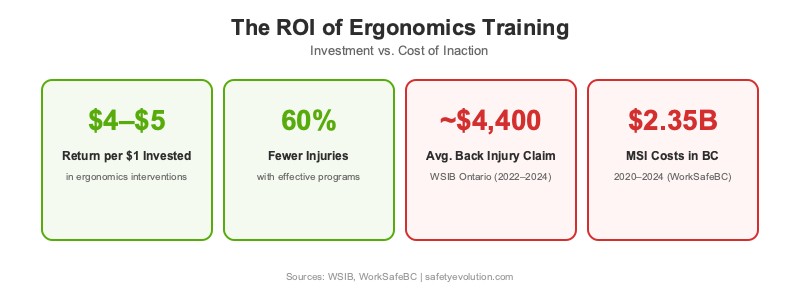
Here is the number most contractors do not know: musculoskeletal injuries account for roughly 30% of all time-loss claims in BC alone. Over the five-year period from 2020 to 2024, WorkSafeBC accepted approximately 88,000 time-loss MSI claims, with total costs exceeding $2.35 billion. Nationally, WCB data across jurisdictions shows MSDs account for 25% to 60% of annual compensation claims.
These are not freak accidents. They are the slow grind: a roofer reaching overhead eight hours a day, a pipefitter torquing fittings in an awkward crouch, a labourer moving 50-pound bags of concrete mix all morning. The injury builds until the worker cannot do the job anymore.
And it hits your bottom line in ways you might not expect. Beyond the direct WCB claim costs, you absorb the cost of hiring and training a replacement, the productivity loss while the crew is short-handed, and the premium increases that follow you for years. A study of an Ontario textile plant found that every $1 spent on ergonomics interventions returned over $4 in health and productivity benefits. Other research puts the return as high as 5:1 within four years.
If you are thinking about where to invest in your safety program, ergonomics training is one of the highest-ROI moves you can make.
What Does Ergonomics Training Actually Cover?
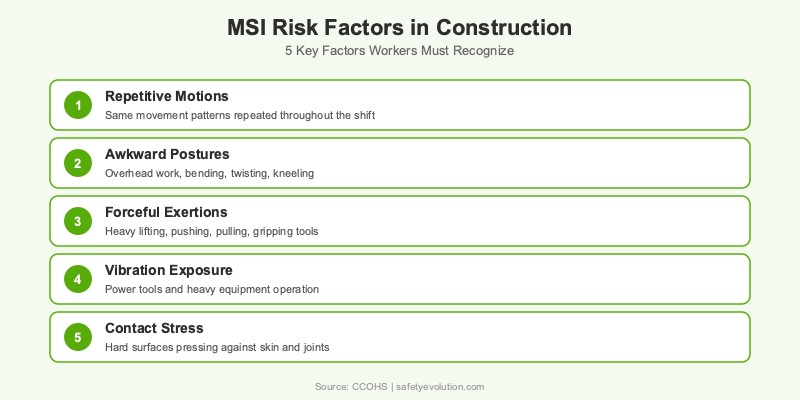
Most contractors think ergonomics is about office chairs and monitor heights. They are wrong. For industrial and construction workplaces, ergonomics training addresses the physical demands your crew faces every shift.
A comprehensive workplace ergonomics training program for construction and industrial workers typically covers:
- MSI risk factor recognition: How to identify repetitive motions, awkward postures, forceful exertions, vibration exposure, and contact stress before they cause injury
- Proper lifting and manual handling techniques: Body mechanics for lifting, carrying, pushing, and pulling loads safely
- Tool and equipment selection: Choosing the right tool for the job to reduce grip force, vibration, and awkward wrist positions
- Work planning and task rotation: How to structure work to avoid prolonged exposure to any single risk factor
- Early symptom recognition and reporting: Teaching workers to recognize the warning signs of MSIs (numbness, tingling, stiffness, reduced grip strength) and report them before they become disabling
- Workstation and workspace setup: Adjusting work heights, tool positions, and material staging to fit the task and the worker
- Controls hierarchy for ergonomic hazards: Engineering controls first (better tools, equipment, layout changes), then administrative controls (task rotation, rest breaks), then PPE where applicable
The key difference between useful ergonomics training and a box-checking exercise is specificity. Generic "lift with your legs" advice does nothing for a crew that spends six hours a day overhead. Training that addresses the actual tasks your workers perform, with the actual tools and materials they use, is what moves the needle.
Is Ergonomics Training Required in Canada?
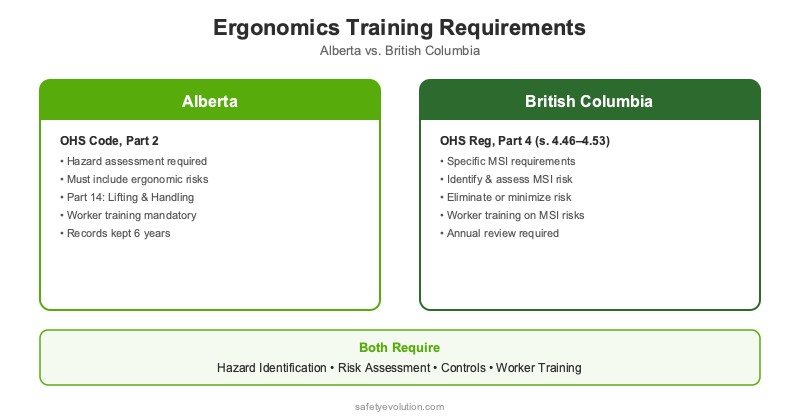
Yes. The specifics vary by province, but every Canadian jurisdiction requires employers to identify and control workplace hazards, and ergonomic hazards are explicitly included.
Alberta
Under Alberta's OHS Code (Part 2: Hazard Assessment, Elimination and Control), employers must assess the work site for existing and potential hazards before work begins. Ergonomic hazards, specifically musculoskeletal injury risk factors, are part of that assessment. Alberta also publishes an "Ergonomics in the Workplace: MSI Prevention Training" bulletin that outlines employer obligations to provide MSI prevention training and workers' obligations to participate in and apply that training.
British Columbia
BC's OHS Regulation, Part 4 (General Conditions), contains specific Ergonomics (MSI) Requirements. Employers must identify factors that may expose workers to MSI risk, assess those risks, implement controls to eliminate or minimize them, and educate and train workers about MSI risks. Employers must also monitor the effectiveness of these measures and review them at least annually.
WorkSafeBC has made MSI prevention a planned inspectional focus for 2026, particularly in construction, healthcare, retail, and transportation. That means inspectors are actively looking for evidence that employers have identified ergonomic hazards and trained their workers accordingly.
Ergonomics Training Gaps Show Up in Your WCB Claims
SE-AI checks your training records for ergonomics coverage and flags teams and trades that are missing MSD prevention training.
Get Early Access →
Federal and Other Provinces
The Canada Labour Code covers federally regulated industries and includes ergonomic requirements. Ontario's Occupational Health and Safety Act (OHSA) requires employers to provide information, instruction, and supervision to protect worker health and safety, which includes ergonomic hazards. Saskatchewan, Manitoba, and other provinces have similar general duty provisions.
The bottom line: if your workers perform physical work, you are required to identify ergonomic hazards and train your people on how to control them. There is no province where this is optional.
Who Needs Ergonomics Training?
The short answer: anyone exposed to MSI risk factors. In construction and industrial settings, that covers nearly your entire workforce. But the training is not one-size-fits-all.
Workers need to understand the specific risk factors in their tasks, how to use proper body mechanics, how to recognize early symptoms, and when to report concerns. A framer needs different training than a welder, even though both face ergonomic hazards.
Supervisors need everything workers need, plus the ability to identify ergonomic risk factors during worksite observations, plan tasks to minimize exposure, and respond appropriately when workers report early symptoms.
Employers and managers need to understand their legal obligations, how to integrate ergonomics into the company's overall health and safety management system, and how to evaluate whether their ergonomics program is actually working.
A common mistake: contractors train the office staff on ergonomics (desk setup, monitor height) and skip the field crew entirely. That is backwards. Your highest-risk workers are the ones handling materials, operating tools, and working in awkward positions all day. They need the training most.
What Are the Benefits of Ergonomics Training?
Here is the blunt truth: most contractors only think about ergonomics after someone gets hurt. By then, you are paying for it twice: once in WCB claims and lost productivity, and again in scrambling to build a program under pressure.
The benefits of investing in ergonomics training before you have a problem:
Fewer injuries, lower WCB costs
Research consistently shows that ergonomic programs can reduce MSI-related injuries by up to 60%. For a construction company, that can mean the difference between a clean claims record and a premium surcharge that follows you for years. In Ontario, the average cost of a single lower back injury claim is approximately $4,400 according to WSIB data (2022-2024). For a 30-person crew, even preventing two or three back injuries per year saves you $10,000 to $15,000 in direct claim costs alone.
Better COR and audit performance
Ergonomics is a required element in most health and safety management systems. If you are working toward COR certification or maintaining one, your auditor will look for evidence that you have identified ergonomic hazards, trained workers on controls, and documented both. An ergonomics training program that is actually running, not just written in your manual, strengthens your audit score.
Higher productivity and lower turnover
Workers who are not in chronic pain work faster, make fewer mistakes, and stay with your company longer. It sounds obvious, but the connection between ergonomics and productivity is measurable. Workers who receive proper training on body mechanics and tool use can sustain output through a full shift instead of slowing down as fatigue and discomfort build through the day.
Regulatory compliance
With WorkSafeBC making MSI prevention an inspectional focus in 2026, showing up without an ergonomics training program is a risk you do not need to take. An inspector who finds workers exposed to MSI risk factors with no evidence of training, hazard identification, or controls can issue orders that stop work until you fix it.
How to Build an Ergonomics Training Program
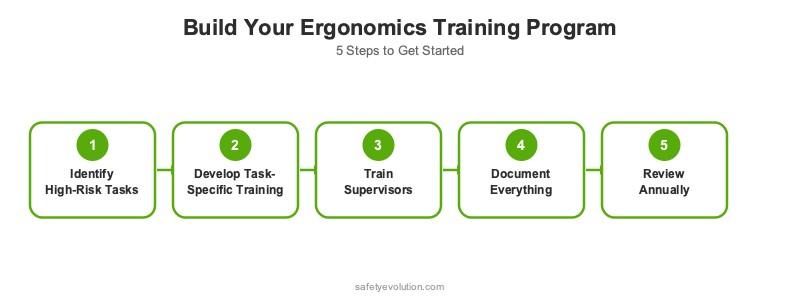
You do not need a PhD in biomechanics. You need a systematic approach that fits your operation. Here is how to build one that actually works.
Step 1: Identify your high-risk tasks
Walk your job sites with fresh eyes. Where are your workers lifting heavy or awkward loads? Working overhead for extended periods? Using vibrating tools all day? Crouching, kneeling, or reaching repeatedly? Review your WCB claim history and first aid records. The patterns will tell you where to focus first.
This is not a one-time exercise. As projects change, your ergonomic risks change. Build this into your regular field-level hazard assessment process.
Step 2: Develop task-specific training content
Generic training fails because it does not address the specific hazards your workers face. If your crew is doing concrete work, the training should cover manual handling of heavy materials, vibration from concrete saws and grinders, and sustained awkward postures during forming and finishing. If your crew is doing electrical work, focus on overhead reaching, repetitive hand/wrist motions, and sustained kneeling.
Use a combination of:
- Classroom or toolbox talk sessions for the fundamentals (risk factors, body mechanics, reporting procedures)
- Hands-on demonstrations at the actual worksite, with the actual tools and materials
- Task observations where a supervisor watches how workers actually perform the job and coaches adjustments in real time
Need ready-made content for the classroom portion? Safety Evolution's free toolbox talk package includes ergonomics and manual handling topics you can use immediately.
Step 3: Train supervisors as your front line
Your supervisors see things every day that workers do not report. A labourer who keeps shifting his weight. A welder rubbing her wrist between passes. These are early warning signs. Supervisors need training to recognize these patterns, have conversations about them without making workers feel targeted, and adjust task assignments to reduce exposure.
This is the step most companies skip, and it is the most important one. A well-trained supervisor prevents more injuries than any training video ever will.
Step 4: Document everything
Your training program needs records: who was trained, on what topics, when, and by whom. Alberta OHS requires employers to keep training records. Your COR auditor will ask for them. And if there is ever a WCB claim or an OHS inspection, documented training is your best defence.
Track this in your safety management system, not a binder on a shelf. If your workers complete a training course, the record should be searchable, with automatic expiry alerts so refresher training does not slip through the cracks.
Step 5: Review and improve annually
BC's OHS Regulation requires employers to review the effectiveness of their ergonomics controls at least annually. Even if your province does not have that explicit requirement, it is good practice. Look at your injury data. Are MSI claims going down? Are workers reporting early symptoms? Are the controls you implemented actually being used?
If the numbers are not moving, your program needs adjustment. Maybe the training is too generic. Maybe supervisors are not reinforcing it. Maybe the engineering controls you thought would work are not practical on site. An annual review is where you figure that out.
Common Mistakes Contractors Make with Ergonomics
We help contractors build and maintain safety programs every week at Safety Evolution. Here are the ergonomics mistakes we see most often:
Treating it as a one-time event. A single training session during orientation does not cut it. Ergonomics awareness needs ongoing reinforcement through toolbox talks, site observations, and refresher training. Your crew's tasks change with every project. The training needs to keep up.
Training the office, ignoring the field. Your admin staff's wrist pain is real, but your field crew's chronic back injuries are costing you ten times more in WCB claims. Prioritize where the risk is highest.
Relying on "lift with your legs" and calling it done. Proper lifting technique matters, but it is one small piece. What about the worker who cannot lift with their legs because they are in a trench? Or the one who has to reach overhead because the work is above them? Training must address the real conditions on your sites.
No follow-up or enforcement. Training without observation and correction is hope, not a program. If supervisors are not watching how workers actually perform tasks and coaching better practices, the training will not stick.
Waiting for injuries before acting. MSIs develop gradually. By the time a worker files a WCB claim, the damage has been building for months or years. A proactive program catches it early, when a conversation and a task adjustment can prevent a lost-time claim.
Does Your Team Know How to Identify Ergonomic Hazards on Site?
SE-AI analyses your training records for ergonomics coverage gaps. It flags workers who have not received ergonomics training, trades with high MSD incident rates but no targeted training, and gaps between your training schedule and regulatory expectations.
Get Early Access to SE-AI →
Frequently Asked Questions
What are the benefits of ergonomics training?
Ergonomics training reduces musculoskeletal injuries (the most common type of workplace injury in Canada), lowers WCB claim costs, improves productivity, and helps employers meet provincial OHS requirements. Research shows ergonomic programs can reduce MSI injuries by up to 60%, with a return of $4 to $5 for every $1 invested.
Is ergonomics training mandatory in Canada?
Every Canadian province requires employers to identify and control workplace hazards, including ergonomic hazards. Alberta's OHS Code requires hazard assessments that include ergonomic risk factors, and BC's OHS Regulation (Part 4) has specific Ergonomics (MSI) Requirements that mandate worker education and training. While there is no single national "ergonomics training certificate," training workers on the MSI risk factors in their specific jobs is a legal obligation.
How often should ergonomics training be done?
Initial training should be provided when workers start a new job or are assigned tasks with MSI risk factors. Refresher training should be conducted at least annually, or whenever work tasks, tools, or conditions change significantly. BC requires employers to review the effectiveness of their ergonomics measures at least annually. Integrating ergonomics topics into regular toolbox talks keeps awareness high between formal sessions.
What does workplace ergonomics training include for construction workers?
For construction workers, ergonomics training should cover: recognition of MSI risk factors specific to their trade (repetitive motions, awkward postures, forceful exertions, vibration), proper lifting and manual handling techniques, tool selection to reduce strain, work planning and task rotation, early symptom recognition and reporting, and how to set up work areas to minimize risk. The training should be task-specific, not generic.
How much does ergonomics training cost?
Costs vary depending on the format and provider. Online awareness courses may cost $30 to $75 per worker. In-person training delivered on site by a qualified instructor typically ranges from $500 to $2,000 per session for a group. Many companies integrate ergonomics into their existing safety training programs at minimal additional cost. The investment is small compared to the cost of a single MSI claim, which averages approximately $4,400 for a lower back injury in Ontario (WSIB, 2022-2024).
Can ergonomics training help with COR certification?
Yes. Ergonomics is a component of a comprehensive health and safety management system, which is what COR auditors evaluate. Demonstrating that you have identified ergonomic hazards, trained workers on controls, and documented training records all contribute to a stronger audit score. For companies working toward or maintaining COR certification, an active ergonomics training program is a practical necessity.
Get Weekly Safety Insights
Regulation updates, toolbox talk ideas, and compliance tips. One email per week.