Last updated: March 2026
Your crew isn't complaining about sore backs because they're getting old. They're getting hurt because the work is set up wrong. Awkward lifts, repetitive gripping, hours spent crouched in a trench or reaching overhead on scaffolding: these are ergonomic hazards, and they're responsible for more lost-time claims than any other injury type in Canada.
We help contractors across Alberta and BC build safety programs that actually hold up under audit. Ergonomic hazards show up on every site we walk, and most crews don't recognize them until someone's filing a WCB claim.
⚡ Quick Answer
- What: An ergonomic hazard is any workplace condition that forces the body into awkward postures, repetitive motions, excessive force, or prolonged static positions, increasing the risk of musculoskeletal injury (MSI)
- Common types: Forceful exertion, awkward postures, repetitive motion, vibration, contact stress, static postures
- Impact: MSIs account for roughly 30% of all time-loss claims in BC alone, costing over $2.35 billion from 2020 to 2024 (WorkSafeBC)
- Controls: Follow the hierarchy: eliminate the hazard first, then engineer it out, then use administrative controls, then PPE as a last resort
- Legal requirement: Alberta OHS Code Part 14 and BC OHS Regulation Part 4 both require employers to identify, assess, and control ergonomic hazards
Ergonomic hazards are workplace conditions that force your body into awkward postures, excessive force, or repetitive motions that lead to musculoskeletal injuries (MSIs). Unlike a fall or an electrical shock, ergonomic injuries build up over weeks and months until a worker can't grip a tool, lift a load, or turn their neck without pain.
This guide breaks down the types of ergonomic hazards found in Canadian workplaces, real examples from construction and industrial settings, and the controls that actually reduce injury rates.
What Is an Ergonomic Hazard?
An ergonomic hazard is any workplace condition that creates a mismatch between the physical demands of a task and the capabilities of the worker's body, increasing the risk of musculoskeletal injury. In plain terms: it's a setup that forces your crew to work in ways their bodies aren't built to sustain.
Most people hear "ergonomics" and think office chairs and monitor heights. On a construction site or oil and gas facility, ergonomic hazards look like a pipefitter crouched inside a vessel for three hours, a labourer hauling 30 kg bags of concrete mix all morning, or an electrician reaching overhead to pull wire until their shoulder gives out.
Here's why it matters: musculoskeletal injuries (MSIs) are the single largest category of workplace injury claims in Canada. WorkSafeBC reported that MSIs account for approximately 30% of all time-loss claims and more than a quarter of total claim costs. From 2020 to 2024, WorkSafeBC accepted roughly 88,000 MSI time-loss claims totalling over $2.35 billion. MSI prevention is a 2026 inspectional focus, with construction specifically named as a priority sector.
If you run a crew and you're not actively identifying ergonomic hazards, you're leaving your biggest injury risk unmanaged. And your WCB premiums are reflecting that.
What Are the Main Types of Ergonomic Hazards?
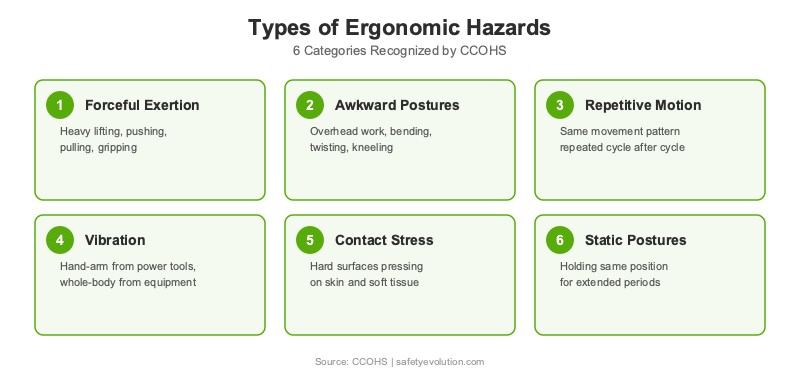
Ergonomic hazards fall into six categories recognized by the Canadian Centre for Occupational Health and Safety (CCOHS). Each one shows up differently depending on whether your crew is on a construction site, in a shop, or working a turnaround.
1. Forceful Exertion
Any task that requires your crew to push, pull, lift, grip, or carry loads that strain muscles and joints. This is the one most contractors recognize because the injuries are immediate and obvious.
Job site examples:
- Lifting bags of cement, bundles of rebar, or sheets of drywall without mechanical assist
- Pulling cable through conduit by hand
- Operating manual pipe wrenches on large-diameter piping
- Pushing loaded wheelbarrows across uneven ground
2. Awkward Postures
Working in positions that stretch joints to the edge of their range of motion. Sustained awkward postures compress nerves, restrict blood flow, and accelerate fatigue in ways that a worker won't feel until the damage is done.
Job site examples:
- Overhead work: pulling wire, installing ductwork, or bolting steel above shoulder height
- Bending and twisting to weld in confined spaces
- Kneeling for extended periods during concrete finishing or tile work
- Working in trenches with limited room to stand upright
3. Repetitive Motion
Performing the same movement pattern over and over, especially when combined with force or awkward positioning. The danger here is cumulative: no single repetition causes injury, but thousands in a shift will.
Job site examples:
- Hammering, drilling, or fastening with power tools for hours
- Hand-nailing in framing
- Repetitive bending to pick up and place materials
- Assembly line tasks in manufacturing (tightening bolts, inspecting parts)
Repetitive motion injuries are preventable. The problem isn't the motion itself; it's how long your crew does it without variation, rest, or mechanical assistance.
4. Vibration
Vibration comes in two forms:
- Hand-arm vibration (HAV): From power tools like grinders, jackhammers, and chainsaws. Long-term exposure causes Hand-Arm Vibration Syndrome (HAVS): numbness, tingling, and reduced grip strength.
- Whole-body vibration (WBV): From heavy equipment like excavators, haul trucks, and forklifts. Linked to chronic lower back pain and spinal disc degeneration.
Job site examples: Operating a jackhammer for demolition, driving a haul truck for 10-hour shifts on rough access roads, using an angle grinder for extended weld prep.
5. Contact Stress
When a hard surface or tool edge presses into soft tissue repeatedly, it compresses nerves and blood vessels. This is the hazard nobody talks about because the effects build slowly.
Job site examples:
- Kneeling on hard surfaces without knee pads (concrete, steel decking)
- Resting wrists on sharp edges of workbenches or equipment housings
- Using tool handles that dig into the palm during sustained gripping
- Leaning against hard edges of scaffold planks or equipment frames
6. Static Postures
Holding the same position for an extended period, even if that position seems "neutral." When muscles stay contracted without movement, blood flow is restricted and fatigue sets in faster than during active work.
Job site examples:
- Standing in one position for hours while monitoring equipment
- Holding a welding torch in a fixed position during long welds
- Sitting in a crane cab for a full shift
- Maintaining a crouched position inside a pipe rack or mechanical room
If your crew can name the first two types but not the last four, your hazard identification process has a gap. And that gap is where your next WCB claim comes from.
Not sure where the gaps are in your safety program? SE-AI can analyse your safety records and show you exactly where ergonomic hazards are going undocumented.
Ergonomic Hazards Are the Most Commonly Missed Category
SE-AI checks your safety records for ergonomic hazards that are not being captured in your inspections and hazard assessments.
Get Early Access →
How Do You Control Ergonomic Hazards on a Job Site?
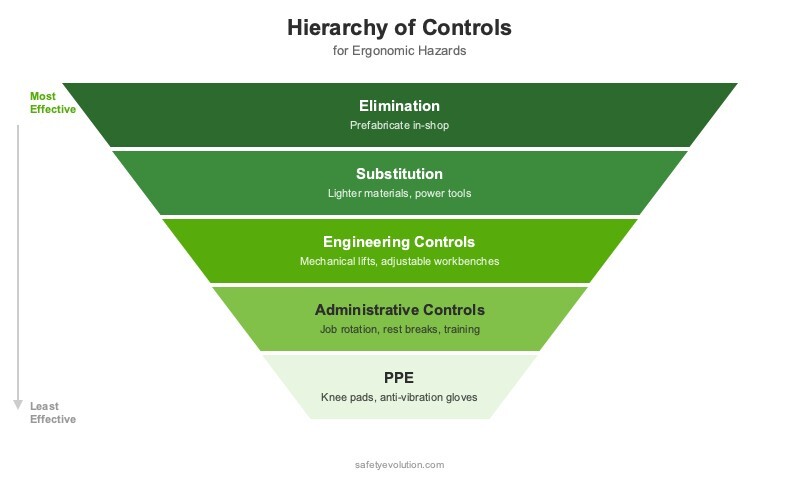
Alberta OHS Code Part 14 and BC OHS Regulation Part 4 (Sections 4.46 to 4.53) both require employers to follow the hierarchy of controls for ergonomic hazards. Start at the top and only move down when the level above isn't practicable.
Level 1: Elimination
Remove the hazard entirely. This is the most effective control and the hardest to implement on an active job site.
- Prefabricate assemblies in the shop instead of building them in awkward field positions
- Design work so that heavy lifts are eliminated from the task (e.g., have materials delivered directly to the work elevation by crane)
- Pre-cut and pre-thread pipe in the shop instead of in a tight mechanical room
Level 2: Substitution
Replace a high-risk process or tool with a lower-risk alternative.
- Switch from manual pipe threading to power threading equipment
- Use lighter-weight materials where structural requirements allow
- Replace hand-operated valves with powered actuators
Level 3: Engineering Controls
Change the physical work environment or equipment to reduce exposure.
- Provide mechanical lifting aids: hoists, vacuum lifters, pallet jacks, material carts
- Install adjustable-height workbenches and sawhorses so workers aren't bending or reaching
- Use anti-vibration tool mounts and low-vibration power tools
- Add anti-fatigue matting at stationary work positions
- Provide equipment with vibration-dampened seats and suspension systems
Level 4: Administrative Controls
Change how the work is organized to reduce the dose of exposure.
- Rotate workers between physically demanding tasks and lighter duties
- Schedule rest breaks during sustained repetitive or forceful work
- Train workers on proper lifting techniques and body mechanics
- Include ergonomic hazard identification in your daily field-level hazard assessments (FLHAs)
- Develop a toolbox talk on ergonomics for your morning safety meetings
Level 5: Personal Protective Equipment (PPE)
PPE is the last line of defence. It reduces the impact of the hazard but doesn't remove it.
- Knee pads for sustained kneeling work
- Anti-vibration gloves for power tool use
- Wrist supports for high-repetition gripping tasks
- Padded tool belts that distribute weight evenly
Most contractors jump straight to Level 4 and 5. They buy knee pads, run a toolbox talk, and call it handled. If your FLHA lists "awkward posture" as a hazard and your only control is "worker will stretch," you haven't controlled anything. You've documented your failure to control it.
What Do Ergonomic Hazards Look Like in Your Industry?
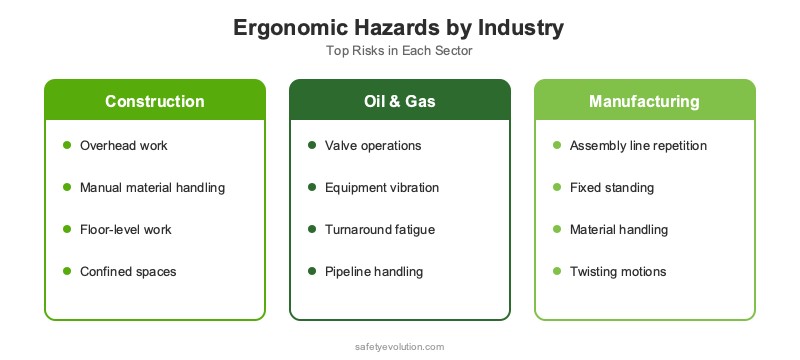
Here's what ergonomic hazards actually look like in the industries where our clients operate.
Construction
Construction has the highest concentration of ergonomic hazards of any industry because work environments change constantly and engineering controls often aren't feasible in temporary work areas.
- Overhead work: Electricians pulling wire, HVAC installers hanging ductwork, drywall tapers finishing ceilings. Sustained overhead reaching compresses the rotator cuff and leads to shoulder impingement.
- Manual material handling: Moving lumber, drywall sheets, concrete bags, and steel. A standard sheet of 5/8" drywall weighs about 32 kg. Your crew is moving dozens of them daily.
- Floor-level work: Concrete finishing, tile installation, plumbing rough-in. Prolonged kneeling combined with forward bending is one of the highest-risk posture combinations for knee and lower back injuries.
- Confined and restricted spaces: Working in mechanical rooms, crawl spaces, attics, and pipe chases where normal body positioning isn't possible.
Oil and Gas
Oil and gas combines heavy manual handling with long shifts and extreme weather, all of which amplify ergonomic risk.
- Valve operations: Manually opening and closing large valves, sometimes requiring sustained forceful twisting in awkward positions
- Equipment operation: 10 to 12-hour shifts in heavy equipment on rough terrain, exposing operators to whole-body vibration
- Turnarounds and shutdowns: Compressed timelines mean longer shifts, less rotation, and more sustained exposure to every risk factor simultaneously
- Pipeline work: Bending, lifting, and positioning heavy pipe sections in remote locations with limited mechanical assist
Manufacturing
- Assembly line repetition: The same hand and arm movements thousands of times per shift. Carpal tunnel, tendinitis, and trigger finger are the predictable results.
- Machine operation: Fixed standing positions, repetitive material feeding, reaching across conveyors
- Material handling: Loading, unloading, and stacking products, often combined with twisting that multiplies load on the lower back
A 15-person concrete sub in Edmonton had three lower back injury claims in one year. All three were labourers doing the same task: bending to shovel and rake fresh concrete for hours during slab pours. Their FLHA listed "manual handling" as a hazard. Their control? "Lift with your legs." That's not a control. That's a hope. When they rotated labourers off the rake every 45 minutes and brought in a concrete pump for larger pours, claims dropped to zero the following year.
Are Ergonomic Hazards Being Identified in Your Workplace Inspections?
SE-AI analyses your inspection reports, incident data, and hazard assessments for ergonomic blind spots. It flags workstations, tasks, and processes where force, repetition, vibration, and posture hazards are not being documented or controlled.
Get Early Access to SE-AI →
What Are the Legal Requirements for Ergonomic Hazards in Canada?
Ergonomic hazard management isn't a best practice in Canada. It's a legal obligation. Both Alberta and BC have specific requirements that apply regardless of company size.
Alberta: OHS Code Part 14
Requires employers to identify MSI hazards, assess risk, implement controls following the hierarchy, train workers, develop a prevention program, and maintain records for 6 years.
BC: OHS Regulation Part 4, Sections 4.46 to 4.53
Requires employers to identify MSI risk factors, assess risk considering physical demands and environmental conditions, eliminate or minimize risk, train workers to recognize MSI risk factors, and review control effectiveness at least annually.
The regulations are clear: "identify, assess, control, train, review." If your safety program doesn't include an ergonomics component, you have a compliance gap. And that gap shows up in COR audits, OHS inspections, and, worst case, incident investigations after someone gets hurt.
Need help building an ergonomics component into your safety program? Safety Evolution's done-for-you safety services include hazard assessment, program development, and audit-ready documentation.
How Do You Identify Ergonomic Hazards Before Someone Gets Hurt?
Ergonomic hazards don't announce themselves like a fall from height or an electrical contact. They build over weeks and months until a worker can't grip a wrench or get out of bed without back pain.
Here's how to catch them before they become claims:
1. Watch the Work, Not the Paperwork
Walk the site and observe how tasks are actually performed. Your FLHAs might say "proper lifting technique" but your crew is bending at the waist because material is staged on the ground with no other option.
2. Talk to Your Crew
Ask directly: "What task makes you sore at the end of the day?" and "What would make this easier?" Five minutes of conversation beats a stack of generic checklists.
3. Review Your WCB Claims Data
Three sprains and strains on the same task isn't bad luck. That's an ergonomic hazard you haven't identified yet.
Your FLHAs should specifically prompt for ergonomic risk factors: force, posture, repetition, vibration, contact stress, and static positions. If your forms only list "manual handling" as a single line item, they're not capturing the full picture.
5. Track Early Warning Signs
Workers reporting stiffness, numbness, tingling, or recurring soreness in the same body part are showing early signs of MSI. Encouraging early reporting is critical because MSIs develop gradually and are often only addressed once symptoms require time away from work.
Early intervention is cheaper than a WCB claim, faster than rehabilitation, and better for your crew. Every time.
Frequently Asked Questions About Ergonomic Hazards
What is an ergonomic hazard in simple terms?
An ergonomic hazard is any workplace condition that puts strain on your body because of how a task is set up, including heavy lifting, awkward positions, repetitive movements, vibration, and holding the same posture for extended periods. Over time, these hazards lead to musculoskeletal injuries like back strains, tendinitis, and carpal tunnel syndrome.
What are 5 examples of ergonomic hazards on a construction site?
Five common examples: (1) lifting heavy materials like drywall or concrete bags without mechanical assist, (2) sustained overhead work such as installing ductwork or pulling wire, (3) prolonged kneeling during concrete finishing, (4) operating vibrating power tools like jackhammers for extended periods, and (5) working in confined spaces that force awkward body positions.
Are employers legally required to address ergonomic hazards in Canada?
Yes. In Alberta, OHS Code Part 14 requires employers to identify MSI hazards, assess risks, implement controls, train workers, and maintain an ergonomic hazard prevention program. In BC, WorkSafeBC's OHS Regulation Part 4 (Sections 4.46 to 4.53) has similar requirements including risk identification, control implementation, worker training, and annual review of control effectiveness.
What is the best way to control ergonomic hazards?
Follow the hierarchy of controls: eliminate the hazard first (e.g., prefabricate in-shop), then substitute with a lower-risk alternative, then engineering controls (mechanical lifting aids, adjustable workstations), then administrative controls (job rotation, rest breaks, training), and finally PPE (knee pads, anti-vibration gloves) as a last resort.
How much do ergonomic injuries cost employers?
Ergonomic injuries (musculoskeletal injuries) are the most expensive category of workplace injury in Canada. In BC alone, WorkSafeBC accepted approximately 88,000 MSI time-loss claims from 2020 to 2024, with total claim costs exceeding $2.35 billion. Beyond direct WCB costs, employers face increased absenteeism, higher insurance premiums, reduced productivity, and worker turnover.
What is the difference between an ergonomic hazard and an ergonomic risk factor?
An ergonomic hazard is the workplace condition itself (e.g., a task requiring heavy lifting). An ergonomic risk factor is the specific physical demand that increases injury risk (e.g., the weight of the load, lift frequency, distance from the body). During assessment, you evaluate risk factors (force, posture, repetition, vibration, duration, contact stress) to determine injury likelihood and severity.
Get Weekly Safety Insights
Regulation updates, toolbox talk ideas, and compliance tips. One email per week.