Last updated: March 2026
A worker shows up to your site on Monday morning and something is off. Eyes glazed, reaction time slow, and he nearly backs a skid steer into a scaffold. Your foreman pulls him aside, but then what? Do you have a written policy that tells your crew exactly what happens next? Do you have a process for testing? For documentation? For getting that worker help without blowing up a human rights complaint?
If your answer is "not really," you are not alone. Most small and mid-size contractors we work with at Safety Evolution have some version of "don't come to work impaired" in their safety manual. But when an incident actually happens, that one-liner does not hold up to an OHS investigation, a COR audit, or a wrongful dismissal claim.
⚡ Quick Answer: Drug and Alcohol Policy Essentials
- What it is: A written workplace policy that defines expectations around substance use, testing procedures, consequences for violations, and support resources for your crew
- Why you need one: Required for COR/SECOR audits, expected by most GCs, and legally critical if an incident involves impairment
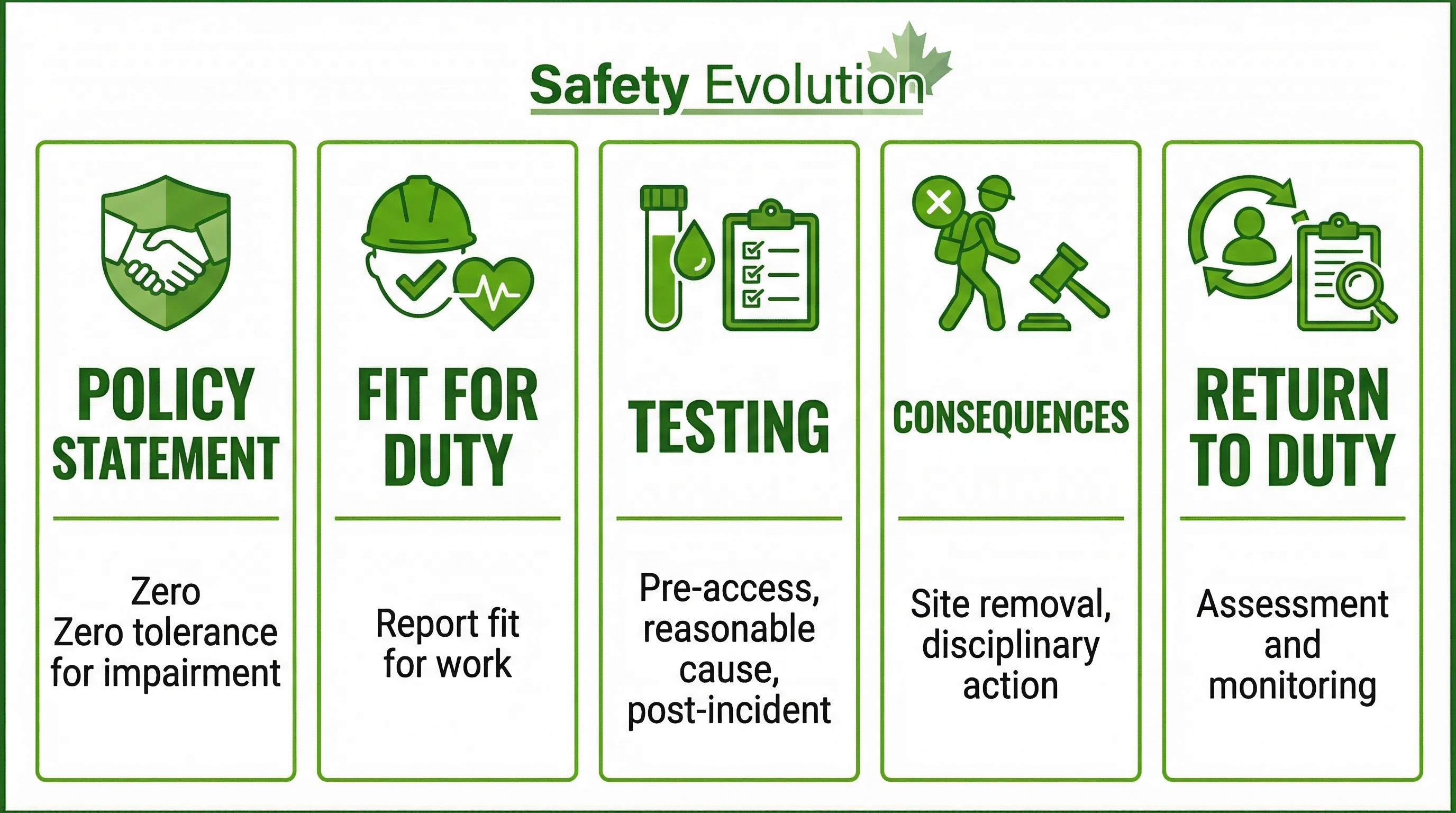
- Key components: Policy statement, fit-for-duty expectations, testing protocols, consequences, return-to-duty process, and employee assistance
- Legal reality: Cannabis legalization (October 2018) did not change your obligation to maintain a safe worksite. Impairment from any source is still a hazard you must control
- Industry standard: The COAA Canadian Model for Providing a Safe Workplace (Version 6.1, May 2023) is the benchmark for construction and energy sector drug and alcohol policies
- Timeline: A solid policy can be developed and rolled out in 2 to 4 weeks with proper guidance
- Free Resource: Download our Construction Health & Safety Manual.
Why Do Construction Contractors Need a Drug and Alcohol Policy?
A drug and alcohol policy is a written document that outlines your company's expectations, rules, and procedures related to substance use and impairment in the workplace. It is not optional window dressing. It is a core safety program element that auditors, GCs, and regulators expect to see.
Here is the reality: construction workers face substance use rates that are nearly twice the national average, according to research from the Canadian Centre on Substance Use and Addiction (CCSA). The physical demands of the work, long hours, remote job sites, and a culture that has historically normalized after-work drinking all contribute to this. Add cannabis legalization since October 2018 into the mix, and the grey area around what is "acceptable" has gotten murkier for contractors.
But the law has not changed on the fundamental point: every province in Canada requires employers to ensure workers are not impaired on the job. In Alberta, the OHS Act makes it clear that employers must identify and control hazards, and impairment is a recognized workplace hazard. In BC, WorkSafeBC states that employers "must not assign impaired workers to activities where impairment may create an undue risk."
Without a written policy, you are flying blind when something goes wrong. And in construction, "something going wrong" can mean a fatality. If your safety program needs a checkup, and flag whether your drug and alcohol provisions would hold up during an audit or incident investigation.
What Should a Drug and Alcohol Policy Include?
Most contractors think a paragraph in their safety manual covers them. They are wrong. A one-liner that says "no drugs or alcohol on site" is not a policy. It is a wish. A proper drug and alcohol policy needs to be comprehensive enough to withstand legal scrutiny and practical enough that your foremen can actually follow it.
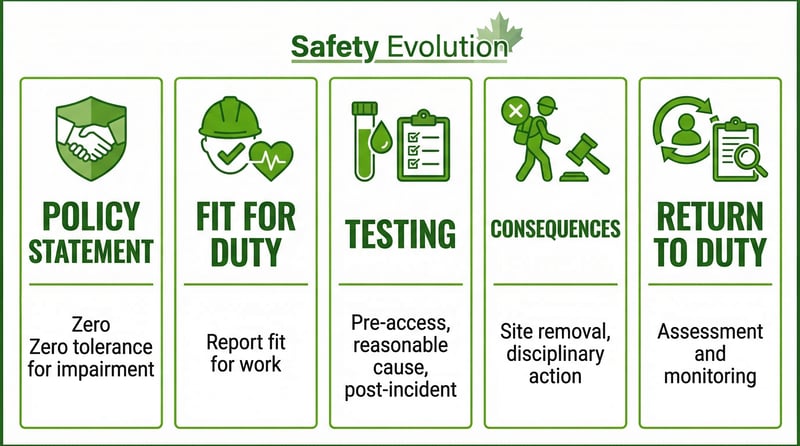
Here are the key components every construction contractor's policy should cover:
1. Policy Statement and Purpose
A clear declaration that your company is committed to a safe, drug- and alcohol-free workplace. This sets the tone and scope. Specify who is covered: employees, subcontractors, visitors on your controlled worksites.
2. Fit-for-Duty Requirements
Every worker must report to site fit for duty. This means free from impairment caused by alcohol, recreational drugs, prescription medication that affects performance, or any other factor including fatigue. This is not just about illegal substances. A worker on strong painkillers after a dental procedure can be just as impaired as someone who had too many beers the night before.
3. Prohibited Conduct
Be specific. Spell out that possession, use, distribution, and sale of alcohol and illicit drugs on company worksites is prohibited. Address cannabis directly: legalization does not mean workers can consume before or during a shift. Address prescription drugs: workers must disclose if medication may cause impairment, without needing to disclose the specific condition.
4. Testing Protocols
This is where policies get legally complicated, and where most contractors either overreach or underdeliver. In Canada, drug and alcohol testing is heavily regulated by human rights legislation. You cannot simply test anyone, anytime.
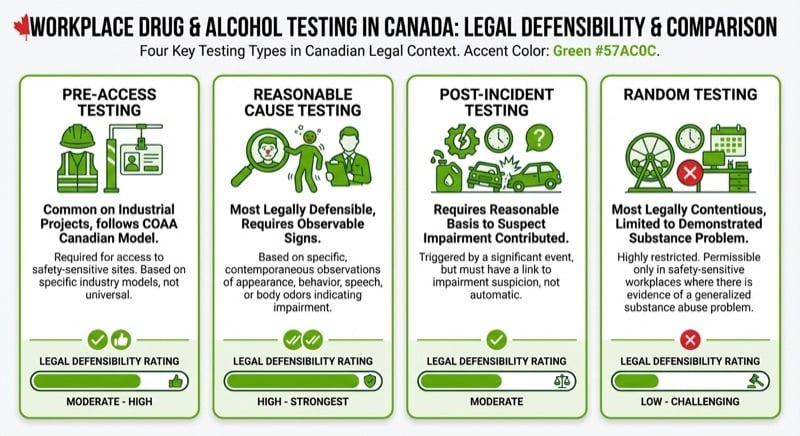
The types of testing generally recognized in Canadian workplaces include:
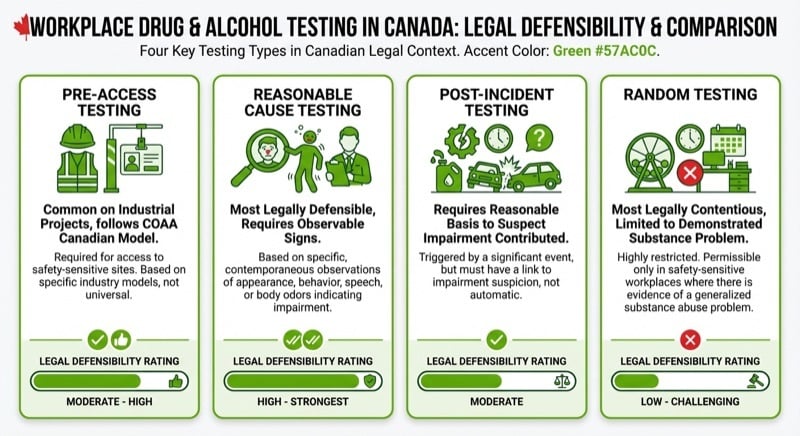
- Pre-access/pre-employment testing: Common on major oil and gas and industrial construction projects. Required by many GCs and project owners, especially those following the COAA Canadian Model. Note that pre-employment testing outside safety-sensitive roles has faced human rights challenges
- Reasonable cause testing: When a supervisor has objective, observable grounds to suspect a worker is impaired. This is widely considered the most legally defensible form of testing. Supervisors need training to document signs: slurred speech, lack of coordination, unusual behaviour, smell of alcohol
- Post-incident testing: After a significant workplace incident where impairment may have been a contributing factor. The key legal requirement: there must be a reasonable basis to suspect impairment contributed to the incident. Blanket post-incident testing (testing everyone after every incident regardless of circumstances) has been challenged in arbitration and human rights proceedings
- Random testing: The most legally contentious form in Canada. Generally only upheld in safety-sensitive workplaces where there is demonstrated evidence of a substance use problem. The Supreme Court of Canada's decision in Stewart v. Elk Valley Coal Corp. (2017) reinforced that employers in safety-sensitive environments can enforce drug and alcohol policies, but random testing still faces significant legal hurdles outside of specific industries like oil sands and nuclear
Important: Drug and alcohol testing policies should always be reviewed by legal counsel familiar with your province's human rights and employment law. What is permissible in Alberta's oil sands may not be permissible for a framing crew in the Fraser Valley.
If you are building a safety program from scratch, drug and alcohol provisions should be one of the first elements you address. Your construction safety orientation should include a formal review of the policy with every new hire.
Need a Complete Safety Program?
Stop starting from scratch. Download our Free Construction Health & Safety Manual to get compliant fast.
Download the Free Manual →
How Does Cannabis Legalization Affect Your Policy?
When Canada legalized recreational cannabis in October 2018, it did not create a right to use cannabis at work or show up impaired. The Government of Canada explicitly states that employers must "include policies on substance use and impairment in hazard prevention programs when the use of cannabis and other causes of impairment represents a hazard."
But cannabis created new challenges that alcohol does not:
- Detection vs. impairment: THC can stay in a person's system for days or weeks after use. A positive drug test does not necessarily prove a worker was impaired at the time of the test. This is a critical legal distinction that has tripped up many employers
- Medical cannabis: Under the Canadian Human Rights Act, employers have an obligation to accommodate workers who use cannabis for medical purposes, up to the point of undue hardship. You cannot simply ban all cannabis use. You need a process for medical disclosures and accommodation
- Cultural normalization: Your crew may see legal cannabis the same way they see a beer after work. Your policy needs to draw a clear line between off-duty use and fitness for duty at the start of a shift
The practical advice: treat cannabis the same way you treat alcohol in your policy. Legal to consume, but not before or during work, and never to the point where it affects your ability to work safely the next day.
What Does COR Require for Drug and Alcohol Policies?
If you are pursuing or maintaining COR certification, your drug and alcohol policy is not a nice-to-have. It is an audit element.
COR audits evaluate your entire occupational health and safety management system, and substance use policies fall under several audit categories:
- Hazard identification and control: Impairment is a recognized hazard. Auditors will look for documented policies and procedures to identify and control it
- Rules and work procedures: Your drug and alcohol policy needs to be a documented, communicated work rule. Auditors check that workers know the policy exists and understand the consequences of violations
- Training and orientation: Your orientation program should include drug and alcohol policy review. Auditors look for sign-off records showing each worker has been trained on the policy
- Incident investigation: When incidents occur, your investigation process should consider whether impairment was a contributing factor. If your policy does not address how to handle suspected impairment during an investigation, that is an audit gap
To pass your COR audit in Alberta, you need at least 80% overall with a minimum of 50% in each element. A missing or weak drug and alcohol policy can drag down multiple elements at once.
How Should Supervisors Handle Suspected Impairment on Site?
Your policy is only as good as your supervisors' ability to execute it. And this is where most contractors fall apart. The foreman knows something is off, but nobody trained them on what to do next.
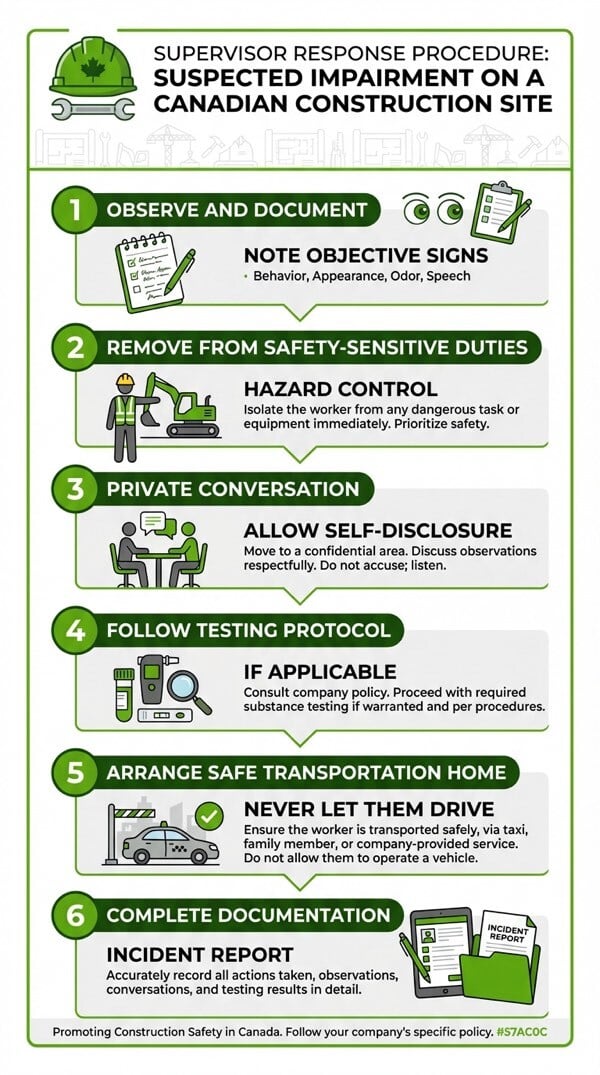
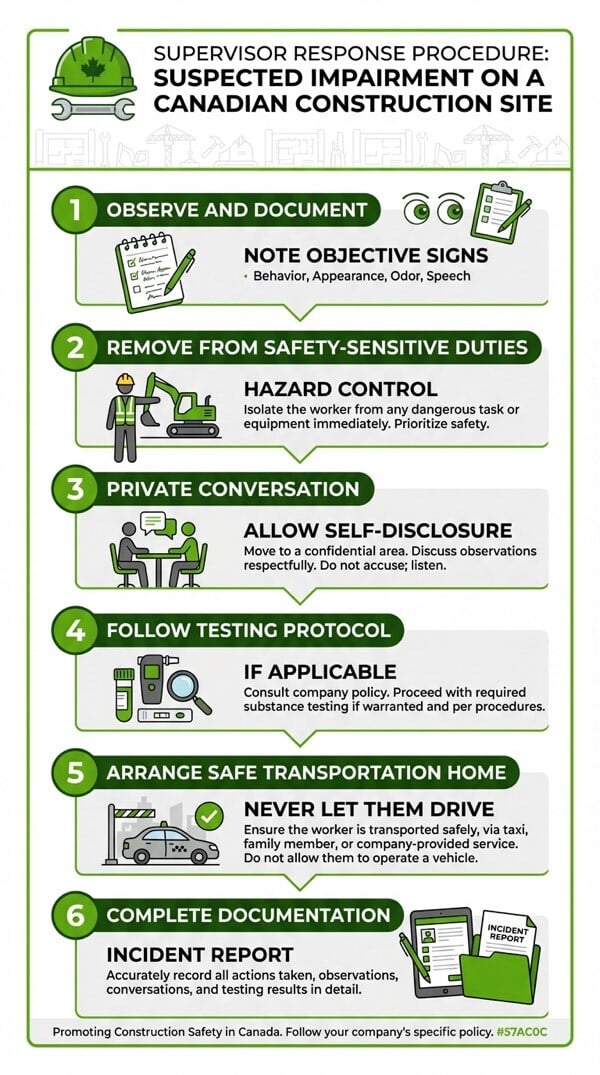
A good drug and alcohol policy includes a clear supervisor response procedure:
- Observe and document. Note specific, objective signs: unsteady gait, slurred speech, smell of alcohol, bloodshot eyes, erratic behaviour. Stick to observable facts, not assumptions about what someone consumed
- Remove the worker from safety-sensitive duties immediately. This is not punishment. It is hazard control. You have a legal obligation to not assign impaired workers to tasks where they could injure themselves or others
- Conduct a private conversation. Ask if the worker is feeling okay. Give them a chance to self-disclose. Some impairment comes from legitimate medical conditions or prescription medication
- Follow your testing protocol (if applicable). If your policy includes reasonable cause testing, initiate the process. Document the observable signs that triggered the decision to test
- Arrange safe transportation home. Never let a potentially impaired worker drive themselves. This is both a legal and moral obligation
- Document everything. Complete an incident report. This protects the company, protects the worker, and creates the record you will need if the situation escalates
Include this response procedure in your toolbox talks at least once a year. Supervisors need to practice this before they face it live.
What Are the Human Rights Considerations?
Here is the blunt truth most safety consultants will not put in their brochure: substance addiction is a recognized disability under Canadian human rights legislation. That means you cannot simply fire someone for failing a drug test without considering your duty to accommodate.
The Supreme Court of Canada addressed this directly in Stewart v. Elk Valley Coal Corp. (2017), ruling that employers in safety-sensitive workplaces can enforce drug and alcohol policies, including termination for policy violations. But the Court also emphasized that accommodation obligations still apply.
What this means for you as a contractor:
- Your policy must include an Employee Assistance Program (EAP) pathway. Before discipline, offer access to support. This is not just good practice; it is a legal expectation in many jurisdictions
- Accommodation up to undue hardship. If a worker discloses an addiction before a policy violation, you are generally required to accommodate them. This might mean modified duties, leave for treatment, or adjusted return-to-work conditions
- Medical cannabis users have rights. You must accommodate medical cannabis use unless doing so would create undue hardship (typically a genuine safety risk in safety-sensitive positions)
- Discipline should be progressive. First violation consequences should differ from repeat violations, and your policy should be transparent about this
This is another area where having your policy reviewed by legal counsel is not optional. The intersection of safety law and human rights law is complex, and getting it wrong can be expensive.
The COAA Canadian Model: Industry Benchmark
If you work in Alberta's construction or energy sectors, you have likely encountered the Canadian Model for Providing a Safe Workplace. Developed jointly by the Construction Owners Association of Alberta (COAA) and Energy Safety Canada, the Canadian Model (currently Version 6.1, issued May 1, 2023) is the most widely adopted drug and alcohol policy framework in the Canadian construction industry.
Many major project owners and GCs require contractors to meet or exceed the Canadian Model's standards as a condition of site access. If you bid on industrial, oil and gas, or major commercial projects in Alberta, your policy should align with this framework.
The Canadian Model covers pre-access testing, reasonable cause protocols, post-incident procedures, return-to-duty requirements, and ongoing monitoring. It also addresses the legal complexities around cannabis and medical accommodation.
How Do You Roll Out a New Policy to Your Crew?
Writing the policy is half the battle. Rolling it out is the other half, and this is where a lot of contractors stumble.
A policy that sits in a binder in the office trailer does not protect anyone. Here is how to make it stick:
- Formal rollout meeting. Gather your crew and walk through the policy. Explain the "why" before the "what." Workers respond better when they understand the policy protects everyone, not just the company
- Signed acknowledgment. Every worker signs a form confirming they received, read, and understand the policy. Keep these on file. COR auditors will ask for them
- Integrate into orientation. Every new hire reviews the policy on Day 1 as part of their construction safety orientation
- Annual refresher. Run a dedicated toolbox talk on the drug and alcohol policy at least once per year. Document attendance
- Supervisor training. Train your foremen and supervisors separately on how to recognize impairment, how to intervene, and how to document. They need to feel confident in the moment, not scrambling to find the policy in the binder
- Post it visibly. Put a summary of key policy points in the lunchroom, on the safety board, and in your digital safety system
Build the Policy Before You Need It
The worst time to write a drug and alcohol policy is after an incident. By then, you are reacting: to an injured worker, to an OHS investigation, to a GC demanding documentation you do not have, to a human rights complaint you did not see coming.
The best time is right now. A well-written drug and alcohol policy, integrated into your broader safety management program, protects your crew, protects your company, and satisfies the auditors and GCs who control your ability to bid.
It does not need to be 50 pages. It does need to be clear, legally sound, communicated to every worker, and supported by supervisor training and documentation.
At Safety Evolution, we help contractors across Canada build safety programs that actually work on site, including drug and alcohol policies that hold up to COR audits, OHS inspections, and the real-world situations your foremen face every week. If you are not sure where to start, or if your current policy would survive scrutiny, let us take a look.
Document Your Policy Acknowledgment Instantly
Having a D&A policy doesn't protect you if you can't prove workers signed off on it. Push digital policy updates to your entire crew and track their digital signatures in real time with Safety Evolution.
30-Day Free Trial
Frequently Asked Questions
Can I drug test my construction workers in Canada?
Yes, but with significant legal limitations. Drug testing is generally permissible for safety-sensitive positions under specific circumstances: reasonable cause (observable signs of impairment), post-incident (where impairment may have contributed), and pre-access (common on major industrial projects following the COAA Canadian Model). Random testing is legally contentious and typically only upheld where there is demonstrated evidence of a workplace substance use problem. All testing must comply with provincial human rights legislation. Have your testing policy reviewed by legal counsel before implementation.
Is a drug and alcohol policy required for COR certification?
While COR does not list "drug and alcohol policy" as a standalone audit element, it is evaluated under multiple audit categories including hazard identification, rules and work procedures, training, and incident investigation. A missing or inadequate drug and alcohol policy can negatively impact your scores across several elements. Most certifying partners and auditors expect to see a documented, communicated substance use policy as part of a complete safety management system.
Can I fire a worker who tests positive for cannabis?
Not automatically. A positive cannabis test does not necessarily prove impairment at the time of testing, since THC can remain in a person's system for days or weeks. Additionally, substance addiction is a recognized disability under Canadian human rights legislation, meaning you may have a duty to accommodate before terminating. Your policy should include progressive discipline, an Employee Assistance Program pathway, and a return-to-duty process. Consult legal counsel before making termination decisions based on drug test results.
What is the COAA Canadian Model?
The Canadian Model for Providing a Safe Workplace is a best-practice drug and alcohol guideline developed jointly by the Construction Owners Association of Alberta (COAA) and Energy Safety Canada. Currently on Version 6.1 (issued May 1, 2023), it provides a standardized framework for drug and alcohol policies that stakeholders across the Canadian construction and energy industries can adopt. Many major project owners and GCs require contractors to meet or exceed the Canadian Model's standards as a condition of site access.
Do I need to accommodate a worker with a substance addiction?
Generally, yes. Under Canadian human rights legislation, substance addiction (including alcohol and drug dependence) is considered a disability. Employers have a duty to accommodate to the point of undue hardship. This may include offering access to an Employee Assistance Program, providing leave for treatment, modifying duties during recovery, or implementing a return-to-duty agreement. However, accommodation does not require you to accept ongoing safety risks. In safety-sensitive positions, the duty to maintain a safe workplace can limit the scope of accommodation required.
How often should I update my drug and alcohol policy?
Review your policy at least annually, and update it whenever there are changes to applicable legislation, case law developments, changes in your operations, or after a significant incident reveals gaps. The COAA Canadian Model is updated periodically (most recently Version 6.1 in May 2023), so check that your policy aligns with the current version if your projects require Canadian Model compliance. Document all reviews and updates as part of your safety management system.
Get Weekly Safety Insights
Regulation updates, toolbox talk ideas, and compliance tips. One email per week.