Last updated: March 2026
A GC just told you that everyone on your crew needs "confined space certification" before they can start work next Monday. You have got training tickets but no idea if those count as a certification. The GC cannot explain the difference either. Welcome to one of the most confusing terminology problems in Canadian construction safety.
Safety Evolution deals with this confusion daily. Contractors call us asking about confined space certification and what they actually need is a training certificate, or vice versa. The words sound the same but mean different things, and getting them mixed up can cost you a project.
⚡ Quick Answer
- What it means: In Canada, "confined space certification" most commonly refers to a training completion certificate (ticket) from an accredited provider, not a professional designation
- No national licence: There is no single national confined space licence or credential in Canada. Training certificates come from individual providers
- Common certificates: ESC Confined Space Entry and Monitor (3-year validity), AASP Confined Space Awareness, provincial provider courses
- Cost: $30 to $250+ depending on the level and format
- Online options: Available for both awareness and entry/monitor levels from accredited providers
What Does Confined Space Certification Actually Mean?
In Canada, "confined space certification" typically refers to a training completion certificate issued by an accredited training provider after a worker successfully completes a confined space course and passes the exam. It is not a professional designation, a government-issued licence, or a trade certification.
This is the most important thing most contractors get wrong. There is no federal or provincial body that issues a "Confined Space Licence" the way a province issues an electrician's licence or a crane operator's ticket. What you get from a training provider is a certificate of completion that proves you passed a course covering confined space hazards, entry procedures, and emergency response.
That certificate (or "ticket") is what GCs check during orientation. When a GC says "do your workers have confined space certification," they are asking whether your crew has completed an accredited training course and has a valid certificate to prove it.
For a full breakdown of what the training covers, including provincial requirements and costs, see our confined space training guide. For the broader context of confined space regulations in Canada, read our complete confined space guide.
Certification vs Training: What Is the Difference?
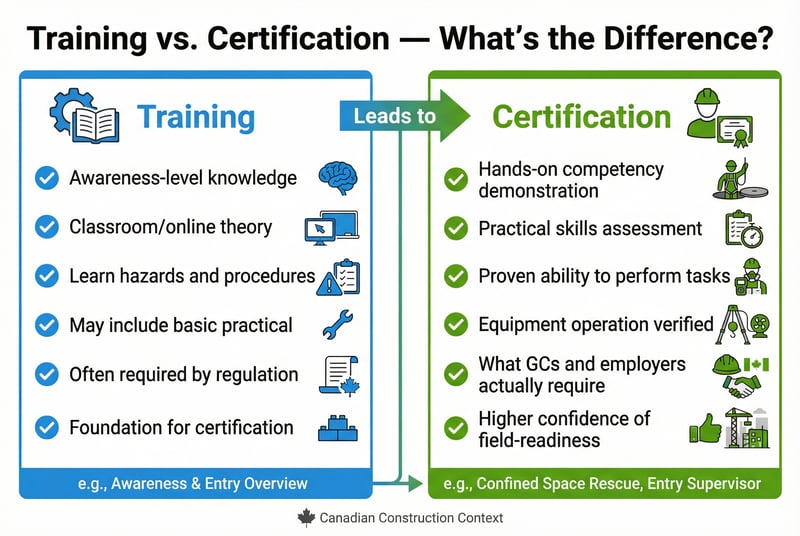
The terms get used interchangeably on job sites, but here is the actual distinction:
|
Training Certificate |
Professional Certification |
| What it is | Proof of course completion | Credential from a recognized body (e.g., CRSP, NCSO) |
| Issued by | Training provider (ESC, AASP, WSPS, etc.) | Professional association (BCRSP, CSSE, etc.) |
| Validity | Typically 3 years | Ongoing with CPD requirements |
| Who needs it | Workers entering confined spaces | Safety professionals, safety officers |
| What GCs check | This one. Valid ticket, current date. | Not typically required for entry-level workers |
When someone searches for "confined space certification," they almost always mean the training certificate. That is what you need for your crew to get on site.
What Certificates Are Recognized in Canada?
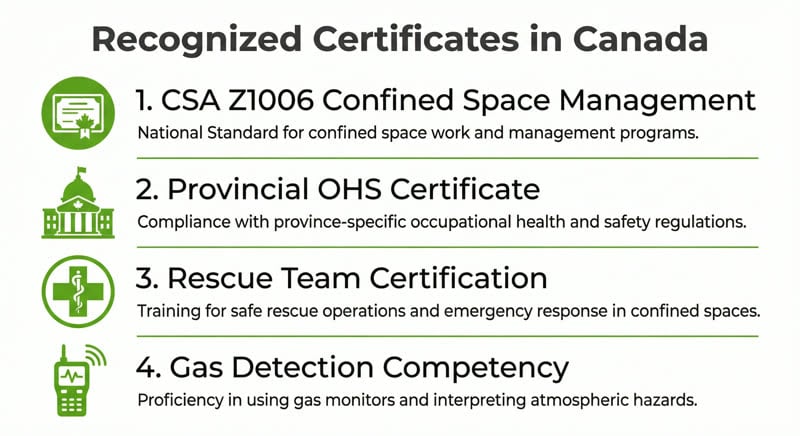
There is no single nationally mandated certificate. Recognition depends on your province, your industry, and your client. Here are the most widely accepted options:
Energy Safety Canada (ESC) Confined Space Entry and Monitor
The de facto standard for oil and gas and heavy industrial work across Western Canada. Covers confined and restricted space identification, hazard assessment, atmospheric testing, entry procedures, and emergency response. Available online and in-classroom. Certificate valid for 3 years. Developed using CSA Z1006-16. If you work in Alberta or BC energy sector, this is what GCs expect to see.
Provincial Safety Association Courses
Each province has safety associations that offer confined space training:
- Ontario: WSPS (Workplace Safety and Prevention Services) and IHSA (Infrastructure Health and Safety Association) offer confined space programs. These are the standard in Ontario construction and industrial settings.
- BC: BCCSA (BC Construction Safety Alliance) recognizes ESC courses and offers related training programs.
- Alberta: ACSA (Alberta Construction Safety Association) and numerous private providers offer courses aligned with OHS Code Part 5 requirements.
Provincial Certification Differences: Alberta vs BC vs Ontario
Although there is no national standard, each province handles confined space certification requirements differently. Understanding these differences matters if your crew works across provincial lines.
- Alberta: Confined space training must align with OHS Code Part 5. Alberta does not mandate a specific provider, but the training must cover hazard assessment, atmospheric testing, entry and exit procedures, and rescue. ESC and ACSA courses are the most commonly accepted. Many Alberta GCs require ESC specifically for energy sector work.
- British Columbia: WorkSafeBC requires confined space training under Part 9 of the OHS Regulation. BC does not certify providers directly, but the training content must address the BC hazard classification system (low, moderate, and high hazard atmospheres). ESC courses are widely accepted in BC's industrial sector. BCCSA members often have pre-approved provider lists.
- Ontario: Ontario's O. Reg. 632/05 governs confined space requirements. Training is typically sourced from WSPS, IHSA, or approved private providers. Ontario GCs in construction are more likely to require IHSA-specific courses, while industrial facilities may accept broader providers. Ontario also requires a written confined space program, which goes beyond the certificate itself.
If your company operates in multiple provinces, consider using a nationally recognized provider like ESC. Their course content generally meets or exceeds the requirements in all three provinces, reducing the risk of a certificate being rejected during site orientation.
Private Provider Courses (AASP, Fast Rescue, Worksite Safety, etc.)
Numerous private training companies offer confined space awareness and entry courses, often at lower price points ($30 to $150 for online courses). These are generally accepted for construction and general industry work. Verify that the specific course is accepted by your GC before enrolling. Some GCs maintain approved provider lists.
Never Miss an Expired Ticket Again
Is your training matrix a nightmare to manage? Track confined space certifications automatically, get alerts before they expire, and physically block uncertified workers from signing entry permits.
30-Day Free Trial
Can You Get Confined Space Certification Online?
Yes. Both awareness-level and entry/monitor-level confined space courses are available online from multiple accredited providers in Canada.
ESC's Confined Space Entry and Monitor course has a fully online option with a proctored final exam. The online certificate is identical to the classroom certificate and is valid for 3 years. Other providers such as AASP, Worksite Safety, and Fast Rescue also offer online confined space courses at various levels.
The key distinction between legitimate online courses and low-quality alternatives:
- Proctored exams: The course requires webcam-monitored testing, not just clicking through slides
- Verifiable certificates: The certificate can be confirmed through the provider's online registry
- Industry recognition: The course appears on your GC's or operator's approved training list
- Content depth: The course covers atmospheric testing, entry procedures, and rescue awareness, not just hazard identification
Online courses are a practical option for renewal, remote workers, and awareness-level training. For first-time entry and monitor certification, especially for workers new to industrial environments, in-person training with hands-on components provides better skill development.
Online vs In-Person Certification: Which Should You Choose?
|
Online Course |
In-Person Course |
| Duration | 4 to 8 hours, self-paced | 6 to 8 hours, instructor-led |
| Cost | $30 to $150 | $110 to $250+ |
| Hands-on practice | No (theory and video-based) | Yes (equipment use, mock entries) |
| Best for | Renewals, remote workers, awareness level | First-time entrants, rescue-level training |
| GC acceptance | Widely accepted from reputable providers | Universally accepted |
For workers renewing an existing certificate or those who primarily need awareness-level knowledge, online is efficient and cost-effective. For first-time entry and monitor candidates, especially those who have never used gas detection equipment or donned a harness, the hands-on component of in-person training builds real competence that slides and videos cannot replicate.
How Long Is the Certificate Valid?
Most confined space training certificates are valid for 3 years from the date of course completion. This is the standard validity period for ESC courses, AASP courses, and most provincial provider programs.
Important notes on validity:
- The 3-year expiry applies to the certificate itself. Your employer is responsible for determining whether refresher training is needed sooner based on the "adequate training" requirement in provincial OHS legislation.
- Some GCs and operators require annual refreshers, even when the certificate is still valid. Check before you bid.
- Site-specific training for each new confined space is separate from the generic certificate and must be provided by the employer.
What Does the Renewal Process Look Like?
Renewing a confined space certificate is straightforward but requires planning. Here is the typical process:
- Check your expiry date: Most certificates show the completion date and a 3-year expiry. Do not wait until the week before expiry to start looking for a course.
- Choose your format: Renewals can usually be done online, even if your original training was in-person. The content is the same refresher curriculum.
- Complete the course and exam: Renewal courses are often shorter than the initial course (4 to 6 hours vs 6 to 8 hours) because they assume existing knowledge.
- Download your new certificate: Most providers issue certificates immediately upon passing the exam. Update your training matrix and distribute copies to active GCs.
Start the renewal process at least 30 days before expiry. If a worker's certificate expires mid-project, they cannot legally enter a confined space until the renewal is complete, which means potential delays and replacement labour costs.
Track your team's certificate expiry dates in a training matrix. A training management system that sends automatic expiry reminders prevents the scramble of discovering expired tickets during site orientation. For COR or SECOR holders, maintaining current training records is an audit requirement.
How Much Does Confined Space Certification Cost?
Costs depend on the certificate level and delivery format. Here are typical ranges as of 2026:
- Awareness level (online): $30 to $50 per worker
- Entry and monitor (online): $80 to $150 per worker
- Entry and monitor (classroom): $110 to $250+ per worker
- Rescue certification: $250 to $500+ per worker (1 to 2 days)
If you need multiple workers certified, ask providers about group rates or on-site delivery. Bringing an instructor to your facility is often more cost-effective than sending 10 workers to a training centre individually. For confined space rescue certification, expect higher costs because of the hands-on equipment practice required.
What to Look for in a Certification Provider
Not all training providers are equal. Before you enroll your crew, use this checklist:
- Accreditation: Is the provider recognized by a provincial safety association or national body like ESC? Ask for their accreditation documentation.
- Course content alignment: Does the course cover the specific requirements of your province's OHS legislation? A generic "confined space awareness" course may not satisfy entry-level requirements.
- Exam format: Legitimate courses require a proctored exam with a minimum passing grade (typically 80%). Courses that let you retake the exam unlimited times with no proctoring are a red flag.
- Certificate verification: Can the certificate be independently verified through the provider's online portal? GCs increasingly check certificates against provider databases.
- GC acceptance: Before paying, confirm with your primary GCs that they accept certificates from this provider. Some GCs maintain approved provider lists and will reject certificates from providers not on the list.
- Support and records: Does the provider maintain your training records and offer replacement certificates if the original is lost? Can they provide bulk enrolment and tracking for your team?
Never Miss an Expired Ticket Again
Is your training matrix a nightmare to manage? Track confined space certifications automatically, get alerts before they expire, and physically block uncertified workers from signing entry permits.
30-Day Free Trial
Frequently Asked Questions
Is there a national confined space certification in Canada?
No. There is no single national confined space licence or certification in Canada. Confined space training is regulated at the provincial level, and certificates are issued by individual training providers such as Energy Safety Canada, WSPS, IHSA, and private companies. The most widely recognized certificate in Western Canada is ESC's Confined Space Entry and Monitor, valid for 3 years.
What is the difference between confined space certification and a confined space ticket?
They are the same thing. "Ticket" is the informal term used on job sites for a training completion certificate. When a GC asks for your "confined space ticket," they want to see a valid training certificate from a recognized provider showing your worker completed an accredited confined space course.
Do I need confined space certification for awareness-only work?
If your workers may encounter confined spaces but do not enter them, a confined space awareness certificate is typically sufficient. This is a shorter course (1.5 to 4 hours) that covers hazard identification and the basics of safe entry. Workers who will actually enter confined spaces need the full entry and monitor certification, which is a more comprehensive course covering atmospheric testing, permits, and rescue procedures.
Can I use an Alberta confined space certificate in BC or Ontario?
There is no automatic interprovincial recognition. However, certificates from nationally recognized providers like ESC are widely accepted across provinces because the course content exceeds most provincial minimum requirements. Always verify with your GC or project owner in the new province. Some Ontario GCs may require WSPS or IHSA courses specifically.
Get Weekly Safety Insights
Regulation updates, toolbox talk ideas, and compliance tips. One email per week.