Last updated: March 2026
You just landed a demolition contract on a pre-1990 building in the Lower Mainland. Three weeks in, WorkSafeBC shows up and asks for your asbestos abatement licence. You do not have one. Neither do your workers have their certification cards. The project stops. Your crew sits idle. And the GC starts calling the next name on the list.
This is not a hypothetical. Since January 1, 2024, BC has been enforcing the strictest asbestos regulations in Canada. In 2023 alone, WorkSafeBC handed out more than 68 penalties across the province for asbestos-related violations. If your crew does any asbestos abatement work on buildings and you have not sorted out licensing and certification, you are exposed.
Asbestos training in BC is now a formal, regulated process. Anyone performing asbestos abatement work must complete training from a WorkSafeBC-approved provider, pass a written exam, and hold a WorkSafeBC-issued certificate. Contractors must hold an asbestos abatement licence. BC is the first jurisdiction in Canada to enforce a formal asbestos abatement licensing program, and the requirements have been in full effect for over two years.
⚡ Quick Answer
- What changed: As of January 1, 2024, asbestos abatement contractors must be licensed and workers must be certified in BC
- Who needs a licence: Employers offering asbestos abatement services to others in relation to buildings
- Who needs a certificate: Any worker performing asbestos abatement work in relation to a building
- 4 certification levels: Level 1 (Foundational Awareness), Level 2 (Asbestos Safety), Level 3 (Asbestos Safety Leader), Level S (Surveyor Safety)
- Certificate validity: 3 years from date of issue
- Licence fee: No fee to apply for a licence through WorkSafeBC
Asbestos training in BC is regulated by WorkSafeBC under OHS Regulation Part 6, which sets out specific training requirements based on the type of asbestos work being performed. BC has some of the most detailed asbestos training requirements in Canada, with distinct certification levels for awareness, moderate-risk removal, and high-risk abatement work.
This guide covers what BC contractors need to know: the training tiers, certification requirements, approved training providers, and what WorkSafeBC expects to see on an inspection.
What Changed on January 1, 2024?
In spring 2022, the BC government passed amendments to the Workers Compensation Act (Bill 5) creating a formal licensing and certification framework for asbestos abatement. WorkSafeBC spent the next 18 months developing policy, building the application portal, and approving training providers. By September 2023, they began accepting licence applications from contractors. On January 1, 2024, enforcement started.
Here is what the new rules require:
- Contractors offering asbestos abatement services to others in relation to buildings must hold a valid asbestos abatement licence (AAL) issued by WorkSafeBC
- Workers performing asbestos abatement work in relation to buildings must hold a WorkSafeBC-issued certificate at the appropriate level
- Training must come from a WorkSafeBC-approved provider. No exceptions. Your in-house program does not count unless it is approved.
Most contractors think they only need to worry about licensing if they are a dedicated asbestos removal company. They are wrong. If you are a renovation contractor, a demolition contractor, a fire and flood restoration company, or even a plumber who offers asbestos removal as part of your services, you need a licence. The definition of "asbestos abatement work" is broad: identifying, sampling, assessing risk, removing, repairing, transporting, disposing of, or supervising work with asbestos-containing material (ACM) in relation to a building.
Who Needs Asbestos Training and Certification?
The short answer: anyone whose hands touch asbestos-related work on buildings in BC. But the details matter, because not everyone needs the same level.
Workers who need certification include:
- Asbestos abatement workers (removal, repair, transport, disposal)
- Asbestos surveyors and sample collectors
- Supervisors planning or overseeing asbestos abatement
- Workers at fire/flood restoration companies handling ACM
Workers who do not need certification but should consider Level 1 training:
- Electricians, plumbers, HVAC contractors, and flooring contractors who may encounter ACM during their regular work but are not performing abatement
WorkSafeBC recommends Level 1 (Foundational Awareness) for these trades. It is not mandatory, but if your crew regularly works in pre-1990 buildings, it is the smart move. One accidental disturbance of ACM can trigger an exposure incident, a stop-work order, and a WorkSafeBC investigation.
For employers trying to sort out their obligations, our guide to asbestos removal and abatement safety covers the procedural requirements in detail.
WorkSafeBC Requires Specific Asbestos Training by Task Type
SE-AI checks your training records against WorkSafeBC asbestos requirements and flags workers who are overdue or missing the required training level.
Get Early Access →
What Are the Certification Levels?
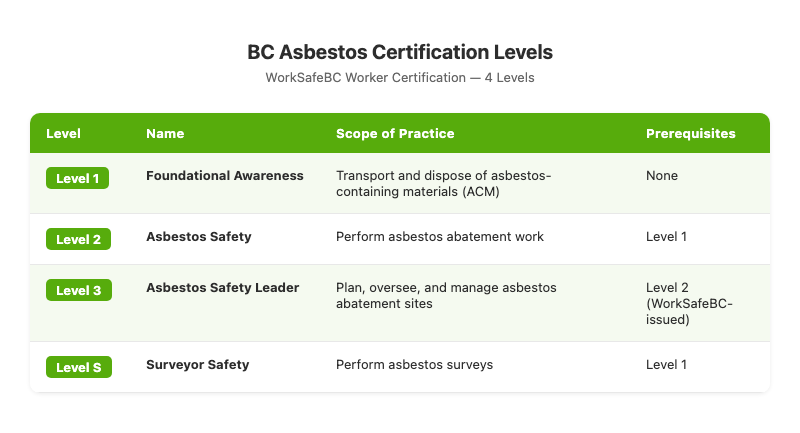
WorkSafeBC created four certification levels, each with its own scope of practice. Getting the wrong level for your crew's actual work is one of the most common mistakes we see. A Level 1 worker cannot legally perform abatement. A Level 2 worker cannot supervise an abatement site. Here is the breakdown:
Level 1: Foundational Awareness
- Scope: Transport asbestos-containing materials and dispose of asbestos waste
- Prerequisites: None
- Best for: Workers handling transport and disposal, plus trades who want general asbestos safety knowledge
Level 2: Asbestos Safety
- Scope: Perform asbestos abatement work (removal, repair, encapsulation)
- Prerequisites: Level 1 (unless the training course combines both levels)
- Exam: Written exam plus practical assessment
- Best for: Your front-line abatement crew
Level 3: Asbestos Safety Leader
- Scope: Everything in Level 1 and 2, plus planning, overseeing, and managing asbestos abatement sites
- Prerequisites: Must hold a WorkSafeBC-issued Level 2 certificate
- Best for: Site supervisors and project managers overseeing abatement projects
Level S: Surveyor Safety
- Scope: Perform asbestos surveys (identification and sampling)
- Prerequisites: Level 1 (unless the course combines both levels)
- Best for: Asbestos surveyors and inspectors
One detail that trips up employers: if a worker holds multiple certification levels, they only need to renew the highest level. A Level 3 holder does not also need to separately renew Level 2 and Level 1.
How Does the Certification Process Work?
The path from untrained worker to certified asbestos abatement professional follows a specific sequence. There are no shortcuts, and no grandfathering provisions for experienced workers who never held formal certification.
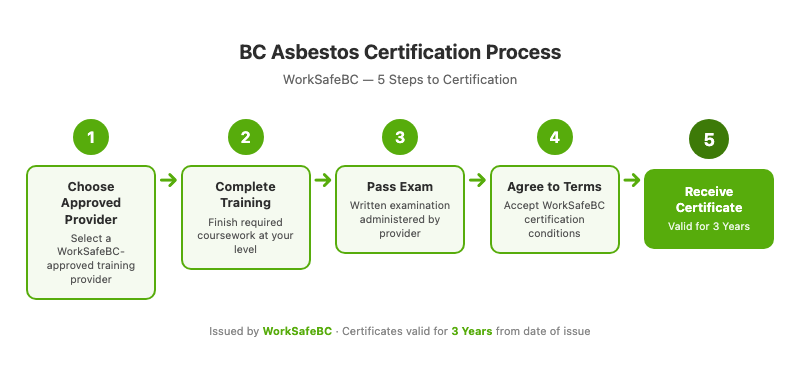
- Choose an approved training provider. WorkSafeBC maintains a list of approved providers on their website. Only training from these providers qualifies for certification. Course dates, locations, length, and costs vary by provider, so contact them directly for details.
- Complete the training program. The curriculum covers asbestos hazard recognition, safe work procedures, regulatory requirements, and practical skills (for Level 2 and above).
- Pass the exam. Levels 1 and S require a written exam. Level 2 requires both a practical assessment and a written exam. Exams are available in English, Chinese (simplified and traditional), Punjabi, Spanish, and Tagalog.
- Agree to the terms and conditions and code of practice. WorkSafeBC requires certification holders to acknowledge their responsibilities.
- Receive your certificate. Valid for 3 years from the date of issue, regardless of whether you stay in BC during that period.
Here is the blunt truth most training providers will not tell you: the exam is not a rubber stamp. Workers do fail. If your crew has been doing asbestos work "the way we have always done it" without formal training, the gap between their habits and the current regulatory standard may be wider than you think. Budget for potential retakes when planning your training schedule.
If your workers completed asbestos-related training with an approved provider after January 1, 2020, they may qualify for full or partial credit toward certification. Workers with valid certificates from Alberta or Prince Edward Island may be eligible for reciprocal certification. Workers who completed equivalent programs in Ontario or Newfoundland and Labrador can apply for equivalency, though they still need to pass WorkSafeBC's exam.
What Do Contractors Need for a Licence?
Getting your asbestos abatement licence (AAL) is straightforward if your paperwork is in order. If it is not, the application will stall.
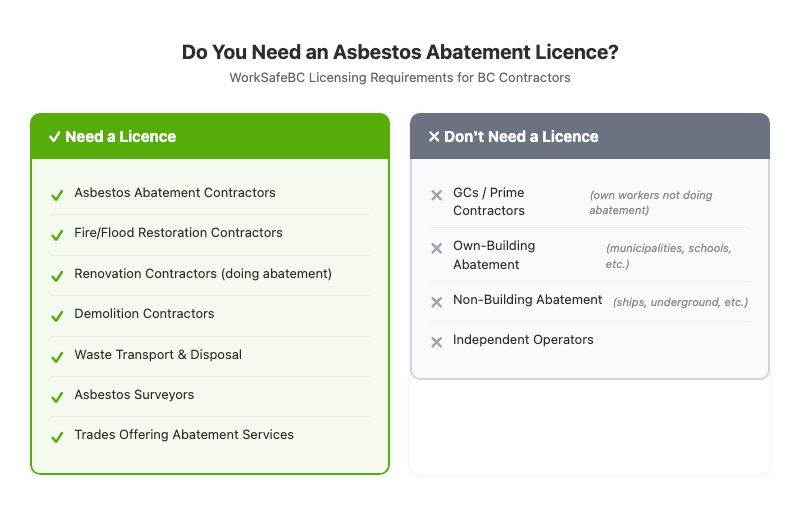
Who needs a licence:
- Asbestos abatement contractors
- Fire and flood restoration contractors
- Renovation contractors performing abatement
- Building demolition contractors
- Asbestos waste transport and disposal contractors
- Asbestos surveyors
- Any trade offering asbestos abatement as an additional service
Who does not need a licence:
- Prime contractors and GCs whose own employees are not performing abatement (but you must verify that your subcontractors are licensed)
- Employers doing abatement on their own buildings (municipalities, school boards, health authorities)
- Employers doing abatement work not in relation to buildings (ships, underground, outdoor piping)
- Independent operators (optional, not required)
Application process:
- Register with WorkSafeBC (if not already registered)
- Log in to the WorkSafeBC online services portal
- Navigate to the Health & Safety tab, then Licensing
- Complete the application form (approximately 20 minutes, should be done by a director or officer of the company)
There is no fee to apply for a licence. However, you must be current on your WorkSafeBC insurance payments (assessments) and any administrative penalty payments. Outstanding amounts can delay or block your application. If you have amounts owing, WorkSafeBC recommends contacting their Collections department to arrange payment before applying.
For GCs: even though you do not need a licence yourself, OHS Regulation Section 6.2.3 requires you to verify that any asbestos abatement contractor you hire holds a valid licence before they start work. If they are not licensed and you let them on site, you are exposed too.
What About Record-Keeping?
Licensing and certification are the visible requirements. The one that quietly catches contractors is documentation.
OHS Regulation Section 6.2.2 requires employers to record details of asbestos in the workplace. This means maintaining records of where ACM has been identified, what condition it is in, what controls are in place, and what abatement work has been done. For contractors managing multiple projects, this documentation burden adds up fast.
Your records should include:
- Copies of all workers' certification cards (with expiry dates tracked)
- Your asbestos abatement licence documentation
- Asbestos survey reports for each project
- Safe work procedures for asbestos abatement
- Air monitoring results (where applicable)
- Training records and refresher schedules
- Disposal documentation
If you are already running a structured safety program through a system like Safety Evolution's safety management services, adding asbestos documentation is a matter of building it into your existing framework. If you are still running paper-based records, this is the kind of compliance requirement that tips the scale toward going digital.
Need a foundation for structuring your worker records? Our orientation and onboarding package includes templates for tracking training certifications and expiry dates.
What Happens If You Are Not Compliant?
The enforcement is real. WorkSafeBC has been active since the requirements took effect, and the consequences go beyond fines:
- Stop-work orders: WorkSafeBC can shut down your project if workers are not certified or the contractor is not licensed. Your crew sits idle while the GC scrambles for a replacement.
- Administrative penalties: Financial penalties for violations. In 2023, before full enforcement even began, more than 68 penalties were issued across BC for asbestos-related violations.
- Licence suspension or revocation: If you have a licence but violate the terms, WorkSafeBC can suspend or revoke it.
- Reputational damage: WorkSafeBC maintains a public registry of licensed contractors. GCs check it. If you are not on the list, you do not get the call.
- Liability exposure: Operating without proper licensing and certification exposes your company to increased liability in the event of a worker exposure incident.
The penalty risk is not theoretical. Five companies on Vancouver Island alone were fined by WorkSafeBC for improper asbestos abatement standards in a single enforcement sweep. If your operation touches asbestos work in BC, compliance is not optional.
How Does BC Compare to Alberta?
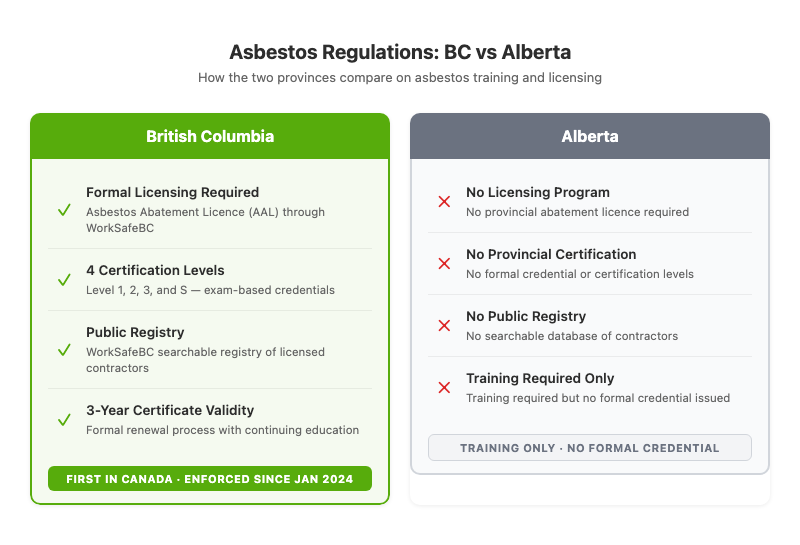
If your company operates in both provinces, the difference is stark. Alberta OHS Code Part 4 covers asbestos as a hazardous substance, and employers must ensure workers are trained. But Alberta has no equivalent licensing program, no formal provincial certification body for asbestos workers, and no public registry of licensed contractors.
In practical terms: a BC-certified asbestos worker moving to Alberta has a credential that Alberta does not issue. An Alberta worker moving to BC must get certified, though reciprocal pathways exist for workers who hold valid Alberta asbestos certificates.
The expectation across the industry is that other provinces will eventually follow BC's lead. If you operate nationally, building your training program to BC's standard now means you are already ahead when the next province implements its own requirements.
How Do You Renew Certification?
Certificates are valid for 3 years. When renewal time comes, your path depends on how long you have waited:
- Within the 3-year validity period or up to 12 months after expiry: Retake and pass the exam only. No need to retake the full training program (though some additional training may be required if regulations have changed since your original certification).
- More than 12 months after expiry: Must retake the full training program and pass the exam from scratch.
The lesson: do not let certificates lapse. Track your crew's expiry dates and schedule renewals before they expire. A worker with an expired certificate cannot legally perform asbestos abatement work in BC, and you cannot put them on a project.
If you need help building a training management system that tracks certification expiry dates and sends reminders, Safety Evolution can set that up as part of your safety program.
Are Your BC Workers Current on Asbestos Training Requirements?
SE-AI analyses your training records against WorkSafeBC asbestos training requirements. It flags workers whose asbestos training has expired, workers assigned to asbestos-related tasks without the correct training level, and gaps between your training schedule and WorkSafeBC regulations.
Get Early Access to SE-AI →
Frequently Asked Questions
Do I need an asbestos abatement licence in BC?
If your company offers asbestos abatement services to others in relation to buildings, you need a licence. This includes asbestos removal contractors, demolition contractors, renovation contractors doing abatement, fire and flood restoration contractors, asbestos surveyors, and any trade offering abatement as an additional service. Prime contractors and GCs whose own employees do not perform abatement do not need a licence, but must verify their subcontractors are licensed.
How long is asbestos certification valid in BC?
Asbestos abatement certificates issued by WorkSafeBC are valid for 3 years from the date of issue. You can renew within 12 months of expiry by retaking the exam. If more than 12 months have passed since expiry, you must retake the full training program and exam.
Who are the approved asbestos training providers in BC?
WorkSafeBC maintains a list of approved training providers on their website. Approved providers include organizations like the BC Construction Safety Alliance (BCCSA), Pinchin Ltd., and several others. Only training from approved providers qualifies for WorkSafeBC certification. Contact providers directly for course dates, locations, and costs.
Does Alberta require asbestos certification?
Alberta does not have an equivalent asbestos licensing or certification program. Alberta OHS Code Part 4 requires employers to ensure workers handling asbestos are properly trained, but there is no provincial certification body, no formal licensing requirement, and no public registry of asbestos contractors. Workers with valid Alberta asbestos certificates may be eligible for reciprocal certification in BC.
What are the 4 levels of asbestos certification in BC?
BC has 4 certification levels: Level 1 (Foundational Awareness) for transport and disposal; Level 2 (Asbestos Safety) for performing abatement work; Level 3 (Asbestos Safety Leader) for planning, overseeing, and managing abatement sites; and Level S (Surveyor Safety) for performing asbestos surveys. Each level has specific prerequisites and scope of practice.
Is there a fee to apply for an asbestos abatement licence?
There is no fee to apply for an asbestos abatement licence through WorkSafeBC. However, you must be registered with WorkSafeBC and current on your insurance payments (assessments) and any administrative penalty payments. Outstanding amounts may delay or block your application.
Get Weekly Safety Insights
Regulation updates, toolbox talk ideas, and compliance tips. One email per week.