Training
BC Forklift Certification: CSA B335-15 Guide
BC forklift training requirements under CSA B335-15 and WorkSafeBC. What employers must do to stay compliant.
Workplace harassment in Canada: legal definition, types, employer obligations, investigation steps, and prevention programs. A guide built for contractors.
Last updated: March 2026
You just got a complaint. One of your crew members says a supervisor has been making comments that crossed the line. You have no policy, no process, and no idea whether this falls under harassment or just a bad day on site. Now you're Googling at 10 PM trying to figure out what the law actually requires you to do before tomorrow morning.
This is the situation Safety Evolution helps contractors navigate every week. Workplace harassment in Canada is governed by federal and provincial law, and your obligations are not optional. They are not something you deal with "when you get bigger." Every employer in Canada, regardless of size, has legal obligations to prevent and address harassment. Getting this wrong leads to fines, lawsuits, WCB claims, and crews that stop trusting you.
Workplace harassment is any unwelcome conduct, comment, or behaviour that a person knows, or ought to know, would humiliate, intimidate, or demean a worker. In Canada, every province and the federal jurisdiction has laws requiring employers to prevent and address workplace harassment, and the penalties for failing to act are getting steeper every year.
This guide covers what Canadian employers need to know: the legal definitions that apply in your province, your obligations as an employer, how to build a compliant harassment program, and what to do when an incident is reported.
Workplace harassment is any action, conduct, or comment, including of a sexual nature, that can reasonably be expected to cause offence, humiliation, or other physical or psychological injury or illness to an employee. That is the federal definition under the Canada Labour Code, subsection 122(1). It is deliberately broad.
This definition covers a lot more than most employers expect. It includes a single serious incident, not just repeated behaviour. It includes comments made digitally: texts, emails, social media. And it includes conduct from anyone connected to the workplace: supervisors, coworkers, clients, subcontractors, and members of the public.
Most contractors think harassment means someone getting physically threatened. They're wrong. The workplace harassment definition under Canadian law catches patterns of behaviour that many employers dismiss as "crew culture" or "just how sites work": persistent insults, exclusion from work assignments, spreading rumours, mocking someone's accent or background. If it causes humiliation or psychological harm, it qualifies.
Provincial definitions vary slightly. Ontario's OHSA defines it as "engaging in a course of vexatious comment or conduct against a worker in a workplace that is known or ought reasonably to be known to be unwelcome." Alberta's OHS Code Part 27 requires employers to have a harassment prevention plan that addresses both violence and harassment. British Columbia addresses it under the Workers Compensation Act (Section 135) and WorkSafeBC policies.
The important point: the definition of workplace harassment varies slightly by province, but every province requires employers to address it. The specific wording differs. The obligation does not. If you operate in multiple provinces, your program needs to meet the requirements of each jurisdiction where your crews work.
For province-specific requirements, we are building detailed guides for Alberta, British Columbia, and Ontario (linked at the bottom of this page).
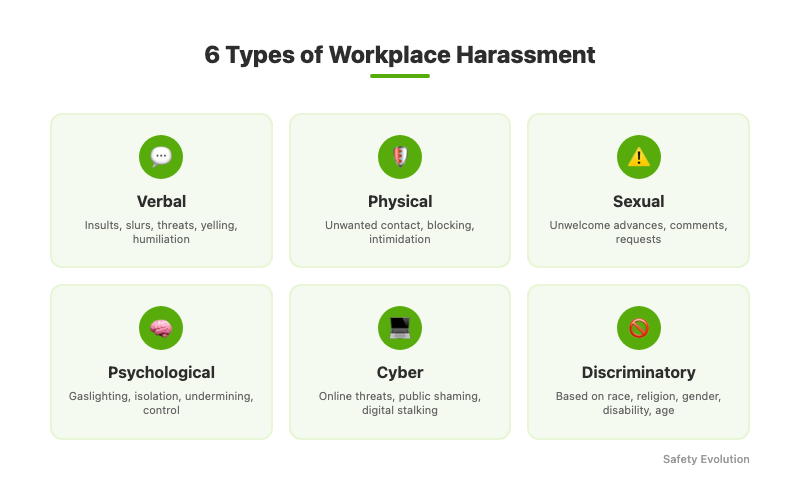
Harassment in the workplace falls into several categories. Understanding these types, and knowing real workplace harassment examples, helps you recognize complaints when they come in and train your crew on what crosses the line.
Yelling, name-calling, persistent insults, mocking someone's accent, race, religion, or appearance. On construction sites, this often gets excused as "busting chops" or site culture. It is not. If it is unwelcome and causes humiliation, it is harassment. Yes, yelling in the workplace can constitute harassment.
Unwanted physical contact: pushing, shoving, blocking someone's path, throwing objects near someone. This overlaps with workplace violence in many provincial definitions. Physical intimidation, like standing too close or invading personal space intentionally, also qualifies.
Unwelcome sexual comments, jokes, advances, touching, or requests for sexual favours. Also includes displaying sexually explicit material on site and making comments about someone's body or appearance. Bill C-65 explicitly includes conduct "of a sexual nature" in the federal harassment definition.
Deliberate exclusion from meetings or assignments, spreading rumours, gaslighting, constant criticism unrelated to work performance, setting impossible deadlines to ensure failure. This is the type that flies under the radar the longest because there is no single dramatic incident to point to.
Harassment via text, email, social media, or group chats. Ontario's OHSA was amended to explicitly include harassment "virtually through the use of information and communications technology." If your crew has a WhatsApp group where someone is being targeted, that counts.
Harassment based on protected grounds under human rights legislation: race, gender, sexual orientation, disability, religion, age, family status. This type carries additional legal exposure because it engages both OHS legislation and human rights law simultaneously.
A strong training program ensures your supervisors and workers can recognize these types before they escalate. Most harassment complaints Safety Evolution sees in the field involve behaviour that started small and was ignored for months.
Workplace harassment law in Canada operates at two levels: federal and provincial. Understanding which one applies to your business is the first step.
If your business is federally regulated (banking, telecommunications, interprovincial transportation, federal government), the Canada Labour Code Part II and the Work Place Harassment and Violence Prevention Regulations (SOR/2020-130) apply directly. Bill C-65, which amended the Code, received Royal Assent on October 25, 2018, and the regulations took effect January 1, 2021.
Federal requirements include:
Most construction contractors, oil and gas companies, and trades businesses are provincially regulated. Each province has its own OHS legislation covering workplace harassment:
Blunt truth: the requirements across provinces are more similar than different. Every province requires a policy, a process, training, and investigation. The differences are in the details: who you report to, what triggers an investigation, and what the penalties look like. If you build a solid national program, you can adapt it to meet any province's specifics.
What If Your Harassment Training Records and Policy Compliance Tracked Themselves?
SE-AI monitors training completion, policy acknowledgements, and investigation timelines. Ask “who hasn’t completed this year’s harassment training?” and get the list instantly.
Be the First to Try It →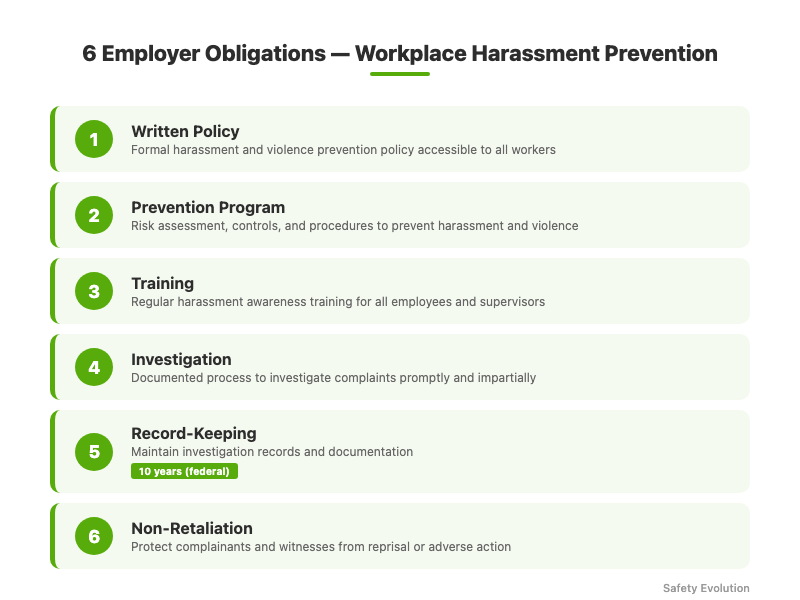
Here is where most contractors get stuck. You know harassment is illegal. You know you need a policy. But what does the law actually require you to do? Here is the breakdown, applicable across most Canadian jurisdictions.
Every employer needs a written workplace harassment and violence prevention policy. This is not a paragraph buried in your employee handbook. It is a standalone document that clearly states: what constitutes harassment, that harassment will not be tolerated, how to report it, and what happens after a report is filed. The policy must be reviewed regularly (annually in Ontario, at least every 3 years in Alberta).
A policy alone is not enough. You need a program that implements the policy. This includes: a workplace risk assessment to identify harassment risk factors, procedures for reporting and investigating complaints, support measures for affected workers, and a commitment to non-retaliation. Building a health and safety program that includes harassment prevention is not extra work; it is a core requirement.
Workers and supervisors must receive training on workplace harassment. SE-AI tracks who has completed training and flags anyone overdue. Training should cover: what harassment is and is not, how to report it, the employer's policy and procedures, the responsibilities of supervisors in responding to complaints, and the consequences of engaging in harassment. This is not a one-time orientation item. Regular refresher training is expected. Federally, the question "how often should workers receive workplace violence and harassment training?" is addressed in the HVP Regulations: training must be provided within 3 months of hire and updated as needed.
When a complaint is received, you must investigate. This is not optional. Even if you think the complaint is minor, even if the complainant says "I don't want to make it a big deal," you have a legal duty to look into it. We cover the investigation process in detail below.
Federal regulations require records to be kept for 10 years. Provincial requirements vary but expect at minimum 2-3 years. SE-AI keeps investigation records searchable and organised so you can produce documentation instantly when it matters. Keep: the complaint, investigation notes, findings, corrective actions taken, and any follow-up. Use a system that is secure and confidential, not a filing cabinet in the office trailer where anyone can access it. Safety Evolution's safety management services include confidential documentation systems built for exactly this kind of record-keeping.
You must protect workers who report harassment from retaliation. Retaliation includes termination, demotion, reduction in hours, reassignment to undesirable work, and any other adverse action. If a worker reports harassment and you punish them for it, you have created a second, potentially worse, legal problem.
The penalties for failing to address workplace harassment are significant and they come from multiple directions:
A 15-person electrical subcontractor in Alberta lost a major GC relationship after an uninvestigated harassment complaint led to a WCB psychological injury claim. The GC's safety department flagged it during a prequalification review. No fine was ever issued, but the lost revenue was six figures. The cost of building a proper program would have been a fraction of that.
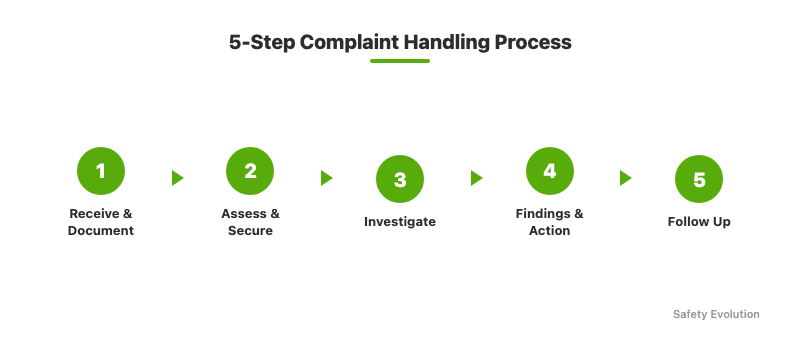
When a complaint comes in, here is the process. This applies whether you are federally or provincially regulated, with minor variations by jurisdiction.
Accept the complaint. Document it in writing immediately: who, what, when, where, witnesses. Do not dismiss it. Do not promise confidentiality you cannot deliver; instead, commit to handling the information with discretion. Use your incident report and investigation kit to capture the details properly from the start.
Assess the immediate risk. Does the complainant need to be separated from the respondent? Do you need interim measures? In construction, this might mean reassigning someone to a different crew or site. Do not default to moving the complainant; that looks like retaliation even if you do not intend it.
Investigate promptly and thoroughly. Interview the complainant, the respondent, and any witnesses. Review any physical evidence (texts, emails, security footage). Document every step. The investigation should be conducted by someone who is impartial. If the complaint involves a supervisor or owner, you will likely need an external investigator. Getting the investigation wrong is the single most common failure point Safety Evolution sees.
Based on the investigation, make a determination. If harassment occurred, take corrective action: this may range from a written warning to termination, depending on severity. Inform both parties of the outcome and the corrective measures being implemented. Document everything.
Check in with the complainant after 30, 60, and 90 days. Has the behaviour stopped? Has there been any retaliation? SE-AI sets these follow-up reminders automatically so nothing slips. Follow-up is where most employers fail. They investigate, take action, and then move on. The law expects ongoing monitoring.
If this process sounds like more than you can handle with your current setup, that is normal. Most contractors running 10-50 person crews do not have HR departments or trained investigators on staff. This is exactly the kind of work that Safety Evolution's done-for-you safety services handle: building the policy, training the team, and guiding investigations when they happen.
A prevention program is not a binder on a shelf. It is a set of practices that your team knows, trusts, and uses. Here is what a solid program includes:
The false belief many contractors hold: "We're too small for this" or "Harassment doesn't happen on my sites." Research says otherwise. A 2022 Canadian study found that over 70% of workers have experienced at least one form of workplace harassment or violence. In 2021, federally regulated employers reported 4,950 occurrences of harassment and violence. Your site is not the exception.
What If You Could Just Ask?
“Is every employee current on harassment training?” “How many complaints were resolved within our 30-day target?” Get answers from your own records in seconds, not days of digging through HR files.
Be the First to Try It →Your workers need to understand their rights, and you should be the one telling them. Being transparent about employee rights builds trust and reduces the likelihood of complaints escalating to external agencies.
In Canada, employees have the right to:
Smart employers do not see these rights as threats. They see them as a framework for building a workplace that retains good people. The responsibility for workplace safety, including a harassment-free environment, sits with everyone from the owner to the newest apprentice. But the legal liability lands squarely on the employer.
Many Canadian laws group harassment and violence together (the federal Canada Labour Code uses the combined term "harassment and violence"), but there is an important distinction:
The overlap is significant: physical harassment is also violence. Sexual harassment can include violence. But understanding the distinction matters because your reporting and investigation processes may differ. Violence that causes physical injury triggers additional reporting requirements to OHS regulators in most provinces. Your incident reporting procedures should account for both.
Canadian workplace harassment law varies by province. These guides cover the specific legislation, reporting channels, and employer obligations in each jurisdiction:
Need help building a prevention program that works across multiple provinces? SE-AI maps your obligations by jurisdiction and flags compliance gaps before they become incidents.
Under the Canada Labour Code, workplace harassment is any action, conduct, or comment, including of a sexual nature, that can reasonably be expected to cause offence, humiliation, or other physical or psychological injury or illness to an employee. Provincial definitions are similar. It includes verbal abuse, bullying, intimidation, sexual harassment, discriminatory behaviour, and cyber harassment. A single serious incident can qualify; it does not have to be a pattern.
Common examples include: persistent yelling or name-calling, mocking someone's accent, race, or background, unwelcome sexual comments or advances, deliberately excluding someone from assignments or meetings, spreading rumours about a coworker, physical intimidation such as blocking someone's path, sending threatening or degrading messages via text or social media, and setting impossible work standards to ensure a specific worker fails.
Penalties vary by province. In Ontario, corporations face fines up to $500,000 per conviction under the OHSA, while individuals can face up to $25,000 and/or 12 months imprisonment. Additional consequences include human rights complaints with financial remedies, WCB claims for psychological injury, civil lawsuits, stop-work orders, and reputational damage that affects your ability to win bids.
Federal regulations require training within 3 months of hire and updates as needed. Most provincial best practices recommend annual refresher training for all workers and immediate training for new hires during orientation. Supervisors should receive additional training on their specific obligations to respond to complaints. Safety Evolution recommends integrating harassment awareness into your regular toolbox talk schedule for ongoing reinforcement.
Yes. Supervisors have a legal duty under OHS legislation to take action when they become aware of harassment. Failing to act can result in personal liability. Under Ontario's OHSA, individual supervisors can face fines up to $25,000 and/or imprisonment. Beyond legal penalties, supervisors who witness harassment and do nothing expose the employer to significantly greater liability because the company is deemed to have had knowledge through its supervisor.
Start with your employer's internal reporting process (required by law in every province). If your employer does not have one, or if the employer is the problem, you can report to your provincial OHS regulator (such as Alberta OHS, the Ontario Ministry of Labour, or WorkSafeBC), your provincial human rights commission, or (for federally regulated workplaces) the Labour Program at Employment and Social Development Canada. You can also consult an employment lawyer specializing in workplace harassment.
Get Weekly Safety Insights
Regulation updates, toolbox talk ideas, and compliance tips. One email per week.
BC forklift training requirements under CSA B335-15 and WorkSafeBC. What employers must do to stay compliant.
Forklift training costs $150 to $500 per operator in Canada. Full cost breakdown by province, training type, and renewal.
What confined space certification means in Canada, which certificates are recognized, online options, costs, and how long your ticket is valid.