Last updated: March 2026
You found out six months ago that your company needed a harassment training program. You told yourself you'd get to it after the current project wrapped. Then a worker filed a complaint, your supervisor handled it poorly, and now you're sitting in a meeting with a labour inspector asking to see your training records.
This is how most contractors discover their workplace harassment training gap: after the fact. Safety Evolution helps Canadian employers build harassment prevention programs that actually hold up when tested. Here's what you need to know before that inspector shows up at your site.
⚡ Quick Answer
- What: Workplace harassment training teaches workers to recognize, report, and prevent harassment and violence at work
- Who needs it: All workers, including supervisors and managers (supervisors need additional content on responding to complaints)
- How often: Federally regulated employers: every 3 years minimum. Provincially regulated: varies, but best practice is every 2-3 years
- Legal basis: Federal: Bill C-65 / Canada Labour Code. Provincial: Ontario OHSA, Alberta OHS Code Part 27, BC Workers Compensation Act, and others
- Cost: Online courses typically run $15-$50 per employee; in-person facilitated sessions range from $500-$2,000+ for group delivery
Workplace harassment training is a structured program that teaches employees how to recognize harassment and violence, understand their employer's prevention policies, report incidents properly, and respond appropriately when they witness or experience harassment at work. It is a legal requirement for employers across Canada, though the specific rules vary by jurisdiction.
What Does the Law Actually Require?
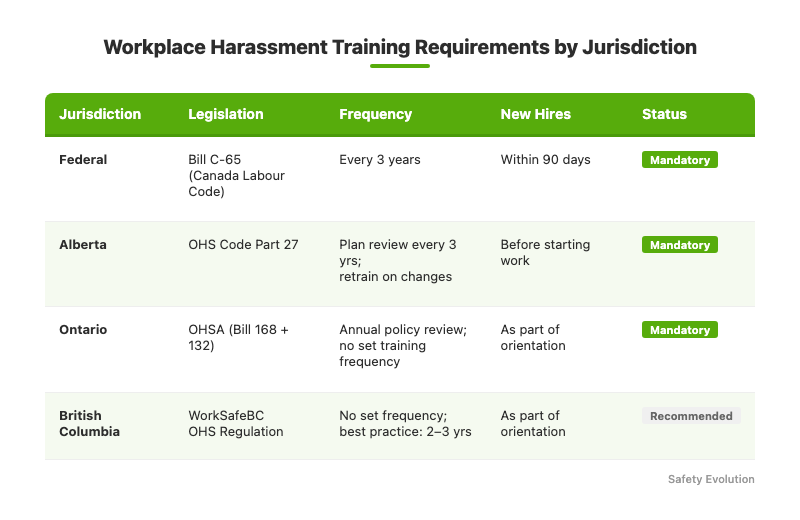
Most contractors think workplace harassment training is optional or just a "nice to have" HR exercise. They're wrong. Every province and the federal government mandate some form of harassment prevention training. The difference is in the details.
If you're a federally regulated employer (think transportation, banking, telecommunications, federal government), the rules are spelled out clearly. Bill C-65, which amended the Canada Labour Code, and the Workplace Harassment and Violence Prevention Regulations (effective January 1, 2021) require every person in the workplace, including the employer, to participate in workplace harassment and violence prevention training.
For provincially regulated employers, which covers most construction, oil and gas, and manufacturing operations, the requirements depend on where you operate.
Alberta
Alberta's OHS Code Part 27 (sections 390-392) requires employers to develop a violence and harassment prevention plan and train all workers on:
- Recognition of violence and harassment
- The employer's violence and harassment prevention plan
- Appropriate response procedures, including how to get help
- Procedures for reporting, investigating, and documenting complaints and incidents
The plan must be reviewed at least every 3 years, after any incident, or when there's a change to work conditions that could affect harassment risk. Training must be updated whenever the plan changes.
Ontario
Ontario's OHSA (sections 32.0.1 to 32.0.7, strengthened by Bill 132 in 2016) requires employers to provide "appropriate information and instruction" on the contents of their workplace harassment policy and program. Employers must review their harassment and violence policies at least once a year. While Ontario does not specify a mandatory retraining interval, the annual policy review requirement means your training should be updated and re-delivered each time your policy changes.
British Columbia
BC uses the term "bullying and harassment" rather than just harassment. Under the Workers Compensation Act and WorkSafeBC regulations, employers must train supervisors and workers on:
- How to recognize bullying and harassment
- How to respond to bullying and harassment
- Procedures for reporting incidents
- How the employer deals with incidents
BC does not mandate a specific retraining cycle, but best practice is every 2-3 years or when policies change.
If you are unsure where your company stands on training compliance, SE-AI can check your training records and flag exactly where harassment training gaps exist.
How Often Should Workers Receive Workplace Violence and Harassment Training?
This is the most searched question on the topic, and the answer frustrates a lot of employers: it depends on your jurisdiction.
Here's the honest breakdown:
- Federally regulated employers: Every 3 years minimum. New hires must complete training within 3 months of starting.
- Alberta: No mandatory retraining interval specified, but your prevention plan must be reviewed every 3 years and workers retrained on changes.
- Ontario: No specific frequency mandated. Policies must be reviewed annually. Best practice: retrain annually or whenever policies are updated.
- British Columbia: No specific frequency mandated. Best practice: every 2-3 years or when policies change.
- Saskatchewan, Manitoba, Nova Scotia, New Brunswick: Training required; best practice frequency of every 2-3 years applies.
The practical answer: If you're running a crew in Alberta, BC, or Ontario, plan on refreshing your harassment training every 2-3 years at minimum. After any incident. After any policy update. And for every new hire before they complete their first 90 days.
Here's the blunt truth: the companies that get in trouble aren't the ones training every 4 years instead of every 3. They're the ones that ran training once in 2019 and haven't touched it since. Labour inspectors check training records, and "we did it a few years ago" without documentation is the same as never doing it at all.
Missing Harassment Training Records Fail COR Audits
SE-AI checks your harassment training records and flags workers who are overdue or have never received the required training.
Get Early Access →
Who Needs Workplace Harassment Training?
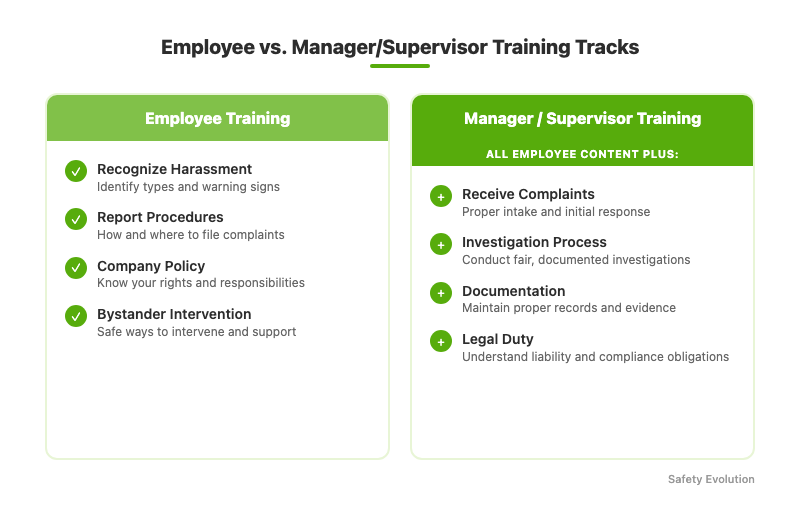
Everyone. Full stop.
But not everyone needs the same training. This is where a lot of employers get it wrong. They run one generic session for the whole company and call it done. That's a compliance gap waiting to happen.
Employee Awareness Training
Every worker in your organization needs awareness-level training covering:
- What constitutes workplace harassment (including sexual harassment)
- Examples of harassment behaviours vs. normal workplace interactions
- Your company's specific harassment prevention policy
- How to report an incident or complaint
- What happens after a report is filed
- Protection against retaliation
- Bystander intervention: what to do when you witness harassment
Supervisor and Manager Training
Supervisors and managers need everything above, plus additional content on:
- Legal duty to act when they become aware of harassment
- How to receive and document a complaint properly
- Confidentiality obligations during the complaint process
- Initial response steps before an investigation begins
- How to prevent retaliation against complainants
- When to escalate to HR, senior management, or external investigators
- Personal liability risks for supervisors who fail to act
A 15-person drywall crew in Edmonton doesn't need the same depth as the operations manager who oversees three job sites. But that operations manager can face personal consequences if a worker reports harassment and they brush it off or "handle it" by moving the complainant to another crew without investigating. We've seen that exact scenario play out with companies where the supervisor thought they were helping but actually made the situation worse by not following proper procedures.
What Does Effective Harassment Training Actually Cover?
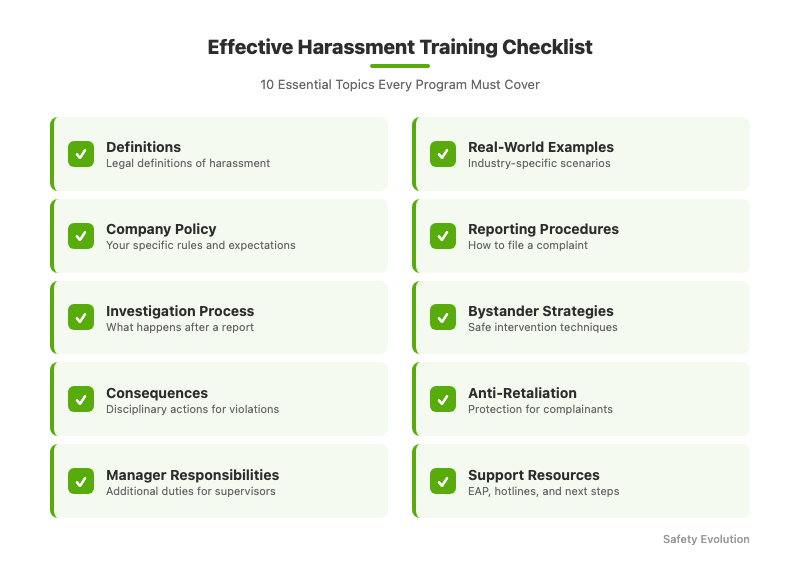
Not all training programs are equal. A 20-minute online video that workers click through while eating lunch is not the same as a structured program that sticks. Here's what good workplace harassment prevention training should include:
Checklist: What Good Training Covers
- Clear definitions of harassment, sexual harassment, violence, and bullying, with your province's specific legal definitions
- Real-world examples relevant to your industry (construction site scenarios, not office cubicle examples)
- Your company's specific policy, not a generic template
- Reporting procedures: who to contact, how to document, what the timeline looks like
- Investigation process overview: what happens after a report, so workers trust the system
- Manager obligations: duty to act, documentation requirements, confidentiality rules
- Bystander strategies: practical tools for intervening or supporting a colleague
- Consequences: for the harasser, but also for supervisors who fail to act
- Protection against retaliation: workers need to know they're safe to report
- Scenario-based exercises: not just theory, but "what would you do if..." situations
The companies that treat harassment training as a check-the-box exercise are the same ones that call us after an incident wondering why their "trained" workers didn't report the problem three months earlier. The training has to be credible enough that a worker on your crew trusts the process will protect them.
Online vs. In-Person Workplace Harassment Training: Which Format Works?
Both can meet legal requirements. Neither is automatically better. The right choice depends on your operation.
Online training works well for:
- Distributed crews across multiple sites
- New hire onboarding when you can't wait for a group session
- Annual refreshers after the initial in-depth session
- Documentation and tracking (most platforms generate completion certificates automatically)
- Cost efficiency, typically $15-$50 per person
In-person (facilitated) training is stronger for:
- Initial rollout of your harassment prevention program
- Supervisor and manager sessions where role-playing and scenario work matter
- Building a culture shift, not just checking a box
- Addressing site-specific risks or recent incidents
- Group sessions typically run $500-$2,000+ depending on group size and facilitator
The most effective approach: start with an in-person session that covers your company-specific policy and includes real scenarios, then use online training for refreshers and new hire onboarding between sessions. Safety Evolution offers both formats through our training courses platform, with instant certificates and built-in expiry tracking so you never miss a renewal.
What Makes a Workplace Harassment Program Compliant?
Training alone isn't enough. The law requires a complete harassment program. Training is one component of a broader prevention framework. Here's what a compliant workplace harassment program includes:
- Written policy: a clear anti-harassment and violence policy that defines prohibited conduct and applies to all workers
- Risk assessment: identifying workplace-specific harassment risk factors (e.g., working alone, late shifts, customer-facing roles)
- Prevention plan: documented measures to eliminate or control harassment hazards
- Reporting procedures: a clear, accessible process for workers to report incidents
- Investigation procedures: a process for investigating complaints fairly and confidentially
- Training: regular, documented training for all workers plus additional training for managers/supervisors
- Review cycle: regular review and update of the policy, plan, and training (at least every 3 years for the plan, annually for the policy in Ontario)
If you have the training but no policy, or a policy but no investigation procedure, you're not compliant. A complete health and safety policy integrates harassment prevention into your overall safety management system. If you're also working toward COR certification, your harassment prevention program feeds directly into the health and safety management system that auditors evaluate.
Need help building a harassment prevention program that covers all seven components? Safety Evolution's done-for-you safety department builds and maintains your entire safety program, including harassment training, policy development, and compliance tracking.
Are Your Harassment Training Records Current for Every Worker?
SE-AI analyses your harassment training records across all workers and roles. It flags expired training, workers who have never received harassment prevention training, and gaps between your training schedule and provincial requirements.
Get Early Access to SE-AI →
Common Mistakes That Get Employers in Trouble
After helping hundreds of Canadian employers get their safety programs audit-ready, these are the harassment training mistakes Safety Evolution sees most often:
- Training everyone the same way. Supervisors need deeper content on receiving complaints and investigation duties. Generic awareness training doesn't cover their legal obligations.
- No documentation. If you can't produce a training record with names, dates, and topics covered, you can't prove training happened. Digital tracking through a safety management system solves this.
- Using a generic template policy. Your harassment prevention policy needs to be specific to your workplace. A policy downloaded from the internet that doesn't reflect your actual reporting procedures, named contacts, and investigation process won't withstand scrutiny.
- "One and done" training. Running a single training session when you started the company and never revisiting it. Workers change, policies evolve, and memories fade. Regular refreshers keep the program credible.
- Ignoring the construction context. Most off-the-shelf harassment training uses office scenarios. If your crew works on construction sites, oil rigs, or manufacturing floors, the training needs to reflect those environments. A worker on a high-rise project faces different dynamics than someone in a cubicle.
Frequently Asked Questions
How often should workers receive workplace violence and harassment training?
Federally regulated employers must provide training at least once every 3 years and within 3 months of hiring. Most provinces don't specify a mandatory frequency, but best practice across Canada is every 2-3 years, after any incident, after policy changes, and for all new hires within their first 90 days.
Who needs workplace harassment training in Canada?
All workers need harassment awareness training, including full-time, part-time, contract, and temporary employees. Supervisors and managers need additional training on receiving complaints, investigation procedures, documentation, and their legal duty to act. Under Bill C-65, even the employer must participate in training.
Is online workplace harassment training acceptable?
Yes, online training meets the legal requirements in all Canadian jurisdictions, provided it covers the required topics and is specific to your workplace policy. Online courses typically cost $15-$50 per employee. However, in-person facilitated sessions are more effective for initial program rollouts and supervisor-specific training. Many employers use a blended approach: in-person for the first session, online for refreshers.
What is the difference between harassment training for employees and managers?
Employee training focuses on recognizing harassment, understanding company policy, and knowing how to report incidents. Manager and supervisor training includes all employee content plus additional modules on receiving complaints properly, maintaining confidentiality, investigation procedures, preventing retaliation, documentation requirements, and their personal legal liability for failing to act on reported harassment.
What does workplace harassment training cost?
Online harassment training courses in Canada typically cost $15-$50 per employee. In-person facilitated group sessions range from $500-$2,000+ depending on group size, location, and whether the content is customized to your workplace. Some safety training providers, including Safety Evolution, offer bundled packages that include both training delivery and policy development.
What topics must workplace harassment training cover?
At minimum, training must cover: definitions of harassment, sexual harassment, and workplace violence; your company's specific harassment prevention policy; how to recognize harassment behaviours; reporting procedures; the investigation process; protection against retaliation; and the consequences of harassment. Managers need additional content on receiving complaints, confidentiality obligations, and investigation responsibilities.
Get Weekly Safety Insights
Regulation updates, toolbox talk ideas, and compliance tips. One email per week.