Last updated: March 2026
```html
You just found out one of your crew members filed a complaint about a foreman, and now WorkSafeBC is asking for documentation you're not sure you have. Or maybe you're a 25-person framing contractor in the Fraser Valley trying to figure out what BC actually requires you to do about bullying on site. Either way, you need answers, not theory.
Here's the uncomfortable truth: workplace harassment in British Columbia isn't treated as a nice-to-have HR policy. It's an occupational health and safety issue, enforced by WorkSafeBC with the same authority they use for fall protection and confined spaces. And the rules have been on the books since November 2013.
Quick Answer: BC Employer Obligations
- Who enforces it: WorkSafeBC, under the Workers Compensation Act (sections 115-117) and OHS policies D3-115-2, D3-116-1, D3-117-2
- What you must do: Develop a policy statement, create reporting/investigation procedures, train workers and supervisors, conduct annual reviews
- What triggers an investigation: A worker calls the Prevention Information Line (604-276-3100) after your internal process fails them
- Penalties: Administrative fines based on payroll size and violation severity; in 2024, WorkSafeBC issued 361 penalties totalling $7.6 million across all violations
- Key difference: BC uses "bullying and harassment" as a single combined term, not just "harassment"
Workplace harassment in BC falls under WorkSafeBC's OHS Policies and the Workers Compensation Act, which require employers to have written policies for preventing workplace bullying and harassment, train workers and supervisors, and investigate all reports. BC has some of the most detailed employer obligations in Canada when it comes to harassment prevention.
This guide covers what BC employers need to know: the regulatory framework, your specific obligations under WorkSafeBC policy, how to handle complaints, and what happens when WorkSafeBC investigates.
What Counts as Bullying and Harassment Under BC Law?
Workplace bullying and harassment in BC is defined as any conduct by a person that a worker is exposed to, which the person knew or reasonably ought to have known would cause the worker to be humiliated or intimidated. This definition comes directly from WorkSafeBC's OHS policies and applies to every workplace in the province.
Here's what trips up most employers: BC bundles "bullying" and "harassment" together as a single concept. You don't need to figure out whether something is technically bullying versus harassment. If it humiliates or intimidates, it's covered.
Examples include verbal aggression, personal insults, derogatory name-calling, harmful hazing or initiation practices, vandalizing personal belongings, and spreading malicious rumours. On a construction site, this might look like a lead hand who singles out one apprentice for constant public ridicule, or a crew that freezes someone out of safety briefings.
There's one critical exception: reasonable management action is not bullying and harassment. Giving performance feedback, assigning work, implementing attendance management, or conducting disciplinary action are all legitimate employer activities. The distinction is whether the action is reasonable and connected to managing the workplace. Telling a worker their framing work doesn't meet code is management. Screaming it in front of the crew while questioning their intelligence is not.
If you're looking for the broader national context on how this compares across provinces, our complete guide to workplace harassment in Canada breaks down the federal framework and how each province handles it differently.
Which Laws Apply to BC Employers?
Two separate legal frameworks cover workplace harassment in British Columbia, and they protect different things:
1. Workers Compensation Act and WorkSafeBC Policies
Sections 115, 116, and 117 of BC's Workers Compensation Act establish duties for employers, workers, and supervisors to maintain safe workplaces. In November 2013, WorkSafeBC enacted three specific policies under these sections:
- D3-115-2 (Employer Duties): Requires employers to prevent or minimize workplace bullying and harassment
- D3-116-1 (Worker Duties): Workers must not engage in bullying and harassment, must report it, and must cooperate with investigations
- D3-117-2 (Supervisor Duties): Supervisors must not engage in bullying and harassment and must apply the employer's policies and procedures
These policies aren't suggestions. They are the standards WorkSafeBC uses to determine whether you've met your legal obligations. A prevention officer who shows up at your job site will check for compliance with these specific policies.
2. BC Human Rights Code
The Human Rights Code prohibits discrimination and harassment based on protected characteristics, including race, colour, ancestry, place of origin, religion, marital status, family status, physical or mental disability, sex, sexual orientation, gender identity or expression, and age. When harassment at work is connected to one of these protected grounds, the worker can file a complaint with the BC Human Rights Tribunal. The filing deadline is one year from the date of the discriminatory act.
Here's why this matters for employers: you can face enforcement from both WorkSafeBC and the Human Rights Tribunal simultaneously. A worker who experiences racist comments from a coworker could trigger a WorkSafeBC investigation for failing to address bullying and harassment, plus a Human Rights Tribunal complaint for discrimination. Two investigations, two potential penalties, from one incident.
WorkSafeBC Expects Documented Harassment Prevention Procedures
SE-AI checks your harassment policy, investigation records, and training documentation against WorkSafeBC requirements.
Get Early Access →
What Are Your 4 Mandatory Obligations as a BC Employer?
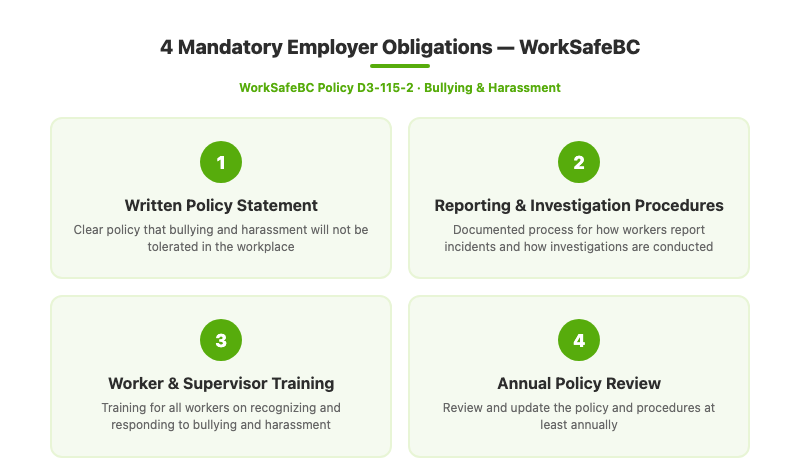
WorkSafeBC is specific about what employers must do. There are four core obligations, and missing any one of them can trigger a penalty:
1. Develop a Written Policy Statement
You need a written policy that clearly states bullying and harassment will not be tolerated in your workplace. This isn't a generic anti-harassment clause buried in an employee handbook. It needs to be a standalone, accessible document that workers can actually find and reference.
2. Create Reporting and Investigation Procedures
Your procedures must include:
- How and when investigations will be conducted
- What the investigation will cover
- The roles and responsibilities of employers, supervisors, workers, and any other parties (investigators, union representatives, witnesses)
- Follow-up steps after the investigation, including corrective actions and timelines
- How investigation records will be documented and maintained
Most contractors think posting a one-page policy in the lunch trailer covers this. It doesn't. WorkSafeBC expects a documented process that someone can follow step-by-step when a complaint comes in. If a prevention officer asks to see your investigation procedure and you hand them a vague paragraph, that's a compliance gap.
3. Train Workers and Supervisors
Everyone on your crew needs to know what bullying and harassment looks like, how to report it, and what happens when a report is made. Supervisors need additional training on their duty to apply the policy and procedures. This isn't a one-time orientation item. If your procedures change or you bring on new workers, the training must follow.
Safety Evolution offers harassment and safety training courses designed specifically for construction and trades employers who need to meet these requirements without pulling their crew off site for days.
4. Conduct Annual Reviews
WorkSafeBC expects you to review your bullying and harassment policies and procedures at least annually. Ask: Did any incidents happen this year? Were the procedures followed? Did workers actually know how to report? The review needs to result in updates where gaps are found.
BC Employer Compliance Checklist
Use this checklist to confirm you're meeting WorkSafeBC's minimum requirements for bullying and harassment prevention:
- ☐ Written policy statement in place and posted where workers can access it
- ☐ Reporting procedure documented: who to report to, how, and within what timeframe
- ☐ Investigation procedure documented: who investigates, steps, documentation, follow-up
- ☐ All current workers trained on the policy and procedures
- ☐ All supervisors trained on their additional duties under D3-117-2
- ☐ New workers trained during orientation
- ☐ Policy and procedures reviewed at least annually
- ☐ Investigation records maintained (but NOT submitted to WorkSafeBC unless requested)
- ☐ Workers know they can contact the WorkSafeBC Prevention Information Line if internal process fails
If you can check every box, you're in solid shape. If you're missing two or more, you have a compliance gap that a WorkSafeBC officer could flag during any site visit. Need help building out your program? Safety Evolution's consulting team works with BC contractors to build compliant safety programs from scratch.
How Do Workers Report Harassment in BC?
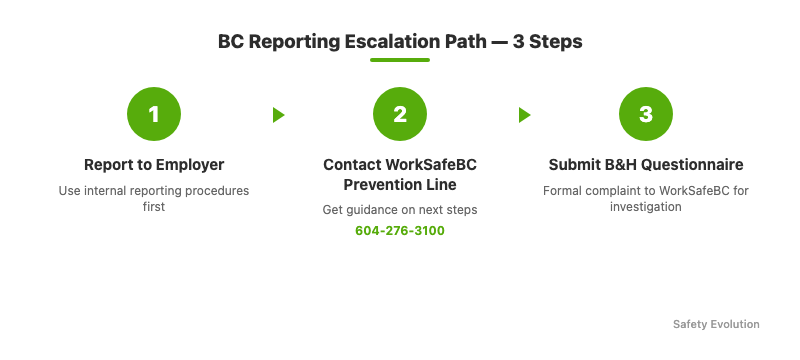
The reporting process in BC follows a specific escalation path that WorkSafeBC has laid out clearly:
Step 1: Report to the employer. Workers are required to report bullying and harassment to their employer first, following the employer's own procedures. This is why having those procedures in place matters so much.
Step 2: Contact WorkSafeBC's Prevention Information Line. If the employer doesn't have proper procedures, or hasn't taken reasonable steps to address the complaint, the worker can call 604-276-3100 (or toll-free 1-888-621-7233) to speak with a prevention officer. The officer will provide guidance and can direct the worker to resources.
Step 3: Submit a Bullying and Harassment Questionnaire. After completing steps 1 and 2, the worker can submit a formal online questionnaire through WorkSafeBC's website. A prevention officer then reviews it to decide whether further investigation is warranted.
For harassment connected to a protected characteristic under the Human Rights Code (such as race, gender, or disability), the worker can also file a complaint with the BC Human Rights Tribunal within one year of the discriminatory act. These processes run independently.
What Are the Penalties for Non-Compliance?
WorkSafeBC can impose administrative penalties on employers who fail to meet their bullying and harassment obligations. The penalty amount depends on three factors:
- Nature of the violation: How serious was the failure? Was it a missing policy, or a complete disregard for worker complaints?
- Company's violation history: Repeat violations within three years increase the penalty
- Payroll size: Larger companies face larger fines
Penalties can increase substantially for high-risk violations, intentional violations, or repeated violations. In 2024, WorkSafeBC imposed 361 penalties across all OHS violations, totalling $7.6 million. The largest single penalty on record is over $1 million.
But the fines aren't the only risk. WorkSafeBC can also charge claim costs back to employers where bullying and harassment leads to a mental health injury claim. Under section 135 of the Workers Compensation Act, a worker can file a mental disorder claim if their condition was predominantly caused by significant work-related stressors, including bullying or harassment. If that claim is accepted, the costs can impact your WorkSafeBC premiums.
There's a due diligence defence: if you can show that you took all reasonable care to prevent the violation, including having proper policies, procedures, training, and enforcement in place, a penalty may not be imposed. This is exactly why documenting everything matters. A good paper trail is your best protection.
How Is BC Different from Federal Rules?
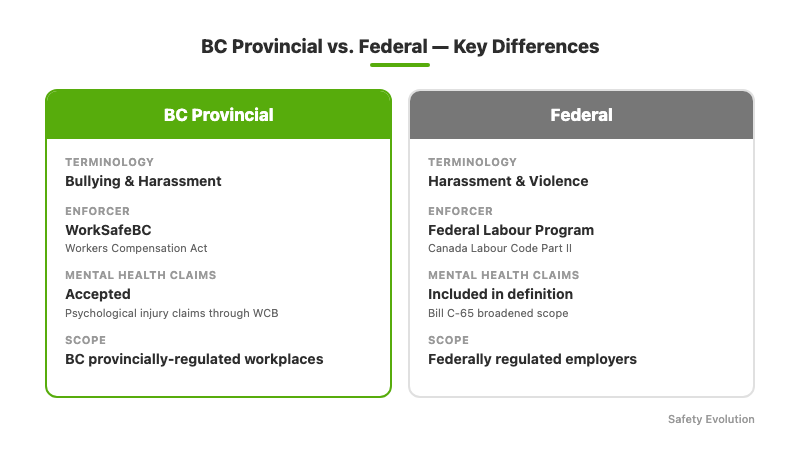
If you've worked on federally regulated projects or looked at other provinces, you might be wondering how BC stacks up. The key differences:
- Terminology: BC uses "bullying and harassment" as a combined term. The federal Canada Labour Code (Bill C-65) uses "harassment and violence." Alberta's OHS Act uses "harassment" and "violence" as separate concepts.
- Enforcement: In BC, WorkSafeBC is the primary enforcer through OHS compliance. Federally, the process involves the federal Minister of Labour and workplace health and safety officers under Part II of the Canada Labour Code.
- Mental health claims: BC explicitly allows mental disorder claims under workers' compensation when bullying and harassment is a significant work-related stressor. Not all provinces have this connection as clearly established.
- Scope: BC's definition covers conduct by anyone in the workplace, not just employees. Clients, members of the public, and third parties on your work site are all covered.
For a full comparison across all provinces, see our workplace harassment in Canada guide.
Does Your BC Harassment Policy Meet WorkSafeBC Requirements?
SE-AI analyses your workplace harassment documentation against WorkSafeBC's bullying and harassment prevention requirements. It flags missing policy elements, undocumented investigation procedures, and training gaps that would surface during a WorkSafeBC inspection.
Get Early Access to SE-AI →
Frequently Asked Questions
Does WorkSafeBC cover harassment complaints?
Yes. WorkSafeBC enforces bullying and harassment requirements under sections 115-117 of the Workers Compensation Act and policies D3-115-2, D3-116-1, and D3-117-2. Workers who experience bullying and harassment can report to their employer first, then contact the WorkSafeBC Prevention Information Line at 604-276-3100 if the issue is not resolved. WorkSafeBC can also investigate employer compliance with bullying and harassment policies and procedures.
What penalties can BC employers face for workplace harassment violations?
WorkSafeBC can impose administrative penalties (fines) on employers who fail to comply with bullying and harassment requirements. The amount depends on the nature of the violation, the employer's violation history, and payroll size. Penalties increase for repeat violations within three years. In 2024, WorkSafeBC imposed 361 penalties across all OHS categories totalling $7.6 million. Employers may also face claim cost charges if bullying leads to an accepted mental disorder claim under section 135 of the Workers Compensation Act.
Do I need a separate policy for bullying in BC?
In BC, bullying and harassment are treated as a single combined concept under WorkSafeBC's policies. You do not need separate policies for each. However, you do need a standalone written policy statement specifically addressing bullying and harassment, along with documented reporting and investigation procedures. A generic line in your employee handbook is not sufficient to meet WorkSafeBC's requirements.
How is BC's approach to workplace harassment different from the federal rules?
BC uses the term "bullying and harassment" and enforcement is handled by WorkSafeBC through OHS compliance. The federal system (under Bill C-65 and the Canada Labour Code) uses "harassment and violence" and is enforced by federal workplace health and safety officers. BC also explicitly allows mental disorder claims under workers' compensation when bullying is a significant work-related stressor, and BC's definition covers conduct by anyone at the workplace, not just employees.
Can a worker file a Human Rights Tribunal complaint and a WorkSafeBC complaint at the same time?
Yes. The BC Human Rights Tribunal and WorkSafeBC are separate bodies with different mandates. A worker can pursue both processes simultaneously. WorkSafeBC addresses whether the employer met their OHS obligations for bullying and harassment prevention. The Human Rights Tribunal addresses whether discrimination based on a protected ground occurred. However, Human Rights complaints must be filed within one year of the discriminatory act.
```
Get Weekly Safety Insights
Regulation updates, toolbox talk ideas, and compliance tips. One email per week.