Last updated: March 2026
Ontario is the largest forklift market in Canada. More warehouses, more manufacturing plants, more construction sites, and more operators than any other province. It also has one of the most active labour enforcement agencies in the country. If you are an Ontario employer with forklift operators, you need to understand what the Ministry of Labour (MOL) expects, because they will check.
Safety Evolution works with Ontario contractors and industrial employers across the province. Here is what you need to know about forklift certification in Ontario, from the regulations to the real-world enforcement.
⚡ Quick Answer
- Regulator: Ontario Ministry of Labour, Immigration, Training and Skills Development (MOL)
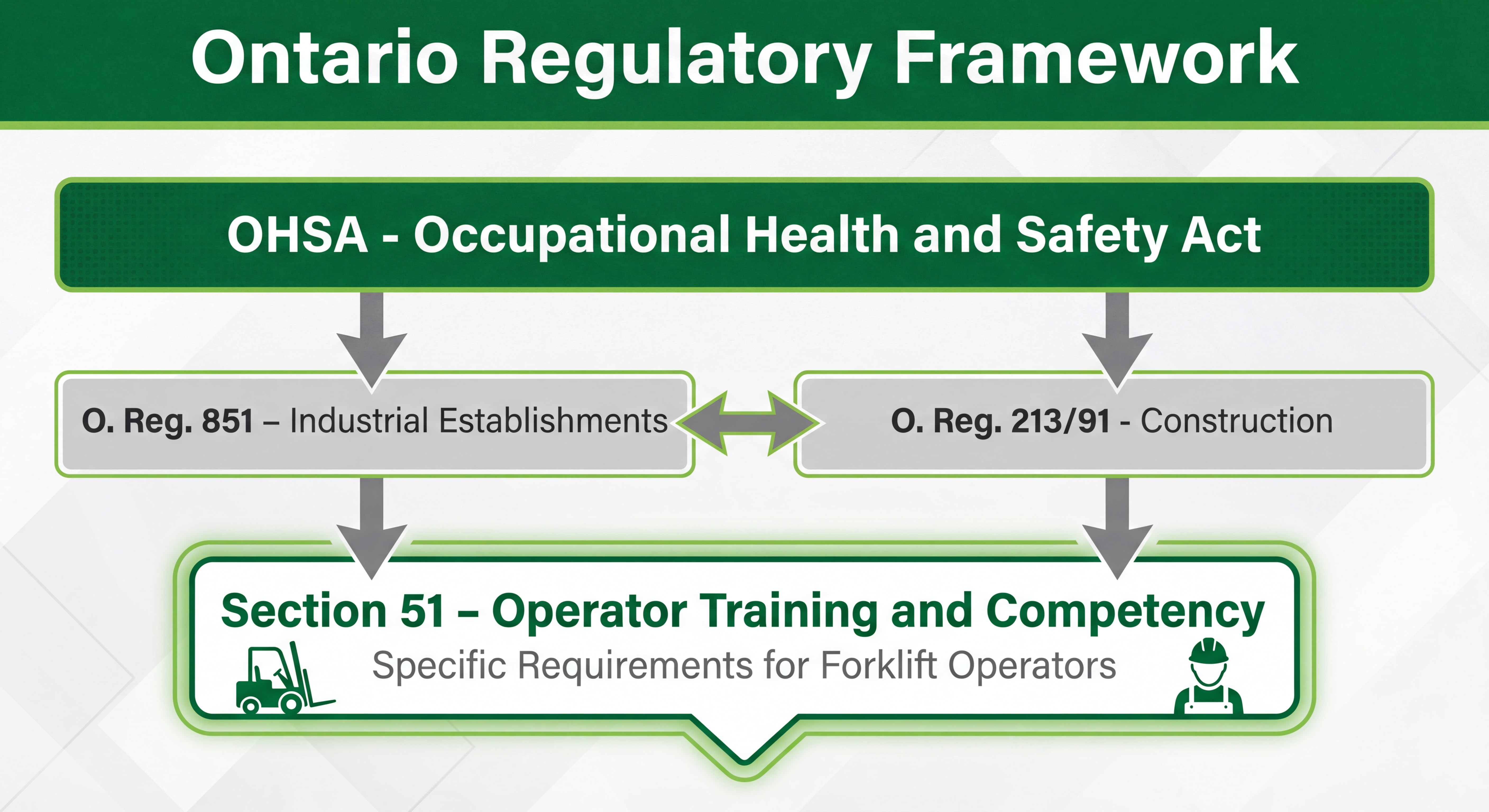
- Key legislation: OHSA, O. Reg. 851 (Industrial), O. Reg. 213/91 (Construction)
- Key requirement: Section 51 of O. Reg. 851 requires operator training and competency demonstration
- No government licence: Ontario does not issue forklift licences. Employer-driven certification.
- Renewal: No legislated expiry; 3-year renewal is industry best practice
- Cost: $150 to $350 per operator in the GTA; less outside major centres
- Search volume: "Forklift training Ontario" is searched 790 times per month, the highest provincial search in Canada
Below, we cover what Ontario's regulations actually require, how the MOL enforces forklift training compliance, what your documentation needs to look like, and how certification costs compare across the province.
What Does Ontario Require for Forklift Operators?
Ontario's Occupational Health and Safety Act (OHSA) and its regulations require employers to ensure forklift operators are trained and demonstrate competency before operating equipment.
The specific requirements depend on your sector:
Industrial Establishments (O. Reg. 851)
Section 51 states that no worker shall operate a lift truck unless they have been trained and have demonstrated competency in the operation of the equipment. This is a direct, enforceable requirement. The employer must:
- Provide or arrange training for every operator
- Verify the operator has demonstrated competency through evaluation
- Maintain written records of training and competency assessment
What O. Reg. 851 Section 51 Actually Says
Section 51 is the specific regulation Ontario employers need to know. It states that no worker shall operate a powered lift truck unless they are trained in its use and have demonstrated competency to the employer. This is a strict liability provision, meaning the employer cannot claim ignorance as a defence. If the operator is on your equipment and something goes wrong, "I did not know they were untrained" is not a valid defence.
The regulation also requires that training address the specific hazards of the workplace, not just generic forklift operation. An operator trained in a climate-controlled warehouse environment is not adequately prepared for operating on a construction site with uneven terrain, weather exposure, and proximity to other trades. The training must be relevant to the actual conditions the operator will face.
Construction Projects (O. Reg. 213/91)
For construction, additional requirements apply around operator training for construction-specific hazards. The regulations require that operators be adequately trained in the safe operation of the equipment, and that the employer take reasonable precautions to protect workers.
Mining and Industrial Sectors
Ontario also has specific regulations for mining operations (O. Reg. 854, Mines and Mining Plants) that include additional requirements for powered mobile equipment. Employers in Ontario's mining sector, particularly in northern Ontario, need to ensure their forklift training program addresses the mining-specific regulations in addition to the general industrial requirements.
How Ontario Enforcement Works
Ontario's MOL is one of the most active enforcement agencies in Canada. MOL inspectors conduct proactive workplace inspections, respond to complaints, and investigate incidents. For forklift operations, inspectors typically check:
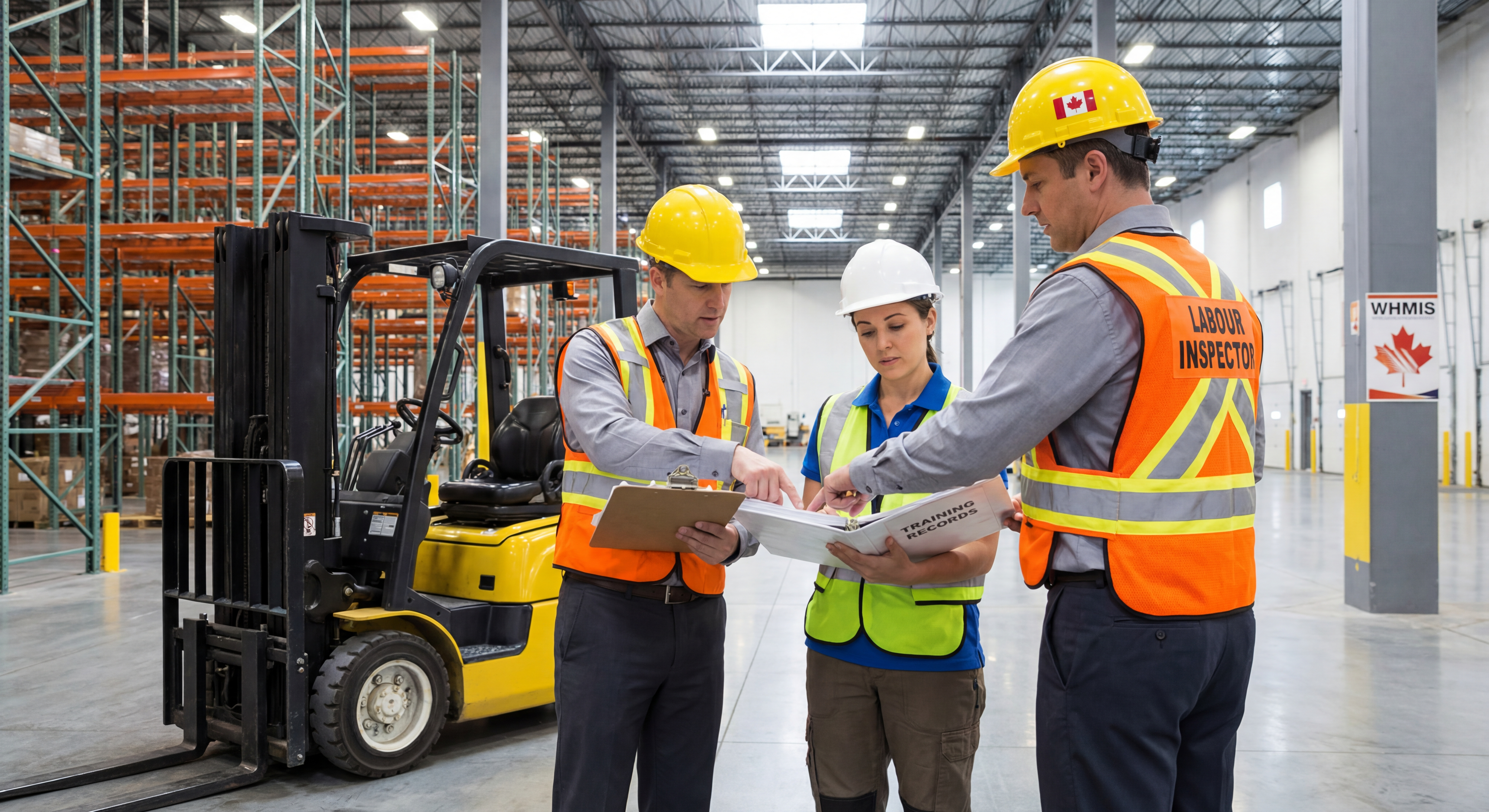
- Training records: They want to see documentation for every operator on site, showing what training was completed, when, and on what equipment
- Competency evaluation: Evidence that operators were not just trained, but evaluated and found competent
- Daily inspection records: Pre-shift inspection logs for each piece of equipment
- Equipment condition: Maintenance records, defect tracking, and resolution
If an inspector finds deficiencies, they can issue orders requiring correction within a specific timeframe. For serious violations, fines under the OHSA can be significant: up to $100,000 for individuals and $1,500,000 for corporations per offence.
For the national picture: Forklift Training and Certification in Canada
MOL Workplace Blitzes
The Ontario MOL conducts targeted inspection blitzes throughout the year, focusing on specific hazards or sectors. Warehouse and industrial workplace blitzes frequently include forklift safety as a focus area. During these blitzes, inspectors visit multiple workplaces in a concentrated period and can issue orders and fines on the spot.
Recent MOL enforcement data shows that forklift-related violations are among the most common orders issued during industrial workplace inspections. The most frequent findings include:
- Incomplete or missing operator training records
- No evidence of competency evaluation
- Pre-shift inspections not being documented
- Inadequate pedestrian protection in forklift operating areas
- Equipment maintenance records not available
Being proactive about compliance is significantly cheaper than responding to an MOL order. Orders require corrective action within a specified timeframe, and non-compliance can lead to escalating penalties.
30-Day Free Trial on your forklift records.
Still tracking forklift certifications in spreadsheets?
If cards expire and no one catches it, you carry the risk. Start a 30-Day Free Trial and track operator status in one place before your next audit.
30-Day Free Trial
Training Provider Landscape in Ontario
Ontario has the most competitive forklift training market in Canada. The GTA alone has dozens of providers, from large established companies to small independent trainers. Quality varies significantly.
Key considerations for Ontario employers:
- CSA B335-15 compliance: While Ontario does not legislatively mandate CSA B335-15, training that aligns with this standard provides the strongest compliance position
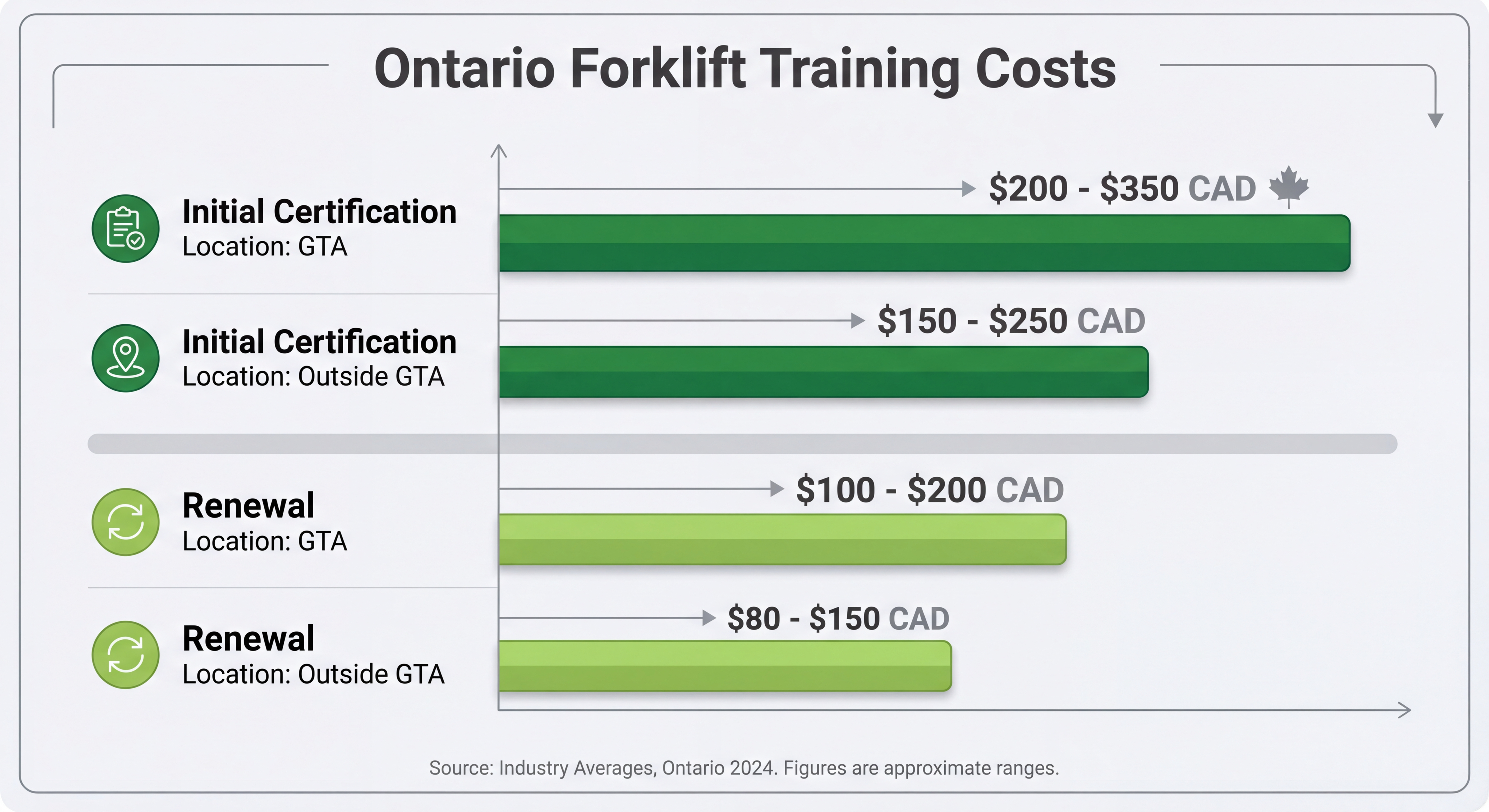
- GTA pricing: Expect $200 to $350 per operator for initial certification in the Greater Toronto Area. Outside the GTA, prices may be $150 to $250.
- Group training options: With high operator volumes in Ontario, on-site group training is common and often more cost-effective for employers with 5 or more operators
- Multi-language training: The GTA's diverse workforce means many providers offer training in multiple languages, which is important for ensuring genuine comprehension
Ontario Forklift Training Costs
| Training Type |
GTA Cost |
Outside GTA |
| Initial certification (counterbalance) |
$200 to $350 |
$150 to $250 |
| Renewal/refresher |
$100 to $200 |
$80 to $150 |
| Reach truck (Class 2) |
$200 to $350 |
$180 to $300 |
| Order picker |
$200 to $350 |
$180 to $300 |
For a detailed national breakdown: How Much Does Forklift Training Cost in Canada?
How to Choose a Training Provider in Ontario
Ontario's competitive training market is a double-edged sword. You have many options, but quality varies significantly. Here is how to vet providers in Ontario:
- Ask for their curriculum outline. A legitimate provider should be able to show you what topics they cover, how much time is allocated to theory vs practical, and what their evaluation criteria are. If they cannot produce this, they may not have a structured program.
- Check for CSA B335-15 alignment. While Ontario does not legislatively mandate CSA B335-15, training that aligns with this standard gives you the strongest defensible position during an MOL inspection or incident investigation.
- Verify practical training time. For new operators, the practical component should include at least 8 hours of supervised equipment operation. Providers offering same-day certification for new operators are cutting this short.
- Ask about documentation. You need detailed records, not just a wallet card. The provider should issue records showing topics covered, equipment classes, evaluation results, and instructor qualifications.
- Request references. Established Ontario providers will have references from other employers in your sector. Ask specifically about their documentation quality and how their training held up during MOL inspections.
- Confirm equipment availability. The provider should train on the specific equipment class your operators will use. If your crew needs Class 2 reach truck training, make sure the provider has reach trucks available for the practical component.
Multi-Language Training in Ontario
Ontario's diverse workforce means many forklift operators work in English as a second language. This is not just a convenience issue; it is a safety issue. An operator who does not fully understand the safety instructions, hazard warnings, or evaluation questions is not genuinely competent, regardless of what the test score says.
Effective approaches for multi-language workforces include:
- Training providers who offer courses in languages beyond English and French (Punjabi, Urdu, Tamil, and Mandarin are commonly available in the GTA)
- Translated training materials and evaluation forms
- Visual and hands-on learning methods that reduce reliance on written or spoken language comprehension
- Bilingual supervisors who can reinforce safety concepts in the operator's primary language during daily operations
Do not assume an operator who passes an English-language evaluation fully understands the safety content. If you have any doubt about language comprehension, arrange training in the operator's primary language.
Ontario-Specific Considerations
Warehousing and Distribution
Ontario's warehouse sector is massive, particularly in the GTA, Peel Region, and Hamilton. These operations typically need Class 1 (electric counterbalance), Class 2 (reach truck, order picker), and Class 3 (electric pallet jack) training. High operator turnover in this sector makes training management particularly challenging.
The growth of e-commerce and same-day delivery has intensified pressure on warehouse operations across the GTA. Faster throughput targets and longer operating hours mean more forklift hours, more operator fatigue, and more opportunities for incidents. Employers in this sector should pay particular attention to:
- Operator fatigue management: Extended shifts and overtime create real fatigue risks for forklift operators. Include fatigue awareness in your training program and establish policies around maximum consecutive operating hours.
- Temporary and agency workers: High turnover often means bringing in temporary workers through staffing agencies. The employer, not the agency, is responsible for ensuring these operators are trained and competent on the specific equipment and at the specific site where they will work.
- Class 3 compliance: Electric pallet jacks (Class 3) are the most common forklift type in warehouses and the most commonly overlooked for training. Ontario MOL inspectors check pallet jack training records with the same rigor as sit-down forklift records.
GTA-Specific Challenges
Employers in the Greater Toronto Area face unique forklift training challenges that warrant specific attention:
- Traffic congestion and loading dock schedules: GTA warehouses often operate on tight loading dock schedules, with truck arrivals timed to the minute. This creates pressure on forklift operators to work fast, which increases incident risk. Your safety program should address time-pressure scenarios and reinforce that speed limits and safety procedures apply regardless of schedule pressure.
- Shared warehouse spaces: Many GTA warehouses are multi-tenant buildings where multiple companies share dock space and common areas. Traffic management becomes more complex when forklifts from different companies operate in the same space. Coordinate with building management and co-tenants on traffic rules and pedestrian zones.
- Labour market competition: The GTA's tight labour market for warehouse workers means experienced forklift operators are in high demand. Employers sometimes skip proper evaluation of new hires to get operators on equipment quickly. This is a false economy that creates liability.
Construction
Ontario construction uses primarily Class 5 (pneumatic tire) and Class 7 (rough terrain/telehandler) equipment. O. Reg. 213/91 adds construction-specific requirements on top of general forklift training. Make sure your training provider covers construction scenarios, not just warehouse operations.
Joint Health and Safety Committees (JHSCs)
Ontario workplaces with 20 or more workers must have a JHSC. Forklift safety should be a regular topic at JHSC meetings, including review of inspection results, incident trends, and training compliance. The JHSC can recommend improvements to your forklift safety program, and the employer must respond to those recommendations in writing.
Ontario Employer Compliance Checklist
Use this checklist to prepare for an Ontario MOL inspection:
- ☐ Training records on file for every forklift operator, including equipment class and evaluation results
- ☐ Competency evaluation documented (not just classroom attendance)
- ☐ Site-specific training records for every operator at every work location
- ☐ Pre-shift inspection logs current and complete
- ☐ Written forklift safety program accessible on site
- ☐ Traffic management plan in place with physical barriers where feasible
- ☐ Equipment maintenance records available for every forklift
- ☐ Incident and near-miss reports documented with investigation outcomes
- ☐ JHSC meeting minutes include forklift safety as a regular agenda item (workplaces with 20+ workers)
- ☐ Sector-specific regulations addressed (O. Reg. 851 for industrial, O. Reg. 213/91 for construction)
How Ontario Compares to Other Provinces
Ontario's approach is similar to Alberta's performance-based model but with stronger enforcement. The key differences from other major provinces:
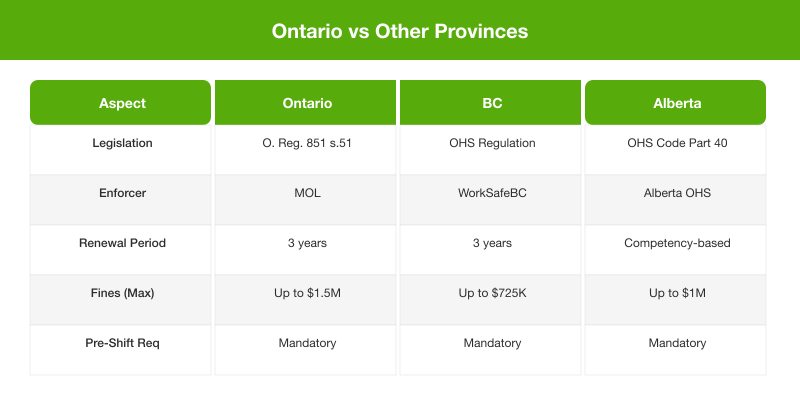
- vs. BC: BC directly references CSA B335-15 in regulation. Ontario does not, but the practical training requirements are similar.
- vs. Alberta: Similar performance-based approach, but Ontario's MOL is generally considered more active in enforcement.
- vs. Saskatchewan/Manitoba: Ontario has sector-specific regulations (industrial, construction, mining) while smaller provinces use more general OHS regulations.
For a complete provincial comparison: Forklift Training Requirements by Province
Safety Evolution offers safety consulting in Toronto and across Ontario, including forklift program development, training coordination, and MOL inspection preparation.
Get ahead of forklift recertification risk
Stop finding gaps after an incident or inspection. Use a 30-Day Free Trial to monitor training, expiries, and compliance actions across your crew.
30-Day Free Trial
Frequently Asked Questions
Is forklift training mandatory in Ontario?
Yes. Under Ontario's OHSA and O. Reg. 851 Section 51, employers must ensure forklift operators are trained and have demonstrated competency before operating equipment. This is an enforceable legal requirement, and MOL inspectors regularly verify compliance.
How much does forklift training cost in Ontario?
Initial forklift certification in Ontario typically costs $200 to $350 per operator in the GTA and $150 to $250 outside major centres. Renewal training costs $100 to $200. On-site group training for 5 or more operators is often more cost-effective.
Does Ontario require forklift certification renewal?
Ontario does not set a legislated expiry date for forklift certification. However, the employer's ongoing duty to ensure operator competency, combined with CSA B335-15 recommendations, makes 3-year renewal the industry standard. Refresher training is also required after incidents, unsafe operation, or workplace changes.
What fines can Ontario employers face for forklift training violations?
Under Ontario's OHSA, fines can reach up to $100,000 for individuals and $1,500,000 for corporations per offence. In addition to fines, the MOL can issue compliance orders, stop-work orders, and in serious cases, pursue prosecution. The penalties increase significantly when a violation contributes to a workplace injury or fatality.
Do temporary workers need forklift training in Ontario?
Yes. Under Ontario's OHSA, the employer at the workplace where the temporary worker operates a forklift is responsible for ensuring they are trained and competent. Even if a temporary worker arrives with a forklift certification from their staffing agency, the host employer must verify that training, conduct site-specific orientation, and complete a practical evaluation on the equipment the worker will use. The host employer, not the staffing agency, is legally responsible.
Get Weekly Safety Insights
Regulation updates, toolbox talk ideas, and compliance tips. One email per week.