Last updated: March 2026
You're running a 30-person electrical outfit in Edmonton, and one of your foremen keeps "joking" about a coworker's accent. The crew laughs it off. Nobody files a complaint. Then the worker walks off the job, files with Alberta OHS, and now an officer wants to see your violence and harassment prevention plan.
You don't have one. Or you have something your old safety consultant threw together in 2019 that doesn't meet the requirements that took effect March 31, 2025.
Alberta overhauled Part 27 of the OHS Code in December 2024, consolidating the old separate violence and harassment plans into a single prevention plan with stricter requirements. If you haven't updated your plan since the changes took effect, you're already out of compliance.
Workplace harassment in Alberta is governed by two separate laws: the OHS Act (which treats harassment as a workplace hazard) and the Alberta Human Rights Act (which covers harassment tied to protected grounds like race, gender, or disability). As an employer, you need to understand both, because a single incident can trigger obligations under each.
⚡ Quick Answer: Workplace Harassment in Alberta
- What law applies: Alberta OHS Act + OHS Code Part 27 (all employers); Alberta Human Rights Act (harassment based on protected grounds)
- Key requirement: Every Alberta employer must have a written violence and harassment prevention plan (consolidated as of March 31, 2025)
- Fines: Up to $10,000/day for administrative penalties; up to $500,000 for a first OHS conviction
- Investigation: Employers must investigate every incident and keep reports for at least 2 years
- Plan review: At least every 3 years, or after incidents, workplace changes, or committee requests
Workplace harassment in Alberta is governed by the Occupational Health and Safety Act and the OHS Code, which require employers to develop harassment prevention plans, investigate complaints, and protect workers from harassment and violence. Alberta's framework was significantly strengthened in 2020 and carries real enforcement consequences for employers who fail to comply.
This guide covers what Alberta employers need to know: the legal definition, your obligations under the OHS Act, how to build a compliant harassment prevention program, and what happens when Alberta OHS investigates a complaint.
What Counts as Harassment Under Alberta Law?
Alberta's OHS Act defines workplace harassment as any single incident or repeated incidents of objectionable or unwelcome conduct, comment, bullying, or action by a person that the person knows or ought reasonably to know will or would cause offence or humiliation to a worker, or adversely affect the worker's health and safety.
That definition is broad on purpose. It covers obvious behaviour (racial slurs, threats, sexual comments) and the grey area stuff that trips up most employers: persistent "ribbing" that one worker finds humiliating, a supervisor who singles someone out in front of the crew, or a pattern of exclusion that makes a worker dread showing up.
Here's where most contractors get it wrong: reasonable management actions are not harassment. Giving performance feedback, assigning work, enforcing safety rules, or disciplining a worker for legitimate reasons? That's managing your crew. The OHS Act explicitly excludes "any reasonable conduct of an employer or supervisor in respect of the management of workers or a work site."
But if your foreman screams at a worker in front of the whole crew over a minor mistake every single shift, that's probably not "reasonable management." The line between tough supervision and harassment is where employers get burned.
What Are the Two Laws Alberta Employers Need to Know?
This is where it gets complicated, and it's the part most safety programs miss entirely.
1. Alberta OHS Act and Code (Part 27)
The OHS framework treats violence and harassment as workplace hazards, just like a missing guardrail or an ungrounded circuit. Every Alberta employer has obligations under this law, regardless of industry or size. The OHS Act sets the general duties: employers must, as far as reasonably practicable, ensure that none of their workers are subjected to or participate in harassment or violence at the work site. Supervisors carry the same duty for workers under their direction.
Part 27 of the OHS Code provides the specific technical requirements: the prevention plan, training, investigation procedures, and worker support. This is where the recent changes landed.
2. Alberta Human Rights Act
The Alberta Human Rights Act kicks in when harassment is based on a protected ground: race, colour, ancestry, place of origin, religious beliefs, gender (including pregnancy and sexual harassment), gender identity, gender expression, sexual orientation, age (18+), physical disability, mental disability, marital status, family status, or source of income.
An employee can file a complaint with the Alberta Human Rights Commission against their employer within one year of the harassment. The Commission can order remedies including compensation for lost wages, general damages for dignity and self-respect, and policy changes.
Here's the critical thing: the OHS route and the human rights route are not either/or. A worker facing racial harassment on a construction site can report to Alberta OHS (workplace hazard), file with the Alberta Human Rights Commission (discrimination), and potentially pursue a WCB claim if they suffer psychological injury. One incident, three potential regulatory pathways for you to deal with.
What Must Your Prevention Plan Include?
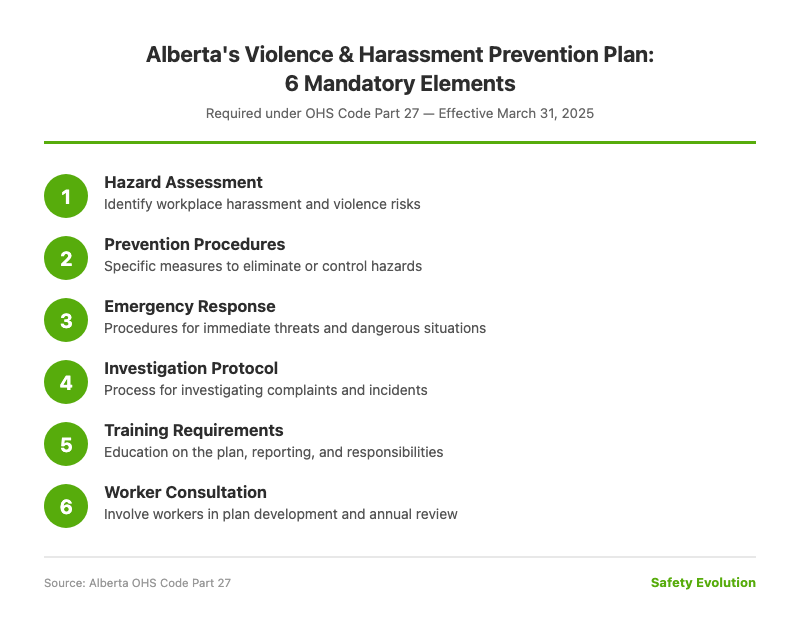
Since March 31, 2025, every Alberta employer needs a single, consolidated violence and harassment prevention plan. The old system of maintaining separate plans for violence and harassment is gone. Here is what Part 27 of the OHS Code now requires in your plan:
Hazard identification and control: Measures to eliminate or, where that's not reasonably practicable, control the hazards of violence and harassment. For a construction crew, this means assessing site-specific risks: isolated work areas, high-stress project phases, mixed-trade sites with workers who don't know each other.
Worker communication procedures: How you'll inform workers about the nature and extent of violence and harassment hazards, including specific or general threats.
Reporting procedures: A clear process for workers to report violence or harassment. Who do they go to? What if the harasser is their direct supervisor? Your plan needs to answer both questions.
Investigation procedures: How complaints and incidents will be investigated. This is not optional, and "I'll deal with it" is not a procedure.
Confidentiality provisions: Protections for all parties involved in a complaint or incident. Disclosure is only permitted when necessary for the investigation, corrective action, informing involved parties of results, warning workers of threats, or when required by law.
You must develop this plan in consultation with your joint health and safety committee (if you have one), your health and safety representative (if you have one), or affected workers if neither exists. This is not a checkbox exercise. Alberta OHS expects genuine consultation.
The Government of Alberta has published a free violence and harassment prevention plan template to help you build your plan.
Alberta OHS Code Part 27 Requires Documented Harassment Procedures
SE-AI checks your harassment policy, investigation records, and training documentation against Alberta OHS Code Part 27.
Get Early Access →
What Training Do You Need to Provide?
Section 391 of the OHS Code requires employers to train workers on four specific topics:
- How to recognize violence and harassment at the work site
- Your violence and harassment prevention plan, including any revisions
- Appropriate responses, including how to get help
- Reporting, investigating, and documenting complaints and incidents
Alberta does not specify a mandatory retraining interval. But your plan must be reviewed at least every 3 years (or sooner if triggered by an incident, workplace change, or committee request), and workers must be trained whenever the plan is updated. In practice, this means you should be retraining every time you revise your plan, and you should be revising your plan after every significant incident.
Managers and supervisors need more than the baseline. They're the ones who will receive complaints, make initial assessments, and decide whether to escalate. They need specific training on receiving complaints, maintaining confidentiality, avoiding retaliation, and understanding their legal duty to act. A supervisor who dismisses a harassment report because "the guys are just joking around" creates liability for you.
If your crew's training consists of a one-time orientation slide from 2020, that's a gap. Especially since the consolidated plan requirements changed in 2025. Everyone on your team should be trained on the new plan, not the old one.
How Do Investigations Work in Alberta?
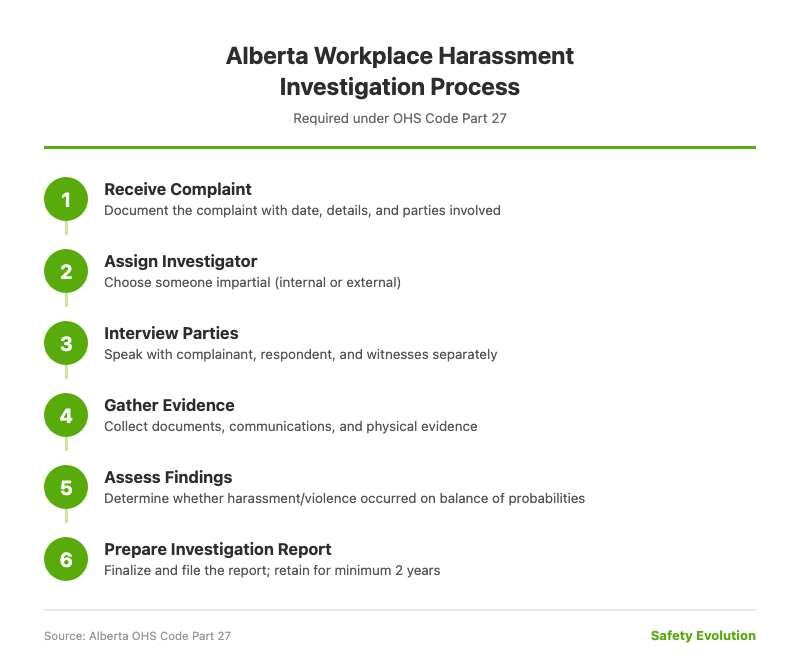
This is the part that catches contractors off guard. Under the OHS Code, employers must investigate every incident of harassment or violence. Not just formal written complaints. Not just the ones that seem serious. Every incident.
After the investigation, you must prepare a report that outlines:
- The circumstances of the incident
- Any corrective action taken to prevent a recurrence
You must keep that report for at least 2 years and have it readily available. If an Alberta OHS officer shows up and asks for it, you need to be able to produce it.
Most contractors think "investigation" means bringing in a lawyer and a private investigator. For serious complaints, maybe. But for many workplace harassment incidents, a competent internal investigation means: interviewing the complainant, interviewing the respondent, interviewing witnesses, documenting everything, and determining what happened and what corrective action to take. The key is that it's timely, thorough, impartial, and documented.
Where employers get into trouble: investigating complaints through the same chain of command as the alleged harasser. If your site supervisor is accused of harassment, that supervisor's buddy the project manager shouldn't be running the investigation. Build an investigation path in your prevention plan that accounts for this.
Safety Evolution helps Alberta employers build investigation-ready safety programs that include clear documentation workflows and incident tracking. If you don't have a system for tracking complaints and investigation outcomes, you're relying on memory, and memory won't hold up when OHS comes calling.
What Are the Penalties for Non-Compliance?
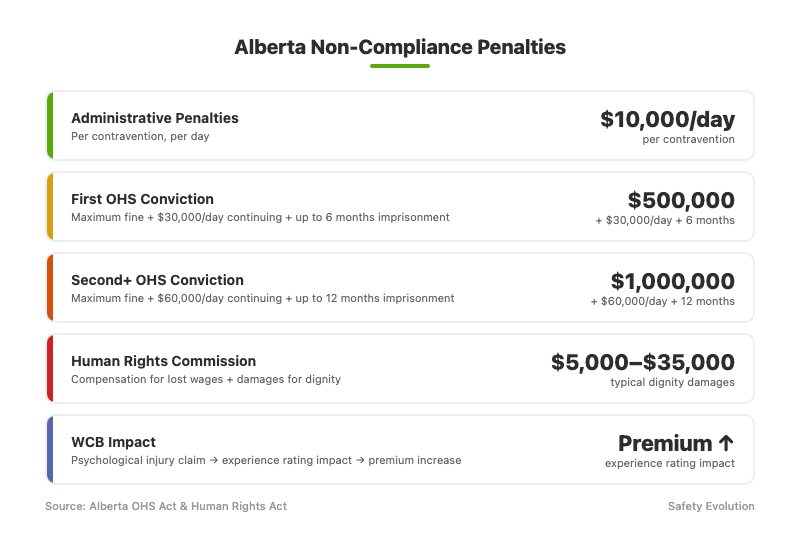
Alberta's penalty structure has real teeth. Here's what you're looking at:
Administrative penalties: Alberta OHS can issue penalties up to $10,000 per contravention, per day the violation continues. These are issued without a court proceeding. An officer observes a violation, refers it for a penalty, and you get a notice. Real examples from 2024: contractors in Edmonton and Calgary receiving $1,000 to $10,000 penalties for OHS Code violations.
Prosecution and conviction: For a first offence under the OHS Act, the maximum fine is $500,000, plus up to $30,000 per day for continuing offences, or up to 6 months imprisonment, or both. A second or subsequent offence jumps to $1,000,000, $60,000 per day for continuing offences, or 12 months imprisonment, or both.
Alberta Human Rights Commission remedies: If a worker files a human rights complaint and it's substantiated, the Commission can order compensation for lost wages, general damages for injury to dignity and self-respect (typically $5,000 to $35,000 in Alberta case law, though amounts vary), and mandatory policy changes.
WCB implications: If a worker suffers a psychological injury from workplace harassment, WCB Alberta may accept the claim. That goes on your record, affects your experience rating, and can increase your premiums. Bullying and harassment are now recognized as potential grounds for psychological injury claims by WCB.
Most contractors think about penalties as fines. The real cost is the operational disruption: OHS stop-work orders, lost contracts because your safety record is flagged, WCB premium increases, and the time you spend dealing with investigations instead of running your business.
How Do Workers Report Harassment in Alberta?
Workers in Alberta have multiple reporting options:
Internal reporting: Through your workplace prevention plan's reporting procedure. This is why your plan needs a clear, accessible process, including an alternate reporting path when the complaint involves a supervisor.
Alberta OHS: Workers can contact Alberta OHS directly at 780-415-8690 (Edmonton) or 1-866-415-8690 (toll-free). OHS officers can inspect work sites and take enforcement action if they find violations of the OHS Act or Code.
Alberta Human Rights Commission: For harassment based on protected grounds (race, gender, disability, etc.), workers can file a complaint with the Commission within one year of the incident.
WCB Alberta: If the harassment caused injury or illness, workers can file a WCB claim.
Police: For criminal harassment (stalking, threats, assault), workers can contact police.
Here's the thing most employers miss: you cannot retaliate against a worker who reports harassment. No demotion, no schedule changes, no "making it uncomfortable" so they quit. Retaliation is a separate violation under both the OHS Act and the Alberta Human Rights Act. If a worker reports and then suddenly gets the worst shifts and the worst assignments, you've compounded your problem.
Alberta Employer Compliance Checklist
Use this checklist to assess where you stand after the March 31, 2025 changes:
- ☐ Consolidated prevention plan: You have a single violence and harassment prevention plan (not two separate documents) that meets the OHS Code Part 27 requirements
- ☐ Hazard assessment: Violence and harassment are addressed in your formal hazard assessment process
- ☐ Worker consultation: Your plan was developed and implemented in consultation with your health and safety committee, representative, or affected workers
- ☐ Reporting procedures: Your plan includes a clear process for workers to report harassment, including an alternate path when the complaint involves a supervisor
- ☐ Investigation procedures: Your plan outlines how complaints and incidents will be investigated, by whom, and how corrective action will be determined
- ☐ Confidentiality provisions: Your plan addresses confidentiality for all parties involved in a complaint or incident
- ☐ Worker training: All workers have been trained on the current (post-March 2025) plan, including recognition, response, and reporting
- ☐ Manager/supervisor training: Supervisors have additional training on receiving complaints, conducting initial assessments, and avoiding retaliation
- ☐ Investigation records: You have a system for documenting investigation reports and retaining them for at least 2 years
- ☐ Plan review schedule: You have a documented review schedule (at minimum every 3 years) and triggers for earlier review
- ☐ Domestic violence provisions: Your plan addresses what happens when domestic violence spills into the workplace
- ☐ Worker support: You have a process to advise affected workers to consult a health professional and to consider them at work during treatment hours
If you checked fewer than 8 of those boxes, your program has significant gaps. That's not unusual for small to mid-size contractors. The December 2024 changes caught a lot of Alberta employers off guard, and the March 2025 compliance deadline came fast.
Safety Evolution is Alberta-based. We work with contractors across the province to build compliant safety programs and provide consulting support in Edmonton and province-wide. We know this regulatory landscape because we operate in it every day.
Does Your Alberta Harassment Policy Meet OHS Code Requirements?
SE-AI analyses your workplace harassment documentation against Alberta OHS Code Part 27 requirements. It flags missing policy elements, undocumented complaint procedures, and training gaps that would surface during an OHS inspection or COR audit.
Get Early Access to SE-AI →
Frequently Asked Questions
Is workplace harassment reportable to OHS in Alberta?
Yes. Violence and harassment are workplace hazards under Alberta's OHS Act, and workers can report concerns directly to Alberta OHS at 780-415-8690 (Edmonton) or 1-866-415-8690 (toll-free). OHS officers can inspect work sites and issue orders or administrative penalties for non-compliance with Part 27 of the OHS Code.
What are the fines for workplace harassment in Alberta?
Alberta OHS can issue administrative penalties up to $10,000 per contravention per day. For convictions under the OHS Act, first offences carry fines up to $500,000 (plus $30,000/day for continuing offences) or up to 6 months imprisonment. Second offences jump to $1,000,000 or 12 months imprisonment. Separately, the Alberta Human Rights Commission can order compensation for lost wages and damages for injury to dignity.
Do I need a harassment policy as an Alberta employer?
Yes. As of March 31, 2025, every Alberta employer must have a consolidated violence and harassment prevention plan under OHS Code Part 27. This is not optional regardless of your industry or company size. The plan must include hazard control measures, reporting procedures, investigation procedures, and confidentiality provisions. The Government of Alberta provides a free template to help you build your plan.
How do workplace harassment investigations work in Alberta?
Under the OHS Code, employers must investigate every incident of violence or harassment. The investigation must examine the circumstances of the incident, and the employer must prepare a report outlining those circumstances and any corrective action taken. Reports must be kept for at least 2 years and provided to an OHS officer on request. For effective investigations, interview the complainant, respondent, and witnesses; document findings; determine corrective action; and ensure the investigator is impartial.
What changed about Alberta's harassment requirements in 2025?
In December 2024, Ministerial Order 2024-12 amended Part 27 of the OHS Code. The main change: employers now maintain one consolidated violence and harassment prevention plan instead of separate plans. The amendments also added mandatory confidentiality provisions, changed when plan reviews are triggered, and strengthened worker protections including explicit "at work" status during treatment for harassment-related injuries. Compliance was required by March 31, 2025.
Get Weekly Safety Insights
Regulation updates, toolbox talk ideas, and compliance tips. One email per week.