Last updated: March 2026
A 15-person mechanical crew in Edmonton gets a new apprentice. The foreman hands him a hard hat, safety glasses, gloves, and a harness. "Here's your gear. If you have questions, ask someone." The apprentice has never worn a fall arrest harness. He does not know how to adjust the leg straps or check the webbing for damage. Three weeks later, he is tied off to an I-beam with a shock-absorbing lanyard that is six inches too long for the clearance below him. Nobody told him how to calculate fall distance.
"Here's your gear" is not PPE training. It is a liability in work boots. And in every province in Canada, it violates the law.
We train construction crews across Canada on PPE, and the gap is not that employers are unwilling to train. It is that they do not know what training is actually required, how to document it, or when retraining is triggered. This guide breaks it all down. If you need help identifying training gaps, SE-AI can analyse your existing PPE training records and show you exactly where the gaps are.
⚡ Quick Answer
- Legal requirement: Every Canadian province requires employers to train workers on proper PPE use, care, and limitations.
- What to cover: Why the PPE is needed, how to put it on and take it off, pre-use inspection, maintenance, and when to replace it.
- Fit testing: Mandatory for respirators in all provinces. Documented annually or when the worker's face shape changes.
- Retraining triggers: New equipment, new hazards, observed misuse, or after an incident involving PPE failure.
- Documentation: Date, topics, trainer name, worker signatures. Required for OHS inspections and COR audits.
What PPE Training Is Legally Required in Canada?
Every Canadian province requires employers to train workers on the proper selection, use, care, and limitations of personal protective equipment. This is not a recommendation. It is a legal obligation under occupational health and safety legislation.
The specific language varies by jurisdiction:
- Alberta OHS Code, Section 230: An employer must ensure that a worker is trained in the correct use, care, and limitations of PPE before the worker uses it.
- WorkSafeBC OHS Regulation, Part 8: Workers must be instructed in the correct use, limitations, and assigned maintenance of PPE.
- Ontario OHSA: Employers must provide information, instruction, and supervision to protect the health and safety of workers, which includes PPE training.
The common thread: training must happen before the worker uses the equipment, not after. Handing someone a respirator during their second week because "we finally got around to it" is a compliance violation from day one.
What Topics Must PPE Training Cover?
Based on CCOHS guidelines and provincial requirements, PPE training must address these areas for every type of PPE a worker is required to use:
- Why the PPE is required. What specific hazard does it protect against? Workers who understand the "why" are more likely to wear the gear consistently. "These goggles protect you from concrete chips that can blind you" is better than "put your goggles on."
- How to put it on and take it off properly. This is called donning and doffing. For simple PPE like safety glasses, it is straightforward. For harnesses, respirators, and chemical suits, proper donning sequence is critical to protection.
- How to adjust the PPE for proper fit. A hard hat with a loose suspension bounces off on impact. A harness with loose leg straps will not distribute fall arrest forces correctly. Fit matters.
- How to inspect PPE before each use. Workers must know what to look for: cracks in hard hat shells, frayed harness webbing, torn respirator seals, worn-out boot soles. If they cannot identify damage, they cannot report it.
- The limitations of the PPE. Safety glasses do not protect against chemical splashes (goggles do). A dust mask does not protect against welding fumes (a respirator does). Every piece of PPE has limits, and workers must know them.
- How to clean, maintain, and store the equipment. Throwing a harness in the bed of a pickup truck exposed to UV and weather degrades it. Storing a respirator without capping the cartridges wastes the filter media.
- When to take PPE out of service and request replacement. Workers need clear criteria: replace the hard hat after any impact, replace harness webbing with visible fraying, replace respirator cartridges per schedule or when breakthrough is detected.
What Are the Fit Testing Requirements?
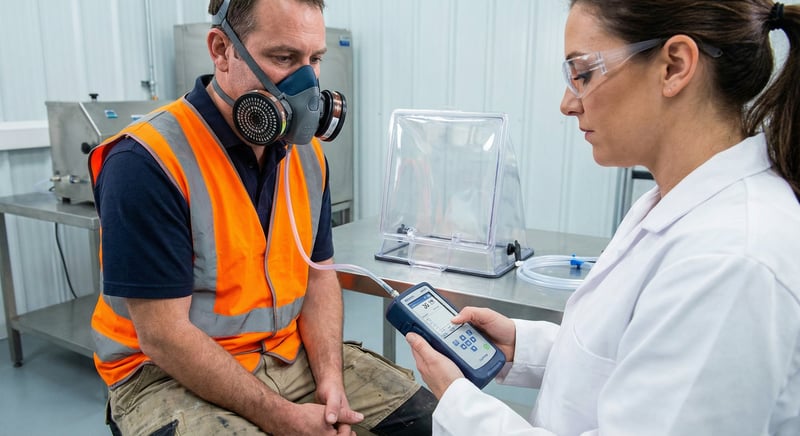
Fit testing is the PPE training topic that trips up the most contractors. Here is what you need to know:
Respirator fit testing is mandatory in every Canadian province where respiratory protection is required. The fit test verifies that the specific make, model, and size of respirator creates an adequate seal on the worker's face.
Two types of fit testing exist:
- Qualitative fit testing: Uses a test agent (sweet or bitter aerosol) that the worker can taste or smell if the respirator leaks. Suitable for half-face respirators. Cannot be used for full-face respirators.
- Quantitative fit testing: Uses a machine to measure the concentration of particles inside and outside the mask. More precise. Required for full-face respirators and recommended for all tight-fitting respirators.
Fit testing must be:
- Conducted before the worker first uses a respirator
- Repeated at least annually
- Repeated whenever the worker's facial characteristics change (significant weight loss or gain, dental work, facial surgery)
- Repeated whenever the respirator model or size changes
- Documented with the worker's name, date, respirator make/model/size, and test results
Beyond respirators, proper fitting is also important for harnesses (leg straps, chest strap, D-ring position), hearing protection (NRR is based on proper fit), and even hard hats (suspension adjustment). While formal "fit testing" is only legally mandated for respirators, training on proper fit for all PPE is an employer obligation.
PPE Without Training Documentation Is a Compliance Gap
SE-AI checks your PPE training records, fit-testing dates, and competency documentation against provincial employer obligations.
Get Early Access →
When Is PPE Retraining Required?
Initial training is not enough. Retraining is triggered by specific events:
- New PPE is introduced. Switching respirator models, upgrading hard hat types, or adding new PPE categories (like arc flash gear for a new project) all require retraining.
- New hazards are identified. Starting a project with silica exposure when the crew has only worked with general dust hazards? Retrain on respiratory protection specific to silica.
- A worker is observed using PPE incorrectly. This is a coaching and retraining moment, not just a disciplinary one. If the worker does not know they are doing it wrong, the training was inadequate.
- After an incident involving PPE. Whether the PPE failed or was not worn, the incident investigation should identify what training gap contributed and trigger targeted retraining.
- Regulatory changes. When provincial OHS codes update PPE requirements, affected workers need retraining on the new standards.
- Extended absence. A worker returning from a long absence (months, not weeks) should have PPE training refreshed as part of their return-to-work process.
The blunt truth: most contractors only retrain when an auditor or inspector tells them to. By then, you are already non-compliant. Build retraining triggers into your PPE program so it happens proactively.
How Do You Document PPE Training for Audits?
Documentation is not paperwork for the sake of paperwork. It is the evidence that protects your company during OHS inspections, COR audits, and incident investigations.
Every PPE training session must be documented with:
- Date and location of training
- Trainer name and qualifications
- Topics covered (specific PPE types, hazards addressed, standards referenced)
- Worker names and signatures confirming attendance and understanding
- Fit test results (for respirators) including make, model, size, and pass/fail
Keep these records for the duration of the worker's employment plus at minimum the retention period required by your province (typically 3 years after the worker leaves). Digital records in a learning management system are easier to search and audit-proof than paper binders.
For COR audits specifically, the auditor will look for:
- Written PPE training procedures in your safety manual
- Evidence that training was delivered (records with dates and signatures)
- Worker competency verification (not just attendance, but demonstrated understanding)
- Retraining records showing the program is maintained over time
What Is the Best Way to Deliver PPE Training?
The most effective PPE training combines classroom instruction with hands-on practice. Here is what works for construction crews:
- Orientation PPE training: Cover all baseline PPE during new worker orientation. This includes the four basics (hard hat, glasses, vest, boots) plus any task-specific PPE the worker will need.
- Hands-on demonstrations: Have workers physically practice donning a harness, adjusting a respirator, inspecting a hard hat, and identifying damaged equipment. Watching a video is not the same as doing it.
- Toolbox talks: Use short PPE toolbox talks to reinforce training throughout the year. Focus on one topic per talk: glove selection one week, hearing protection the next.
- Online courses for the theory: Safety Evolution's PPE for Construction course covers the regulatory requirements, equipment standards, and proper procedures. Combine with hands-on practice for complete training.
For the broader context of PPE fundamentals, see our pillar guide: What Is PPE? Guide to Personal Protective Equipment. For understanding what PPE is required on your specific site, read: PPE Requirements for Construction Sites in Canada.
Are Your PPE Training Records Meeting Provincial Requirements?
SE-AI analyses your PPE training logs, competency assessments, and retraining triggers. It flags workers without documented training for their assigned PPE, expired fit-test records, and training gaps that would surface during a COR audit.
Get Early Access to SE-AI →
Frequently Asked Questions
What PPE training must an employer provide in Canada?
Canadian employers must train workers on the proper selection, use, care, limitations, and maintenance of every type of PPE they are required to wear. Training must occur before the worker uses the equipment and be documented with dates, topics, and worker signatures. This applies in all provinces under their respective OHS legislation.
How often does respirator fit testing need to happen?
Respirator fit testing must happen before a worker first uses a respirator, then at least annually afterward. Additional fit testing is required when the worker's facial characteristics change significantly, when the respirator model or size changes, or when the worker reports difficulty with the seal. All fit tests must be documented.
Can PPE training be done online?
The theoretical component of PPE training (regulations, hazard identification, equipment standards) can be delivered online. However, hands-on practice with actual equipment is essential and cannot be fully replaced by online training. The best approach combines online courses for theory with in-person demonstrations for practical skills like harness donning, respirator fit checks, and equipment inspection.
How long do PPE training records need to be kept?
Keep PPE training records for the duration of the worker's employment at minimum. Most provincial OHS legislation requires retention for at least 3 years after the worker leaves. For COR audit purposes, maintain at least 3 years of training records. Digital records are recommended for easy retrieval during audits and investigations.
What happens if you do not provide PPE training?
Failure to provide PPE training violates provincial OHS legislation and can result in compliance orders, administrative penalties, and in serious cases, prosecution. If a worker is injured and the investigation reveals no PPE training was provided, the employer faces significantly increased liability. Missing training records also negatively impact COR audit scores, potentially affecting your certification status.
Get Weekly Safety Insights
Regulation updates, toolbox talk ideas, and compliance tips. One email per week.