Last updated: March 2026
You just lost a bid. Not because your crew couldn't do the work. Not because your price was wrong. Because the GC asked for your health and safety policy, and you either didn't have one or sent over a generic template you downloaded three years ago. It happens every week to contractors across Canada, and it's one of the most preventable problems in this industry.
At Safety Evolution, we build safety programs for contractors every week. The first thing we look at? The policy. It tells us everything about whether a company is serious or just checking boxes. can tell you exactly where your program stands right now.
⚡ Quick Answer
- What: A health and safety policy is a written statement of your company's commitment to protecting workers, signed by senior leadership, that outlines responsibilities and safety objectives
- Who needs one: Every Canadian employer. In Alberta, a formal H&S program (including a policy) is required for 20+ workers. In BC, all employers need an OHS program with a policy statement.
- Why it matters: Required for COR/SECOR certification, GC bid packages, and regulatory compliance. Without it, you can't bid on most commercial work.
- Penalties: In Alberta, OHS fines can reach $500,000 for non-compliance
- Free Resource: Download our Construction Health & Safety Manual.
What Is a Health and Safety Policy?
A health and safety policy is a written document that states your company's commitment to workplace safety, defines the responsibilities of employers, supervisors, and workers, and sets the direction for your entire safety program. Think of it as the foundation your safety management system sits on. Every procedure, every training requirement, every toolbox talk traces back to this document.
It's not a manual. It's not your full safety program. It's a short, clear statement, typically one to two pages, that says: "This is what we believe, this is who's responsible, and this is how we'll protect our people."
Most contractors think the policy is just paperwork that sits in a binder. They're wrong. connects your policy commitments to your actual safety data so you can see whether those commitments are being met. A good health and safety policy is the first thing an auditor reads during a COR audit, the first thing a GC reviews in your bid package, and the first thing an OHS officer asks for during a site visit. If yours reads like it was copied from the internet in 2018, everyone notices.
Why Does Your Company Need a Health and Safety Policy?
Because the law requires it, your clients demand it, and your workers deserve it.
It's a Legal Requirement
Every province in Canada requires employers to maintain an occupational health and safety program, and the policy is the cornerstone of that program.
In Alberta: Under Section 16 of the OHS Act, employers with 20 or more regularly employed workers must have a formal health and safety program. The policy is a required element of that program. Even if you have fewer than 20 workers, you still need OHS documentation, including hazard assessments and emergency response plans. And if you're pursuing COR certification, a written policy is non-negotiable regardless of your size.
In BC: WorkSafeBC's OHS Regulation (Part 3) requires all employers to have an occupational health and safety program. That program must include "a statement of the employer's aims and the responsibilities of the employer, supervisors and workers." Employers with 20 or more workers need a formal program; smaller employers (fewer than 20) still need a "less formal" program, but the policy statement is part of both.
The penalties are real. In Alberta, OHS fines can reach $500,000, with an additional $30,000 per day for continuing offences. Alberta publishes administrative penalties regularly, and contractors get fined for exactly this type of gap.
GCs Require It Before You Can Bid
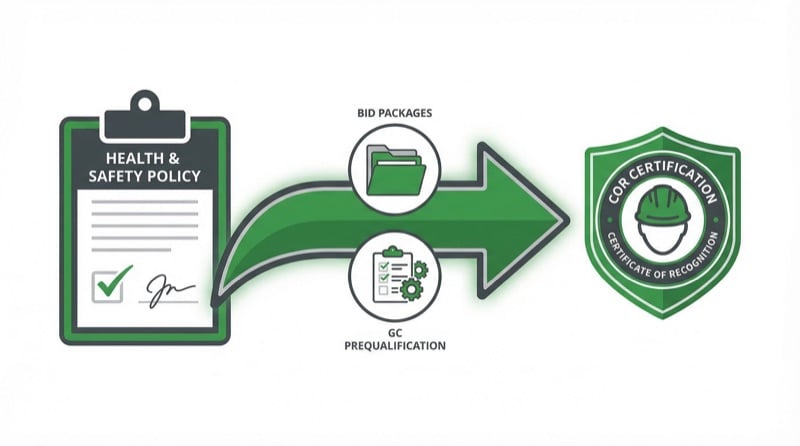
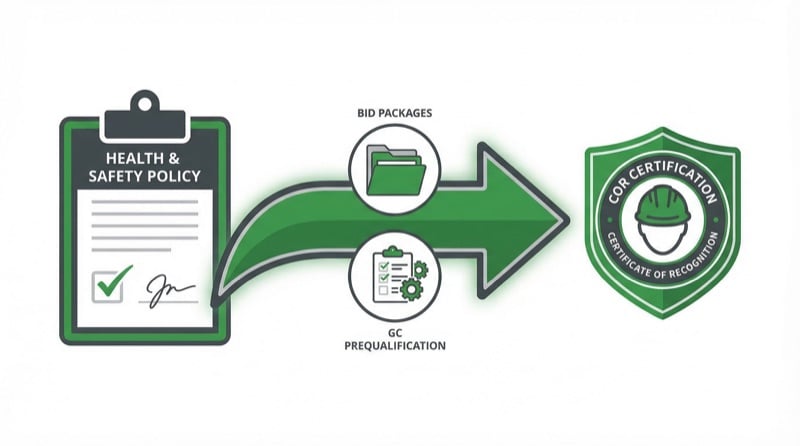
Here's the part that hits your bottom line directly. General contractors across Canada require subcontractors to submit their health and safety policy as part of the prequalification process. No policy, no bid package. No bid package, no work.
We've seen 15-person electrical subs in Edmonton lose six-figure contracts because their safety policy was a half-page document that hadn't been updated since their company changed names. The GC didn't even read the rest of the bid.
It's the Foundation of COR and SECOR
If you're working toward your COR or SECOR certification, the health and safety policy is Element 1 of the audit. Auditors check whether it exists, whether it's signed by senior management, whether workers know about it, and whether it reflects how your company actually operates. A copied template will fail every time.
Not sure if your current safety program would hold up to scrutiny? analyses your records and tells you exactly where you stand.
Need a Complete Safety Program?
Stop starting from scratch. Download our Free Construction Health & Safety Manual to get compliant fast.
Download the Free Manual →
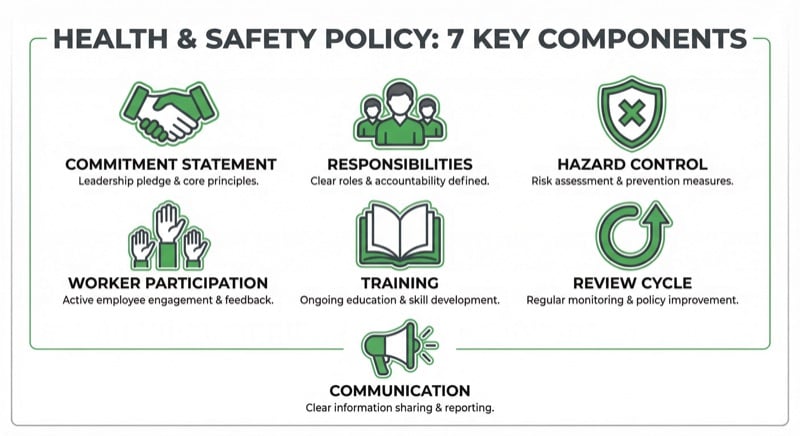
What Should a Health and Safety Policy Include?
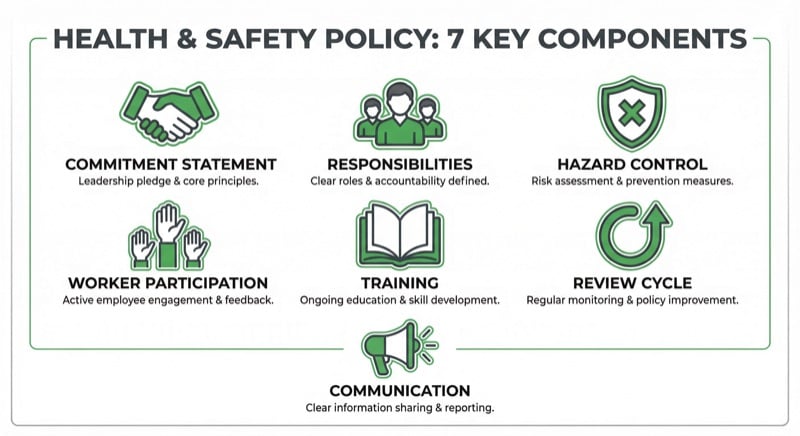
A strong health and safety policy doesn't need to be long, but it needs to be specific. Based on CCOHS guidance and provincial requirements, here's what yours should cover:
- Senior management commitment statement. Not a generic "safety is important." A clear declaration that the company will meet all applicable OHS legislation, signed and dated by the owner.
- Defined responsibilities. Spell out the duties of employers, supervisors, and workers. In BC, WorkSafeBC explicitly requires this. In Alberta, it's a core program element.
- Hazard identification and control. State that the company will identify, assess, and control workplace hazards. This connects directly to your field-level hazard assessments, inspections, and incident investigation procedures.
- Worker participation. Workers have the right to participate in health and safety, report hazards without reprisal, and refuse unsafe work. Every province requires this.
- Training commitments. The company will provide training, instruction, and supervision for safe work.
- Review and continuous improvement. How often you'll review the policy (annually at minimum) and your commitment to improving over time.
- Communication. How the policy will be shared: posted in the workplace, included in orientations, available to anyone who asks.
That's it. One to two pages. Clear, specific, honest. If you're writing 10 pages, you're probably mixing your policy with your procedures, and that creates confusion for everyone.
What Most Companies Get Wrong
Here's the blunt truth: most health and safety policies we review are garbage. Not because the companies don't care about safety, but because someone downloaded a template off the internet, changed the company name, and filed it away. It hasn't been looked at since.
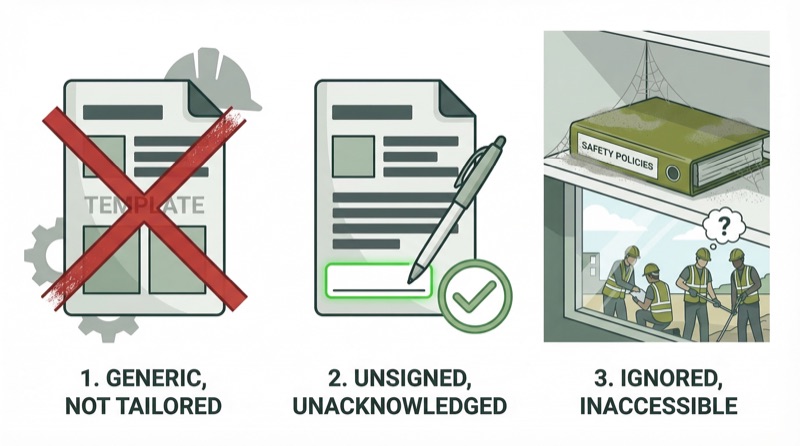
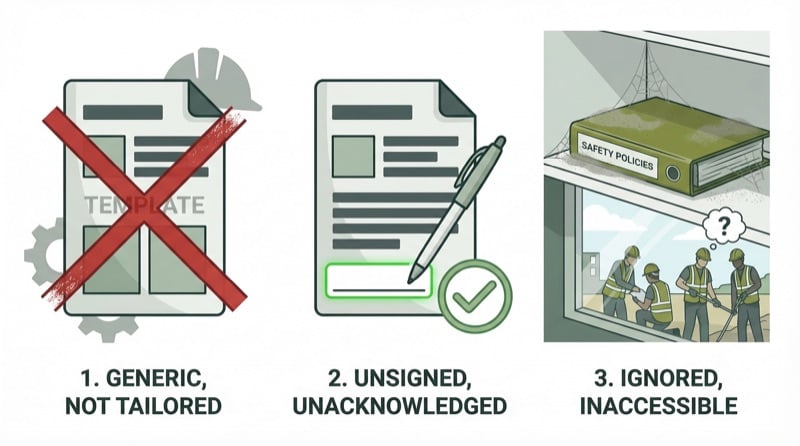
The three most common problems:
The policy doesn't match the business. If you're a mechanical contractor and your policy talks about "office ergonomics" and "slip hazards in the cafeteria," anyone reviewing it knows you didn't write it. Your policy needs to reflect your actual operations, your actual hazards, and your actual industry.
Nobody's signed it. A health and safety policy without a signature from the owner or senior leader is just a piece of paper. The signature is the commitment. Without it, auditors flag it, GCs question it, and OHS officers notice.
Workers have never seen it. can show you which workers have acknowledged your policy and which have not. If your crew can't tell you what your company's safety policy says, the policy isn't doing its job. This is a common audit finding: the document exists, but it sits in a binder in the office while the crew is on site.
Safety Evolution builds audit-ready safety programs for contractors every week. Your policy is the first thing we write, and we make sure it reflects your actual business, not someone else's template.
How to Make Your Health and Safety Policy Actually Work
Start with your operations, not a template. Walk your sites. Talk to your supervisors. Look at your incident reports. The policy should reflect your actual hazards, not a generic list from the internet.
Keep it short and clear. Your crew reads this. Write at a grade 8 reading level. Short sentences. Plain language. If a worker can't understand the policy, it fails.
Get the owner to sign it. Not the safety coordinator. The owner or GM. This signals that safety comes from the top.
Post it where people see it. Lunchroom. Tool crib. Site orientation board. Include it in your worker orientation package. Hand it to every new hire on their first day.
Review it every year. Alberta's OHS legislation requires formal safety program reviews at least every three years, but best practice is annually. Update it whenever your operations change significantly.
Connect it to daily work. connects your policy to your actual safety activities so you can see whether commitments are being met. Reference the policy in your safety meetings and toolbox talks. That's how a piece of paper becomes a living part of your safety culture.
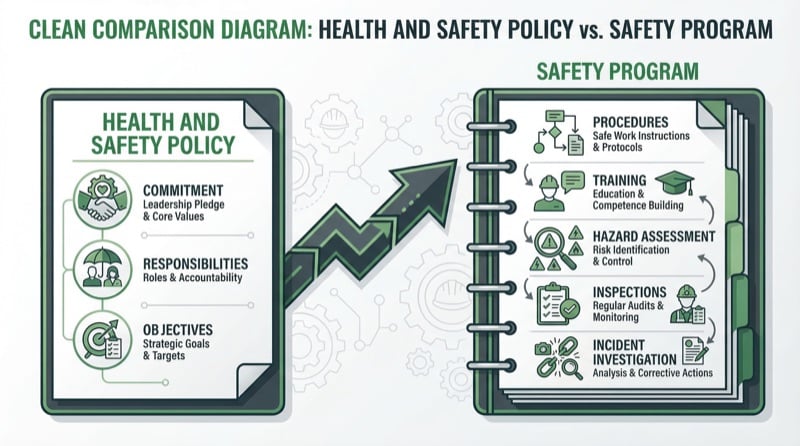
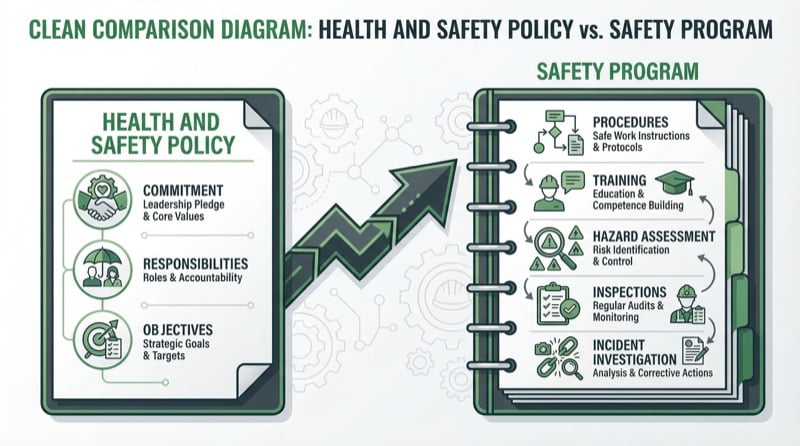
One more thing contractors get confused about: the policy is NOT the program. Your policy is the "why" and "who" (one to two pages). Your safety program is the "how": procedures, training plans, hazard assessments, inspections, and documentation. In Alberta, the formal program includes 10 elements. In BC, WorkSafeBC outlines similar requirements in Part 3. The policy sits at the top and ties everything together.
When Safety Evolution Can Help
If you've read this far, you know whether your current policy measures up. Maybe it's outdated. Maybe it's a template that doesn't fit. Maybe you're starting from scratch.
Safety Evolution is a done-for-you safety department. We build your program, control your documents, verify daily forms, and package everything for GC submittals and COR audits. The policy is where we start.
and see exactly where your safety program stands. It analyses your existing records and shows you what it takes to get audit-ready. We help contractors like you do this every week.
Turn Your Policy Into Action
A written policy sets the standard, but how are you proving it’s being followed? Safety Evolution turns your policies into trackable, digital workflows so you have the documentation to prove compliance.
30-Day Free Trial
Frequently Asked Questions
Is a health and safety policy required by law in Canada?
Yes. Every Canadian province requires employers to have an OHS program, and a written health and safety policy is a foundational element. In Alberta, a formal program is required for 20+ workers. In BC, all employers need an OHS program. Even smaller employers need basic OHS documentation.
What's the difference between a health and safety policy and a safety program?
A health and safety policy is a short commitment statement (one to two pages) that outlines your safety objectives, responsibilities, and principles. A safety program is the full system of procedures, training, hazard assessments, and documentation that puts the policy into action. The program can be hundreds of pages. You need both.
Do I need a health and safety policy to get COR certified?
Yes. A written health and safety policy is Element 1 of the COR audit. The auditor evaluates whether your policy exists, is signed by senior management, has been communicated to workers, and reflects your operations. A missing or generic policy will cause you to fail this element.
How long should a health and safety policy be?
One to two pages. It should cover your commitment statement, responsibilities of employers, supervisors, and workers, and objectives for hazard management and continuous improvement. Longer than two pages means you're mixing policy with procedures.
How often should I review my health and safety policy?
At least once a year. Alberta's OHS legislation requires formal safety program reviews every three years minimum, but annual review is the standard for COR-certified companies. Also update your policy whenever operations change significantly or after a major incident.
Get Weekly Safety Insights
Regulation updates, toolbox talk ideas, and compliance tips. One email per week.