<img height="1" width="1" style="display:none" src="https://www.facebook.com/tr?id=2445087089227362&amp;ev=PageView&amp;noscript=1">

Lockout Tagout Checklist: OSHA Compliance Audit

Use this LOTO compliance checklist to audit your program against OSHA 1910.147. Covers procedures, training, inspections, devices, and documentation.


Last updated: April 2026

Your LOTO program looks complete on the shelf. Written procedures, training records, locks in the cabinet. Then the OSHA inspector starts asking questions: "Show me the machine-specific procedure for that hydraulic press. When was the last annual inspection? Who conducted it? Can you show me the documentation?" And the gaps appear. A lockout tagout checklist is a systematic audit tool that verifies your energy control program meets every requirement of OSHA 1910.147 before an inspector does it for you. With 2,443 LOTO citations issued in fiscal year 2024, this is not a checklist you skip. Use it quarterly, use it before audits, use it every time you add new equipment.

⚡ Quick Answer
  • Purpose: Audit your LOTO program against OSHA 1910.147 and Canadian provincial OHS requirements
  • Covers: Written procedures, training, periodic inspections, lockout devices, group lockout, contractor coordination, documentation
  • Frequency: Minimum annually (OSHA inspection requirement); best practice quarterly
  • Who runs it: An authorised employee NOT using the procedures being reviewed

Complete LOTO Compliance Checklist

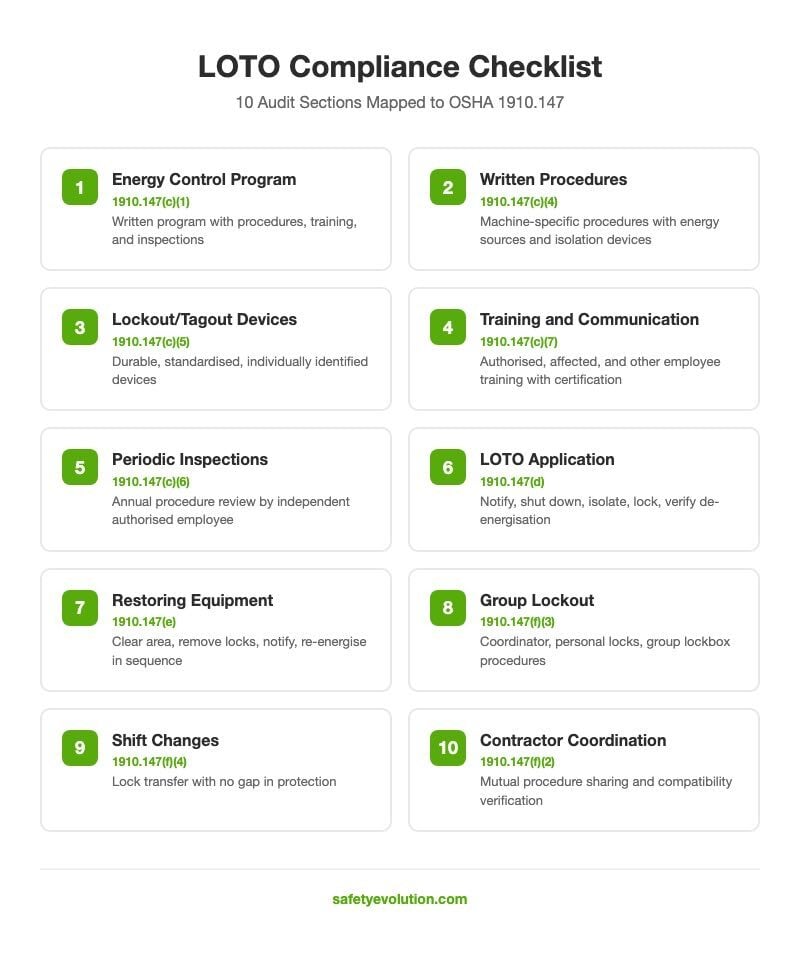
This checklist maps directly to the subsections of OSHA 1910.147. Each item includes the specific regulatory reference so you know exactly what the inspector is checking. For the full background on lockout tagout procedures, see our pillar guide.
1. Energy Control Program (1910.147(c)(1))

  • ☐ Written energy control program established
  • ☐ Program includes procedures, training, and periodic inspections
  • ☐ Program covers all machines and equipment where unexpected energisation could cause injury

2. Written Procedures (1910.147(c)(4))

  • ☐ Machine-specific energy control procedures documented for each piece of equipment
  • ☐ Each procedure identifies all energy sources (electrical, hydraulic, pneumatic, mechanical, chemical, thermal, gravitational)
  • ☐ Each procedure identifies the specific energy-isolating devices (disconnect switches, breakers, valves, blocks)
  • ☐ Each procedure includes shutdown, isolation, lockout, verification, and restoration steps
  • ☐ Procedures for residual energy dissipation documented (bleeding pressure, discharging capacitors, blocking gravity loads)
  • ☐ Exception criteria reviewed: if no written procedure exists for a machine, verify ALL 8 conditions in 1910.147(c)(4)(i) Note are met
  • Procedure templates standardised across the organisation
LOTO compliance checklist overview showing 10 audit sections mapped to OSHA 1910.147 subsections

3. Lockout/Tagout Devices (1910.147(c)(5))

  • ☐ Lockout devices are durable enough to withstand the workplace environment
  • ☐ Lockout devices are standardised (colour, shape, or size) within the facility
  • ☐ Each lockout device is singularly identified (unique to the authorised employee)
  • ☐ Lockout devices are the only devices used for energy control (not shared with other purposes)
  • ☐ Tags are legible and understandable by all employees
  • ☐ Tags identify the authorised employee, date, time, and reason for lockout
  • ☐ Sufficient lockout devices available for all authorised employees
  • ☐ Multi-lock hasps available for group lockout situations

4. Training and Communication (1910.147(c)(7))

  • ☐ All authorised employees trained on hazardous energy recognition, type/magnitude, and control methods
  • ☐ All affected employees trained on recognising LOTO and the prohibition against starting locked-out equipment
  • ☐ All other employees in work areas trained on the purpose and restrictions of LOTO
  • ☐ Additional tagout training provided where tagout devices are used
  • ☐ Training certification on file with employee names and training dates
  • ☐ Retraining records documented with the trigger that prompted retraining
  • Training program includes machine-specific content (not generic only)

5. Periodic Inspections (1910.147(c)(6))

  • ☐ Each energy control procedure inspected at least once per year
  • ☐ Inspection conducted by an authorised employee NOT using the procedure being reviewed
  • ☐ Inspection verifies the procedure is adequate and employees understand responsibilities
  • ☐ Inspection includes a review between inspector and each authorised employee
  • ☐ If tagout is used, inspector reviews tagout limitations with each employee
  • ☐ Inspection documented: inspector name, date, machines covered, employees included
  • ☐ Corrective actions from inspections documented and completed

6. Lockout/Tagout Application (1910.147(d))

  • ☐ Affected employees notified before lockout is applied
  • ☐ Machine shut down using established procedure before isolation
  • ☐ All energy-isolating devices activated (disconnected, closed, blocked)
  • ☐ Personal locks applied by each authorised employee
  • ☐ Tags attached with worker ID, date, time, and reason
  • ☐ Stored energy dissipated or restrained before work begins
  • ☐ De-energisation verified (start controls tested, gauges checked, circuits tested)

7. Restoring Equipment to Service (1910.147(e))

  • ☐ Work area inspected: tools and materials removed
  • ☐ All workers verified clear of the equipment
  • ☐ Affected employees notified before energy is restored
  • ☐ Each authorised employee removes their own lock
  • ☐ Equipment re-energised in the correct sequence

8. Group Lockout (1910.147(f)(3))

  • ☐ Group lockout procedures documented for multi-worker servicing
  • ☐ Single authorised employee designated to coordinate group lockout
  • ☐ Each worker applies their own personal lock (typically to a group lockbox)
  • ☐ Group lockout coordinator verifies all workers are accounted for before lock removal
  • ☐ In Alberta: complex group control procedures certified by a professional engineer where required (OHS Code s. 215.1)

9. Shift Changes and Personnel Transfers (1910.147(f)(4))

  • ☐ Procedure documented for lock transfer during shift changes
  • ☐ Incoming shift applies locks before outgoing shift removes theirs (no gap in protection)
  • ☐ Procedure documented for lock removal when the authorised employee is unavailable

10. Contractor Coordination (1910.147(f)(2))

  • ☐ Host employer and contractor have informed each other of their LOTO procedures
  • ☐ Contractors' LOTO procedures are compatible with the host employer's program
  • ☐ Affected employees of each employer are aware of the other's lockout procedures

Run This Checklist Automatically. Every Quarter.

SE-AI tracks your procedures, training, inspections, and devices. Ask it "what's missing from our LOTO program?" and get the gaps in seconds.

See SE-AI Early Access →

Canadian LOTO Audit Additions

If you operate in Canada, add these items to your checklist. These map to CSA Z460-20 and provincial OHS requirements.

  • ☐ Personal lock assignment list maintained in writing (Alberta OHS Code s. 214)
  • ☐ Workers demonstrated competency before working independently (Alberta OHS Code Part 1 s. 15)
  • ☐ Piping isolation uses blanking/blinding or double block and bleed where required (Alberta s. 215.4-215.5)
  • ☐ Complex group control procedures certified by a professional engineer where applicable (Alberta s. 215.1)
  • ☐ Training developed based on manufacturer documentation, industry best practices, and input from authorised persons (CSA Z460-20)
  • ☐ LOTO procedures accessible to workers at the point of use

For contractors pursuing COR certification, this checklist covers the LOTO elements that COR auditors will verify. Keep your checklist results and corrective action documentation as audit evidence.
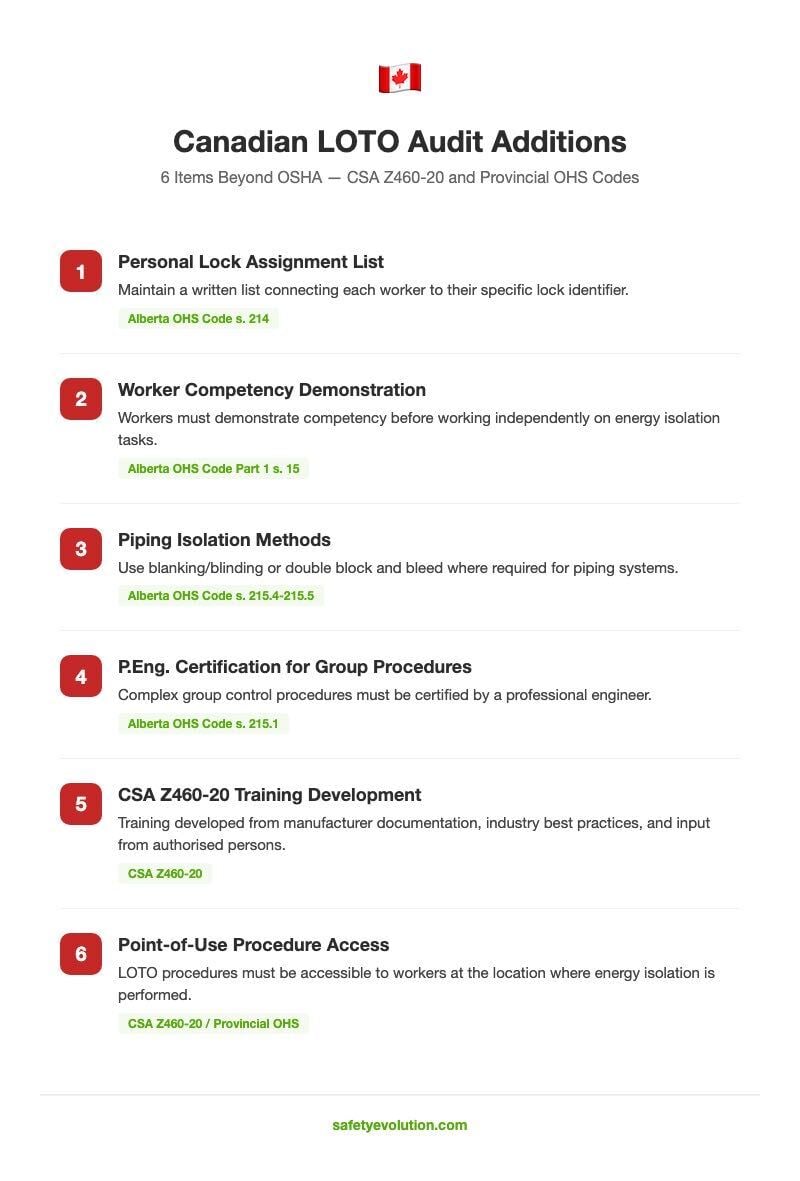
Six Canadian LOTO audit additions beyond OSHA requirements

How to Use This Checklist

Quarterly self-audit: Assign a qualified person (authorised employee or safety coordinator) to walk through each section. Document findings and corrective actions. This catches gaps before they become violations.

Pre-inspection preparation: If you receive notification of an OSHA inspection or a COR audit, run the full checklist immediately. Fix what you can before the inspector arrives. Document everything you fix and everything you plan to fix.

New equipment onboarding: Every time you add, modify, or replace equipment, run sections 2 (procedures), 4 (training), and 6 (application) for that specific machine. This is the most commonly missed trigger for procedure updates.

Contractor onboarding: Before any outside contractor begins work on your equipment, run section 10 (contractor coordination). Verify their procedures are compatible with yours and that all affected employees are informed.

If you are managing this across multiple sites or dozens of machines, a spreadsheet eventually breaks. EHS software that tracks procedures, training, inspections, and devices in one system makes quarterly audits a 10-minute task instead of a two-day project.

Your Next Audit Is Coming. Is Your LOTO Program Ready?

SE-AI runs a continuous compliance check on your LOTO program and flags gaps the moment they appear. Not when the inspector walks in.

See SE-AI Early Access →

Frequently Asked Questions

How often should I run a LOTO compliance audit?

OSHA requires a periodic inspection of each energy control procedure at least once per year (1910.147(c)(6)). Best practice is to run a full program audit quarterly and an additional check whenever equipment is added, modified, or replaced. The annual inspection must be conducted by an authorised employee who is not using the procedure being reviewed.

Who should conduct the LOTO audit?

OSHA requires the annual periodic inspection to be performed by an authorised employee who is not using the energy control procedure being inspected. This ensures an independent review. The auditor must be knowledgeable about LOTO requirements and able to evaluate whether procedures are adequate and employees understand their responsibilities.

What documentation do I need for a LOTO audit?

A complete LOTO audit requires: written machine-specific procedures, training certification records (employee names and training dates), periodic inspection records (inspector name, date, machines covered, employees included, findings), personal lock assignment lists, corrective action documentation, and group lockout procedures. In Alberta, the personal lock assignment list is a regulatory requirement under OHS Code s. 214.

What happens if my LOTO audit finds compliance gaps?

Document the gap, assign a corrective action with a deadline, and fix it. If the gap involves missing procedures, write them. If it involves training, schedule and deliver the training. If it involves outdated procedures, update them and retrain affected employees. The documentation of your self-audit and corrective actions is itself evidence of due diligence, which can reduce penalties if an inspector later finds the same issue.

Does this checklist cover Canadian LOTO requirements?

Yes. The main checklist covers OSHA 1910.147 requirements. The "Canadian LOTO Audit Additions" section adds items specific to CSA Z460-20 and provincial OHS codes including Alberta OHS Code Part 15 (personal lock lists, professional engineer certification for complex group procedures, piping isolation). The combined checklist covers both US and Canadian compliance requirements.

Get Weekly Safety Insights

Regulation updates, toolbox talk ideas, and compliance tips. One email per week.

Similar posts

Get Safety Tips That Actually Save You Time

Join 5,000+ construction and industrial leaders who get:

  • Weekly toolbox talks

  • Seasonal safety tips

  • Compliance updates

  • Real-world field safety insights

Built for owners, supers, and safety leads who don’t have time to chase the details.

Subscribe Now