Lockout Tagout Procedure Template (Free Download)
Download a free LOTO procedure template with all OSHA-required elements. Includes machine-specific examples and a step-by-step writing guide.
LOTO compliance prevents 50,000 injuries/year. Step-by-step procedures, OSHA & Canadian regulations, penalties, and audit tips for contractors.
Last updated: April 2026
A maintenance worker reaches into a conveyor to clear a jam. Nobody locked out the power. The machine restarts. That scenario kills workers every year, and it is entirely preventable. Lockout tagout (LOTO) is a safety procedure that isolates hazardous energy sources during equipment servicing or maintenance to prevent unexpected startup, movement, or energy release. OSHA estimates that proper LOTO compliance prevents 120 fatalities and 50,000 injuries annually. Despite that, lockout tagout was the 5th most-cited OSHA violation in fiscal year 2024, with 2,443 citations. If you run a crew that services equipment, this guide covers everything you need to build a LOTO program that protects your workers and passes audit.
Lockout is the physical placement of a lock on an energy-isolating device (a disconnect switch, circuit breaker, or valve) that prevents the device from being activated. The lock physically blocks anyone from restoring power, pressure, or flow to the equipment while workers are servicing it.
Tagout is the placement of a standardised warning tag on the energy-isolating device. The tag identifies who applied the lock, when, and why. It serves as a communication tool, not a physical barrier. In both the United States and Canada, tags supplement locks but do not replace them.
LOTO applies to all forms of hazardous energy, not just electrical. If a piece of equipment can move, shock, burn, crush, or release pressure during maintenance, it needs to be locked out. The OSHA standard and CCOHS guidance identify seven categories of hazardous energy:
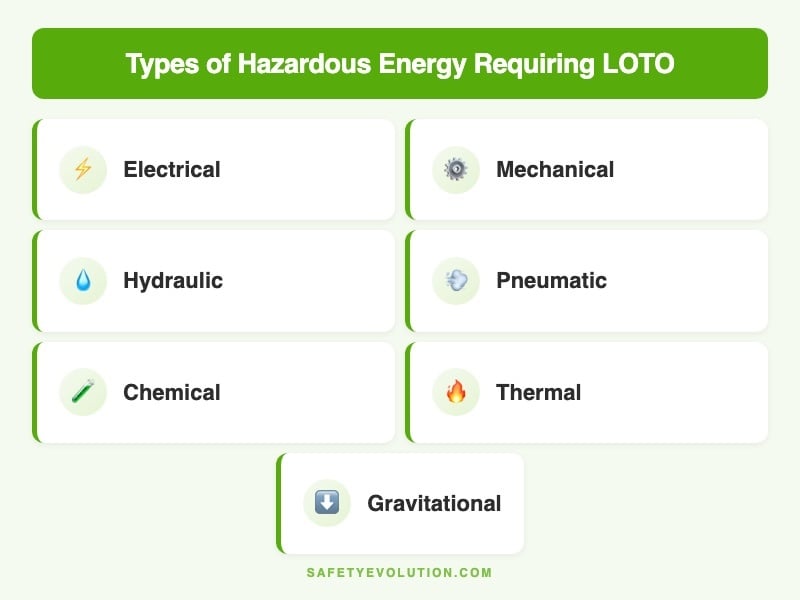
Most people think lockout tagout is only about electrical panels. They are wrong. A hydraulic press that is depressurised but not locked can drift closed under gravity. A chemical line that is valved off but not bled still holds residual pressure. A spring-loaded mechanism stores mechanical energy whether the power is on or off. Every energy source that could injure a worker during servicing must be isolated, locked, tagged, and verified.
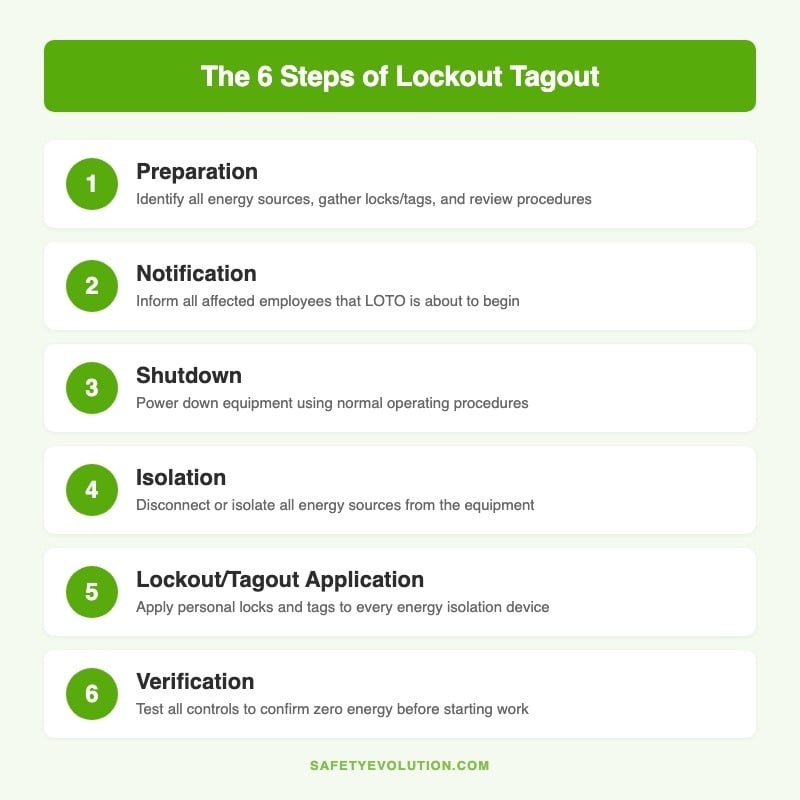
These six steps follow the framework in OSHA 29 CFR 1910.147 and align with the Canadian standard CSA Z460-20. Whether you are in Alberta or Texas, the core sequence is the same.
Step 1: Preparation. Before touching the equipment, the authorised employee identifies the machine, all energy sources connected to it, and the specific energy-isolating devices that must be locked out. This means reviewing the machine-specific LOTO procedure (not a generic template) and gathering the correct locks, tags, and any blocking or bleeding equipment needed.
Step 2: Notification. Every affected employee must be told that lockout is about to happen. This includes what equipment is being locked out, why, for approximately how long, and who is responsible for the lockout. In practice, this is a face-to-face conversation at the machine, not an email from the office.
Step 3: Shutdown. Follow the manufacturer's or employer's established shutdown procedures. Ensure all controls are in the off position and all moving parts (flywheels, spindles, gears) have come to a complete stop before proceeding to isolation.
Step 4: Isolation. Activate all energy-isolating devices. Disconnect electrical switches. Close and lock valves. Set circuit breakers to the off position. For confined spaces or piping systems, this may include blanking, blinding, or double block and bleed procedures. Every energy source identified in Step 1 must be physically isolated.
Step 5: Lockout/Tagout Application. Each authorised employee applies their own personal lock to every energy-isolating device. A tag is attached with the worker's name, date, time, and reason for the lockout. One worker, one lock. If three workers are servicing the same machine, three locks go on each isolating device, typically through a multi-lock hasp.
Step 6: Verification. This is the step that gets skipped most often, and it is the one that kills people. After all locks and tags are in place, the authorised employee must verify that the equipment is truly de-energised. Try the normal start controls. Check pressure gauges. Test electrical circuits with a voltage tester. Verify that residual energy (capacitors, pressurised lines, raised loads) has been dissipated or blocked.
Returning to service is just as critical. When the work is complete: remove all tools and materials from the equipment, verify that all workers are clear and accounted for, remove locks in sequence (each worker removes their own lock), and notify all affected employees before restoring energy.
Both OSHA and Canadian regulations define three categories of workers involved in LOTO:
Authorised employees (called "authorised persons" under CSA Z460-20) are trained to perform lockout. They identify energy sources, apply locks and tags, verify isolation, and remove locks when work is complete. This is not an optional certification. It requires documented training in hazard recognition, energy control methods, and the specific procedures for the equipment they service.
Affected employees operate equipment or work in areas where LOTO is in effect. They do not apply locks. Their training requirement is simpler but equally important: they must know that lockout is in effect, understand that they cannot attempt to start the equipment, and know who to contact about the lockout.
Other employees work in the general area. They need to understand the purpose of LOTO and the prohibition against removing locks, tags, or attempting to energise locked-out equipment.
If you are a contractor with crews on multiple sites, here is the blunt truth: every worker who could conceivably encounter locked-out equipment needs training appropriate to their role. "We only train the maintenance guys" is exactly how affected employees get hurt.
Tracking LOTO Training Across Your Crew?
Safety Evolution tracks who is trained, what has expired, and whether your procedures are audit-ready. No more spreadsheets at 11 PM.
Start Your 30-Day Free Trial and Fix LOTO Gaps →The US lockout tagout standard is 29 CFR 1910.147, The Control of Hazardous Energy. It has been in effect since January 2, 1990, and applies to general industry workplaces. Despite being one of OSHA's oldest standards, it remains one of the most frequently violated.
Three required program elements:
When is tagout alone permitted? Only when the energy-isolating device cannot physically accept a lock (no hasp hole, no mechanism for a lock). Even then, the employer must prove that the tagout program provides protection equivalent to lockout. In practice, this is a high bar. OSHA strongly prefers lockout, and new equipment installed after January 2, 1990, must be designed to accept a lock.
Scope: The standard covers servicing and maintenance of machines and equipment where unexpected energisation or the release of stored energy could cause injury. It does not apply to construction (covered under 1926 Subpart K), agriculture, or maritime (separate standards). It also does not apply to minor tool changes or adjustments that are routine and integral to production, provided the machine is adequately guarded.
OSHA updated penalty amounts effective January 15, 2025:
| Violation Type | Maximum Penalty |
|---|---|
| Serious | $16,550 per violation |
| Other-Than-Serious | $16,550 per violation |
| Willful or Repeated | $165,514 per violation |
| Failure to Abate | $16,550 per day beyond abatement date |
Source: OSHA Penalties, effective Jan 15, 2025.
In fiscal year 2024, OSHA issued 2,443 lockout tagout citations, making it the 5th most-cited standard. That was a 24% increase over the prior year. Between October 2022 and September 2023, LOTO violations across 1,368 inspections resulted in $20.7 million in total penalties, with food manufacturing alone accounting for 384 citations and $7.5 million in fines.
Canada does not have a single federal LOTO standard equivalent to OSHA 1910.147. Instead, the national standard CSA Z460-20 ("Control of Hazardous Energy: Lockout and Other Methods") provides the framework, and each province enforces LOTO through its own occupational health and safety legislation.
Key difference from the US: In Canada, lockout is the primary and preferred method of energy control across all provinces. Unlike OSHA, which allows tagout alone when a device cannot accept a lock, Canadian jurisdictions are generally stricter. Tags are informational. They supplement locks but cannot substitute for them.
Part 15 of the Alberta OHS Code (sections 212 through 215.3) covers the management of hazardous energy control. Key requirements:
Part 15 was amended effective March 31, 2023. If your procedures predate that update, review them against the current code.
Alberta penalties: Administrative penalties of up to $10,000 per offence and $10,000 per day the offence continues (OHS Act s.41). Conviction penalties for a first offence can reach $500,000 and up to 6 months in prison (OHS Act s.48(1)).
Part 10 of the BC OHS Regulation covers de-energisation and lockout. Requirements include personal locks with unique marks or tags, mandatory verification of lockout, and specific procedures for shift changes and personnel transfers. If the unexpected energisation or startup of equipment could cause injury, the energy source must be isolated and the isolating device locked out.
Ontario Regulation 851 addresses LOTO across several sections. Section 42 requires electrical disconnection, lockout, and tagging for work on live exposed parts. Sections 75 and 76 require lockout during cleaning, maintenance, and repair of machinery, with all energy sources effectively controlled. Ontario's framework applies broadly across industrial workplaces.
Federally regulated workplaces (telecommunications, banking, interprovincial transport) fall under the Canada Occupational Health and Safety Regulations, which include hazardous energy control requirements aligned with provincial standards.
LOTO violations increased 29% from 2022 to 2023 according to a Grace Technologies study. Here are the most frequently cited failures and what to do about them.
1. No written, machine-specific procedures. This is the most common LOTO citation. A generic policy that says "lock out equipment before servicing" does not satisfy 1910.147(c)(4). Every machine or piece of equipment with hazardous energy must have its own documented procedure that identifies the specific energy sources and isolation points. If you have 30 machines, you need 30 procedures.
2. Failure to verify isolation. Step 6 gets skipped because it feels redundant. "I flipped the breaker, I put the lock on, obviously it is off." Then the capacitor discharges, or the backup power kicks in, or the hydraulic cylinder drifts. Always verify. Try the start controls. Check the gauges. Test with a voltage meter.
3. Inadequate or missing training. Training records that say "LOTO training: completed" with no detail do not satisfy the standard. Authorised employees need training on specific energy sources, specific procedures, and the equipment they will actually service. Affected employees need training on what LOTO means and why they cannot restart equipment. Both need retraining when procedures change.
4. No periodic inspections. The annual inspection requirement under 1910.147(c)(6) is one of the most overlooked elements. The inspection must be conducted by an authorised employee who is not using the procedure being reviewed. It must verify that the procedure is adequate and that employees understand their responsibilities. Document it.
5. Using tagout when lockout is feasible. If the energy-isolating device can accept a lock, you must use a lock. Tagout alone is only permitted when the device physically cannot be locked. Even then, you must demonstrate equivalent protection. Inspectors look for this.
6. Group lockout without proper procedures. Turnarounds, shutdowns, and large maintenance jobs require group lockout procedures. Alberta mandates complex group control procedures certified by a professional engineer (OHS Code s. 215.1) when the scale warrants it. OSHA requires a single authorised employee to coordinate group lockout and ensure each worker applies a personal lock.
Whether you are preparing for a COR audit in Canada or an OSHA inspection in the US, the core requirements are the same. Here is what a defensible LOTO program looks like.
1. Conduct an energy survey. Walk every piece of equipment. Identify every energy source: electrical, hydraulic, pneumatic, chemical, thermal, mechanical, gravitational. Document the energy-isolating devices (disconnect switches, breakers, valves, blocks). This is the foundation. If you skip it, every procedure you write is incomplete.
2. Write machine-specific procedures. One procedure per machine (or group of identical machines with identical energy sources). Each procedure names the equipment, lists every energy source, identifies every isolating device, and describes the exact steps for shutdown, isolation, lockout, verification, and return to service.
3. Assign and document personal locks. Every authorised worker gets a lock with a unique identifier. Maintain a written list of lock assignments. In Alberta, this is a regulatory requirement under OHS Code s. 214. Everywhere else, it is best practice and audit evidence.
4. Train and document training. Train authorised employees on the procedures they will use, the energy sources they will encounter, and the equipment they will service. Train affected and other employees on the purpose and limitations of LOTO. Document training dates, content covered, trainer name, and attendee signatures. A toolbox talk on LOTO is a good annual refresher, but it does not replace the initial training.
5. Schedule annual inspections. Set a calendar reminder. Assign inspectors (who are not using the procedure they are inspecting). Use a checklist. Document findings and corrective actions. This is the element that separates programs that look good on paper from programs that actually work. If you are evaluating EHS software to manage your safety program, confirm it includes LOTO inspection tracking and automated reminders.
6. Establish group lockout procedures. For shutdowns and turnarounds where multiple workers service multiple energy sources, you need group lockout procedures. In Alberta, complex group control procedures (s. 215.1) must be certified by a professional engineer. In the US, a single authorised employee must coordinate, with each worker applying their own personal lock to a group lockbox.
For contractors pursuing COR certification, LOTO documentation is a standard audit element. Auditors will check for written procedures, training records, annual inspection documentation, and personal lock assignment lists. If you are bidding on work through ISNetworld or Avetta, your LOTO program is a common prequalification question.
Stop Digging Through Spreadsheets for Compliance Gaps
Safety Evolution monitors your LOTO procedures, training records, and inspection dates across every site. Ask a question, get an answer. No exports, no digging.
Start Your 30-Day Free Trial and Fix LOTO Gaps →Lockout physically prevents equipment from being energised by placing a lock on the energy-isolating device. Tagout is a warning tag that identifies who applied the lock, when, and why. In both the US and Canada, lockout is the primary and preferred method. Tags supplement locks but cannot replace them. OSHA permits tagout alone only when the isolating device cannot physically accept a lock, and even then the employer must prove equivalent protection.
Under OSHA 1910.147(c)(6), employers must conduct a periodic inspection at least once per year for each energy control procedure. The inspection must be performed by an authorised employee who is not using the procedure being inspected. In Canada, CSA Z460-20 recommends annual review, and provincial regulations like Alberta OHS Code Part 15 require employers to ensure procedures remain current and effective.
In the US, OSHA penalties for serious LOTO violations are up to $16,550 per violation as of January 2025. Willful or repeated violations carry penalties up to $165,514 per violation. In Alberta, administrative penalties reach $10,000 per offence per day, with conviction penalties for a first offence up to $500,000 and 6 months imprisonment under OHS Act s.48(1).
OSHA 1910.147 applies to general industry, not construction. Construction workplaces fall under 1926 Subpart K (Electrical), which has separate de-energisation and lockout requirements. In Canada, provincial OHS codes apply LOTO requirements across all industries, including construction. Alberta OHS Code Part 15 applies to any workplace where hazardous energy must be controlled.
Only the authorised employee who applied the lock should remove it. Both OSHA and Canadian regulations have specific procedures for situations where that person is unavailable (shift changes, emergencies). In Alberta, OHS Code s. 215.3(2) allows a supervisor or designated worker to remove a lock in an emergency, provided all workers are accounted for and verified clear. OSHA requires the employer to develop a procedure for lock removal in the worker's absence.
LOTO applies to all forms of hazardous energy that could cause injury during servicing or maintenance. This includes electrical, mechanical, hydraulic, pneumatic, chemical, thermal, and gravitational energy. Any energy source capable of unexpected startup, movement, or release must be isolated, locked, tagged, and verified before work begins.
Get Weekly Safety Insights
Regulation updates, toolbox talk ideas, and compliance tips. One email per week.
Download a free LOTO procedure template with all OSHA-required elements. Includes machine-specific examples and a step-by-step writing guide.
OSHA requires LOTO training for 3 employee types. Here's what to cover, how often to retrain, and what documentation passes audit.
LOTO violations hit 2,443 citations in FY2024. See the most common failures, real penalty amounts, and how to fix each one before an inspector finds...