Lockout Tagout Procedures: Complete LOTO Guide
LOTO compliance prevents 50,000 injuries/year. Step-by-step procedures, OSHA & Canadian regulations, penalties, and audit tips for contractors.
LOTO violations hit 2,443 citations in FY2024. See the most common failures, real penalty amounts, and how to fix each one before an inspector finds it.
Last updated: April 2026
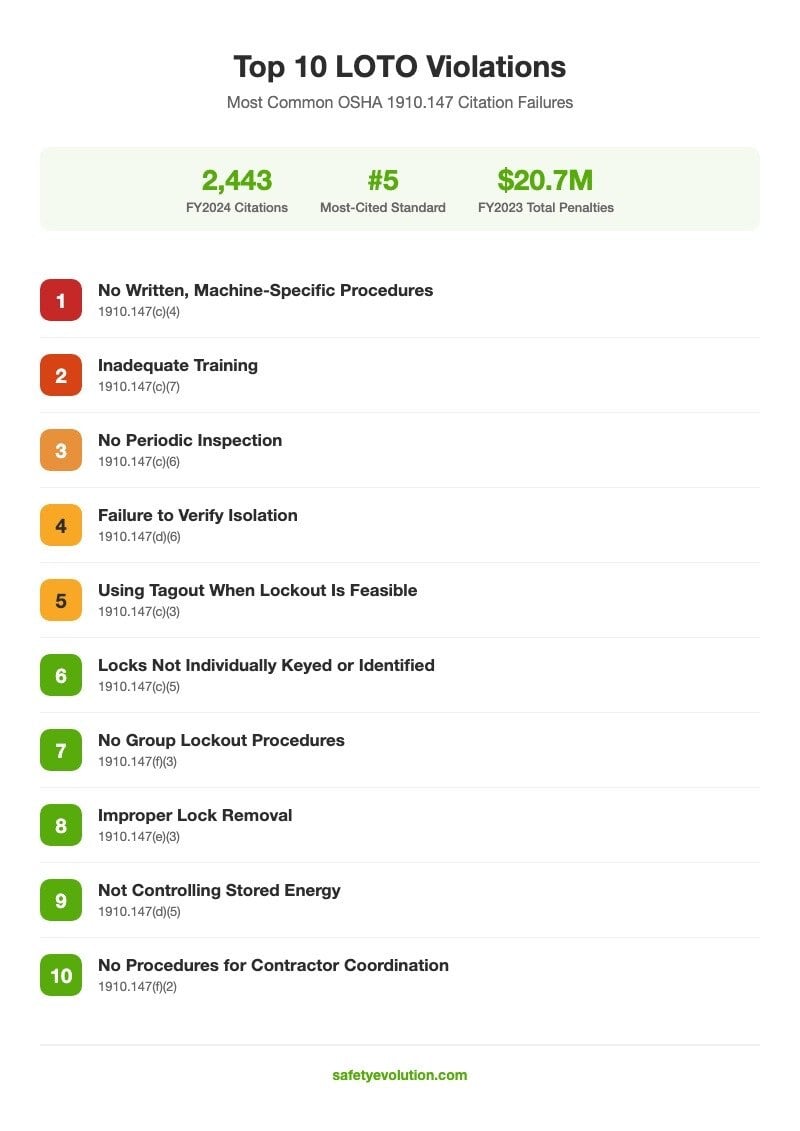
In fiscal year 2024, OSHA issued 2,443 lockout tagout citations, making it the #5 most-cited standard in the country. That was a 24% jump from the prior year. Between October 2022 and September 2023, LOTO violations across 1,368 inspections resulted in $20.7 million in total penalties. Lockout tagout violations occur when employers fail to establish, document, or enforce energy control procedures that prevent unexpected equipment startup during servicing or maintenance. The violations follow predictable patterns. Here are the most common failures, what they cost, and exactly how to fix each one.
OSHA's LOTO citations cluster around the same failures year after year. Each one maps to a specific subsection of 29 CFR 1910.147. If your program has any of these gaps, fix them before an inspector finds them.
The single most-cited LOTO violation. Employers have a generic lockout policy but no documented procedure for each piece of equipment. OSHA requires a written procedure that identifies the specific energy sources, isolation devices, and step-by-step lockout/verification methods for each machine. A one-page policy that says "lock out equipment before servicing" does not satisfy this requirement. If you have 30 machines with different energy configurations, you need 30 machine-specific procedures.
Three categories of workers need LOTO training: authorised, affected, and other employees. The most common training gap is failing to train affected employees (operators who use locked-out equipment but do not apply locks). If an operator does not know what a lock on a disconnect switch means, your training program has failed. OSHA also cites employers for not certifying training with employee names and dates.
OSHA requires an annual inspection of each energy control procedure. The inspection must be conducted by an authorised employee who is not using the procedure being reviewed. Many employers write procedures and never review them. If equipment has been modified since the procedure was written, the procedure is outdated, and the inspection would have caught it.
Workers apply locks and tags but skip the verification step. They assume the equipment is de-energised because the breaker is off. Then a capacitor discharges, or backup power kicks in, or hydraulic pressure drifts. The standard requires the authorised employee to verify de-energisation by testing (try the start controls, check pressure gauges, test with a voltage meter) before starting work.
If an energy-isolating device can accept a lock, you must use a lock. Tagout alone is only permitted when the device physically cannot be locked. Even then, the employer must demonstrate that the tagout program provides full employee protection. OSHA strongly prefers lockout, and any equipment installed after January 2, 1990, must be designed to accept a lock.
Lockout devices must be singularly identified. Each authorised worker must have their own lock with a unique identifier. Shared locks, combination locks, or locks without identification are violations. In Alberta, OHS Code s. 214 explicitly requires personal lock assignment with a maintained written list.
Turnarounds, shutdowns, and large maintenance jobs involving multiple workers and multiple energy sources require group lockout procedures. The standard requires a single authorised employee to coordinate the group lockout and each worker to apply their own personal lock (typically to a group lockbox). Employers who use a single lock for the entire crew are in violation.
Only the authorised employee who applied a lock should remove it. Supervisors who remove locks because a worker went home, or crews that use master keys to clear lockout at shift change, are violating the standard. OSHA requires a specific procedure for lock removal when the authorised employee is unavailable, including verification that the employee is not at the facility and reasonable efforts to contact them.
Isolating the energy source is not enough if residual energy remains. Capacitors hold charge after electrical disconnect. Hydraulic cylinders hold pressure after valves close. Springs store mechanical energy whether power is on or off. The standard requires that stored energy be dissipated, discharged, restrained, or otherwise rendered safe before work begins.
When outside contractors work on equipment, the employer and the contractor must inform each other of their respective lockout procedures. Inspectors cite employers who allow contractors to work without verifying that the contractor's LOTO procedures are compatible with the host employer's procedures.
How Many of These Violations Are in Your Program?
Safety Evolution audits your LOTO program against all 10 common violations and tells you exactly where the gaps are. One question, one report.
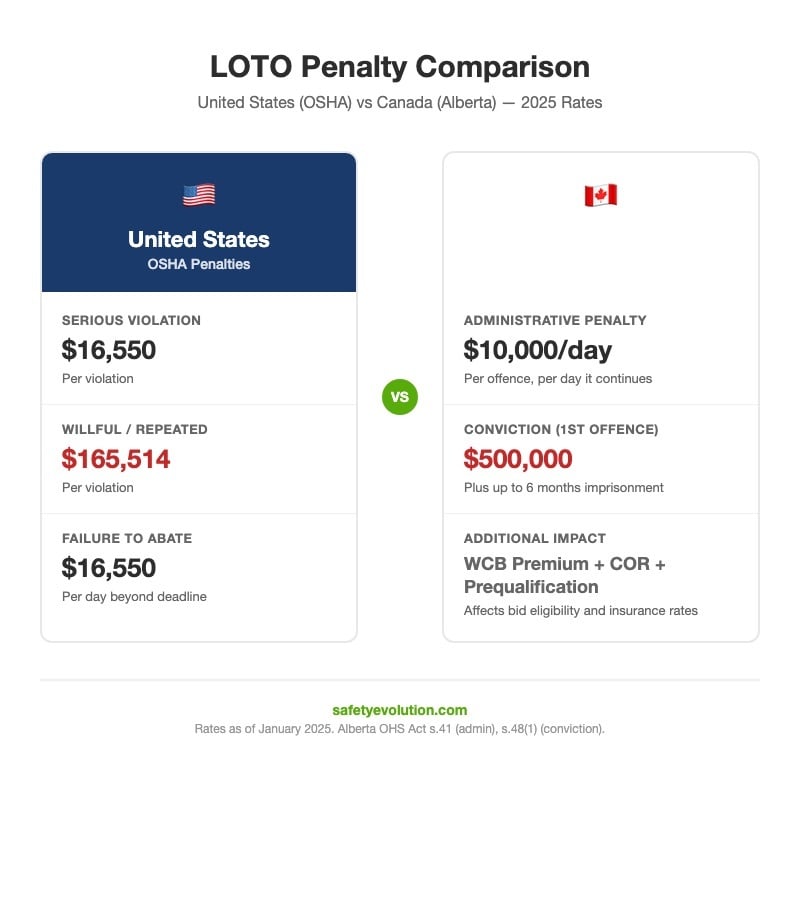
Start Your 30-Day Free Trial and Prevent LOTO Violations →OSHA penalty amounts are adjusted annually for inflation. Current rates as of January 15, 2025:
| Violation Type | Maximum Penalty |
|---|---|
| Serious | $16,550 per violation |
| Other-Than-Serious | $16,550 per violation |
| Willful or Repeated | $165,514 per violation |
| Failure to Abate | $16,550 per day beyond abatement date |
Source: OSHA Penalties, effective Jan 15, 2025.
A single inspection can yield multiple citations. In the food manufacturing sector alone, LOTO violations accounted for 384 citations and $7.5 million in penalties during FY2023. Willful violations, where OSHA determines the employer knowingly disregarded the standard, carry penalties nearly 10x higher than serious violations.
Employers placed in OSHA's Severe Violator Enforcement Program (SVEP) face mandatory follow-up inspections, corporate-wide enforcement action, and public listing. LOTO willful violations are a common trigger for SVEP placement.
Canadian penalties vary by province but can be equally severe:
Beyond direct penalties, LOTO violations in Canada can affect WCB premium rates, COR certification status, and prequalification standing with major operators. For contractors bidding through ISNetworld or Avetta, a LOTO violation on record can disqualify you from bid lists.
Every violation on the list above has a fix. Here is the practical path from gap to compliance for the most common failures.
No written procedures? Start with an energy survey of every machine. Write one procedure per machine using a standardised template. Prioritise equipment with the highest energy levels and most frequent servicing.
Training gaps? Classify every worker as authorised, affected, or other. Deliver role-appropriate training. Document names, dates, content covered, and trainer. Certify the training per OSHA requirements. See our full guide on LOTO training requirements.
No annual inspections? Schedule them now. Assign inspectors (who are not using the procedures they inspect). Use a checklist. Document findings and corrective actions. Set calendar reminders for next year.
Verification being skipped? Make verification a checklist item on every LOTO procedure. Train authorised employees to always try the start controls, check gauges, and test circuits before starting work. Treat skipped verification as a safety stop: if it did not happen, the lockout tagout procedure is not complete.
Shared or unmarked locks? Issue individually keyed, uniquely marked locks to every authorised employee. Maintain a written assignment list. In Alberta, this is explicitly required under OHS Code s. 214.
If you are managing LOTO compliance across multiple sites, consider EHS software that tracks procedures, training records, inspection dates, and lock assignments in one system. Spreadsheets work until they do not, and the gap between "works" and "does not" is usually discovered during an inspection.
Find the Gaps Before the Inspector Does
Safety Evolution checks your LOTO procedures, training records, and inspection logs against regulatory requirements and flags every gap with the specific fix.
Start Your 30-Day Free Trial and Prevent LOTO Violations →The most common LOTO violation is failure to develop and document machine-specific energy control procedures as required by OSHA 1910.147(c)(4). Many employers have a generic lockout policy but lack the written, equipment-specific procedures that identify each energy source and isolation point for each machine.
As of January 2025, OSHA can fine up to $16,550 per serious violation and up to $165,514 per willful or repeated violation. Failure to abate penalties add $16,550 per day beyond the abatement deadline. A single inspection can result in multiple citations, and willful violations can trigger placement in OSHA's Severe Violator Enforcement Program.
Yes. Under the OSH Act, a willful violation that results in a worker's death can lead to criminal prosecution. If convicted, penalties include fines and up to 6 months imprisonment for a first offence, doubling for subsequent offences. In Canada, Bill C-45 (Westray Law) allows criminal negligence charges against organisations and individuals whose negligence causes workplace death or injury.
OSHA issued 2,443 lockout tagout citations in fiscal year 2024, making it the #5 most-cited standard. This was a 24% increase over fiscal year 2023. LOTO has appeared in OSHA's Top 10 most-cited standards consistently for over a decade.
OSHA may inspect LOTO compliance during any general scheduled inspection, in response to a worker complaint, following a workplace injury or fatality, or as part of a targeted enforcement programme focused on high-hazard industries. Referrals from other agencies and follow-up inspections for previous violations are also common triggers.
Get Weekly Safety Insights
Regulation updates, toolbox talk ideas, and compliance tips. One email per week.
LOTO compliance prevents 50,000 injuries/year. Step-by-step procedures, OSHA & Canadian regulations, penalties, and audit tips for contractors.
OSHA requires LOTO training for 3 employee types. Here's what to cover, how often to retrain, and what documentation passes audit.
Download a free LOTO procedure template with all OSHA-required elements. Includes machine-specific examples and a step-by-step writing guide.