Last updated: March 2026
You need your operators forklift certified before they step onto a job site. The GC is asking for proof, and your newest hire starts next week. But there is no government office that issues forklift licences in Canada. No provincial exam centre. No DMV equivalent. So how does this actually work?
Safety Evolution has guided hundreds of contractors through the forklift certification process across Canada. Here is the step-by-step reality of how to get your crew certified, what it costs, and the mistakes that trip up most employers.
⚡ Quick Answer
- Step 1: Identify which forklift class(es) your operators need
- Step 2: Choose a training provider that follows CSA B335-15
- Step 3: Complete classroom, practical, and evaluation components
- Step 4: Document everything and keep records on file
- Cost: $150 to $300+ per operator depending on class and provider
- Timeline: 1 to 5 days depending on experience level
- Key fact: Forklift certification is employer-driven in Canada, not government-issued
Below, we walk through each step of the forklift certification process - from identifying which equipment classes you need to choosing a provider, completing training, and keeping your records audit-ready.
Step 1: Determine Which Equipment Classes You Need
Forklift certification in Canada is not a single credential. It is tied to specific equipment classes. Before you contact a training provider, you need to know exactly what equipment your operators will use.
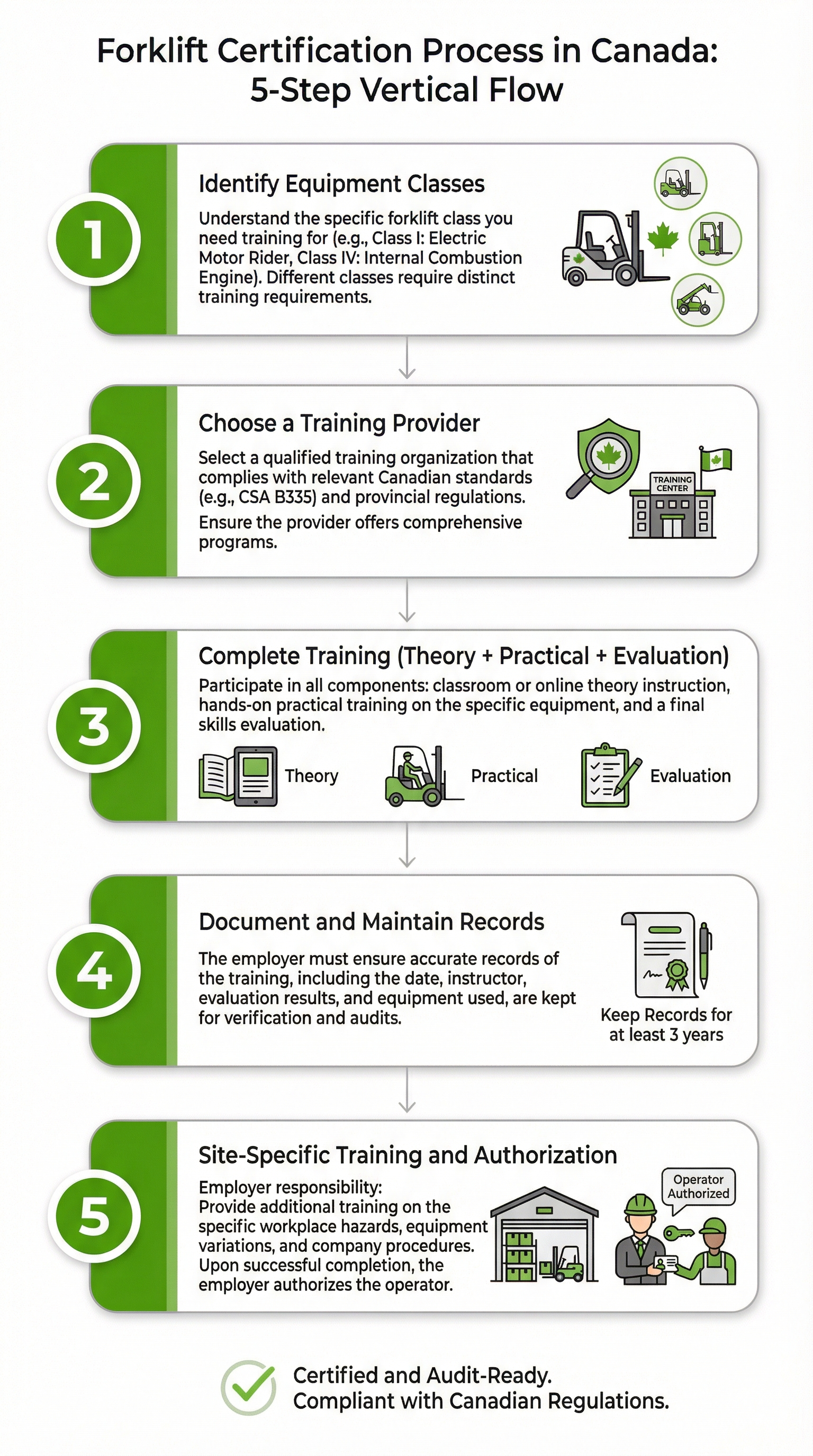
There are 7 classes of powered industrial trucks, ranging from electric pallet jacks (Class 3) to rough terrain telehandlers (Class 7). Each requires its own training. An operator certified on a warehouse counterbalance is not certified to operate a telehandler on a construction site.
Audit your fleet first. List every piece of powered industrial truck equipment your company owns or rents. Then match each to the 7 forklift classes to determine what training you need.
Equipment Class Quick Reference
Here is a simplified breakdown to help you identify what your operators need:
- Class 1 (Electric Motor Rider Trucks): Sit-down electric counterbalance forklifts. Common in warehouses and manufacturing.
- Class 2 (Electric Narrow Aisle Trucks): Reach trucks, order pickers, and turret trucks. Used in high-density racking environments.
- Class 3 (Electric Motor Hand/Hand-Rider Trucks): Pallet jacks and walkie stackers. The most common and often the most overlooked for training requirements.
- Class 4 (Internal Combustion Engine Trucks, Cushion Tires): Propane or diesel counterbalance forklifts with solid tires. Indoor use on smooth floors.
- Class 5 (Internal Combustion Engine Trucks, Pneumatic Tires): Propane, diesel, or gas forklifts with air-filled tires. Used outdoors and on construction sites.
- Class 6 (Electric and IC Engine Tractors): Tow tractors and terminal tractors.
- Class 7 (Rough Terrain Forklift Trucks): Telehandlers and all-terrain forklifts. Common on construction sites and in oil and gas operations.
Many contractors need training on multiple classes. A typical construction company might need Class 5 and Class 7. A warehouse operation might need Class 1, 2, and 3. Each class requires its own training module, though they are often bundled by training providers.
Step 2: Choose a Training Provider
There is no government-certified forklift training program in Canada. Training is delivered by private providers, community colleges, equipment dealers, and safety companies. This means quality varies significantly.
Here is what to look for in a training provider:
- CSA B335-15 compliance: The provider should explicitly state that their program meets or exceeds CSA B335-15 requirements. Ask for their curriculum outline.
- Three-component training: Classroom theory, practical hands-on operation, and a competency evaluation. All three are mandatory. If a provider skips any component, walk away.
- Equipment-specific training: The provider should train on the actual class of equipment (or an identical model) your operators will use. Generic "forklift" training is not sufficient.
- Qualified instructors: Instructors should have documented experience operating the equipment types they teach and should be trained in adult education methods.
- Documentation: The provider should issue detailed training records (not just a wallet card) that include the topics covered, equipment types, evaluation results, and instructor information.
Be cautious of providers offering same-day certification for new operators. A complete beginner cannot realistically cover all CSA B335-15 requirements in 8 hours. See our guide on how long forklift training takes for realistic timelines.
Questions to Ask Before You Book
Before committing to a training provider, ask these questions. The answers will tell you quickly whether the provider is legitimate or cutting corners:
- "Does your program align with CSA B335-15?" The answer should be an immediate yes with specifics.
- "What equipment do you train on?" They should name specific models and classes, not just "forklifts."
- "What documentation will I receive?" You need detailed records, not just a wallet card.
- "How long is the training for a new operator with no experience?" If the answer is less than 2 days, the program is likely cutting content.
- "Can you provide references from other contractors in my industry?" Established providers will have references readily available.
- "Do you offer on-site group training?" If you have 5 or more operators, on-site training is usually more cost-effective and can use your actual equipment.
30-Day Free Trial and flag which operators need training updates in your province.
Still tracking forklift certifications in spreadsheets?
If cards expire and no one catches it, you carry the risk. Start a 30-Day Free Trial and track operator status in one place before your next audit.
30-Day Free Trial
Step 3: Complete the Training
Under CSA B335-15, forklift operator training must include three components. No shortcuts.
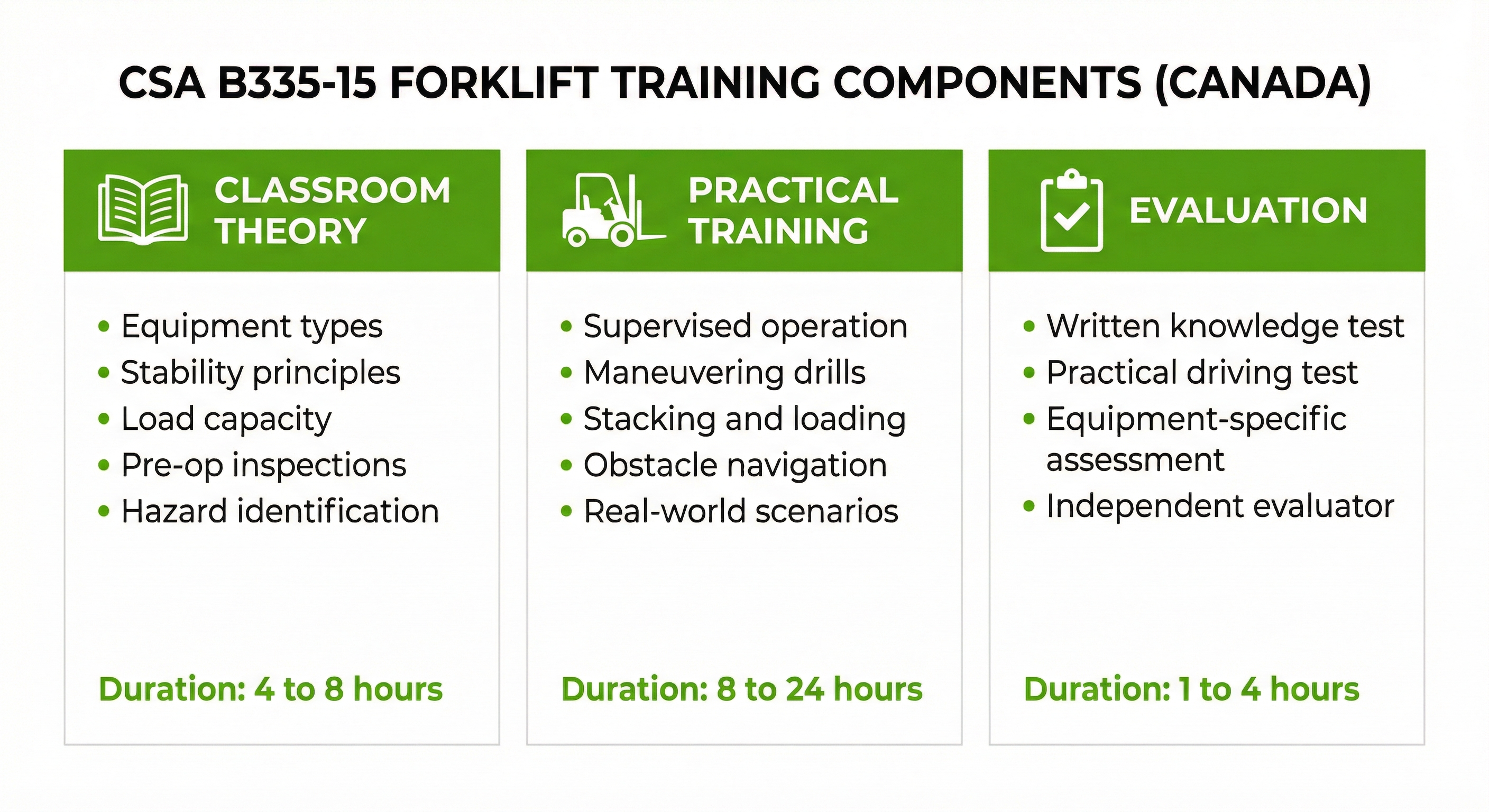
Classroom / Theory (4 to 8 hours)
Covers the fundamentals: equipment types, stability principles, load capacity, pre-operation inspection procedures, hazard identification, and relevant regulations. This component ensures operators understand the "why" behind safe operation, not just the "how."
Good classroom training goes beyond lecturing from slides. It includes case studies from real incidents, video demonstrations, interactive exercises, and quizzes to check comprehension along the way. Operators who understand the physics of forklift stability (the stability triangle, load centre distance, and how centre of gravity shifts) are far less likely to tip a machine over than those who simply memorize rules.
Practical / Hands-On (8 to 24 hours)
This is where competency is built. Operators practice on the actual equipment under supervised conditions. They learn maneuvering, stacking, loading and unloading, obstacle navigation, and real-world scenarios specific to their workplace.
The practical component is the most important part. An operator who can pass a written test but cannot safely stack pallets at height is not competent. Good providers give enough seat time to build real skills, not just enough to check a box.
For experienced operators, the practical component may take as little as 4 to 8 hours. For complete beginners, expect 16 to 24 hours of supervised practice before they are ready for evaluation. Rushing this step to save time is the single most common mistake employers make, and it is the mistake most likely to result in an incident.
Evaluation (1 to 4 hours)
A formal competency assessment that includes a written knowledge test and a practical driving evaluation. The evaluator confirms the operator can safely operate the specific equipment class in the conditions they will face on the job.
The evaluation should be conducted by someone other than the primary instructor when possible. This provides an objective assessment that is harder to challenge during an investigation. For more details on what the exam involves: Forklift Certification Exam: What to Expect.
Step 4: Document and Maintain Records
This is where most employers drop the ball. The training happens, the operator gets a wallet card, and the documentation ends there.
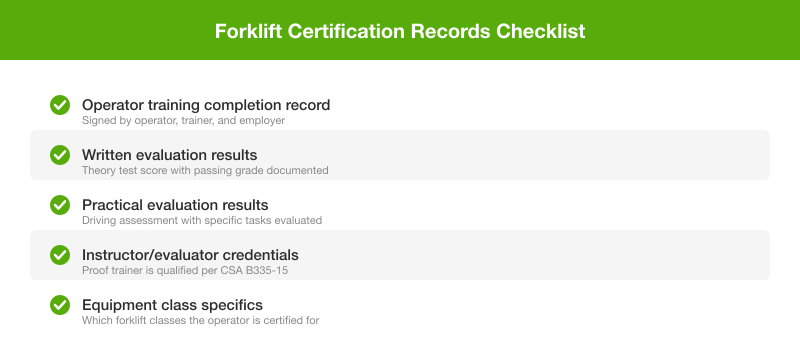
What you actually need on file:
- Training completion records: Detailed documentation of what was covered, which equipment classes, dates, and duration
- Evaluation results: Written test scores and practical evaluation outcomes
- Instructor credentials: Who delivered the training and their qualifications
- Equipment specifics: What equipment types/classes the operator was trained and evaluated on
- Renewal tracking: Scheduled dates for refresher training (every 3 years or sooner if triggered)
These records must be accessible on site during regulatory inspections. A wallet card alone is not sufficient documentation in most provinces.
Safety Evolution's training management platform can store all training records digitally, track expiry dates, and send automatic renewal reminders so nothing falls through the cracks.
Record Retention: How Long to Keep Training Files
There is no universal retention period set in legislation, but best practice is to keep training records for a minimum of 5 years after the operator leaves your company or 5 years after the training date, whichever is longer. Some industries, particularly oil and gas, require longer retention. If in doubt, keep the records indefinitely. Digital storage makes this easy, and the records could protect you in a lawsuit or investigation years after the training occurred.
Step 5: Site-Specific Training and Authorization
Even after an operator completes formal training with a provider, the employer has one more step: site-specific training and written authorization.
This covers:
- The specific layout of your workplace (aisles, racking, dock areas, pedestrian zones)
- Your company's forklift operating procedures and rules
- Site-specific hazards (floor conditions, overhead obstructions, traffic patterns)
- Emergency procedures specific to your site
After completing site-specific training, the employer provides written authorization for the operator to use specific equipment at that specific workplace. This is the final piece that regulators look for.
Site-specific training does not need to be elaborate, but it must be documented. A 30 to 60 minute walkthrough of the facility, covering traffic routes, pedestrian areas, emergency exits, and any site-specific hazards, followed by a signed acknowledgment form, is usually sufficient. The key is that it is done and documented for every operator at every location.
Common Mistakes in the Certification Process
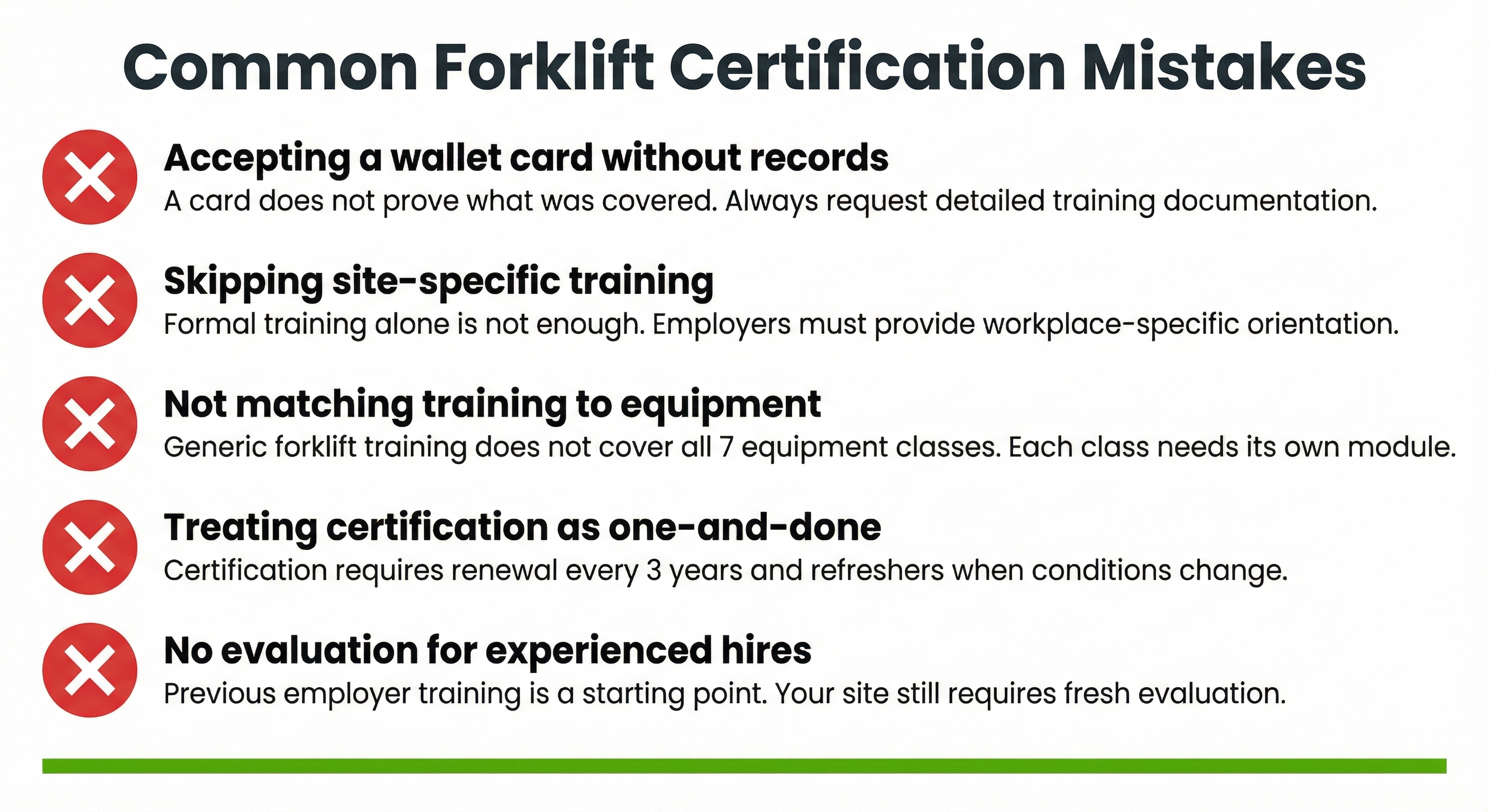
Most contractors think getting forklift certified is as simple as sending someone to a course. They are wrong. Here are the mistakes we see most often:
- Accepting a wallet card without verifying content. A card from a training provider does not tell you what was covered. Ask for detailed records that show the curriculum, equipment types, and evaluation results.
- Skipping site-specific training. Formal training is only part of the requirement. The employer must also provide workplace-specific training and authorization.
- Not matching training to equipment. Sending operators to a generic "forklift" course when they operate three different equipment classes. Each class needs its own training component.
- Treating certification as one-and-done. Forklift certification needs renewal every 3 years and refresher training whenever conditions change. Learn more about when forklift certification expires.
- No competency verification for experienced hires. An experienced operator joining your company still needs evaluation on your equipment and site-specific training. Their previous employer's training is a starting point, not the finish line.
The Class 3 Blind Spot
One of the most overlooked certification gaps involves Class 3 equipment: electric pallet jacks and walkie stackers. Many employers do not realize that powered pallet jacks are classified as powered industrial trucks under CSA B335-15 and require the same training framework as larger forklifts. We regularly see warehouses where every sit-down forklift operator is certified, but the pallet jack operators have never received formal training. This is a compliance gap and a safety gap. Pallet jacks cause more foot and ankle injuries than any other powered industrial truck class.
How Much Does Forklift Certification Cost?
Costs vary by province, equipment class, and provider. As a general guide:
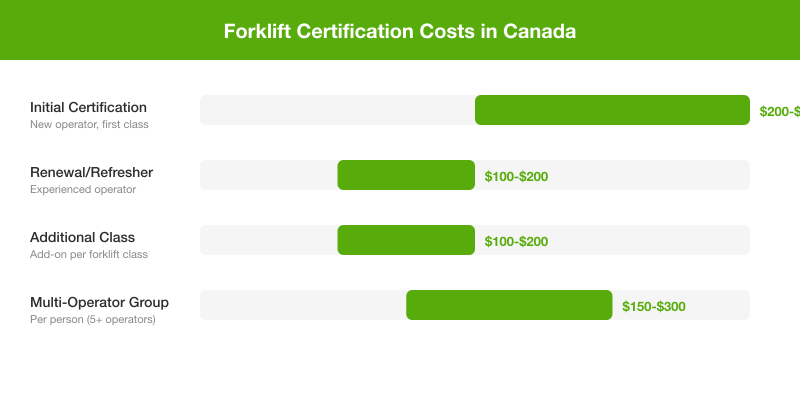
- Initial certification (new operator): $200 to $400 per operator for a standard counterbalance class
- Renewal/refresher: $100 to $200 per operator
- Multi-class training: Additional $100 to $200 per extra class
- On-site group training: Often more cost-effective for 5+ operators
For a detailed cost breakdown by province, see: How Much Does Forklift Training Cost in Canada?
How to Reduce Training Costs Without Cutting Corners
Training costs can add up, especially for contractors with high operator turnover. Here are legitimate ways to reduce costs while maintaining compliance:
- Group on-site training: If you have 5 or more operators who need training at the same time, on-site group sessions are almost always cheaper per operator than sending individuals to a training centre.
- Bundle equipment classes: Many providers offer discounts when training operators on multiple equipment classes in one session.
- Consider in-house training for renewals: If you have a qualified trainer (or are willing to invest in train-the-trainer certification), handling refreshers internally can reduce per-operator costs significantly.
- Time training strategically: Schedule training during slow periods or between projects to minimize lost productivity. Avoid peak season when both your crews and training providers are busiest.
Get ahead of forklift recertification risk
Stop finding gaps after an incident or inspection. Use a 30-Day Free Trial to monitor training, expiries, and compliance actions across your crew.
30-Day Free Trial
Frequently Asked Questions
How do I get a forklift licence in Canada?
Canada does not issue forklift licences through a government agency. Forklift certification is obtained through training providers and is employer-driven. The process involves completing classroom theory, practical hands-on training, and a competency evaluation, followed by employer-issued authorization. The employer is responsible for ensuring training meets CSA B335-15 standards.
How long does it take to get forklift certified?
New operators typically need 3 to 5 days for initial certification. Experienced operators seeking evaluation at a new employer may complete the process in 1 to 2 days. Renewal training for already-certified operators takes 4 to 8 hours.
Is forklift certification valid across Canada?
There is no nationally portable forklift certification in Canada. Training completed in one province is generally accepted as a baseline in other provinces, but the new employer must verify competency, provide site-specific training, and complete their own evaluation and documentation.
Can I get forklift certified online?
The classroom theory portion can be completed online, but CSA B335-15 requires hands-on practical training and an in-person evaluation that cannot be done online. Any provider claiming to offer complete forklift certification entirely online is not meeting Canadian standards.
Who is responsible for forklift training: the employer or the operator?
The employer is legally responsible in every Canadian province. While operators must participate in and complete training, the legal duty to ensure training is provided, current, and documented falls on the employer under provincial occupational health and safety legislation.
Do I need separate certification for each type of forklift?
Yes. Forklift certification is equipment-class specific. An operator certified on a Class 1 electric counterbalance is not automatically certified to operate a Class 7 telehandler. Each equipment class requires its own training and evaluation component. However, most training providers can bundle multiple classes into a single training session to reduce scheduling and cost.
Get Weekly Safety Insights
Regulation updates, toolbox talk ideas, and compliance tips. One email per week.