Last updated: April 2026
Your operator just finished three days of forklift training. Now comes the part that makes everyone nervous: the exam. What does it actually test? Can you fail? What happens if you do? Most operators walk in with no idea what to expect, and most employers have never seen the evaluation criteria. That lack of transparency is a problem we can fix right now.
Safety Evolution has put hundreds of operators through forklift evaluations. Here is exactly what the exam involves, what the pass criteria look like, and how to make sure your crew is ready.
⚡ Quick Answer
- Two parts: Written knowledge test + practical driving evaluation
- Written test: 20 to 40 multiple-choice questions on safety rules, equipment knowledge, and hazard identification
- Practical test: Pre-op inspection demonstration + supervised driving course including stacking, maneuvering, and load handling
- Pass rate: Most providers require 80% on the written test and satisfactory completion of all practical tasks
- Can you fail? Yes. Operators who fail can typically retake after additional practice or training
Below, we break down both parts of the forklift certification exam in detail - what topics the written test covers, what the practical evaluation looks like, what the pass criteria are, and how to make sure your operators are prepared before they walk in.
Quick Answer
The forklift certification exam has two parts: a written test (or online quiz) covering theory, and a practical evaluation where you operate the forklift under observation. In the US, OSHA requires both components plus a workplace performance evaluation. In Canada, most providers follow a similar two-part format. The written portion typically has 20 to 30 questions; you need 70 to 80% to pass. The practical evaluation tests pre-trip inspection, maneuvering, load handling, and parking procedures.
US vs Canada: How the Exam Differs
The basic structure is the same in both countries: written test + practical evaluation. The differences are in how the results are documented and who conducts the evaluation:
| Element |
US (OSHA) |
Canada |
| Who conducts the exam |
Qualified person (knowledge, training, experience per 1910.178(l)(2)(iii)) |
Competent person or approved training provider |
| Written test required |
Not explicitly (formal instruction must be evaluated, method flexible) |
Typically yes (most providers use a written exam) |
| Practical evaluation required |
Yes (practical + workplace evaluation) |
Yes |
| Passing score |
Competency-based (no set percentage) |
Typically 70-80% written, pass/fail practical |
OSHA's approach is competency-based rather than score-based. The trainer must determine that the operator can safely operate the specific truck type in the actual workplace. A 75% score on a multiple-choice test does not satisfy OSHA if the operator cannot demonstrate safe operation on the floor.
For the complete OSHA training requirements, see our OSHA Forklift Training: Complete Employer Guide.
The Written Knowledge Test
The written portion of a forklift certification exam tests the operator's understanding of safety principles, equipment characteristics, and workplace hazards. It is not a trick test. If the operator paid attention during classroom training, they should pass. But the topics are broader than many expect.
What the Written Test Covers
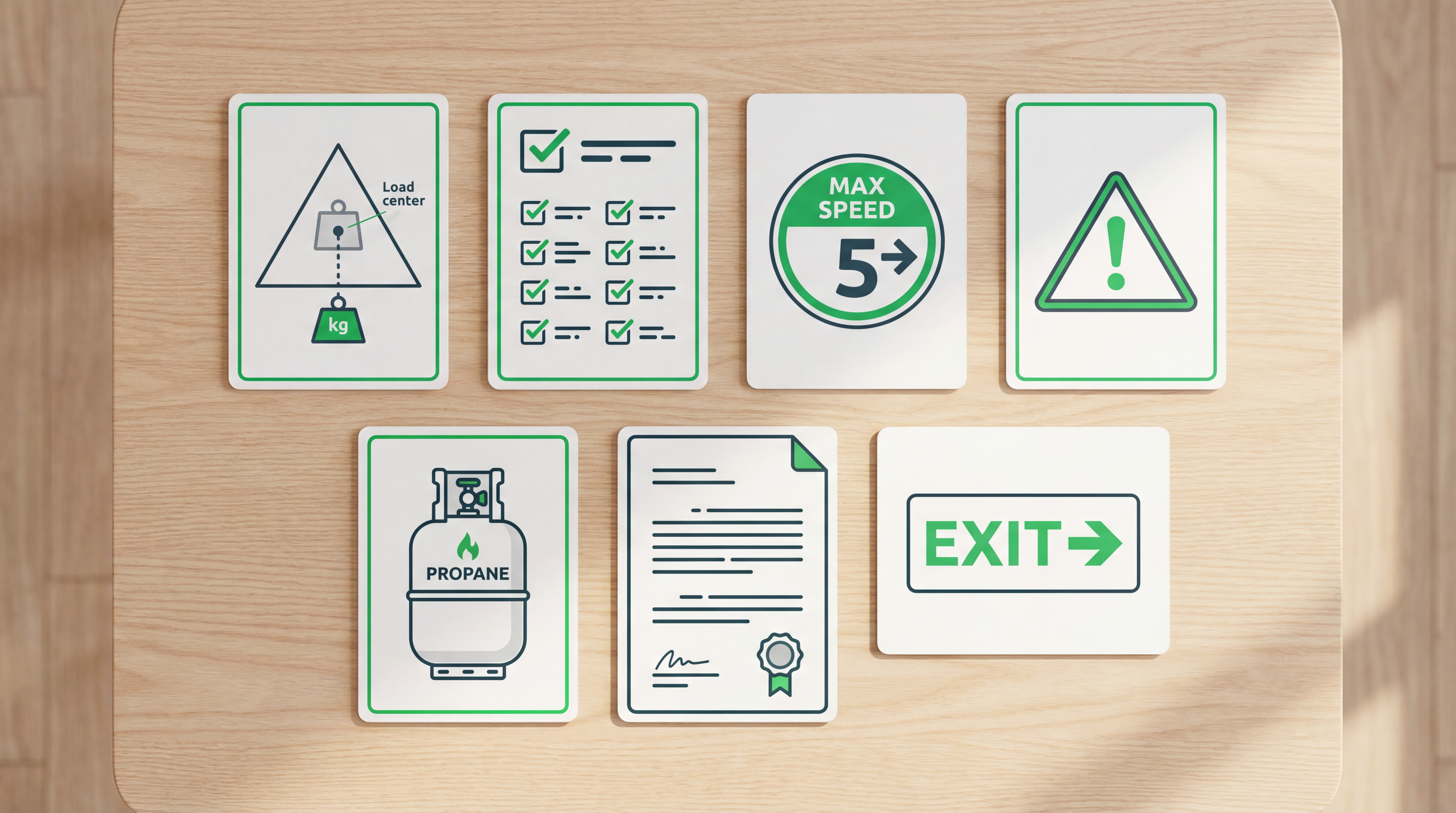
- Stability and load handling: The stability triangle, load centre distance, rated capacity, and what happens when you exceed it
- Pre-operation inspection: What to check before each shift, what defects take the equipment out of service, and documentation requirements
- Operating rules: Speed limits, right-of-way, horn use at intersections, seatbelt requirements, carrying loads at proper height
- Hazard identification: Recognizing unstable loads, floor and surface hazards, overhead obstructions, pedestrian zones
- Refueling and charging: Propane tank change procedures, battery charging safety, ventilation requirements for IC engines
- Regulatory knowledge: Employer and operator responsibilities, who can operate equipment, training requirements
- Emergency procedures: What to do if the forklift tips, how to respond to a fuel spill, evacuation procedures
Written Test Format
Most training providers use a 20 to 40 question multiple-choice format. Some include true/false and fill-in-the-blank questions. The passing grade is typically 80%, though some providers set it at 70%.
The test is usually closed-book, completed immediately after classroom training, and takes 30 to 60 minutes.
Sample Written Test Questions
While every training provider uses their own test, the types of questions are consistent. Here are examples of what operators should expect:
- Stability questions: "What is the stability triangle on a forklift and why is it important?" or "What happens to the centre of gravity when you raise a load?"
- Pre-op inspection: "Name three items that should be checked during a pre-shift inspection" or "What should you do if you find a cracked fork during inspection?"
- Operating rules: "What is the recommended travel speed for a forklift operating indoors?" or "When approaching a blind corner, what should you do?"
- Load handling: "What does the data plate on a forklift tell you?" or "Why should you tilt the mast back before traveling with a load?"
- Emergency procedures: "If you feel the forklift starting to tip, what should you do?" (Answer: stay in the seat, brace yourself, lean away from the direction of the tip. Never try to jump out.)
Operators who struggle with written tests due to language barriers or learning differences should discuss accommodations with the training provider. Many providers offer verbal tests or translated materials as alternatives.
Written Test Tips for Employers
As an employer, you can improve your operators' success rate on written tests without compromising the evaluation's integrity:
- Share the test topics (not the answers) in advance. Let operators know what subjects will be covered so they can review their classroom notes.
- Address language barriers proactively. If an operator's first language is not English, arrange for a translated test or verbal administration. An operator who knows the material but cannot read the questions in English is being tested on language, not forklift safety.
- Allow adequate time. Rushing operators through the written test increases anxiety and errors. Most providers allow 30 to 60 minutes, which should be sufficient for 20 to 40 questions.
Still tracking forklift certifications in spreadsheets?
If cards expire and no one catches it, you carry the risk. Start a 30-Day Free Trial and track operator status in one place before your next audit.
30-Day Free Trial
The Practical Driving Evaluation
This is the part that actually determines whether an operator is safe to run equipment. The practical evaluation tests real skills on real equipment under the observation of a qualified evaluator.
Pre-Operation Inspection
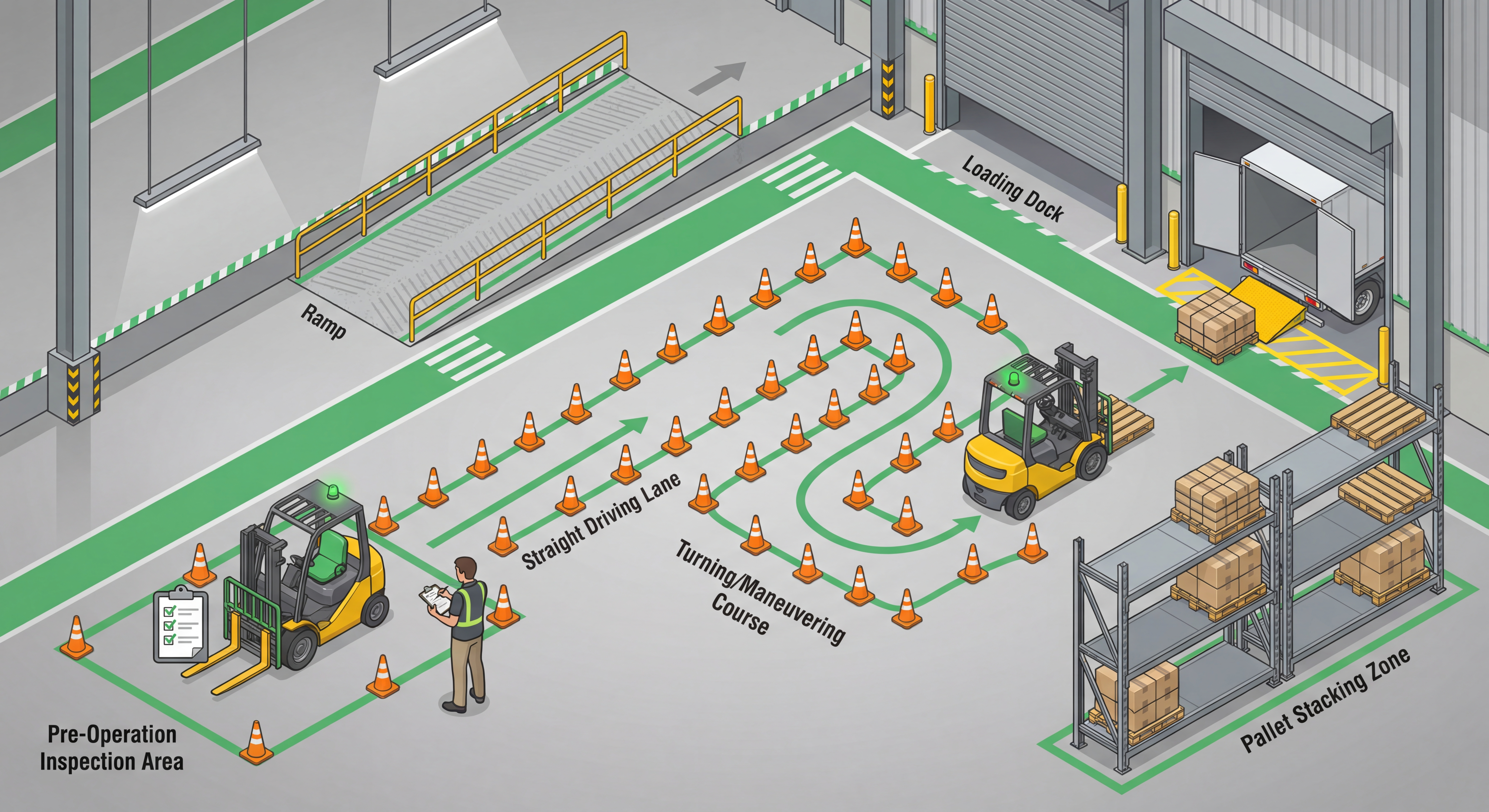
Before the driving evaluation begins, the operator must demonstrate a complete pre-shift inspection. The evaluator watches the operator walk through the entire checklist: fluids, tires, forks, mast operation, brakes, horn, lights, seatbelt. Skipping steps or failing to identify planted defects can result in a fail.
Driving Course Tasks
The practical evaluation typically includes:
- Start-up procedures: Proper mounting, seatbelt, controls check, mirror adjustment
- Forward and reverse travel: Smooth operation, proper speed, looking in the direction of travel
- Turning and maneuvering: Navigating through cones or aisles, 3-point turns, proper use of horn at blind corners
- Stacking and unstacking: Placing and retrieving loads at various heights, proper approach, mast tilt, load positioning
- Loading and unloading trucks: Dock approach, trailer chocking verification, load placement
- Ramp operations: Carrying loads uphill (forks up the ramp), empty travel downhill (forks facing down the ramp)
- Parking and shutdown: Proper parking procedure, forks flat on ground, parking brake, key removal
How Practical Evaluations Are Scored
Most evaluators use a standardized checklist with three categories for each task:
- Satisfactory: The operator completed the task safely and correctly without assistance or correction.
- Needs improvement: The operator completed the task but with minor errors that did not create an immediate safety risk. These are noted for additional practice but do not necessarily result in a fail.
- Unsatisfactory: The operator either could not complete the task or completed it in a way that created a safety risk. This results in a fail for that specific task.
Most providers require satisfactory performance on all safety-critical tasks (pre-op inspection, looking in direction of travel, load handling at height, and proper shutdown) for a pass. One or two "needs improvement" scores on non-critical tasks may be acceptable with the understanding that additional practice is needed.
The evaluator should provide specific, documented feedback for any "needs improvement" or "unsatisfactory" scores. This feedback is valuable for the operator's development and for the employer's records.
What Happens During the Evaluation: A Minute-by-Minute Walkthrough
Here is what a typical 1 to 2 hour practical evaluation looks like:
- Pre-op inspection (10 to 15 minutes): The operator walks through the full pre-shift inspection checklist while the evaluator observes and scores each step. Some evaluators plant a defect (a disconnected seatbelt, a low tire, an inoperative horn) to see if the operator catches it.
- Basic driving (15 to 20 minutes): Forward travel, reverse travel, turns, and stop-start control. The evaluator checks for smooth operation, proper speed, and correct body positioning (looking in direction of travel).
- Maneuvering (15 to 20 minutes): Navigating through a course of cones or simulated aisles, 3-point turns, and backing into a narrow space. This tests spatial awareness and control.
- Load handling (20 to 30 minutes): Picking up, transporting, and placing loads at various heights. Stacking and unstacking. Approaching loads squarely, tilting mast back, and traveling with loads at the correct height.
- Specialized tasks (10 to 15 minutes): Depending on the work environment, this may include loading/unloading a truck, ramp operation, or working in narrow aisles.
- Shutdown (5 minutes): Proper parking, forks flat on the ground, parking brake engaged, key removed, seatbelt removed.
30-Day Free Trial and flag where documentation gaps exist.
What Causes Operators to Fail?
Failure is less common than you might think, but it happens. Here are the most common reasons:
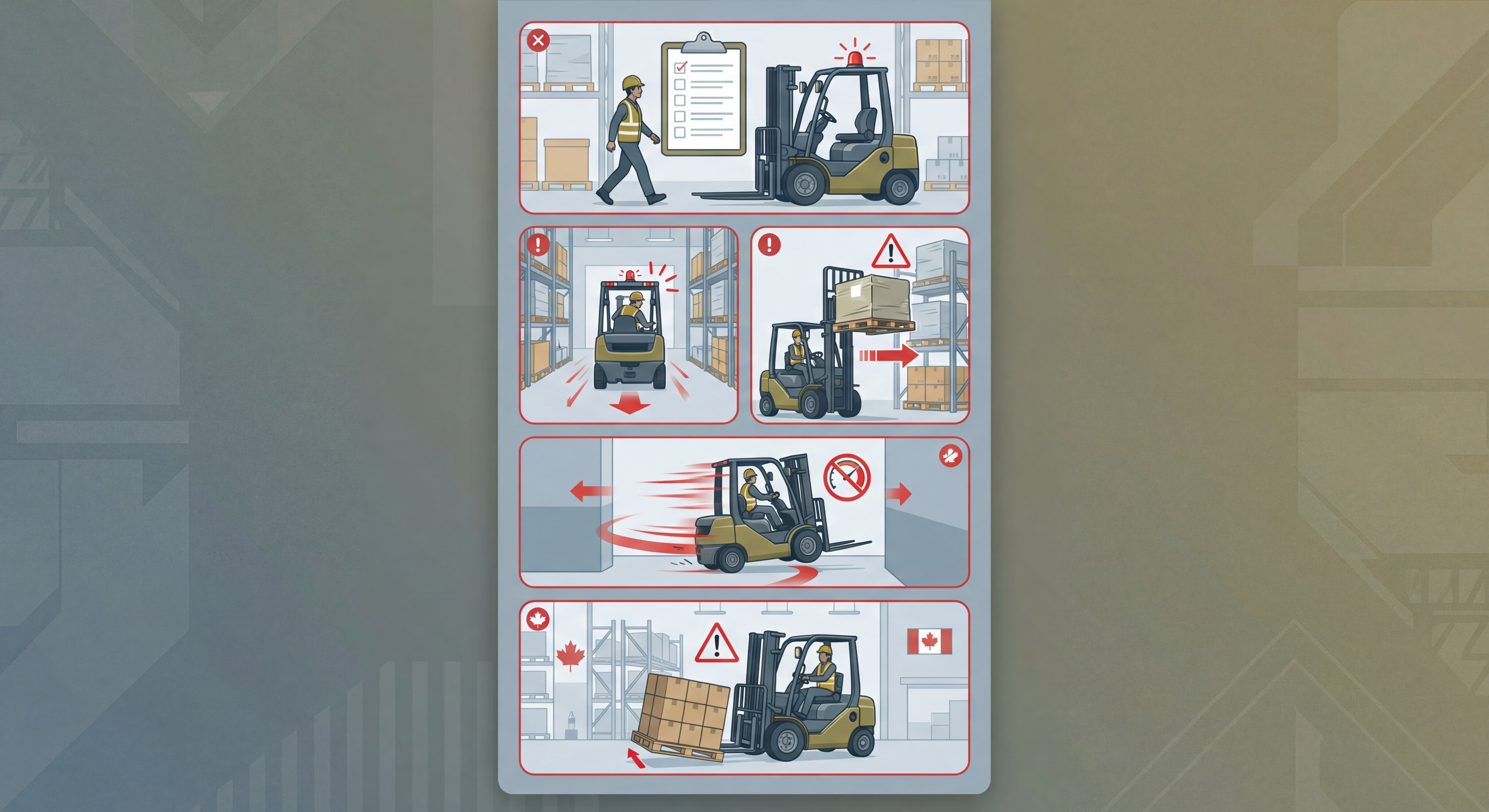
- Skipping the pre-op inspection. Some operators try to rush through or skip steps. Evaluators watch for this specifically.
- Not looking in the direction of travel. Driving forward while looking backward (or vice versa) is an automatic fail with most evaluators.
- Traveling with forks raised. Forks should be 4 to 6 inches off the ground during travel. Driving with forks at stacking height is a stability hazard and an instant red flag.
- Speeding on turns. Tip-overs are the leading cause of forklift fatalities, and most tip-overs happen during turns. Evaluators watch speed closely.
- Poor load handling. Approaching a load off-centre, scooping instead of squaring up, or failing to tilt the mast back before traveling.
How to Prepare Your Operators
The best preparation is good training. But there are additional steps employers can take:
- Share what the test covers. Give operators this article or a similar overview so they know what to expect. Uncertainty increases anxiety and errors.
- Allow practice time. If possible, let operators practice on the equipment before the evaluation day. Familiarity with the specific machine matters.
- Review the pre-op inspection checklist. This is often the most underestimated part. Walk through it together before training day.
- Match the training to the equipment. Make sure the evaluation is done on the same class of forklift the operator will actually use.
What Happens If an Operator Fails?
Failing the forklift exam is not the end. Most training providers allow retakes after additional practice or remedial training:
- Written test failure: The operator reviews the areas they got wrong and retakes the test, usually the same day or the next day.
- Practical evaluation failure: The operator gets additional supervised practice time to address the specific skills that were deficient, then retakes the practical evaluation.
- Multiple failures: If an operator cannot pass after reasonable additional training, it may be an indication that they are not suited for forklift operation. This is a difficult conversation, but it is a safety-critical one.
The employer should never pressure a training provider to pass an operator who has not demonstrated competency. That pressure creates liability, not savings.
For the full certification process: How to Get Forklift Certified in Canada
For understanding renewal and refresher exams: Does Forklift Certification Expire?
How Refresher Exams Differ from Initial Exams
When experienced operators renew their certification every 3 years, the evaluation is typically shorter and more focused than the initial exam:
- Written test: Similar content, but experienced operators generally complete it faster with higher scores. Some providers use a shorter refresher-specific test (15 to 20 questions) rather than the full initial exam.
- Practical evaluation: The evaluator focuses on identifying bad habits rather than building new skills. Common bad habits that develop over time include one-handed steering, not using the horn at intersections, traveling with forks too high, and skipping steps in the pre-op inspection.
- Duration: A refresher evaluation typically takes 30 to 60 minutes for the practical component, compared to 1 to 2 hours for initial certification.
- Updated content: Refresher training and exams should cover any changes to regulations, equipment, or workplace procedures since the operator's last certification.
For more on renewal timing and triggers: Does Forklift Certification Expire?
Get ahead of forklift recertification risk
Stop finding gaps after an incident or inspection. Use a 30-Day Free Trial to monitor training, expiries, and compliance actions across your crew.
30-Day Free Trial
Frequently Asked Questions
How many questions are on a forklift certification exam?
Most forklift certification written exams have 20 to 40 multiple-choice questions. The exact number varies by training provider. The passing grade is typically 80%. Topics cover stability, load handling, pre-operation inspection, operating rules, hazard identification, and emergency procedures.
Is the forklift exam hard?
The forklift exam is straightforward for operators who paid attention during training. The written test covers material directly from the classroom portion. The practical evaluation tests skills practiced during hands-on training. Most operators pass on their first attempt. Common failure points include skipping pre-op inspection steps and not looking in the direction of travel.
Can you retake the forklift exam if you fail?
Yes. Most training providers allow retakes after additional practice or remedial training. Written test retakes are often available the same day. Practical evaluation retakes usually require additional supervised practice time before reattempting. Some providers charge a small retake fee.
What is on the practical forklift test?
The practical forklift evaluation includes a pre-operation inspection demonstration, forward and reverse driving, turning and maneuvering through obstacles, stacking and unstacking at various heights, loading and unloading from trucks, ramp operations, and proper shutdown procedures. The evaluator observes safety compliance throughout.
Do employers need to keep copies of forklift exam results?
Yes. Employers should keep detailed records of both written test results and practical evaluation outcomes for every operator. These records should include the date, the evaluator's name, the equipment class tested, the specific tasks evaluated, and the results for each task. Keep records for at least 5 years or as long as the operator is employed, whichever is longer. These records are the first thing a regulator requests after an incident.
Can the forklift exam be taken in a language other than English?
Many training providers offer written tests and verbal evaluations in multiple languages. If an operator's first language is not English, arranging a translated or verbally administered test ensures the evaluation measures forklift knowledge rather than English proficiency. This is particularly common in the Greater Toronto Area and Metro Vancouver, where training providers offer courses in Punjabi, Mandarin, French, and other languages.
Get Weekly Safety Insights
Regulation updates, toolbox talk ideas, and compliance tips. One email per week.