Last updated: April 2026
You just won a contract that needs three different types of forklifts on site. Your operator is certified on a counterbalance. Does that cover a reach truck? What about the telehandler the GC is bringing in? If you are not sure, you are not alone. Most contractors treat forklift certification as one thing when it is actually seven different equipment classes, each with its own handling, hazards, and training requirements.
At Safety Evolution, we help contractors across Canada sort out exactly this kind of confusion every week. Here is what you actually need to know about forklift classes and the training that goes with each one.
⚡ Quick Answer
- What: Powered industrial trucks are classified into 7 types by the Canadian Standards Association (CSA) and industry standards
- Why it matters: Operators must be trained on the specific class of forklift they will operate, not just "forklifts" in general
- Key rule: CSA B335-15 requires training to be equipment-specific. A Class 1 cert does not cover Class 7 equipment
- Employer obligation: You must ensure every operator is trained and evaluated on each type of equipment they use
Below, we break down each of the seven forklift classes, what equipment falls into each category, and what that means for your training and documentation requirements.
Quick Answer
Forklifts are classified into 7 classes (I through VII) based on power source and design. Both OSHA and CSA use the same 7-class system, which comes from the Industrial Truck Standards Development Foundation (ITSDF, formerly ITA) classification. OSHA requires operators to be trained on the specific truck type they will operate. Training on a Class IV counterbalance does not qualify an operator to run a Class II reach truck.
Forklift Classification: Universal Across US and Canada
The 7-class forklift classification system is universal across both countries. It originates from ANSI/ITSDF B56.1 in the US and is referenced by CSA B335-15 in Canada. Under OSHA 1910.178(l)(3), operators must be trained on the specific truck types they will use, and training on one class does not transfer to another. OSHA also uses designations (D, DS, DY, E, ES, EE, EX, G, GS, LP, LPS) for hazardous location classifications, but the 7-class system is what matters for training requirements.
What Are the 7 Forklift Classes?
Forklift classes are a standardized system that groups powered industrial trucks into seven categories based on their power source, operator position, and design. This classification system helps employers, trainers, and regulators ensure operators receive the right training for the right equipment.
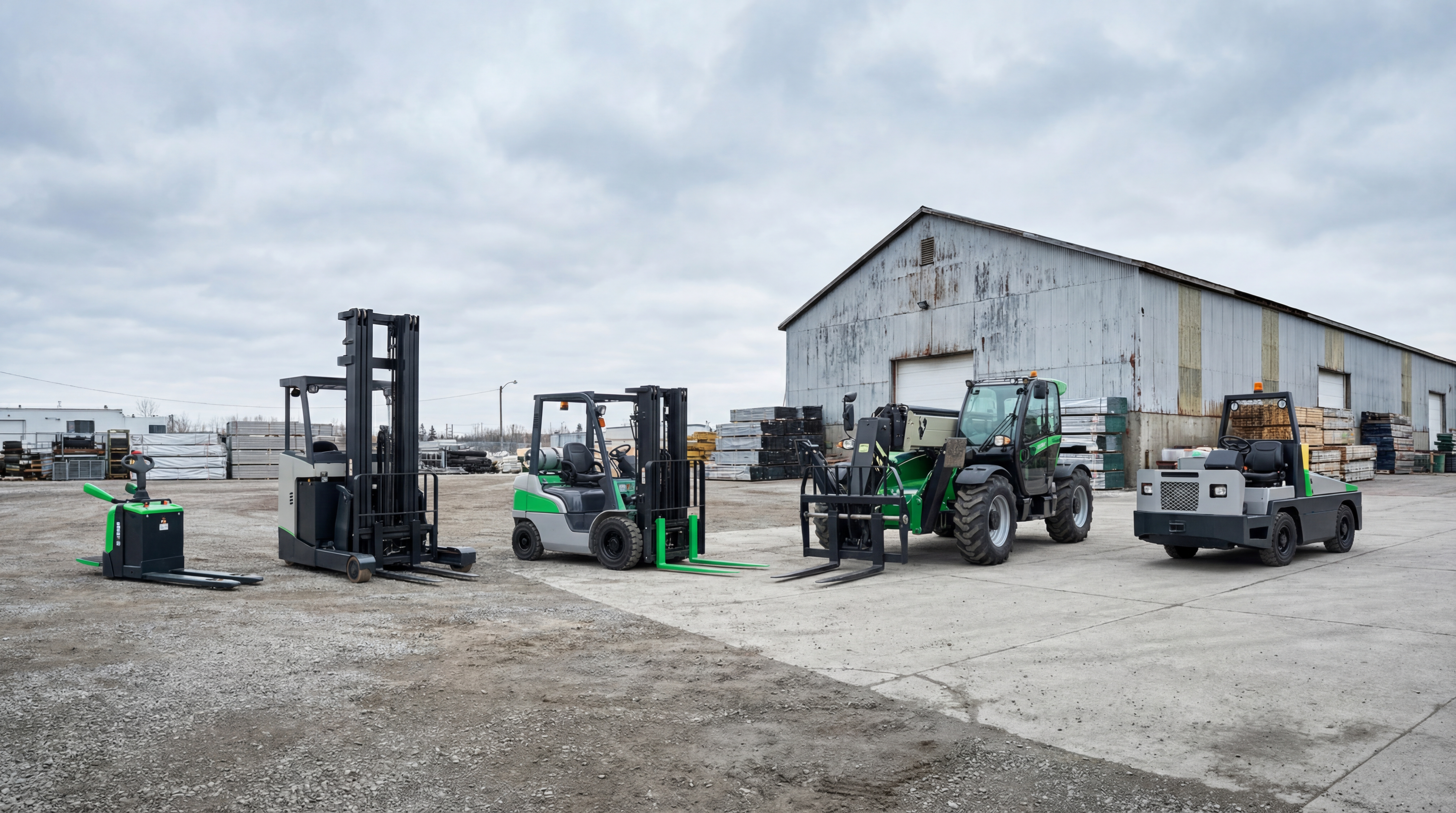
Here is the full breakdown:
Class 1: Electric Motor Rider Trucks
These are the workhorses of warehouses and distribution centres. Sit-down, counterbalanced, battery-powered. They produce zero emissions, making them ideal for indoor use. If your crew works in a warehouse, cold storage, or food processing facility, this is likely what they are operating.
Common types: Sit-down counterbalance, three-wheel electric
Training focus: Battery handling and charging safety, indoor maneuvering, load capacity on smooth floors
Class 2: Electric Motor Narrow Aisle Trucks
Built for tight spaces. These trucks operate in aisles as narrow as 6 feet, reaching heights that make most people uncomfortable. Reach trucks, order pickers, and turret trucks all fall here.
Common types: Reach trucks, order pickers, turret trucks, side loaders
Training focus: Working at height (order pickers), narrow aisle navigation, rack awareness, fall protection when elevated
Class 3: Electric Motor Hand Trucks
Pallet jacks, both powered walkies and rider types. The operator walks alongside or rides a small platform. These are everywhere, from loading docks to retail back rooms, and they are responsible for a surprising number of foot and ankle injuries because people underestimate them.
Common types: Electric pallet jacks, walkie stackers, end riders
Training focus: Pedestrian awareness, foot placement, load stability on inclines
Class 4: Internal Combustion Engine Trucks (Cushion Tires)
These look like Class 1 machines, but they run on propane, gasoline, diesel, or compressed natural gas. Cushion tires mean they are designed for smooth indoor surfaces only. They cannot handle gravel, mud, or uneven ground.
Common types: Sit-down counterbalance with cushion tires (IC engine)
Training focus: Fuel handling (propane tank changes), ventilation requirements for indoor use, emission monitoring
Class 5: Internal Combustion Engine Trucks (Pneumatic Tires)
The same engine types as Class 4, but with pneumatic (air-filled) tires for outdoor use. These handle loading docks, lumber yards, construction staging areas, and anywhere the ground is not perfectly smooth. This is the class most construction contractors encounter.
Common types: Outdoor counterbalance forklift, yard truck
Training focus: Outdoor terrain hazards, uneven surfaces, weather conditions, refueling procedures
Class 6: Electric and Internal Combustion Engine Tractors
Tow tractors and industrial tuggers. They do not lift loads. They pull them. Used in airports, manufacturing plants, and large distribution facilities to move material trains across long distances.
Common types: Tow tractors, terminal tractors, baggage tractors
Training focus: Coupling and uncoupling, turning radius with trailing loads, pedestrian zones
Class 7: Rough Terrain Forklifts
If your crew works on construction sites, oil and gas pads, or anywhere with dirt, gravel, or slopes, this is the class that matters most to you. Telehandlers fall into this category. These machines are powerful, tall, and unforgiving if operated incorrectly on uneven ground.
Common types: Straight mast rough terrain, telehandlers (variable reach), truck-mounted forklifts
Training focus: Ground conditions assessment, load charts at extended reach, outrigger setup, stability on slopes
Explore Safety Evolution's training courses to see which forklift classes your team needs coverage on.
Why Does Forklift Class Matter for Training?
Here is where most employers get tripped up. They send an operator to a one-day forklift course, get a card back, and assume that card covers everything with forks on the front. It does not.
CSA B335-15, the Canadian standard for powered industrial truck operator training, requires that training be specific to the type of equipment the operator will use. An operator trained on a Class 1 electric counterbalance is not qualified to jump on a Class 7 telehandler without additional training and evaluation.
Think of it this way: a Class C driver's licence does not let you drive a semi. Same principle.
Here is what we see go wrong on real job sites:
- A warehouse operator gets moved to the yard and hops on a pneumatic tire forklift (Class 5) with no additional training. Different handling, different hazards, different terrain.
- A contractor rents a telehandler (Class 7) for a two-week job and assumes their counterbalance-certified operator can figure it out. That telehandler has a completely different stability profile and load chart.
- An employer uses a single "forklift training" certificate for all equipment, then discovers during a WorkSafeBC inspection that the certificate does not match the equipment on site.
Each of these is a real scenario we have walked contractors through. The fix is straightforward: match your training to your fleet.
Not sure if your forklift records would pass inspection today?
Missing proof and scattered documents create compliance risk. Start your 30-Day Free Trial and keep inspection-ready records.
30-Day Free Trial
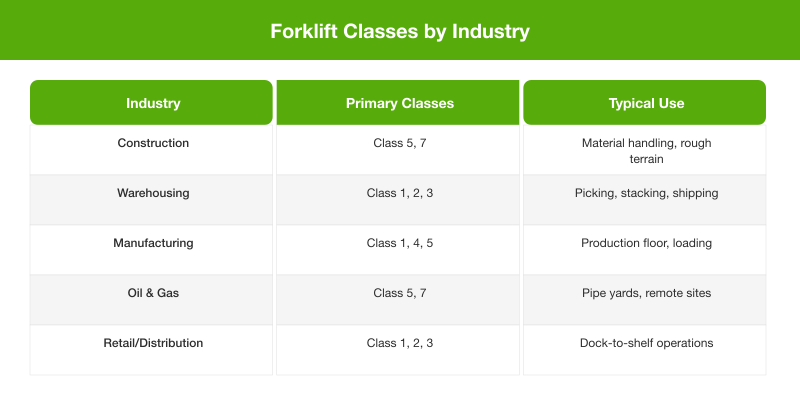
Which Forklift Classes Does Your Crew Need?
This depends on your industry and what equipment shows up on your sites. Here is a quick guide:
| Industry |
Most Common Classes |
Why |
| Construction |
Class 5, Class 7 |
Outdoor terrain, telehandlers, material handling on rough ground |
| Warehousing |
Class 1, Class 2, Class 3 |
Indoor operations, narrow aisles, pallet movement |
| Manufacturing |
Class 1, Class 4, Class 5 |
Mixed indoor/outdoor, IC engines for ventilated areas |
| Oil and Gas |
Class 5, Class 7 |
Remote pads, heavy material, rough terrain |
| Lumber and Building Supply |
Class 4, Class 5 |
Yard work, loading trucks, mixed surfaces |
If your crew uses more than one class, each operator needs training on each class they will operate. There is no shortcut here.
How Does Class-Specific Training Work?
Under CSA B335-15, forklift operator training must include three components for every class of equipment:
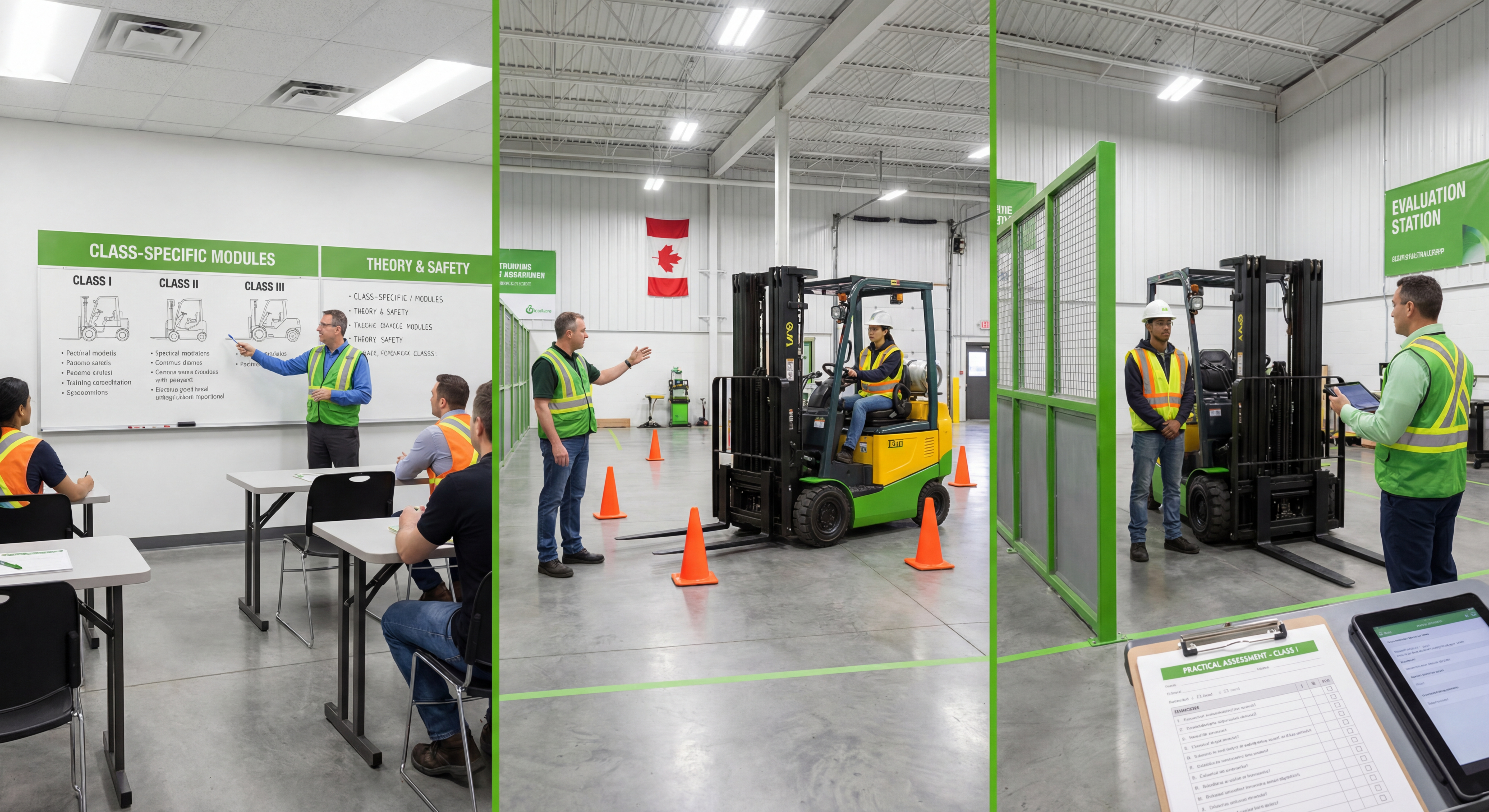
- Classroom instruction: Theory on the specific equipment type, its controls, stability characteristics, and hazards unique to that class
- Practical training: Hands-on operation of the actual equipment (or identical model) under supervision
- Evaluation: A competency assessment proving the operator can safely operate that specific equipment type
An operator who completes all three on a Class 1 electric counterbalance and then needs to operate a Class 7 telehandler must go through all three components again for Class 7. The classroom portion covers different content. The practical portion uses different equipment. The evaluation tests different skills.
Some training providers offer multi-class courses that cover related classes (like Class 4 and Class 5, which share similar controls but differ in tire type and terrain). These can be efficient if your crew needs both.
What Happens If Training Does Not Match the Equipment?
Most contractors think a forklift card is a forklift card. They are wrong.
Here is what actually happens when there is a mismatch:
- Regulatory inspection: An OHS officer or WorkSafeBC inspector can ask to see training records that match the equipment on site. If your operator has a Class 1 card but is running a Class 7 telehandler, that is a compliance gap. Stop-work orders, fines, and a very bad day.
- Incident investigation: If there is an accident and the investigation reveals the operator was not trained on that specific equipment class, the employer faces significantly increased liability. "They had forklift training" is not a defence if the training did not cover the machine involved.
- Insurance implications: WCB claims can be affected when training records do not match the equipment involved in an incident. This can impact your premiums for years.
For more on the legal consequences of operating without proper certification, see our guide on forklift training and certification in Canada.
How to Audit Your Fleet Against Your Training Records
Here is a practical step you can do this week:
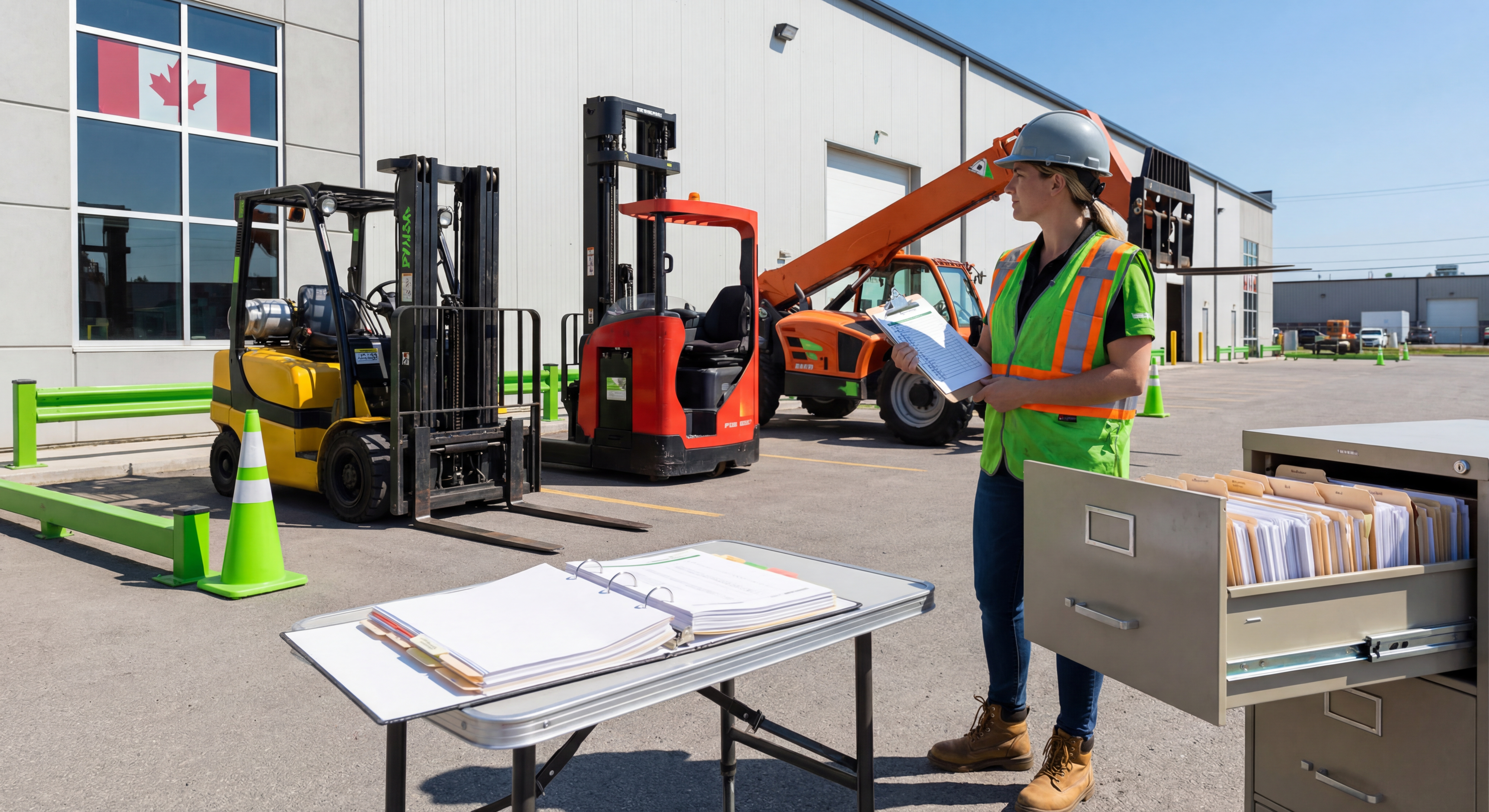
- List every piece of powered industrial truck equipment your company owns, rents, or has on site. Include everything with forks, a mast, or a lifting mechanism.
- Classify each piece. Use the 7-class system above. If you are not sure, the equipment manual or the manufacturer's website will list the class.
- Pull your training records. For each operator, check which classes their training covers.
- Find the gaps. Any operator running equipment outside their trained class is a compliance gap.
- Schedule the training. Prioritize the highest-risk gaps first: Class 7 (rough terrain) and Class 2 (heights) carry the most serious hazard profiles.
If you are not sure how to classify your fleet or structure your forklift training budget, we can walk you through it.
Forklift Classes and Certification Renewals
Training does not last forever. In most Canadian jurisdictions, forklift certification should be renewed every three years. But here is the part many employers miss: renewal applies per class, not per operator.
If an operator is certified on Class 1 and Class 5, both certifications have their own renewal timelines. Some provinces, like BC under WorkSafeBC, also require refresher training whenever an operator is observed operating unsafely, is involved in an incident, or moves to a new workplace with different equipment or conditions.
For a deeper look at renewal timelines, check our guide: Forklift License vs Certification in Canada.
Common Mistakes Employers Make with Forklift Classes
- Treating all forklifts as one category. A pallet jack (Class 3) and a telehandler (Class 7) have nothing in common except that they move material. Training for one does not cover the other.
- Assuming brand training equals class training. Getting trained on a Toyota 8FGU25 does not automatically cover all Class 5 machines. Training should cover the class characteristics, not just one model.
- Forgetting about rented equipment. If you rent a telehandler for a two-week job, your operators still need Class 7 training before they touch it. "We only had it for two weeks" is not a defence.
- Ignoring pallet jacks. Class 3 powered pallet jacks are the most underestimated equipment on this list. They cause serious foot, ankle, and crushing injuries. They require training just like every other class.
Be inspection-ready without the last-minute scramble
Run your forklift compliance workflow in one system with a 30-Day Free Trial and close gaps before regulators find them.
30-Day Free Trial
Frequently Asked Questions
How many forklift classes are there?
There are 7 classes of powered industrial trucks. Class 1 through 3 are electric powered. Class 4 and 5 use internal combustion engines (propane, gas, diesel). Class 6 covers tow tractors. Class 7 covers rough terrain forklifts, including telehandlers.
Do I need separate training for each forklift class?
Yes. Under CSA B335-15, forklift training must be specific to the type of equipment the operator will use. An operator certified on a Class 1 electric counterbalance cannot operate a Class 7 telehandler without completing separate training and evaluation for that class.
What forklift class is a telehandler?
Telehandlers are classified as Class 7 (Rough Terrain Forklifts). They require specific training that covers variable reach load charts, outrigger setup, stability on slopes, and ground condition assessment. Standard counterbalance forklift training does not cover telehandler operation.
What is the most common forklift class on construction sites?
Class 5 (pneumatic tire counterbalance) and Class 7 (rough terrain, including telehandlers) are the most common on construction sites. Both are designed for outdoor use on uneven surfaces. Construction contractors should ensure operators are trained on both classes if their sites use both equipment types.
Does a powered pallet jack need forklift training?
Yes. Powered pallet jacks are Class 3 powered industrial trucks and require operator training under CSA B335-15. Despite being smaller and simpler than sit-down forklifts, they cause a significant number of foot, ankle, and crushing injuries each year.
Get Weekly Safety Insights
Regulation updates, toolbox talk ideas, and compliance tips. One email per week.