Last updated: April 2026
It is 2:30 PM on a Thursday. Your operator clips a pedestrian with a loaded forklift in the warehouse. The worker is injured. An ambulance is called. Within 24 hours, an OHS investigator is on site asking one question before anything else: "Was this operator trained and certified to operate this equipment?" If the answer is no, or if the answer is "well, sort of," everything that follows gets significantly worse for you.
Safety Evolution has seen the aftermath of forklift incidents where training was missing or inadequate. Here is what actually happens when certification is not in order, and why the cost of proper training is a fraction of what these consequences cost.
⚡ Quick Answer
- Regulatory fines: Up to $100,000 for individuals, $1,500,000 for corporations (Ontario OHSA). Similar or escalating penalties in other provinces.
- Criminal liability: Under Bill C-45, individuals (including owners and supervisors) can face criminal charges for failing to ensure worker safety
- WCB impacts: Premium surcharges, experience rating penalties, and potential cost recovery for claims
- Civil liability: Lawsuits from injured workers or their families, particularly where training was clearly deficient
- Operational: Stop-work orders, contract termination by GCs, loss of COR/safety certifications, reputational damage
- Free Resource: Download our Incident Report & Investigation Guide to learn how to properly document and investigate these events before they happen again.
Below, we walk through exactly what happens after a forklift incident when certification is missing or deficient - from the first inspector visit through regulatory fines, criminal liability, and the long-term operational fallout.
Quick Answer
If a forklift accident occurs and the operator was not trained, the employer faces OSHA citations, workers' comp claims, and potential personal injury lawsuits. In the US, OSHA can cite the employer up to $165,514 per willful violation. The lack of training documentation becomes evidence of negligence in civil litigation. In Canada, provincial OHS regulators can levy fines up to $500,000+ (Alberta), and the absence of training records shifts liability squarely to the employer.
US Liability: What Happens When OSHA Investigates
When a forklift accident results in serious injury or death, OSHA opens an investigation. The first document they request is training records. Under OSHA 1910.178(l)(6), employers must have certification records for every operator. If those records do not exist or are incomplete, the employer faces:
- OSHA citations: Up to $16,550 per serious violation, $165,514 per willful violation. Each untrained operator = separate violation.
- Civil lawsuits: The absence of training records is treated as evidence of negligence. Plaintiffs' attorneys use missing OSHA-required documentation to establish the employer knew or should have known the operator was unqualified.
- Workers' comp premium increases: A serious forklift incident spikes your experience modification rate (EMR) for 3 years, increasing premiums by 20 to 50% on average.
- Criminal prosecution: In cases of death, federal prosecutors can bring criminal charges against employers who willfully violated OSHA standards. Individual managers can face personal criminal liability.
- Contract disqualification: ISNetworld, Avetta, and Veriforce review training documentation. A single OSHA citation can trigger a suspension from prequalification platforms, locking you out of bids.
The penalty math is stark: one forklift fatality with no training records can generate $500,000+ in combined OSHA fines, legal fees, and settlement costs, not counting the workers' comp impact. For the full OSHA requirements, see our OSHA Forklift Training: Complete Employer Guide.
Canadian Liability: Provincial Enforcement
What Happens Immediately After an Incident?
When a forklift incident results in serious injury or death, the employer's training records become the first focus of the investigation. Not the second focus. Not one of many factors. The first thing regulators, investigators, and eventually lawyers look at.
Here is the typical sequence:
- Emergency response. The injured worker receives medical attention. The scene is secured.
- Regulatory notification. Under most provincial legislation, serious injuries must be reported to the OHS regulator immediately. Failure to report is a separate offence.
- Investigation begins. An OHS officer arrives on site. They request the operator's training records, the pre-shift inspection log, the equipment maintenance records, and your forklift safety program documentation.
- The training gap is identified. If the operator was not trained on that equipment class, if training was expired, if there is no documentation, or if the training program was clearly inadequate, the investigation intensifies.
- Enforcement action. Depending on the severity, this can range from compliance orders to administrative penalties to prosecution.
Worried one forklift incident could become a legal mess?
When training records are hard to prove, liability gets expensive fast. Try Safety Evolution free for 30 days and keep defensible records ready.
30-Day Free Trial
Regulatory Fines and Penalties
Every province has the authority to impose significant fines for OHS violations. When a forklift incident involves an untrained or uncertified operator, the penalties increase because the violation is considered foreseeable and preventable.
| Province |
Max Fine (Individual) |
Max Fine (Corporation) |
Imprisonment |
| Ontario |
$100,000 |
$1,500,000 |
Up to 12 months |
| Alberta |
$500,000 |
$1,000,000 |
Up to 6 months |
| British Columbia |
Administrative penalties vary |
Up to $725,000+ |
Possible under WCA |
| Saskatchewan |
$100,000+ |
$1,500,000+ |
Up to 2 years |
These are maximums, but regulators do impose substantial penalties for training-related violations, particularly when the violation contributed to a serious injury. A $50,000 fine for a training gap that contributed to an incident is not unusual.
What Fines Actually Look Like in Practice
Maximum penalties are the theoretical ceiling. Here is what employers actually face in practice:
- First offence, no injury: A routine inspection reveals untrained forklift operators. The employer receives a compliance order to rectify the training gap within 30 days. If the gap is not closed, administrative penalties of $5,000 to $15,000 per operator are common.
- Training gap contributing to a minor injury: An operator with expired training clips a pedestrian, causing a sprained ankle. The employer faces a fine of $25,000 to $50,000, a compliance order, and WCB claim impacts. The fine increases if the employer knew the training was expired.
- Training gap contributing to a serious injury or fatality: An untrained operator tips a forklift, resulting in a critical injury. The employer faces fines of $100,000 to $500,000 or more, potential criminal investigation under Bill C-45, civil lawsuits, WCB premium surcharges for years, and probable loss of COR and GC contracts.
The pattern is clear: penalties escalate dramatically with the severity of the outcome and the degree to which the employer should have known about the training gap. A $200 training course that could have prevented a $100,000 fine is the most straightforward cost-benefit analysis in workplace safety.
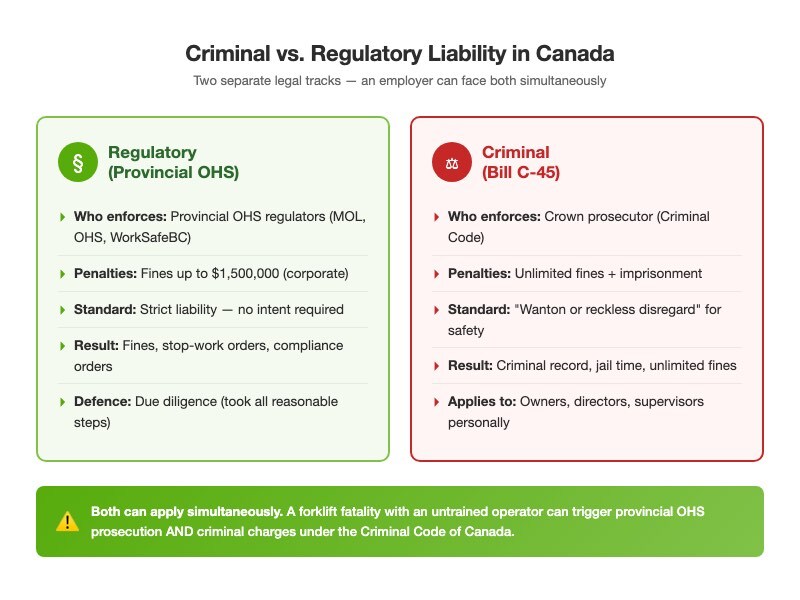
Criminal Liability Under Bill C-45
Most contractors do not know this: since 2004, Canadian employers and individuals can face criminal charges for failing to take reasonable steps to prevent workplace injury or death.
Bill C-45 (the Westray Bill) amended the Criminal Code of Canada to create a duty for "everyone who undertakes, or has the authority, to direct how another person does work or performs a task" to take reasonable steps to prevent bodily harm. This applies to:
- Company owners and directors
- Managers and supervisors who have authority over workers
- The corporation itself
If a forklift fatality or serious injury occurs and the investigation reveals the employer knew (or should have known) that operators were not properly trained, criminal negligence charges are possible. The penalties include imprisonment.
This is not theoretical. Criminal charges have been laid against employers in Canada for workplace safety failures. The absence of basic training records, like forklift certification, makes a prosecution case significantly stronger.
Who Is Personally Liable Under Bill C-45?
The scope of personal liability under Bill C-45 is broader than most employers realize. The Criminal Code provision applies to "everyone who undertakes, or has the authority, to direct how another person does work or performs a task." In practical terms, this includes:
- Company owners and directors: Even if they are not on site day-to-day, owners and directors have a duty to ensure safety systems (including training programs) are in place and functioning.
- Site supervisors and foremen: The person who assigns an operator to a forklift has authority over how that work is performed. If they assign an untrained operator to equipment, they bear personal liability.
- Safety managers and coordinators: The person responsible for the company's safety program has a duty to identify and close training gaps. Knowing about a gap and failing to act on it creates personal exposure.
- The corporation itself: The company as a legal entity can be charged separately from individuals.
The key phrase in Bill C-45 is "wanton or reckless disregard." Operating forklifts with untrained operators, especially after the employer has been made aware of the training gap, can meet this threshold. Ignorance is not a defence when the employer's duty to know is established in legislation.
before a gap becomes a legal problem.
WCB and Insurance Impacts
Beyond fines and criminal liability, an incident involving an untrained operator creates financial ripple effects that last years:
- WCB claims and surcharges. The injured worker's WCB claim is charged to your account. If the investigation reveals a training deficiency, your experience rating is impacted more severely, increasing your premiums for 3 to 5 years.
- WCB cost recovery. In some jurisdictions, WCB can pursue cost recovery from the employer when the injury resulted from a clear regulatory violation like absent training.
- General liability insurance. Your insurer may deny coverage or increase premiums if the incident resulted from a regulatory violation that the employer should have prevented.
- Contract insurance requirements. GCs often require specific insurance levels and safety certifications. A major incident, particularly one involving training deficiencies, can disqualify you from future contracts.
How WCB Experience Rating Works
WCB experience rating systems vary by province, but the principle is the same: employers with more claims and higher costs pay higher premiums. Here is how a forklift incident involving an untrained operator impacts your WCB costs:
- Immediate claim costs: The injured worker's medical treatment, wage replacement, and rehabilitation costs are charged to your account. A serious forklift injury can generate $50,000 to $200,000 in claim costs.
- Experience rating impact: Most provinces use a 3 to 5 year lookback period for experience rating. A single serious claim can increase your annual premiums by 15% to 50% for the entire lookback period.
- Dollar impact example: If your annual WCB premiums are $50,000 and a serious claim increases your rate by 30%, that is an additional $15,000 per year for 3 to 5 years, or $45,000 to $75,000 in total additional premiums from a single incident.
- Cost transfer and surcharges: In some jurisdictions, WCB can impose additional surcharges when the claim resulted from a clear regulatory violation like absent training. This is on top of the regular experience rating impact.
These premium increases apply regardless of whether you are fined by the regulator or face criminal charges. They are a separate financial consequence that compounds the other costs of operating with untrained operators.
Operational Consequences
The financial penalties are bad. The operational consequences can be worse:
- Stop-work orders. An OHS regulator can shut down your forklift operations until all training gaps are resolved. If forklifts are essential to your operation, this halts production.
- GC contract termination. Most subcontracts include clauses requiring compliance with safety regulations. A forklift incident caused by training deficiencies is grounds for immediate termination.
- COR/safety certification loss. If you hold COR and a critical training gap is identified, your certification can be suspended or revoked. For many contractors, no COR means no bids. Learn more about COR: COR Certification in Canada
- Reputational damage. In tight-knit industries like construction and oil and gas, word travels fast. A serious forklift incident involving untrained operators can cost you contracts for years.
- Worker morale and retention. Workers talk. If your crew knows a colleague was injured because the company did not bother with proper training, trust erodes fast.
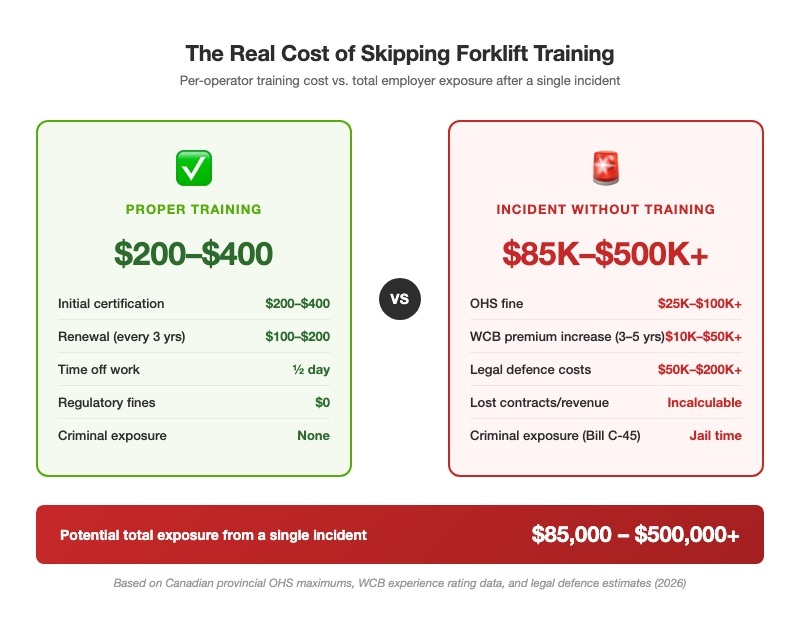
The Cost Comparison That Should End the Debate
Here is the math that every contractor should run:
| Item |
Cost |
| Forklift training per operator |
$200 to $400 |
| Forklift renewal per operator |
$100 to $200 |
| Average OHS fine for training violation |
$25,000 to $100,000+ |
| WCB premium increase (3-5 years) |
$10,000 to $50,000+ |
| Legal defence costs |
$50,000 to $200,000+ |
| Lost contracts and revenue |
Incalculable |
The cost of forklift training is not an expense. It is insurance against consequences that can end a business.
Real Scenarios: How Training Gaps Create Cascading Consequences
Here are two scenarios based on patterns we have seen across Canadian workplaces. Details are generalized, but the consequences are real.
Scenario 1: The "He Said He Was Trained" Contractor
A small mechanical contractor hires a new labourer who says he can operate a forklift. The site supervisor takes his word for it and puts him on a Class 5 rough terrain forklift the same day. Three weeks later, the operator misjudges a turn on uneven ground and tips the forklift. He is pinned under the rollover cage with a broken leg.
The investigation reveals: no training records for the operator, no pre-shift inspection logs, no written forklift safety program. The operator's previous "training" was showing a friend how to drive a forklift at a farming operation 8 years ago.
Consequences: $75,000 OHS fine. Stop-work order on all forklift operations. GC terminates the subcontract. COR audit triggered, resulting in findings. WCB claim costs of $120,000 charged to the employer's account. Annual premiums increase by $18,000 for 4 years. Total financial impact: over $250,000 from an incident that a $300 training course would have prevented.
Scenario 2: The Expired Certification Warehouse
A mid-sized distribution company has 12 forklift operators. Eight have current training. Four have training records that expired 2 to 4 years ago. The company knows the certifications are expired but has been delaying renewals due to scheduling pressure during a busy period.
During a routine MOL inspection, the inspector asks for training records. The four expired certifications are identified immediately. No injuries have occurred, but the inspector issues compliance orders for all four operators and a $40,000 administrative penalty for the company.
The company must take all four operators off forklift duties until they complete refresher training, which takes a week to arrange. During that week, productivity drops by 30% because the remaining eight operators cannot cover the workload. The total cost: $40,000 in fines, $8,000 in rush-scheduled training, and an estimated $25,000 in lost productivity. All to avoid spending $600 on four refresher courses ($150 each) that should have been completed on schedule.
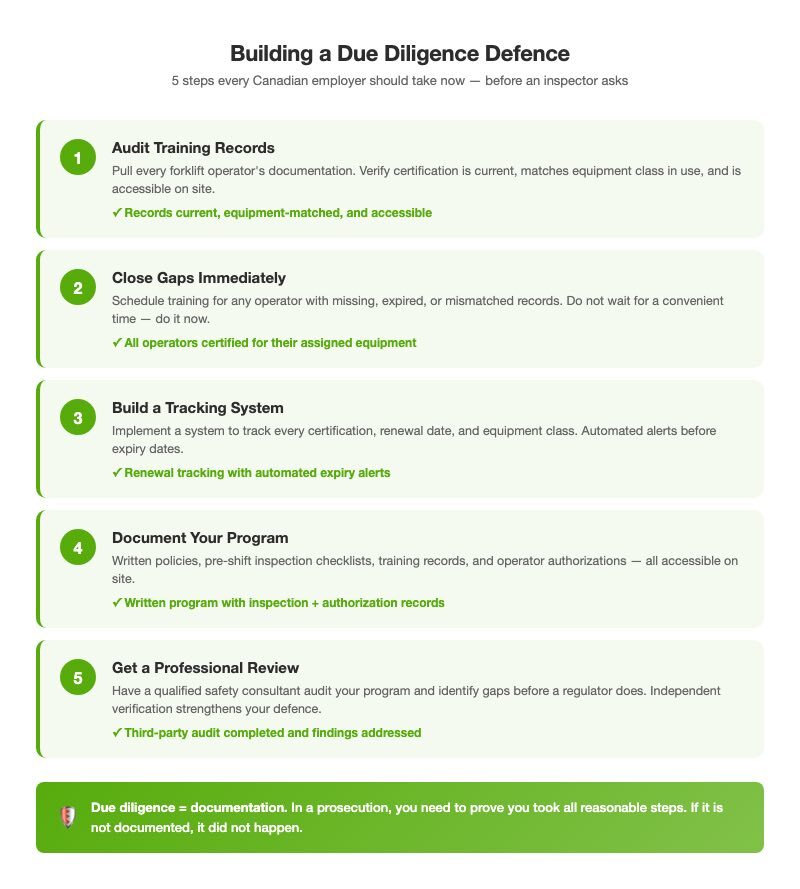
What You Should Do Right Now
- Audit your training records. Pull every forklift operator's training documentation right now. If any operator's records are missing, expired, or do not match the equipment they are using, that is your gap.
- Close the gaps immediately. Schedule training for anyone who needs it. Do not wait for a convenient time. Do it now.
- Build a tracking system. Use Safety Evolution's training management tools to track every certification, every renewal date, and every equipment class.
- Document your program. Written policies, inspection checklists, training records, and operator authorizations. All accessible on site.
- Get a professional review. Safety Evolution's safety services team can audit your current program and identify gaps before a regulator does.
Protect your business before the next incident
Build cleaner training proof, action tracking, and audit trails with a 30-Day Free Trial so you are not scrambling after an event.
30-Day Free Trial
Frequently Asked Questions
What happens if a forklift operator is not certified and causes an accident?
The employer faces regulatory fines (up to $1,500,000 for corporations), potential criminal charges under Bill C-45, WCB premium increases lasting 3 to 5 years, civil liability, stop-work orders, GC contract termination, and possible loss of safety certifications like COR. The absence of training documentation is one of the most aggravating factors in OHS enforcement actions.
Can an employer go to jail for a forklift accident?
Yes. Under Bill C-45 (the Westray Bill), individuals who have authority to direct how work is done, including owners, directors, managers, and supervisors, can face criminal charges if they fail to take reasonable steps to prevent workplace injury or death. Imprisonment is a possible outcome for criminal negligence convictions.
Does WCB cover forklift accidents if the operator was not trained?
The injured worker is generally covered by WCB regardless of training status. However, the employer faces additional consequences: the claim impacts your experience rating and premiums for 3 to 5 years, and in some jurisdictions WCB can pursue cost recovery from employers who violated training requirements. The financial impact can be tens of thousands of dollars in increased premiums.
Can a GC terminate a subcontract over a forklift training violation?
Yes. Most subcontracts include clauses requiring compliance with all applicable safety regulations. A forklift incident caused by a training deficiency is a regulatory violation that can trigger contract termination clauses. Beyond the immediate contract, the incident record can disqualify you from future bids with that GC and others who check safety records during prequalification.
What is Bill C-45 and how does it apply to forklift accidents?
Bill C-45, also known as the Westray Bill, amended the Criminal Code of Canada in 2004 to create a legal duty for anyone who directs how work is performed to take reasonable steps to prevent bodily harm. If a forklift fatality or serious injury occurs and the investigation reveals the employer failed to provide basic training, individuals including owners, directors, and supervisors can face criminal negligence charges with potential imprisonment. The absence of forklift training records is one of the most damaging pieces of evidence in a Bill C-45 prosecution.
Get Weekly Safety Insights
Regulation updates, toolbox talk ideas, and compliance tips. One email per week.