Last updated: April 2026
Your best forklift operator has been running the same counterbalance for six years. His original training card is laminated and living in his wallet. Is he still certified? Can you still use that card to prove competency during an inspection? The answer is more complicated than a simple yes or no, and getting it wrong can cost you a stop-work order, a fine, or worse.
At Safety Evolution, we deal with expired and outdated forklift certifications weekly. Here is what Canadian employers actually need to know about forklift certification expiry and renewal.
⚡ Quick Answer
- Does it expire? Most provinces recommend or require renewal every 3 years, though not all set a hard expiry date in legislation
- CSA B335-15: Recommends refresher training at least every 3 years
- BC (WorkSafeBC): 3-year renewal is standard practice under CSA B335-15
- Alberta: Employer must ensure competency is maintained; 3-year renewal is industry standard
- Ontario: No legislated expiry, but employers must ensure ongoing competency; 3-year renewal is best practice
- Early recertification triggers: Incident, unsafe operation observed, new equipment, new workplace
Below, we cover how expiry works in each major province, what triggers early recertification, and how to stay ahead of renewal deadlines instead of scrambling after an audit flag.
Quick Answer
In the US, forklift certification does not technically "expire," but OSHA requires a performance evaluation at least every 3 years. In Canada, most provinces follow a 3-year renewal cycle, though the specific rules vary. If the 3-year evaluation reveals the operator is still competent, no additional training is required. If it reveals deficiencies, refresher training in the relevant topics is mandatory.
US: OSHA's 3-Year Re-Evaluation Rule
Under OSHA 1910.178(l)(4)(iii), employers must conduct a performance evaluation of each powered industrial truck operator at least once every 3 years. This is not a "recertification" or "renewal." It is the employer observing the operator in the workplace and confirming they are still operating safely.
Key details US employers miss:
- The 3-year cycle is the minimum. Refresher training is also required after incidents, unsafe operation observations, new equipment assignments, or workplace changes.
- The evaluation does not require repeating the full initial training. It is an assessment of current competency.
- If the evaluation reveals the operator is competent, no additional training is needed.
- If deficiencies are found, refresher training in those specific topics is required before the operator can continue.
- The employer must document the evaluation (date, evaluator, results).
Many training providers market "forklift recertification" as if the original certification expires on a specific date. Under OSHA, the obligation is on the employer to evaluate, not on a certificate to expire. For the full OSHA requirements, see our OSHA Forklift Training: Complete Employer Guide.
Canada: Provincial Certification Renewal
Does Forklift Certification Actually Expire in Canada?
Forklift certification in Canada does not have a single national expiry rule. Each province handles it differently. Some set explicit renewal periods. Others put the obligation on the employer to ensure operators remain competent. In practice, the 3-year renewal cycle recommended by CSA B335-15 has become the industry standard across the country.
Here is the truth most employers do not want to hear: even if your province does not legally mandate a 3-year expiry, an operator whose last training was 6 years ago is a liability. Regulations change. Equipment evolves. Skills deteriorate when not reinforced. A regulator or investigator asking "when was this operator last trained?" will not be impressed by a card from 2020.
The confusion arises because Canada does not issue forklift "licences" the way it issues driver's licences. There is no government database, no expiry date printed by a provincial authority, and no central registry. Certification is employer-driven, which means the employer bears the full responsibility for knowing when training was completed and whether it is still current. This is fundamentally different from what many contractors expect, and it is the root cause of most compliance failures we see.
Still tracking forklift certifications in spreadsheets?
If cards expire and no one catches it, you carry the risk. Start a 30-Day Free Trial and track operator status in one place before your next audit.
30-Day Free Trial
What Does CSA B335-15 Say About Renewal?
CSA B335-15 is the Canadian standard for powered industrial truck operator training. While it is not legislation itself, most provincial OHS regulations reference it directly or align with its requirements. The standard recommends:
- Refresher training at least every 3 years
- Re-evaluation whenever an operator is observed operating unsafely
- Additional training when operators move to a new workplace or new equipment
- Refresher training after any incident or near miss involving powered industrial trucks
The key word is "refresher," not "recertification." The standard recognizes that experienced operators do not need to start from scratch every 3 years. A refresher course typically takes 4 to 8 hours and includes an updated theory review and a practical skills evaluation.
It is worth understanding why the CSA settled on 3 years rather than 2 or 5. The interval reflects research on skill degradation, the typical pace of regulatory updates, and the practical reality that equipment models and workplace configurations change over multi-year cycles. Three years balances the cost of retraining against the risk of letting competency slip. For high-risk environments like construction or oil and gas sites, some safety managers choose a 2-year cycle to provide an additional margin of safety.
For the full standard requirements, see our complete guide: Forklift Training and Certification in Canada.
What a Refresher Course Actually Covers
A good refresher course is not a rubber-stamp exercise. It should include:
- Updated theory review: Any changes to CSA standards, provincial legislation, or company procedures since the operator's last training
- Pre-operation inspection refresher: Reinforcement of the full pre-shift checklist, since inspections are often the first thing operators start cutting corners on after a few years
- Practical skills evaluation: The operator drives the equipment under observation. The evaluator checks for bad habits that develop over time, such as one-handed steering, travelling with forks raised, or skipping horn use at intersections
- Hazard identification exercise: A scenario-based review of workplace hazards that tests whether the operator can still recognize and respond to risks
- Documentation: Updated training records with the date, topics covered, equipment class, evaluator name, and results
If your refresher course takes less than 4 hours, it is probably not covering enough. If it takes less than 2 hours, it is almost certainly a compliance checkbox rather than genuine skill reinforcement.
Renewal Rules by Province
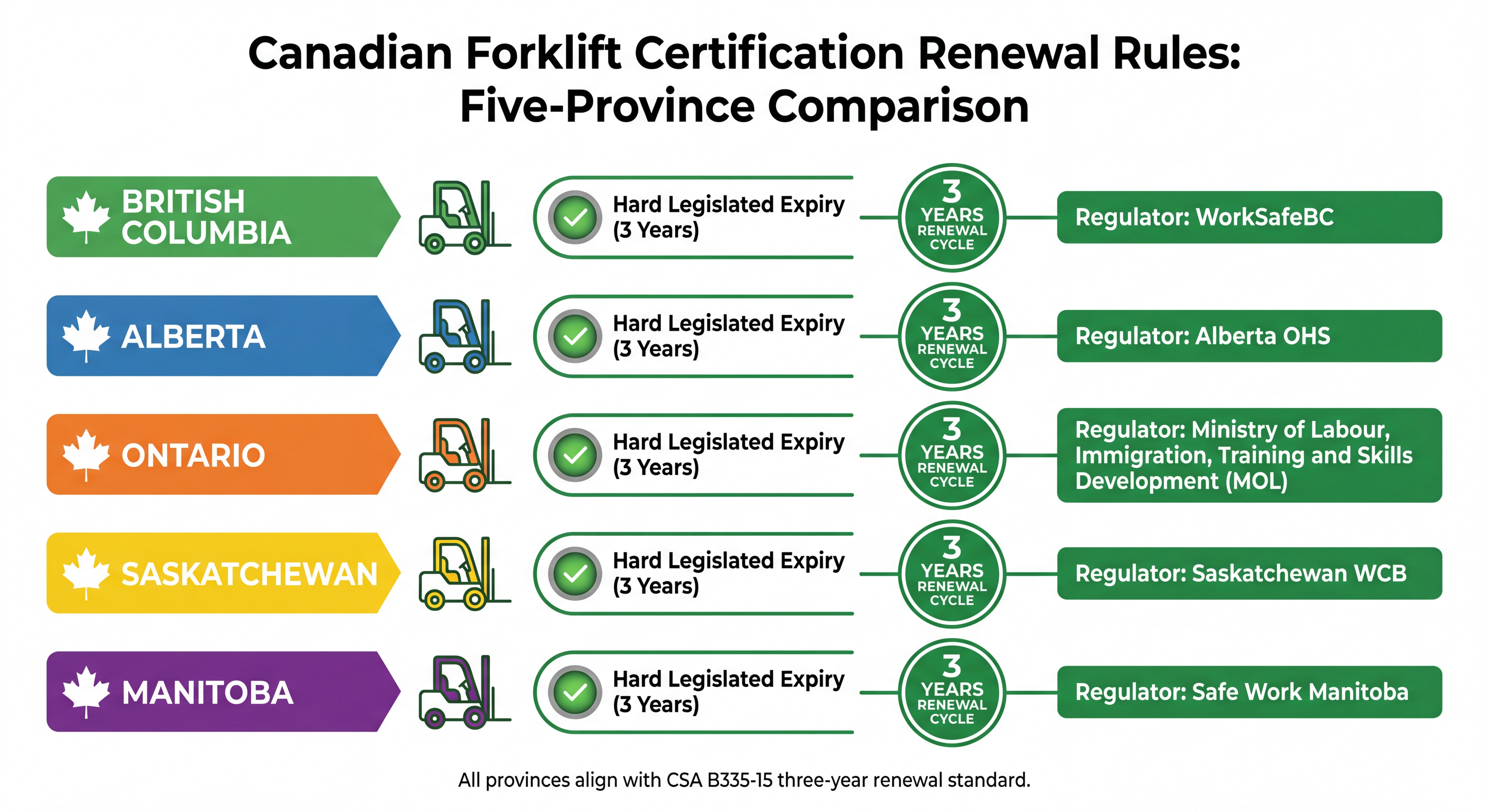
Here is what the major provinces require. Note that even in provinces without a hard legislated expiry, the employer's duty to ensure competency effectively creates a renewal requirement.
| Province |
Legislated Expiry? |
Industry Standard |
Key Regulator |
| British Columbia |
References CSA B335-15 (3-year cycle) |
3 years |
WorkSafeBC |
| Alberta |
No hard expiry in legislation; employer duty to ensure competency |
3 years |
Alberta OHS |
| Ontario |
No legislated expiry; employer must ensure competency |
3 years |
Ontario MOL |
| Saskatchewan |
Employer must ensure training is current |
3 years |
Saskatchewan WCB |
| Manitoba |
Employer must ensure training is current |
3 years |
Manitoba Workplace Safety |
Province-Specific Details Employers Miss
The table above gives the high-level picture, but there are nuances within each province that trip up contractors working across jurisdictions:
- British Columbia: WorkSafeBC takes the CSA reference seriously during inspections. If your operator's last training was more than 3 years ago, expect a compliance order. BC also has specific requirements for forklift operators on construction sites, including proximity-to-workers rules and mandatory seatbelt use that may differ from your warehouse training.
- Alberta: The performance-based approach means Alberta OHS officers focus on whether the employer can demonstrate competency, not whether a specific time interval has passed. However, if you cannot show any refresher training in the last 5 years, the officer will question your competency management process. Oil and gas clients in Alberta often require 2-year renewal cycles through their contractor management systems (ISN, ComplyWorks).
- Ontario: The MOL does not set a renewal date, but they do issue compliance orders when operators have not been retrained in a reasonable period. Three years is the benchmark inspectors use. Ontario also requires sector-specific training: industrial establishments under O. Reg. 851 and construction projects under O. Reg. 213/91 have different requirements.
- Saskatchewan and Manitoba: These provinces follow the general pattern of employer-driven competency, with 3-year renewal as industry standard. Contractors moving between these provinces and Alberta or BC should not assume the training requirements are identical.
For province-specific details, see our guides on BC Forklift Certification and forklift training requirements by province.
What Triggers Early Recertification?
Even if an operator's 3-year cycle has not elapsed, several events require immediate refresher training or re-evaluation:
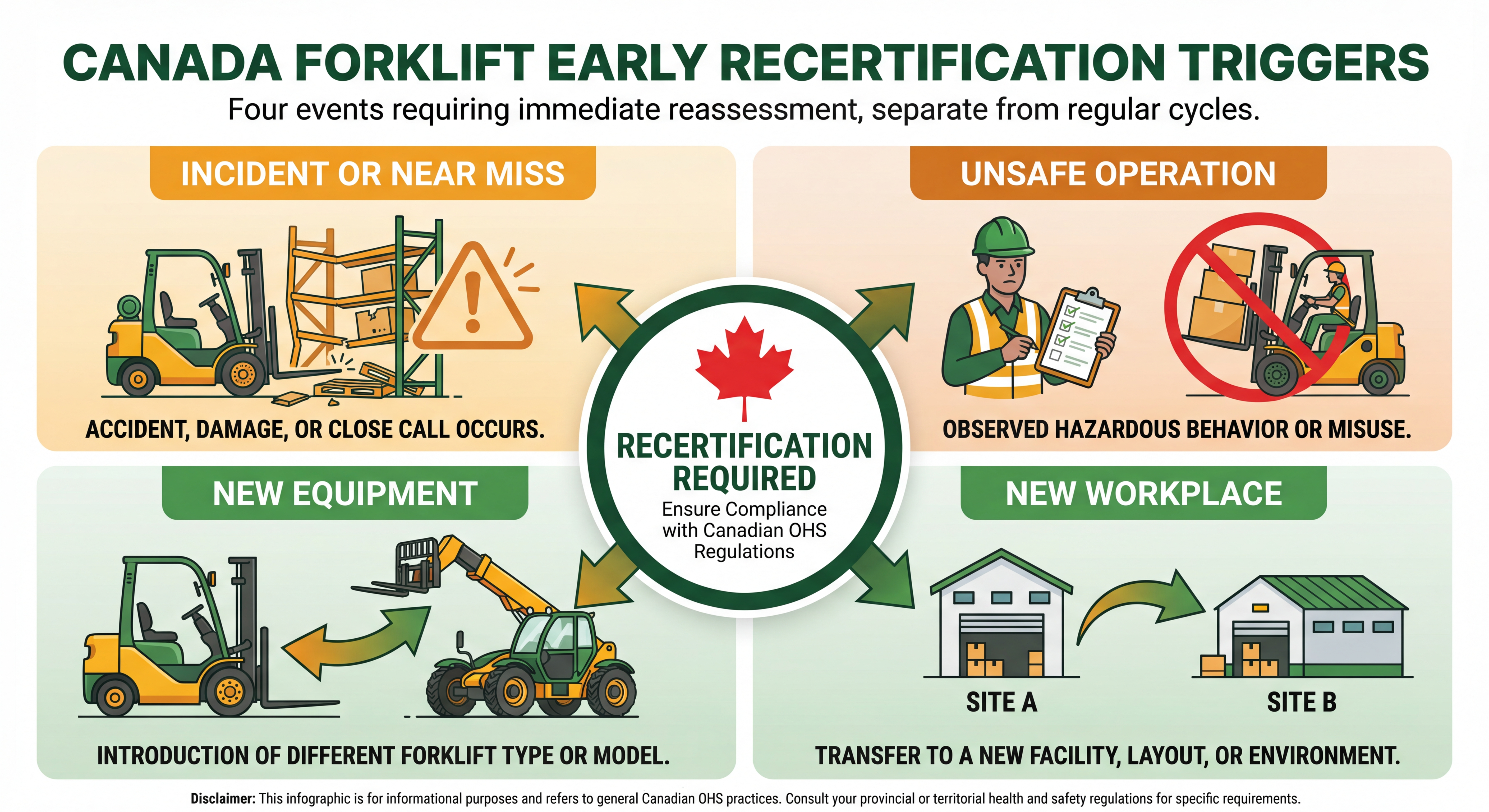
- Incident or near miss: Any incident involving a forklift, whether it results in injury, property damage, or a close call, should trigger a skills review and refresher training for the involved operator
- Unsafe operation observed: If a supervisor witnesses an operator driving unsafely, speeding, carrying unstable loads, or failing to follow procedures, refresher training is required before the operator returns to the equipment
- New equipment type: An operator certified on a Class 5 counterbalance needs additional training before operating a Class 7 telehandler, regardless of when their last certification was
- New workplace: Different sites have different layouts, traffic patterns, floor conditions, and hazards. A change of employer or work site warrants site-specific training
- Regulatory changes: If provincial regulations or CSA standards are updated, affected operators need training on the changes
Common Mistakes with Early Recertification
Most employers handle scheduled 3-year renewals reasonably well. Where they fail is with event-triggered recertification. Here are the patterns we see repeatedly:
- Near misses get ignored. The forklift clipped a racking upright but nobody was hurt, so no report is filed and no retraining happens. This is exactly the kind of event that precedes a serious incident. Every near miss involving a forklift should be documented and should trigger, at minimum, a supervisor review of the operator's skills.
- "Same brand" is treated as "same equipment." An operator certified on a 5,000-lb counterbalance is not automatically competent on a 10,000-lb counterbalance from the same manufacturer. Load capacity, stability characteristics, and handling are fundamentally different. If the equipment model changes significantly, refresher training is needed.
- Site-specific training is skipped when operators move between company sites. Your warehouse in Calgary and your warehouse in Edmonton have different layouts, different racking configurations, different traffic patterns, and possibly different equipment. An operator transferring between sites needs a documented site-specific orientation.
- Seasonal workers are not retrained. If an operator works your busy season from April to September and then returns the following April, that 7-month gap is long enough for skill degradation. A refresher evaluation before they resume operating is good practice, even if the 3-year cycle has not elapsed.
The Real Cost of Letting Certification Lapse
Most contractors think the risk of expired certification is a fine during an inspection. That is the least of it.
Here is what actually happens when an operator's training is outdated and something goes wrong:
- The investigation goes straight to training records. After any forklift incident, the first thing an OHS investigator requests is the operator's training documentation. If the last training was 5 years ago, that becomes a focal point of the investigation.
- Insurance complications. WCB claims can be challenged or surcharge-impacted when an employer failed to maintain current training. Your premiums can increase for years.
- Personal liability for the employer. Under most provincial OHS acts, the employer (meaning you, personally, if you are the owner) has a duty to ensure workers are competent. Letting certification lapse is a failure of that duty.
- GC contract violations. Many general contractors require current forklift certification as a condition of your subcontract. If your operator's training expired 18 months ago and there is an incident, you have breached your contract.
What Expired Certification Costs in Real Dollars
To put the financial risk in perspective, here is what we see when contractors let forklift training lapse:
- Regulatory fines: $25,000 to $100,000 per violation is common for training-related infractions in provinces like Ontario and Alberta. In the worst cases, corporate fines can exceed $1,000,000.
- WCB premium increases: An incident involving an untrained operator can push your experience rating up, adding $10,000 to $50,000 in additional premiums over 3 to 5 years.
- Legal defence costs: If the incident leads to a prosecution under provincial OHS legislation or the Criminal Code (Bill C-45), legal fees alone can run $50,000 to $200,000.
- Lost contracts: A safety violation on record can disqualify you from GC bid lists. For a mid-sized contractor, losing one or two major clients because of a training gap can mean $500,000 or more in lost annual revenue.
Compare that to the $100 to $200 per operator cost of a 3-year refresher. The math is not close.
The cost of renewing forklift training is a fraction of what any of these scenarios costs.
How to Track and Manage Forklift Certification Renewals
The easiest way to lose track of renewals is to rely on wallet cards and spreadsheets. Here is a system that actually works:
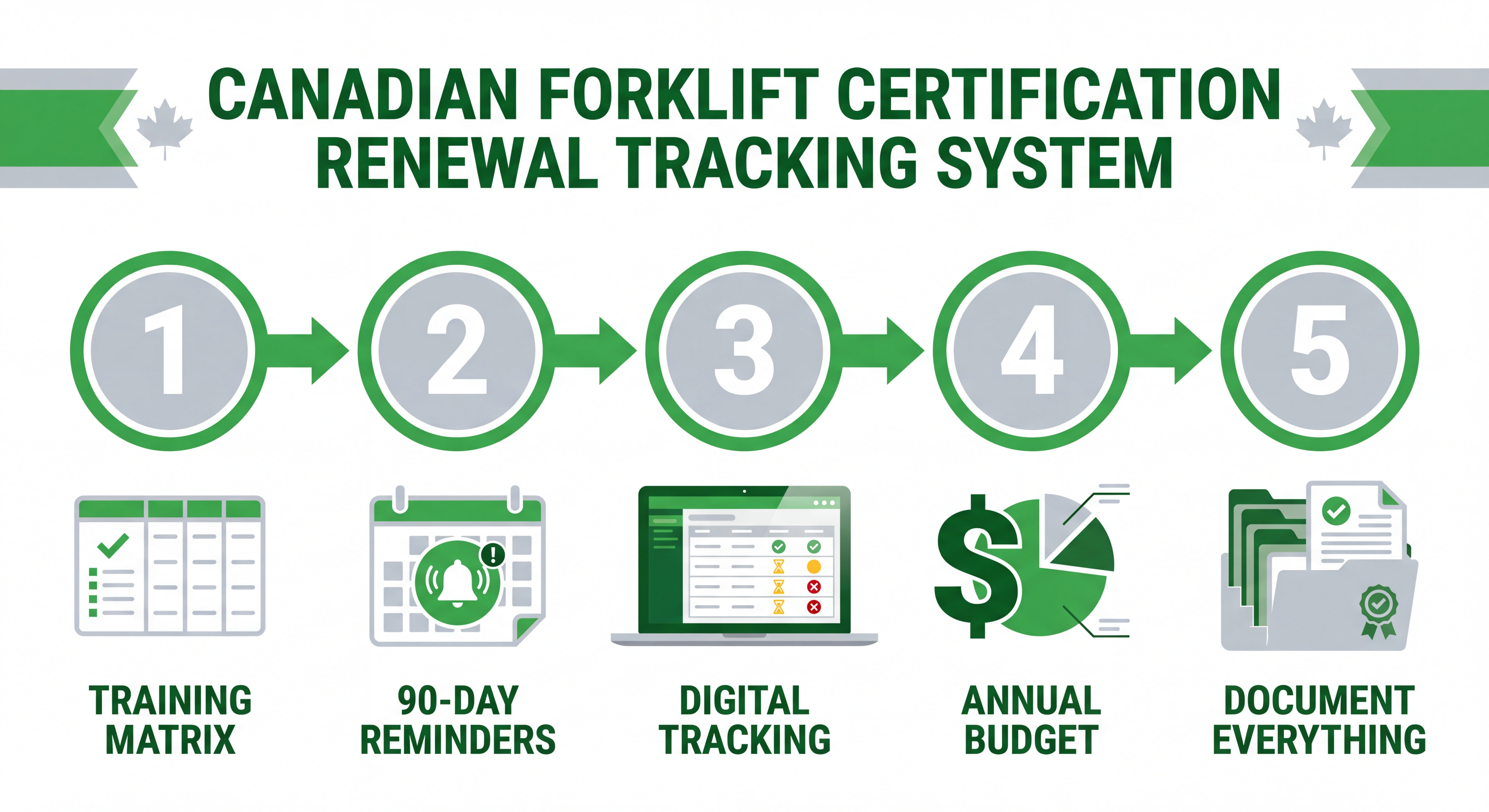
- Build a training matrix. List every operator, every equipment class they are certified on, and the certification date. Calculate the 3-year renewal date.
- Set reminders 90 days before expiry. This gives you time to schedule training without losing operators during a critical project.
- Use a digital system. Safety Evolution's training management platform tracks certification dates, sends automatic expiry alerts, and stores all training records in one place.
- Include forklift renewals in your annual safety budget. If you have 10 operators, budget for 3 to 4 renewals per year on a rolling basis.
- Document everything. Keep records of initial training, refresher training, incident-triggered retraining, and any evaluations. These records are your evidence of compliance.
Building a Renewal Budget
One of the most practical steps you can take is building forklift renewal costs into your annual safety budget so renewals never get deferred because of cash flow. Here is a simple formula:
- Count your operators. Include anyone who operates a forklift, even occasionally. Part-time and seasonal operators count.
- Divide by 3. On a rolling 3-year cycle, roughly one-third of your operators will need renewal each year.
- Multiply by the per-operator renewal cost. In most provinces, this is $100 to $200 for a refresher course.
- Add a buffer for event-triggered retraining. Plan for 1 to 2 additional unplanned refreshers per year for incidents, new equipment, or new hires who need evaluation.
For example, a contractor with 15 forklift operators should budget for approximately 5 to 7 renewals per year, or roughly $700 to $1,400 annually. That is a rounding error in most project budgets, but it eliminates a significant compliance and liability risk.
Employer Checklist: Forklift Certification Renewal
Use this checklist to make sure your renewal process is complete and audit-ready:
- ☐ Complete training matrix listing all operators, equipment classes, and certification dates
- ☐ 90-day advance reminders set for every operator's renewal date
- ☐ Refresher training provider identified and on standby (or in-house trainer current)
- ☐ Annual renewal budget approved and allocated
- ☐ Training records stored digitally and accessible on site
- ☐ Event-triggered retraining policy documented and communicated to supervisors
- ☐ Site-specific training records current for every active work location
- ☐ GC training requirements reviewed and met for all active subcontracts
Get ahead of forklift recertification risk
Stop finding gaps after an incident or inspection. Use a 30-Day Free Trial to monitor training, expiries, and compliance actions across your crew.
30-Day Free Trial
Frequently Asked Questions
Does forklift certification expire in Canada?
Most Canadian provinces recommend or require forklift certification renewal every 3 years, following CSA B335-15 guidelines. While not every province sets a hard legislated expiry date, the employer's legal duty to ensure operator competency effectively requires regular renewal.
How often do you need to renew forklift certification?
The industry standard across Canada is renewal every 3 years. However, additional refresher training is required after incidents, when operators change workplaces, when new equipment is introduced, or when unsafe operation is observed.
How long does a forklift renewal course take?
A forklift renewal or refresher course typically takes 4 to 8 hours (1 day). It includes updated theory, a practical skills evaluation, and covers any changes to regulations or equipment since the operator's last certification.
What happens if my forklift certification expires?
Operating with expired certification can result in regulatory fines during inspections, increased employer liability in the event of an incident, WCB premium impacts, and potential breach of subcontract requirements with general contractors. The cost of renewal is far less than the cost of any of these consequences.
Is forklift certification valid across provinces in Canada?
There is no national forklift certification card in Canada. Training completed in one province is generally recognized in others, but the receiving employer must still verify the operator's competency and may require additional site-specific or equipment-specific training. Some provinces have specific requirements that may not be covered by training completed elsewhere.
Can I renew my forklift certification online?
The theory portion of a renewal can be completed online, but CSA B335-15 requires a hands-on practical evaluation that must be done in person on the actual equipment. A fully online renewal does not meet Canadian standards. The most common approach is online theory followed by an in-person practical evaluation.
How much does forklift certification renewal cost in Canada?
Forklift certification renewal typically costs $100 to $200 per operator for a refresher course. This is significantly less than initial certification ($200 to $400) because experienced operators need less seat time. Group on-site renewals for 5 or more operators are often more cost-effective.
Get Weekly Safety Insights
Regulation updates, toolbox talk ideas, and compliance tips. One email per week.