Last updated: April 2026
Your new hire starts Monday. The GC wants proof of forklift certification before they set foot on site. You need to know: how long is this going to take? A day? A week? The answer depends on more variables than most employers expect, and getting it wrong means either rushing an operator through training they are not ready for or losing billable days waiting for a course to finish.
Safety Evolution works with contractors across Canada who face this exact scheduling challenge. Here is an honest breakdown of what forklift training actually takes, so you can plan around it instead of scrambling.
⚡ Quick Answer
- New operators: 3 to 5 days (24 to 40 hours) for full certification
- Experienced operators (new employer): 1 to 2 days for evaluation and site-specific training
- Renewal/refresher: 4 to 8 hours (typically 1 day)
- Additional equipment class: 1 to 2 days per class added
- CSA B335-15 requirement: Training must include classroom, practical, and evaluation components for each equipment type
Below, we break down the factors that determine training duration, what a typical training day looks like under CSA B335-15, and how to plan forklift training around your project schedule without cutting corners.
Quick Answer
Initial forklift training takes 1 to 5 days depending on operator experience, equipment class, and jurisdiction. In the US, OSHA 1910.178 requires formal instruction, practical training, and a workplace evaluation but does not mandate minimum hours. In Canada, typical initial training runs 3 to 5 days for new operators and 4 to 8 hours for renewal. OSHA requires re-evaluation at least every 3 years. Canadian renewal periods vary by province, typically 3 years.
US vs Canada: How Training Duration Differs
The biggest difference between US and Canadian forklift training duration comes down to structure:
| Element |
United States (OSHA) |
Canada (Provincial) |
| Minimum hours mandated |
No minimum (competency-based) |
No federal minimum; some provinces set guidelines |
| Typical initial training |
8 to 24 hours (1 to 3 days) |
16 to 40 hours (3 to 5 days) |
| Online theory available |
Yes (theory only, practical must be in-person) |
Yes (same requirement for in-person practical) |
| Re-evaluation cycle |
At least every 3 years (1910.178(l)(4)(iii)) |
Varies by province (typically 3 years) |
| Refresher duration |
2 to 4 hours (evaluation-focused) |
4 to 8 hours (renewal training) |
OSHA's approach is competency-based: the standard does not prescribe a minimum number of hours. Training must continue until the operator demonstrates competency. For experienced operators switching employers, this can mean a shorter program if they can demonstrate existing competency. For new operators with zero experience, most employers find 2 to 3 full days is the minimum needed for the three-part training requirement.
For the complete US regulatory requirements, see our OSHA Forklift Training: Complete Employer Guide.
What Determines How Long Forklift Training Takes?
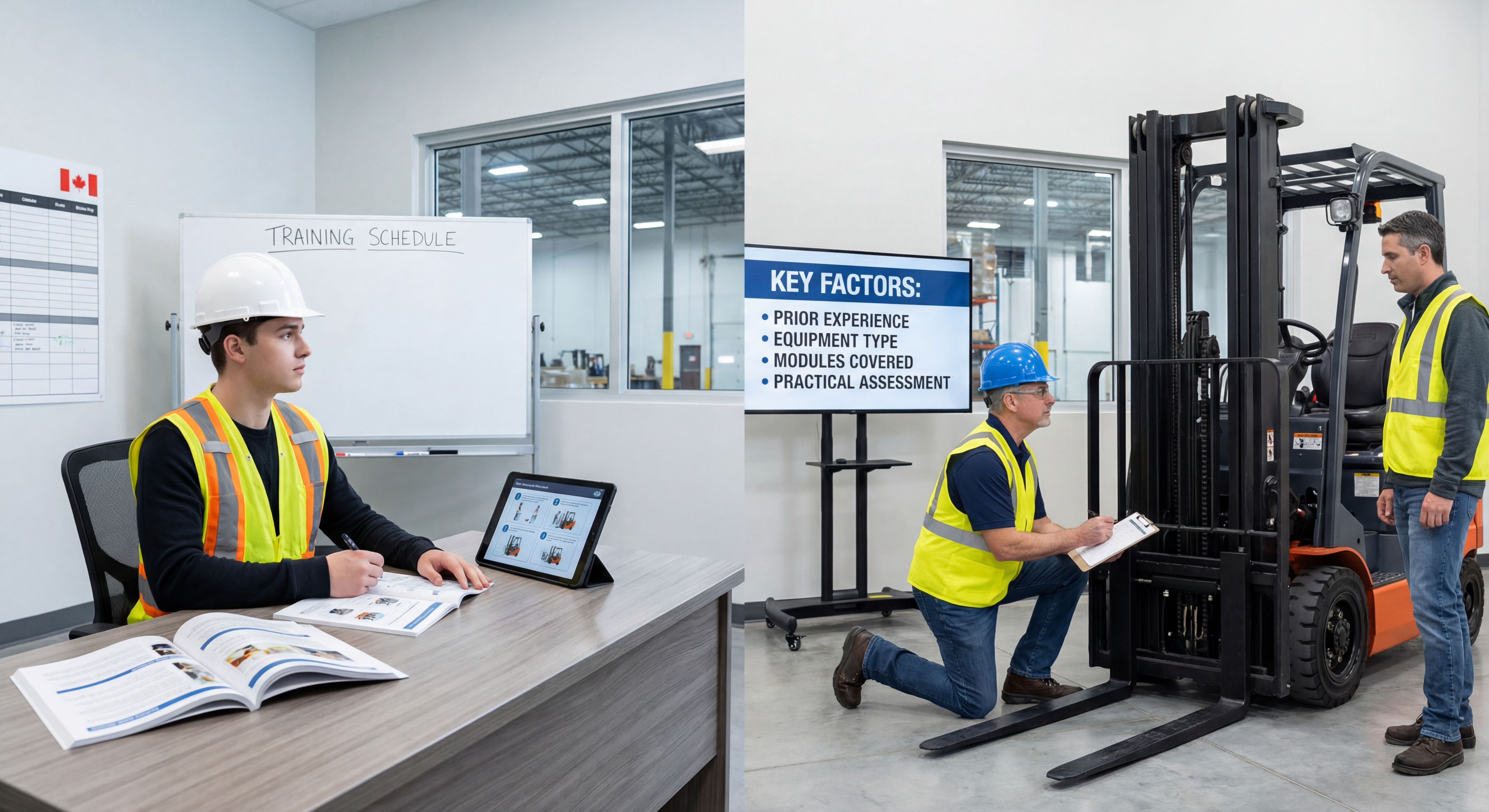
The duration of forklift training depends on four factors: the operator's prior experience, the class of equipment, whether it is initial certification or renewal, and provincial requirements. There is no single "forklift training" timeline because no two operators start from the same place.
Factor 1: Operator Experience Level
A brand-new operator who has never touched a forklift needs significantly more seat time than someone who has been operating for years but needs certification at a new employer. Here is the realistic breakdown:
- Zero experience: 3 to 5 days. This includes classroom theory, supervised practice, and a competency evaluation. Some training providers stretch this over two weeks with part-time scheduling.
- Some experience, no formal certification: 2 to 3 days. The classroom portion covers the same content, but practical training moves faster because the operator already understands basic controls.
- Experienced, certified at a previous employer: 1 to 2 days. Focus shifts to evaluation, site-specific hazards, and any equipment differences from what they operated before.
Factor 2: Equipment Class
Training on a sit-down counterbalance (Class 1 or 5) is different from training on a reach truck (Class 2) or a telehandler (Class 7). More complex equipment takes longer. A Class 7 rough terrain course for a new operator can take the full 5 days because of the additional stability, load chart, and terrain assessment content.
If your crew needs training on multiple classes, each additional class typically adds 1 to 2 days. See our full breakdown in Forklift Classes Explained: Types 1-7.
Factor 3: Initial vs. Renewal
Renewal training is significantly shorter. In most provinces, forklift certification should be renewed every 3 years, and the renewal course runs 4 to 8 hours. It covers regulation updates, a practical skills check, and any new equipment the operator will use.
Learn more about renewal timelines: Forklift License vs Certification in Canada.
Factor 4: Province and Training Provider
There is no federally mandated forklift training duration in Canada. Each province sets its own requirements under occupational health and safety legislation. However, CSA B335-15, which most provinces reference, establishes the minimum content that must be covered. The time it takes to cover that content properly is what drives the duration.
Some training providers offer compressed 1-day courses that claim to cover everything. Be cautious. If a provider is certifying brand-new operators in 8 hours, they are either cutting corners on practical time or not meeting CSA B335-15 requirements. Either way, that certificate may not hold up under scrutiny during an inspection or incident investigation.
30-Day Free Trial against project timelines and flag where gaps will form.
Still tracking forklift certifications in spreadsheets?
If cards expire and no one catches it, you carry the risk. Start a 30-Day Free Trial and track operator status in one place before your next audit.
30-Day Free Trial
What Does the Training Day Actually Look Like?
Under CSA B335-15, forklift operator training has three mandatory components. No component can be skipped, regardless of how experienced the operator is.
| Component |
Typical Duration |
What It Covers |
| Classroom / Theory |
4 to 8 hours |
Equipment types, stability triangle, load capacity, pre-op inspection, regulations, hazard identification |
| Practical / Hands-On |
8 to 24 hours |
Supervised operation, maneuvering, stacking, loading/unloading, obstacle courses, real-world scenarios |
| Evaluation |
1 to 4 hours |
Written test, practical driving test, pre-op inspection demonstration |
The practical component is where most of the time goes, and where it should go. An operator who passes a written test but cannot safely stack pallets at height is not competent. Good training providers give operators enough seat time to build real muscle memory, not just enough to check a box.
How Multi-Class Certification Affects Training Time
If your operators need certification on more than one forklift class, total training time increases significantly. Each equipment class has different operating characteristics, stability limits, and hazards. CSA B335-15 requires separate training and evaluation for each class.
Here is what adding equipment classes typically looks like:
- Adding one class (e.g., Class 5 to Class 7): 1 to 2 additional days. The classroom portion covers class-specific theory (load charts, terrain considerations, outrigger use), and the practical portion requires enough seat time on the new equipment for the operator to demonstrate competency.
- Adding two or more classes: 2 to 4 additional days. Providers often batch classroom theory for multiple classes, but practical time cannot be combined. Each class needs its own hands-on training and separate evaluation.
- Cross-class transfers: An operator certified on a Class 1 electric counterbalance moving to a Class 7 telehandler is not just adding a class - it is a fundamentally different piece of equipment. Expect the same training investment as a new operator for that class.
Construction contractors running mixed fleets are the most affected by multi-class requirements. A site with counterbalance forklifts, telehandlers, and powered pallet jacks means every operator needs training across three different equipment classes. The planning question is not "how long does forklift training take?" but "how many classes does my crew actually need, and can we schedule them back-to-back?"
Can You Speed Up Forklift Training?
Honestly? Not much, and you should be suspicious of anyone who says otherwise.
Here is the blunt truth: the fastest path to forklift certification is not a shortcut in the training. It is preparation before the training starts. Employers who send operators in with pre-reading materials, equipment manuals, and a clear understanding of what they will be operating cut 15 to 20 percent off total training time because the classroom portion moves faster.
What does not work:
- "Fast-track" 4-hour certification courses. These may exist, but they almost certainly do not meet CSA B335-15 requirements for a new operator. A 4-hour course might be legitimate for a refresher, but not for initial certification.
- Online-only certification. Forklift training requires a hands-on practical component and an in-person evaluation. Online courses can cover the theory portion, but they cannot replace seat time. Learn more: Forklift Training and Certification in Canada.
- Skipping the evaluation. Some employers ask operators to "self-certify" or sign off on their own competency. This is not valid under any provincial regulation and creates massive liability exposure.
How to Plan Forklift Training Around Your Project Schedule
The biggest frustration we hear from contractors is not the training itself. It is the scheduling. You cannot afford to lose operators for a week during a critical project phase. Here is how to make it work:
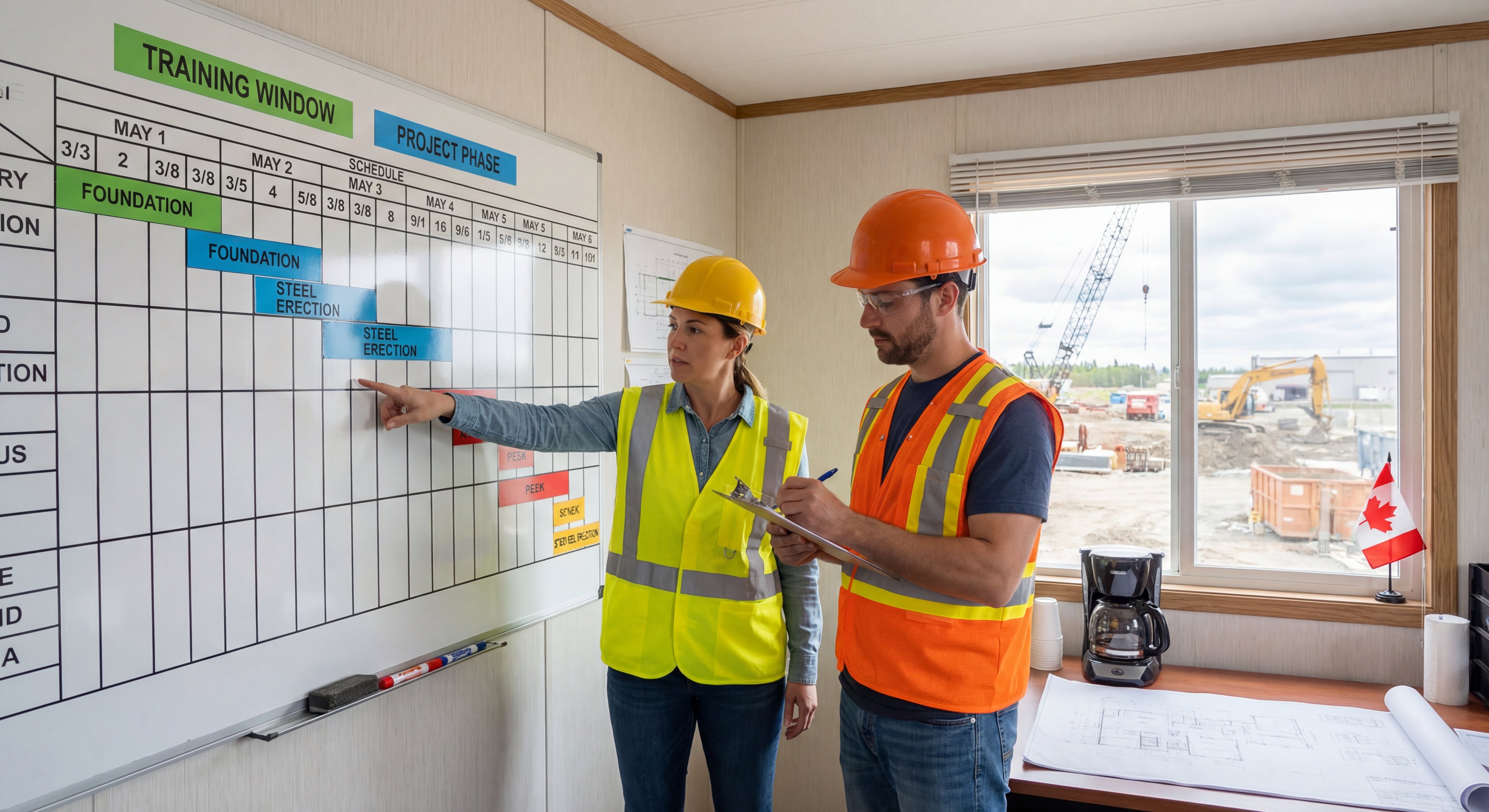
- Schedule training during mobilization or between projects. The lull between contracts is the best time to get operators trained or renewed.
- Stagger your crew. Do not send all your operators to training at once. Split them so you always have coverage on site.
- Track renewal dates proactively. Do not wait for a certification to expire. Safety Evolution's training management tools can track expiry dates automatically so you never get caught off guard.
- Consider on-site training. Many providers will come to your location, which eliminates travel time and lets operators train on the actual equipment they will use. This also meets the CSA B335-15 preference for equipment-specific training.
A note on seasonal planning: In construction, winter shutdowns and spring mobilization periods are the most common windows for forklift training. If your operation runs year-round, plan quarterly training blocks - one group per quarter keeps coverage continuous and ensures no operator's certification lapses mid-project. For multi-site operations, coordinate with your safety coordinator to avoid scheduling conflicts where two sites lose operators on the same week.
Documentation matters here too. Keep a master training schedule that tracks each operator's certification date, equipment classes covered, and next renewal date. When a new project starts, your site supervisor should be able to check that list in under a minute and confirm every operator on the crew is current. If they cannot, your scheduling system needs work.
For a full look at what forklift training costs across Canada, including how duration affects price, see our guide: How Much Does Forklift Training Cost in Canada?
What About Refresher Training and Re-Evaluation?
Beyond the standard 3-year renewal cycle, additional refresher training is required when:
- An operator is observed operating unsafely
- An operator is involved in an incident or near miss
- An operator moves to a new workplace with different equipment, conditions, or layout
- New equipment is introduced to the workplace
- Workplace conditions change significantly (new racking systems, different floor surfaces, changed traffic patterns)
Refresher training is typically shorter (2 to 4 hours) and focuses on the specific issue that triggered the need. But it must be documented. An undocumented refresher is the same as no refresher at all during an audit or investigation.
How refresher training scheduling works in practice: Most employers find that batching refresher training annually or semi-annually is more efficient than tracking individual 3-year expiry dates. If you have 20 operators with staggered certification dates, pick a quarter each year to run all refreshers. You stay ahead of individual deadlines, and the group format reduces your per-operator cost.
The 3-year cycle is a maximum interval, not a minimum. Many safety-conscious contractors run annual refresher sessions that cover regulation updates, site-specific changes, and observed performance issues. These shorter sessions (1 to 2 hours) keep operators sharp and give supervisors a documented touchpoint with each certified operator.
Get ahead of forklift recertification risk
Stop finding gaps after an incident or inspection. Use a 30-Day Free Trial to monitor training, expiries, and compliance actions across your crew.
30-Day Free Trial
Frequently Asked Questions
How long does forklift training take for a beginner?
A complete beginner with no prior forklift experience should expect 3 to 5 days (24 to 40 hours) for initial forklift certification. This includes classroom theory, supervised hands-on practice, and a competency evaluation as required by CSA B335-15.
How long is a forklift refresher course?
Forklift refresher or renewal training typically takes 4 to 8 hours (1 day). It includes a review of current regulations, a practical skills check, and evaluation on the equipment the operator will use. Refresher training is recommended every 3 years in most Canadian provinces.
Can I get forklift certified in one day?
Experienced operators who need evaluation at a new employer or renewal of an existing certification can often complete training in one day. However, brand-new operators cannot realistically complete the full classroom, practical, and evaluation requirements of CSA B335-15 in a single day. Be cautious of providers offering same-day certification for beginners.
Is online forklift training faster than in-person?
Online training can cover the classroom theory portion more flexibly, but it does not replace the mandatory hands-on practical training and in-person evaluation. The total time commitment is similar because the practical component, which takes the majority of training time, must be completed in person.
How long does forklift certification last in Canada?
Forklift certification in Canada is generally recommended to be renewed every 3 years, though this varies by province. Some jurisdictions also require refresher training whenever an operator changes workplaces, is involved in an incident, or is observed operating unsafely.
Get Weekly Safety Insights
Regulation updates, toolbox talk ideas, and compliance tips. One email per week.