Last updated: April 2026
You have decided to bring forklift training in-house. Smart move if you have the volume to justify it. But before your most experienced operator starts teaching the new hires, you need to answer a critical question: is that person actually qualified to train? Knowing how to operate a forklift and knowing how to teach someone else to operate one safely are two very different skills. That is where train-the-trainer certification comes in.
Safety Evolution works with contractors across Canada who run in-house forklift training programs. Here is what you need to know about train-the-trainer certification, whether you need it, and how to get it right.
⚡ Quick Answer
- What it is: A certification program that qualifies individuals to deliver and evaluate forklift operator training
- Who needs it: Anyone who will deliver in-house forklift training and evaluate operator competency
- Duration: Typically 2 to 5 days depending on the provider and equipment classes covered
- Cost: $500 to $1,500 per trainer
- Required? Strongly recommended and practically necessary for a defensible in-house program, though not explicitly mandated by all provinces
Below, we cover what train-the-trainer certification actually involves, who needs it, what it costs, and how to decide whether building in-house training capacity makes sense for your operation.
Quick Answer
Forklift train-the-trainer programs prepare internal employees to deliver OSHA-compliant or CSA-compliant forklift training. In the US, OSHA does not require a specific trainer credential, but trainers must demonstrate knowledge, training, and experience. In Canada, requirements vary by province. The typical train-the-trainer course costs $500 to $1,500 and takes 2 to 3 days. For companies with 10+ operators, it pays for itself in the first training cycle.
US Train-the-Trainer: What OSHA Requires
OSHA's 1910.178(l)(2)(iii) states that forklift training and evaluation must be conducted by "persons who have the knowledge, training, and experience to train powered industrial truck operators and evaluate their competence." OSHA does not require:
- A specific certification or credential
- A minimum number of training hours for the trainer
- A government-issued trainer license
- Renewal of any trainer qualification
What OSHA does require is that you can demonstrate your trainer is qualified. A train-the-trainer course is the most straightforward way to document this. If OSHA inspects your facility and asks who trained your operators, you need to show that the trainer has verifiable knowledge, training, and hands-on experience with the specific equipment types.
Practical tip: document your trainer's qualifications in writing. Keep a file with their train-the-trainer certificate, their own operator training records, their years of forklift operating experience, and any continuing education. This file is what you show OSHA when they ask.
For the full OSHA training requirements, see our OSHA Forklift Training: Complete Employer Guide.
Canadian Train-the-Trainer: Provincial Requirements
What Is Forklift Train-the-Trainer?
Forklift train-the-trainer is a certification program that equips an individual with both the equipment competency and the instructional skills needed to train and evaluate forklift operators. It goes beyond operating ability to cover adult learning principles, curriculum delivery, evaluation techniques, and training program management.
Think of the difference between a professional driver and a driving instructor. Both can drive. Only one can teach someone else to drive safely and evaluate whether they are ready. Train-the-trainer bridges that gap for forklift operations.
The Difference Between Operator Competency and Trainer Competency
This is the distinction most employers miss. An operator needs to safely operate the equipment. A trainer needs to safely operate the equipment AND effectively teach someone else to do the same AND objectively evaluate whether that person is ready.
These are three separate skill sets:
- Operating skills: The ability to safely run the equipment in real-world conditions. Your trainer needs to be an experienced, competent operator on every equipment class they will teach.
- Teaching skills: The ability to break down complex tasks into learnable steps, adapt instruction to different learning styles, manage a classroom, demonstrate techniques clearly, and provide constructive feedback. These are adult education skills that most operators have never been taught.
- Evaluation skills: The ability to objectively assess whether an operator is safe to run equipment independently. This requires defined criteria, consistent standards, and the willingness to fail someone who is not ready, even if it creates scheduling problems or tension with a supervisor.
A train-the-trainer course builds all three. Skipping it means your "trainer" is really just an experienced operator showing the new person what they do, with no structured curriculum, no evaluation framework, and no instructional technique.
Hard to keep forklift safety consistent across sites?
Different supervisors and paper systems create blind spots. Start a 30-Day Free Trial and standardize training and compliance tracking company-wide.
30-Day Free Trial
Who Needs Train-the-Trainer Certification?
You need a certified trainer if:
- You plan to deliver any forklift training in-house (initial certification, refreshers, or site-specific training)
- You want to evaluate operator competency internally rather than relying on a third-party evaluator
- You operate in a province that requires or strongly recommends qualified trainers for in-house programs
- You work for GCs who require proof that your in-house training is delivered by a qualified instructor
For the comparison between in-house and external training: In-House vs Third-Party Forklift Training
What Does the Train-the-Trainer Course Cover?
A good train-the-trainer program covers two streams: equipment competency and instructional skills.
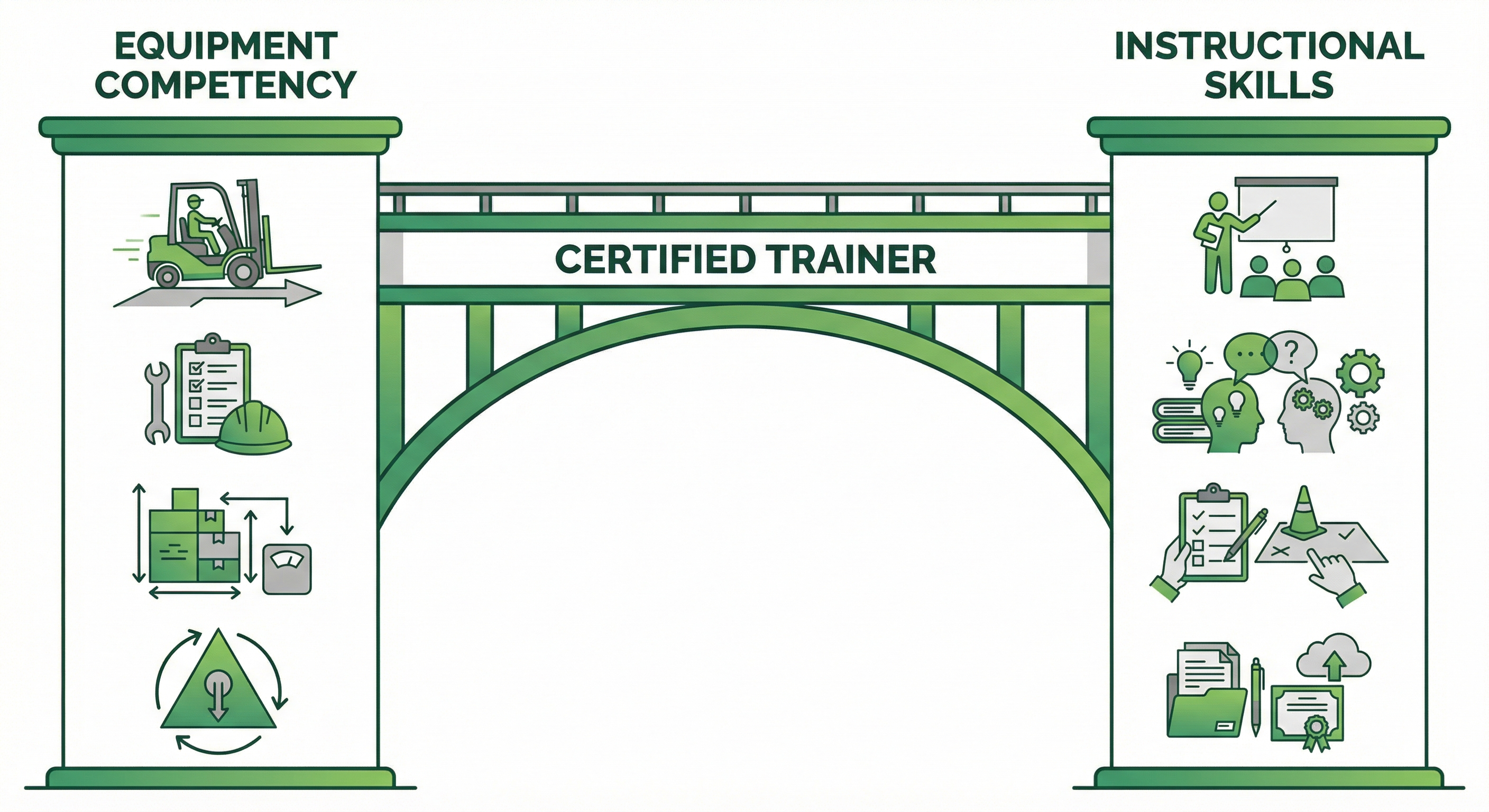
Equipment Competency
- In-depth knowledge of forklift classes, stability principles, and load handling
- Advanced operating skills on the equipment classes the trainer will teach
- Pre-operation inspection procedures and defect identification
- CSA B335-15 requirements and how they apply to training programs
- Provincial OHS legislation relevant to powered industrial trucks
Instructional Skills
- Adult learning principles and how they apply to equipment training
- Curriculum development and lesson planning
- Classroom presentation and facilitation techniques
- Practical training delivery and supervision methods
- Competency evaluation techniques: how to objectively assess whether an operator is safe
- Documentation: what to record, how to maintain training records
Provincial Perspectives on Train-the-Trainer Requirements
The requirement for formal train-the-trainer certification varies by province, but the practical reality is consistent: you need a qualified trainer to run a defensible in-house program.
- British Columbia: WorkSafeBC's reference to CSA B335-15 includes the expectation that training is delivered by a competent person. While "competent person" is not defined as someone with a specific train-the-trainer certificate, demonstrating competency through a recognized program is the most defensible approach during an inspection.
- Alberta: Alberta's performance-based OHS Code requires that employers ensure operators are trained by someone competent. Alberta OHS officers will ask about the trainer's qualifications. Having a formal train-the-trainer certification provides clear evidence of trainer competency.
- Ontario: Ontario's MOL expects that in-house forklift training is delivered by a qualified person. During inspections, officers may ask about the trainer's qualifications, experience, and how they were evaluated to deliver training. A train-the-trainer certificate is the simplest way to answer these questions.
- Saskatchewan and Manitoba: Similar to Alberta, these provinces focus on competency outcomes. Formal trainer certification is not explicitly mandated but is considered best practice and is the standard expectation in most industrial sectors.
Regardless of provincial requirements, the practical reality is this: if an incident occurs and the investigation reveals your in-house trainer had no formal training qualifications, the adequacy of your entire training program will be questioned. The $500 to $1,500 investment in train-the-trainer certification is cheap insurance against that scenario.
30-Day Free Trial to show whether train-the-trainer makes sense for your operation.
How Much Does Train-the-Trainer Cost?
| Program Type |
Typical Cost |
Duration |
| Basic (single equipment class) |
$500 to $800 |
2 to 3 days |
| Comprehensive (multiple classes) |
$800 to $1,500 |
3 to 5 days |
| Renewal |
$300 to $600 |
1 to 2 days |
Calculating the ROI of Train-the-Trainer
The return on investment for a train-the-trainer certification depends on how many operators you train annually. Here is a practical calculation:
- Train-the-trainer cost: $1,000 (average for a comprehensive multi-class course)
- Per-operator cost of third-party training: $275 (average initial certification)
- Per-operator cost of in-house training: $75 (materials, trainer time, equipment wear)
- Savings per operator trained in-house: $200
- Break-even: 5 operators ($200 x 5 = $1,000)
If you train 15 operators per year, the train-the-trainer certification saves approximately $3,000 annually in direct training costs. Over the 3-year period before the trainer's certification needs renewal, that is $9,000 in savings from a $1,000 investment.
The calculation does not include the indirect benefits: scheduling flexibility, reduced travel time to training centres, the ability to deliver refresher training on short notice when triggered by incidents, and the integration of your specific workplace procedures into the training curriculum. These benefits are harder to quantify but often more valuable than the direct cost savings.
For full cost context: How Much Does Forklift Training Cost in Canada?
What to Look For in a Train-the-Trainer Provider
- CSA B335-15 alignment: The program should prepare your trainer to deliver CSA-compliant training
- Hands-on practice teaching: The best programs include supervised practice where trainees deliver portions of a training session and receive feedback
- Evaluation skills focus: A strong emphasis on how to objectively evaluate operator competency, not just how to operate the equipment
- Course materials included: Look for programs that provide a ready-to-use training curriculum, evaluation forms, and documentation templates
- Multi-class coverage: If your fleet includes multiple equipment classes, ensure the program covers all of them
Questions to Ask Before Enrolling Your Trainer
Before you invest $500 to $1,500 in a train-the-trainer course, ask the provider these questions:
- "Does the course include supervised practice teaching?" The best programs include sessions where the trainee delivers a portion of a training module and receives feedback. If the course is all theory with no practice teaching, your trainer may know what to teach but not how to teach it.
- "What equipment classes does the course cover?" Make sure the course covers every class of equipment your in-house trainer will need to teach. A course that only covers Class 5 counterbalance will not qualify your trainer to teach Class 7 telehandler operation.
- "Are curriculum templates included?" Building a training program from scratch is time-consuming. Courses that include ready-to-use curriculum templates, evaluation forms, and documentation tools save significant setup time.
- "What is the renewal process?" Train-the-trainer certifications need renewal, typically every 3 to 5 years. Know the renewal cost, duration, and requirements upfront.
- "Can you provide references from other companies that have set up in-house programs after your course?" This tells you whether graduates of the program actually go on to run successful in-house training.
Common Mistakes When Selecting a Trainer Candidate
Choosing the wrong person for the train-the-trainer role is a costly mistake. Here are the patterns we see:
- Choosing by seniority instead of suitability: The most senior operator is not always the best trainer. Seniority measures experience, not teaching ability. Choose someone who communicates well, has patience with learners, and can be objective in evaluations.
- Not allocating enough time for the trainer role: If your trainer is also a full-time operator or supervisor, training delivery will always take a backseat to their primary duties. Ensure the person you select has dedicated time for training responsibilities.
- Choosing someone who cannot fail a colleague: The trainer must be willing and empowered to fail an operator who is not ready. If your workplace culture makes this impossible, in-house training will not produce genuine competency evaluations. Consider whether a supervisor or someone outside the direct work crew is a better fit for the role.
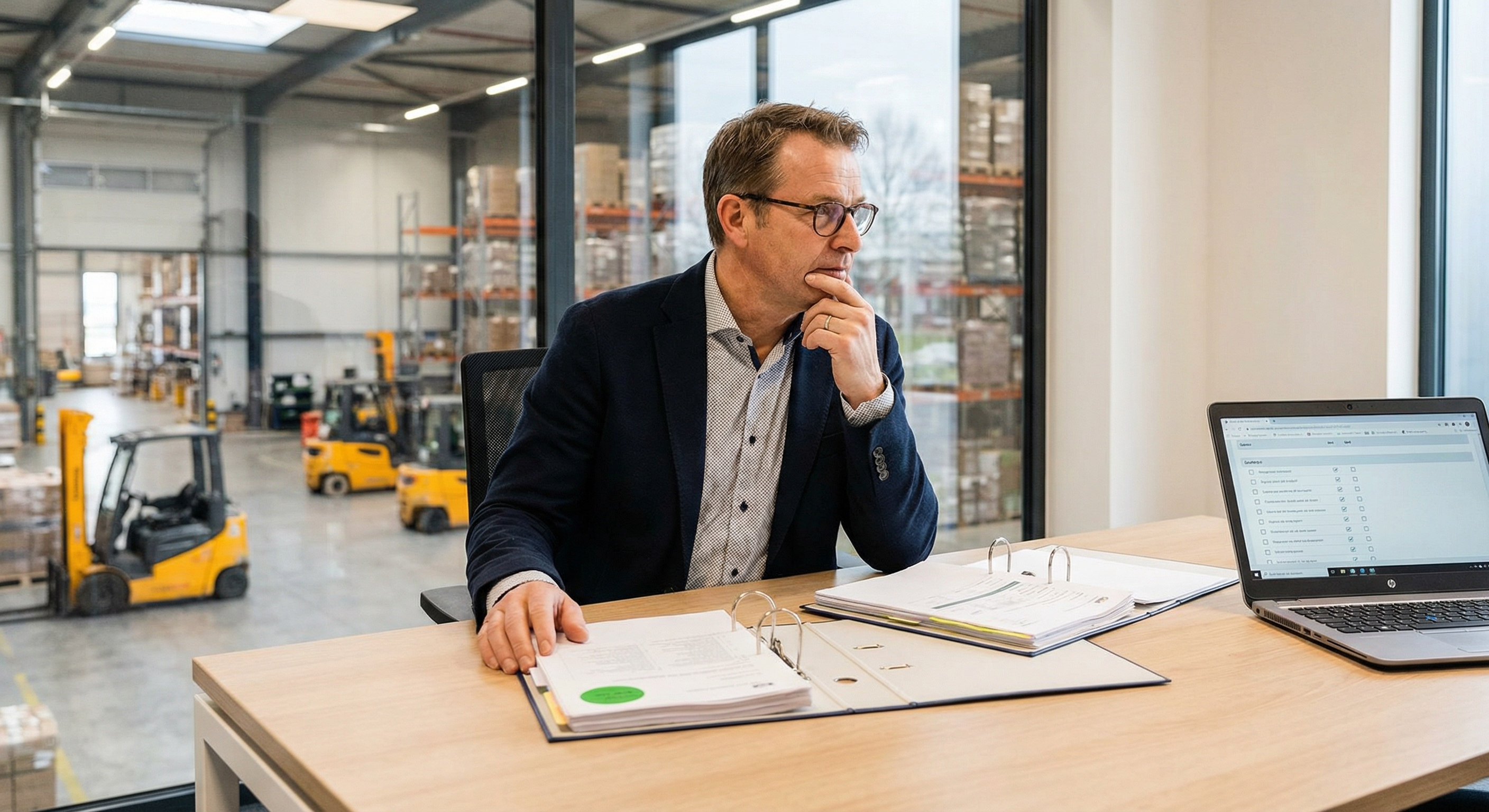
Setting Up Your In-House Program After Certification
Once your trainer is certified, here is how to build a defensible in-house program:
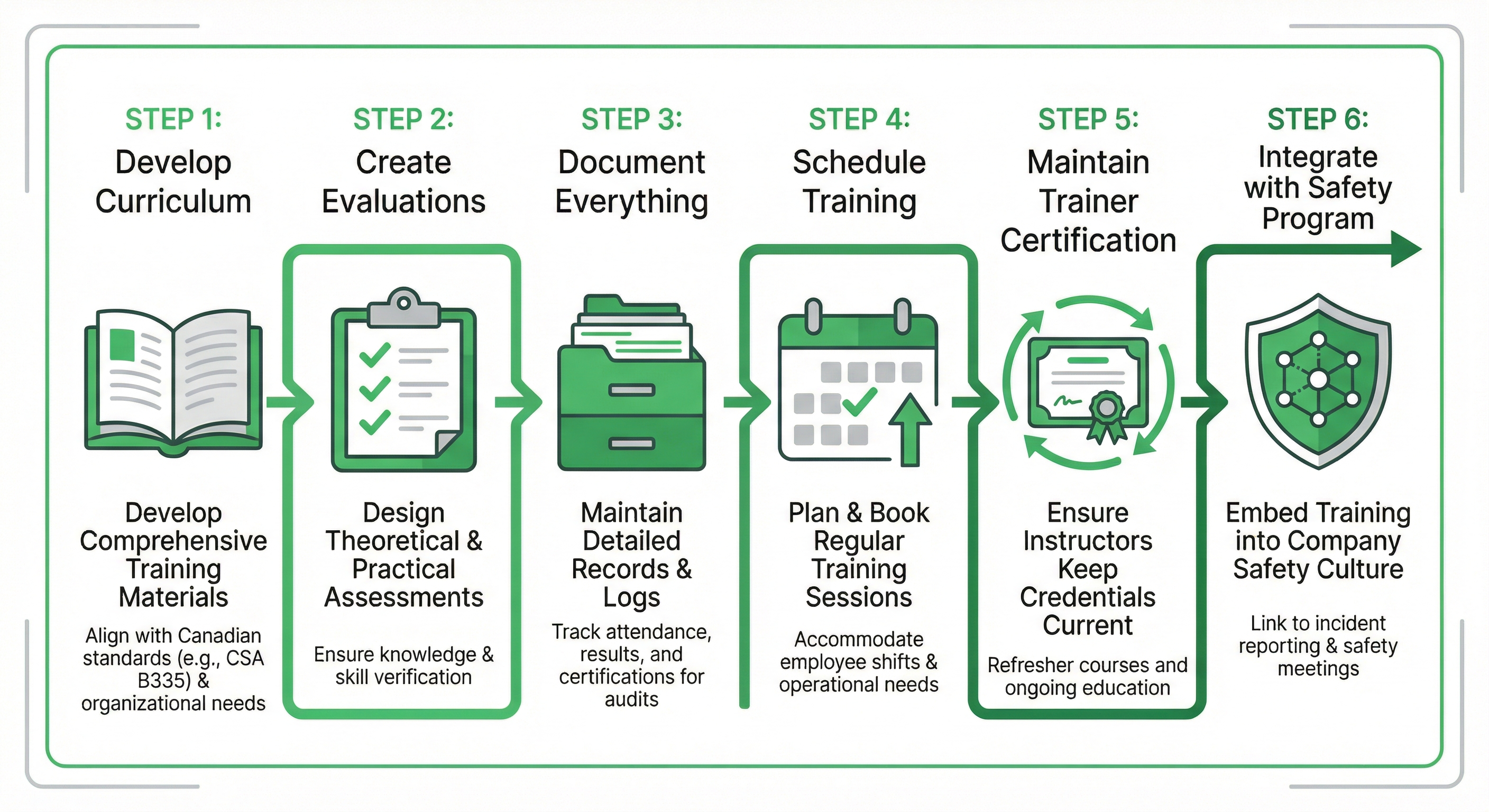
- Develop your curriculum. Use the materials from the train-the-trainer course as a foundation. Customize for your equipment, site hazards, and company procedures.
- Create evaluation forms. Standardized checklists for written tests and practical evaluations. The trainer's course should provide templates.
- Document everything. Every training session, every evaluation, every operator authorization. Keep records for at least 5 years.
- Schedule regular training. Initial certifications for new hires, renewals every 3 years, and refresher training as needed.
- Maintain the trainer's own certification. Train-the-trainer certifications also need renewal, typically every 3 to 5 years.
- Establish a trainer performance review process. Periodically review your trainer's performance by observing a training session, reviewing evaluation consistency, and checking that documentation meets your quality standards. A trainer who started strong can develop shortcuts over time, just like an operator can.
- Integrate with your safety program. Make forklift training part of your broader forklift safety program and, if applicable, your COR documentation.
Keeping Your Trainer's Skills Current
Certifying your trainer is not a one-time event. To maintain a high-quality in-house program, you need to invest in your trainer's ongoing development:
- Attend regulatory updates. When provincial OHS regulations change or CSA B335-15 is updated, your trainer needs to know about it. Subscribe to regulatory update services from your provincial safety association (e.g., ACSA in Alberta, IHSA in Ontario) and ensure your trainer reviews relevant changes.
- Practice on new equipment. When you add a new equipment class to your fleet, your trainer needs hands-on time with that equipment before they can teach it. Budget time and access for the trainer to develop proficiency on new machines.
- Peer observation. If possible, have your trainer periodically attend a training session delivered by another qualified trainer or a third-party provider. Observing other instructors helps your trainer pick up new techniques and identify areas where their own delivery can improve.
- Document lessons learned. After every training session, the trainer should note what went well, what could be improved, and any questions from operators that the curriculum did not adequately address. These notes inform curriculum updates and continuous improvement.
Build a forklift program your whole team can run
Use a 30-Day Free Trial to centralize records, assign actions, and keep every location aligned.
30-Day Free Trial
Frequently Asked Questions
Do you need a train-the-trainer certificate for forklift training?
While not all provinces explicitly mandate it in legislation, a forklift train-the-trainer certification is strongly recommended and practically necessary for a defensible in-house training program. It ensures your trainer has both equipment competency and instructional skills. Many GCs and auditors expect to see proof of trainer qualifications.
How long is a forklift train-the-trainer course?
A basic forklift train-the-trainer course covering a single equipment class typically takes 2 to 3 days. Comprehensive programs covering multiple equipment classes run 3 to 5 days. Renewal courses take 1 to 2 days.
How much does forklift train-the-trainer certification cost?
Forklift train-the-trainer certification costs $500 to $1,500 depending on the number of equipment classes covered and the provider. Renewal courses cost $300 to $600. The investment typically pays for itself after training 5 to 10 operators in-house instead of sending them to third-party providers.
Does train-the-trainer certification expire?
Yes. Most train-the-trainer certifications should be renewed every 3 to 5 years. The renewal course updates the trainer on regulatory changes, new equipment types, and evolving best practices in training delivery and evaluation.
Can one trainer certify operators on multiple equipment classes?
Yes, provided the trainer has been trained and certified on each equipment class they will teach. A comprehensive train-the-trainer course covering multiple classes typically takes 3 to 5 days. If your fleet includes equipment classes that were not covered in the original train-the-trainer course, your trainer will need additional qualification on those classes before delivering training.
What happens if our in-house trainer leaves the company?
If your designated trainer leaves, you lose your ability to deliver in-house training until a replacement is qualified. This is why some companies certify two trainers as a backup plan. In the interim, use a third-party provider for any training needs. Also ensure that the training program documentation (curriculum, evaluation forms, records) is company property and does not leave with the trainer.
Get Weekly Safety Insights
Regulation updates, toolbox talk ideas, and compliance tips. One email per week.