Last updated: April 2026
You have certified operators. You have the equipment. But every time you walk through the warehouse or drive past the yard, you see close calls. Pedestrians cutting through forklift lanes. Operators skipping pre-shift inspections. Loads stacked too high. Having trained operators is necessary, but it is not a safety program. A safety program is the system that makes sure those trained operators actually follow the rules every single day.
At Safety Evolution, we build forklift safety programs for contractors across Canada. Here is what a real program looks like, not the binder-on-a-shelf version, but the one that actually prevents incidents.
⚡ Quick Answer
- A forklift safety program includes: operator training and certification, pre-shift inspections, traffic management, load handling procedures, maintenance schedules, and incident response
- It is not just training: Training certifies the operator. The program manages the daily reality of forklift operations.
- Who needs one: Any employer operating powered industrial trucks. Required under most provincial OHS regulations.
- Key elements: Written procedures, documented inspections, operator authorization, and ongoing competency checks
- Free Resource: Download our Construction Health & Safety Manual.
Below, we walk through every element of a real forklift safety program - from operator authorization and daily inspections to traffic management and incident response - so you can build one that actually works on site.
OSHA Requirements for Forklift Safety Programs
While OSHA does not have a single regulation titled "forklift safety program," several sections of 29 CFR 1910.178 combine to require one in practice:
- 1910.178(l): Operator training, evaluation, certification, and 3-year re-evaluations
- 1910.178(q)(7): Daily pre-shift inspections of all powered industrial trucks
- 1910.178(p)(1): Immediate removal from service of any truck found defective or unsafe
- 1910.178(n): Traffic rules, speed limits, pedestrian safety, loading dock procedures
- 1910.178(l)(4)(ii): Refresher training triggers (incidents, new equipment, workplace changes)
A forklift safety program that covers training, inspections, maintenance, traffic management, and incident response satisfies all of these simultaneously. For the complete OSHA training requirements, see our OSHA Forklift Training: Complete Employer Guide.
Why Training Alone Is Not Enough
Operator training certifies individuals. A safety program manages the environment, equipment, and procedures that keep forklift operations safe every day.
Here is the blunt truth: most forklift incidents do not happen because the operator was untrained. They happen because the workplace lacks systems. Pedestrians walk into traffic zones because there are no barriers. Operators skip pre-shift inspections because nobody checks. Equipment runs with known defects because there is no maintenance tracking.
Training is one component. The forklift training and certification piece is critical, but it sits inside a larger framework.
Consider this scenario: you send every operator to a CSA B335-15 compliant training program, and they all pass with flying colours. Six months later, an operator hits a pedestrian in your warehouse. The investigation reveals there were no designated forklift travel lanes, no barriers separating pedestrian and forklift areas, no speed limits posted, and the pre-shift inspection logs have been blank for weeks. The training was perfect. The system around the training was absent. That system is what a forklift safety program provides.
Hard to keep forklift safety consistent across sites?
Different supervisors and paper systems create blind spots. Start a 30-Day Free Trial and standardize training and compliance tracking company-wide.
30-Day Free Trial
The 7 Elements of a Forklift Safety Program
1. Operator Training and Certification
Every operator must be trained and evaluated on the specific class of forklift they will operate, per CSA B335-15. Your program should include:
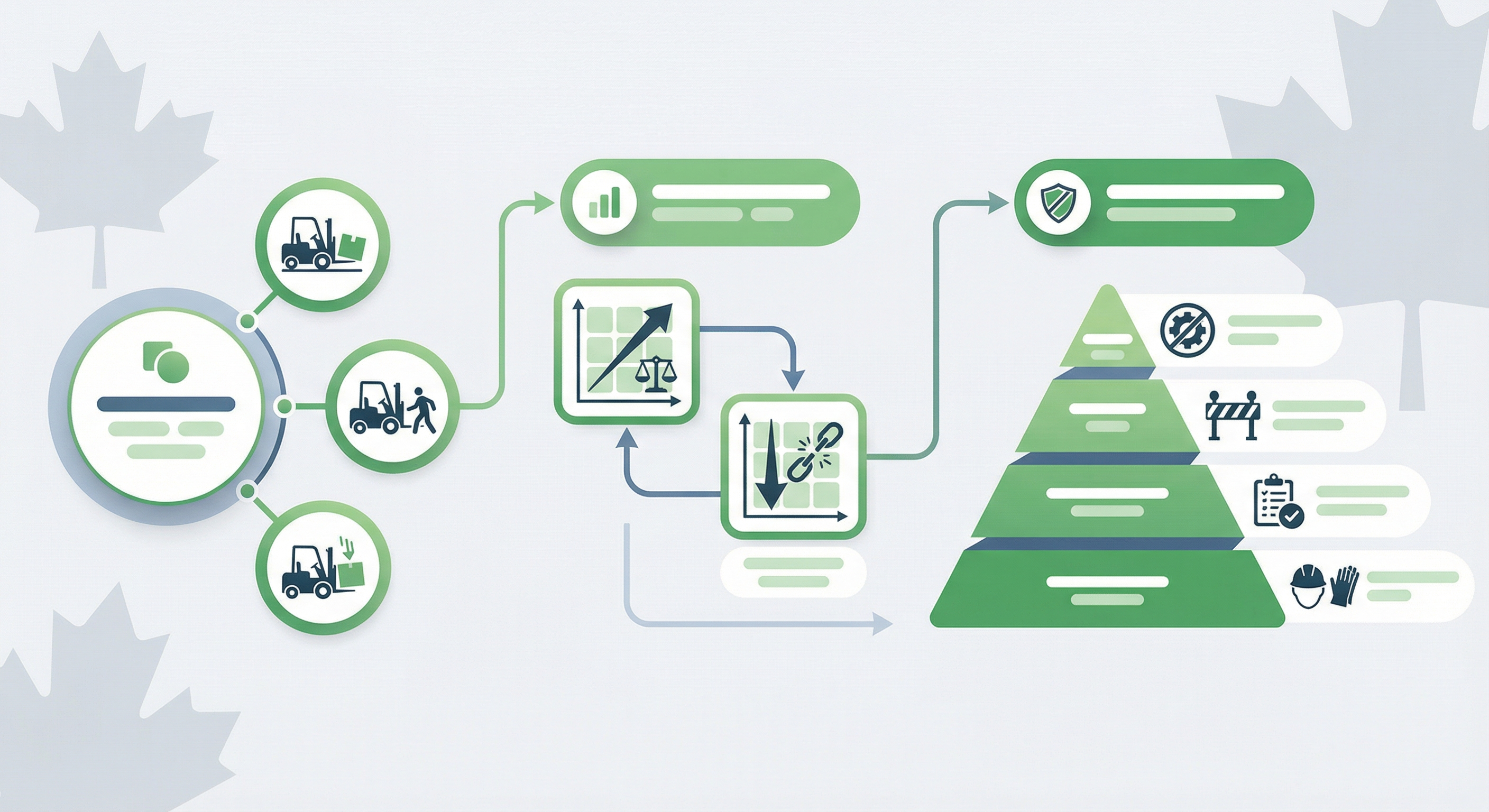
- Initial certification for new operators
- Refresher training every 3 years
- Re-evaluation after incidents, unsafe behaviour, or workplace changes
- Site-specific training for every new work location
- Written authorization before any operator touches equipment
Your program document should clearly state who is authorized to operate each piece of equipment. Keep an authorization list posted near the equipment or in a central location, and update it whenever an operator is added, removed, or suspended from operation.
2. Pre-Shift Equipment Inspections
Before every shift, operators must inspect their equipment. Not a glance. A documented, checklist-driven inspection covering:
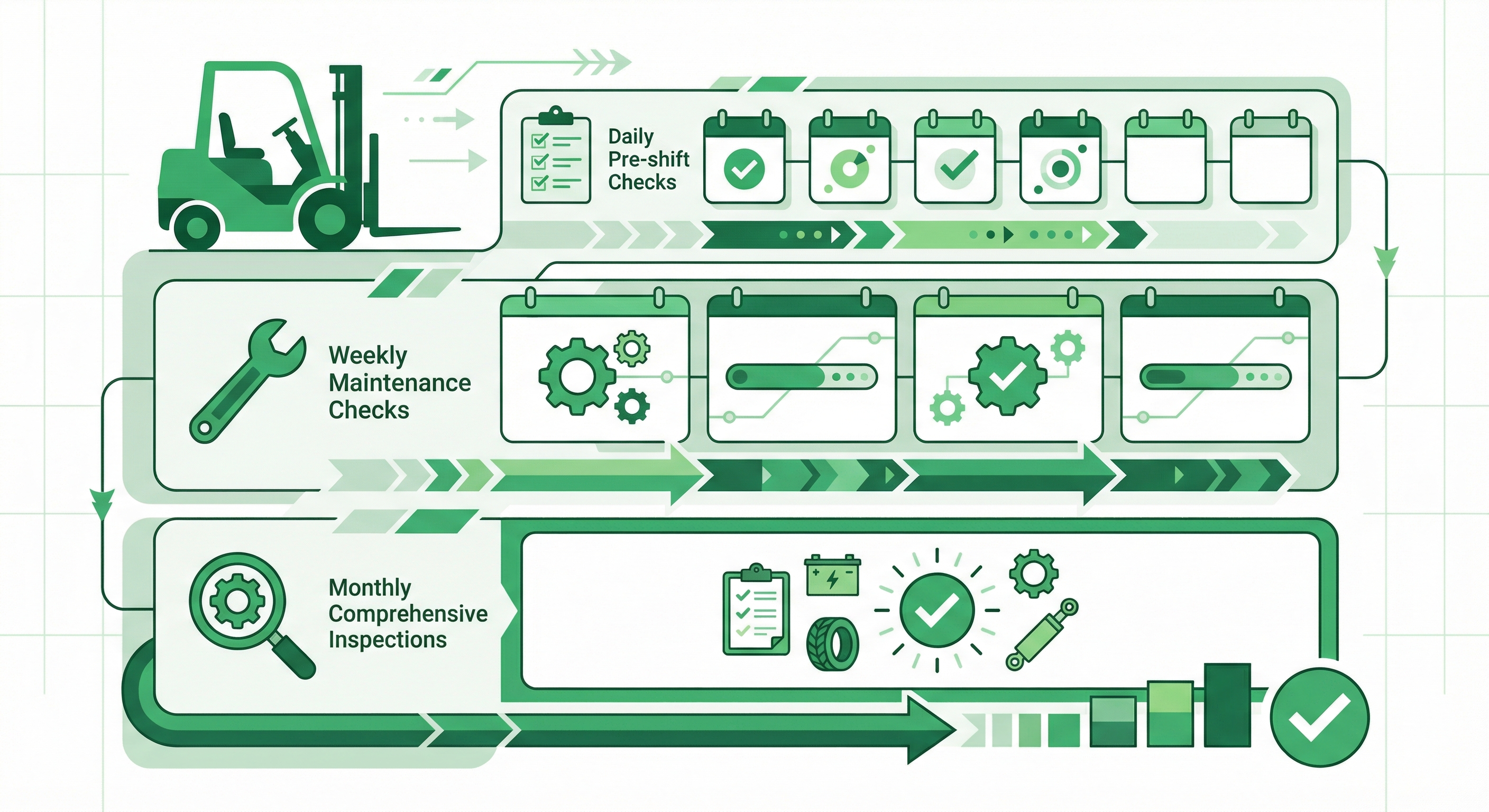
- Fluid levels (hydraulic, engine oil, coolant for IC engine trucks)
- Tire condition and pressure
- Forks for cracks, bends, or wear
- Mast operation (raise, lower, tilt)
- Brakes (service and parking)
- Horn, lights, backup alarm
- Seatbelt condition
- Battery condition and charge (electric trucks)
If any defect is found, the equipment is taken out of service until repaired. No exceptions. Use digital inspection forms that capture results, photos, and timestamps automatically.
Making Pre-Shift Inspections Actually Happen
The biggest challenge with pre-shift inspections is not the checklist. It is getting operators to complete them honestly and consistently. Here is what works:
- Digital forms over paper. Paper checklists get lost, get wet, get filled out at the end of the week from memory, or sit in a stack that nobody reviews. Digital forms on a tablet or phone capture a timestamp, require each field, and can flag incomplete submissions instantly.
- Supervisor spot checks. Randomly ask an operator to walk you through their inspection while you watch. Not as a punishment, but as a reinforcement. When operators know someone might watch, they take the process more seriously.
- Take equipment out of service when defects are reported. Nothing kills an inspection culture faster than operators reporting defects that are never fixed. If an operator flags a cracked fork and the forklift is still running 3 weeks later, they stop reporting.
- Keep it under 10 minutes. A thorough pre-shift inspection should take 5 to 10 minutes. If your checklist is so long that operators need 20 minutes to complete it, they will start skipping items. Focus on safety-critical items.
and flag exactly where the gaps are.
3. Traffic Management
The biggest risk in any forklift operation is the interaction between forklifts and pedestrians. Your traffic management plan should include:
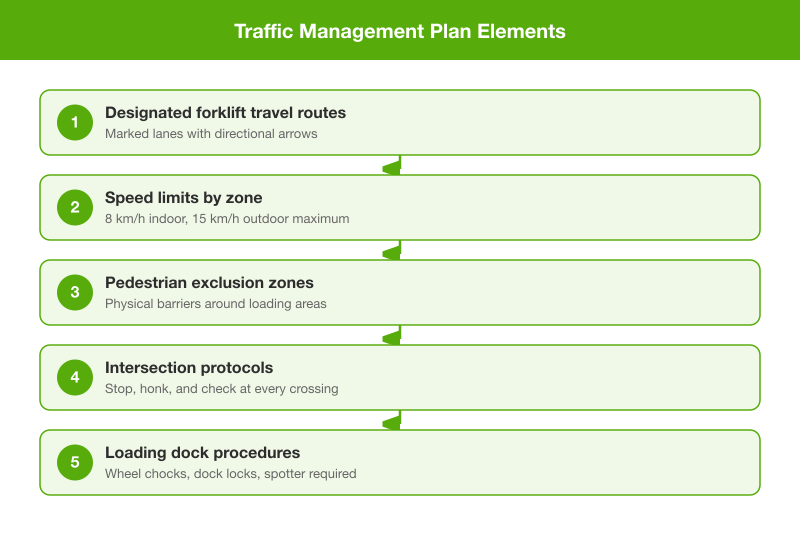
- Designated travel routes for forklifts, separate from pedestrian pathways where possible
- Speed limits appropriate for each area (typically 8 to 10 km/h indoors, 15 km/h outdoors)
- Intersection protocols including horn use, mirrors, and right-of-way rules
- Exclusion zones around loading docks, racking areas, and elevated work
- Physical barriers (bollards, guardrails, painted lanes) separating forklift and pedestrian areas
Traffic Management That Actually Prevents Incidents
Painted lines on the floor are a starting point, but they are not barriers. A forklift does not stop because it crosses a yellow line. Effective traffic management uses a hierarchy of controls:
- Physical separation (best): Bollards, guardrails, concrete barriers, and dedicated forklift corridors that are physically separate from pedestrian areas. This removes the risk entirely in those zones.
- Engineered controls: Convex mirrors at blind corners, speed bumps in transition zones, automatic warning lights that activate when a forklift approaches an intersection, and proximity sensors that alert operators when pedestrians are nearby.
- Administrative controls: Written procedures, speed limits, right-of-way rules, and horn-use protocols. These rely on operator compliance, which is less reliable than physical barriers but still necessary.
- Personal protective equipment: High-visibility vests for all pedestrians in forklift areas. This is the last line of defence, not the first.
The best programs use all four levels simultaneously. Physical barriers where possible, engineered controls at high-risk intersections, administrative rules for everything else, and PPE as a baseline.
4. Load Handling Procedures
Document your load handling procedures for each equipment type:
- Maximum load capacity for each piece of equipment (posted on the data plate)
- Load centre distance calculations
- Stacking heights and stability requirements
- Procedures for unusual or unbalanced loads
- Ramp and incline operating procedures (forks uphill for loaded travel, forks downhill for unloaded)
One commonly overlooked element is attachment-specific load capacity. When you add an attachment (a side shifter, clamp, rotator, or fork extension), the effective load capacity of the forklift decreases. The data plate capacity assumes standard forks with a standard load centre. Every attachment changes the equation. Your load handling procedures should account for this, and operators should be trained on the reduced capacity when using attachments.
5. Maintenance Program
Beyond daily inspections, forklifts need scheduled maintenance:
- Manufacturer-recommended service intervals
- Documentation of all maintenance and repairs
- Lock-out/tag-out procedures for maintenance activities
- Qualified mechanics for repairs (not operators doing their own mechanical work)
A maintenance log should be kept for each piece of equipment, recording every service, repair, and defect resolution. When a pre-shift inspection identifies a defect, the maintenance log should show when the defect was reported, when it was repaired, who performed the repair, and when the equipment was returned to service. This chain of documentation is what regulators expect to see.
6. Incident Reporting and Investigation
Your program must include procedures for:
- Reporting all forklift incidents, near misses, and property damage
- Investigating root causes (not just "operator error")
- Implementing corrective actions
- Tracking trends across incidents to identify systemic issues
Use Safety Evolution's incident report and investigation kit to standardize your process.
Building a Near-Miss Culture
The incidents you should worry about most are the ones that are not being reported. For every serious forklift incident, there are typically dozens of near misses that preceded it. Capturing those near misses gives you the data to fix problems before someone gets hurt.
Building a near-miss reporting culture requires:
- Easy reporting: If reporting a near miss requires filling out a 3-page form and explaining it to three people, nobody will do it. Use a simple digital form that takes less than 2 minutes to complete.
- No-blame response: The operator who reports a near miss should never be punished for it. If a near-miss report leads to a reprimand, you have killed your reporting culture permanently.
- Visible action: When a near miss is reported, act on it. Investigate the root cause, implement a fix, and communicate what changed. When operators see that their reports lead to real improvements, they report more.
- Leadership participation: Site supervisors and managers should actively encourage near-miss reporting and participate in investigations. If leadership treats near misses as a nuisance, the front line will stop reporting.
7. Program Review and Continuous Improvement
Review your forklift safety program at least annually. Check:
- Are all operator certifications current?
- Are pre-shift inspections being completed consistently?
- What incidents or near misses occurred and what trends emerged?
- Have any equipment, procedures, or workplace conditions changed?
- Does the program still meet current regulatory requirements?
The annual review should produce a written summary with findings and action items. Assign responsibility for each action item and set deadlines. Then follow up. A review that identifies 10 issues but resolves none of them is worse than no review, because it creates documented evidence that you knew about problems and did not fix them.
Common Forklift Safety Program Failures
Most contractors think they have a forklift safety program. Most of them are wrong. Here is what we actually find when we audit:
- Pre-shift inspections are not being done. The checklists exist. They are blank. Or they are filled out at the end of the week from memory. Digital forms with timestamps fix this.
- No traffic management plan. Forklifts and pedestrians share the same space with no designated routes, barriers, or protocols. This is the number one risk factor for serious forklift incidents.
- Training records are incomplete or missing. Operators have wallet cards but no detailed training documentation. The wallet card does not tell you what equipment classes were covered or what evaluation was performed.
- No incident tracking. Near misses go unreported because there is no easy reporting mechanism and no culture of reporting without blame.
- Program exists but nobody follows it. The binder is on the shelf. It was written three years ago. Nobody has read it since. A program that is not enforced daily is just paper.
Safety Evolution offers done-for-you safety program development if you need help building or overhauling your forklift safety program.
How to Document Your Program
Your forklift safety program should be a living document. At minimum, maintain:
- Written policies and procedures covering all 7 elements above
- Operator training records with dates, equipment classes, evaluation results, and renewal schedules
- Pre-shift inspection logs (digital is strongly recommended for consistency and audit readiness)
- Maintenance records for every piece of equipment
- Incident and near-miss reports with investigation outcomes and corrective actions
- Annual program review documentation
Keep everything accessible on site. During a regulatory inspection, you need to produce these records quickly. A digital system makes this significantly easier than paper files.
The Cost of Not Having a Forklift Safety Program
Many contractors view a forklift safety program as an overhead cost. In reality, it is the absence of a program that costs money. Here is what the lack of a structured forklift safety program actually costs:
- Regulatory fines: A single OHS inspection finding related to an absent safety program can result in fines ranging from $10,000 to $100,000 depending on the province and severity.
- Incident costs: Without a traffic management plan, pre-shift inspections, and load handling procedures, the likelihood of incidents increases dramatically. A single forklift pedestrian strike with a serious injury can cost $200,000 or more in fines, WCB impacts, legal fees, and lost productivity.
- Equipment damage: Without daily inspections and a maintenance program, equipment runs with developing defects until something breaks. Reactive maintenance costs 3 to 5 times more than preventive maintenance, and unexpected breakdowns disrupt operations.
- GC contract issues: Most general contractors require subcontractors to have documented safety programs, including forklift safety if you operate powered industrial trucks. Not having a program can disqualify you from bid lists or trigger contract reviews.
- COR implications: If your company holds or is pursuing a Certificate of Recognition (COR), an absent or inadequate forklift safety program is an audit finding that can jeopardize your certification.
Compare these costs to the investment in building a program: 40 to 80 hours of staff time to develop, implement, and train on the program, plus the cost of digital inspection tools and any physical traffic management improvements. For most contractors, the program pays for itself after preventing a single incident or passing a single inspection that would otherwise have generated fines.
Implementation Timeline: Building Your Program Step by Step
If you are starting from scratch or rebuilding a neglected program, here is a realistic implementation timeline:
- Week 1 to 2: Audit current state. List all equipment, all operators, current training records, and existing documentation. Identify the biggest gaps.
- Week 3 to 4: Write the program. Create written policies and procedures for all 7 elements. You do not need a 200-page manual; a concise 20 to 30 page document that is actually usable is better than an encyclopedia nobody reads.
- Week 5 to 6: Implement traffic management. Install physical barriers, paint floor markings, post speed limit signs, and designate pedestrian and forklift zones. This is often the highest-impact improvement.
- Week 7 to 8: Launch pre-shift inspections. Deploy digital forms, train operators on the inspection process, and establish the defect reporting and resolution workflow.
- Week 9 to 12: Close training gaps. Schedule training for any operator who needs initial certification, renewal, or equipment-specific training. Update all training records.
- Ongoing: Run the program daily. Conduct spot checks, review inspection logs weekly, investigate every incident and near miss, and complete an annual program review.
Build a forklift program your whole team can run
Use a 30-Day Free Trial to centralize records, assign actions, and keep every location aligned.
30-Day Free Trial
Frequently Asked Questions
What should a forklift safety program include?
A comprehensive forklift safety program should include operator training and certification, pre-shift equipment inspections, traffic management procedures, load handling rules, equipment maintenance schedules, incident reporting and investigation processes, and an annual program review. All elements must be documented and accessible on site.
Is a forklift safety program legally required?
Yes. While provinces may not use the exact phrase "forklift safety program," every province requires employers to ensure safe operation of powered industrial trucks through training, inspections, maintenance, and documented procedures. These requirements collectively form a safety program.
How often should forklift pre-shift inspections be done?
Pre-shift inspections should be completed before every shift by the operator who will use the equipment. If equipment is used on multiple shifts, each incoming operator should perform an inspection at the start of their shift. Inspections should be documented using a standardized checklist.
What is the most common cause of forklift accidents?
Pedestrian strikes and tip-overs are the two most common serious forklift incidents. Pedestrian strikes result from inadequate traffic management, and tip-overs from overloading, speeding on turns, or operating on uneven surfaces. A strong safety program addresses both through designated traffic routes, speed limits, load handling procedures, and operator training.
How long does it take to implement a forklift safety program?
A basic forklift safety program can be built and implemented in 8 to 12 weeks. The first 2 weeks are spent auditing your current state. The next 2 to 4 weeks are for writing policies, installing traffic management controls, and launching inspection processes. The remaining weeks are for closing training gaps. Ongoing maintenance, including daily inspections, incident investigations, and annual reviews, is what keeps the program effective after implementation.
Get Weekly Safety Insights
Regulation updates, toolbox talk ideas, and compliance tips. One email per week.