Last updated: April 2026
OSHA forklift training is a federal requirement under 29 CFR 1910.178(l) that applies to every employer with powered industrial truck operators in the United States. Powered industrial trucks (the regulatory term for forklifts) ranked #6 on OSHA's most frequently cited violations list in 2024, with 2,248 citations issued. A single serious violation can cost your company up to $16,550, and willful violations reach $165,514 per occurrence.
Quick Answer
OSHA requires every forklift operator to complete training before operating a powered industrial truck. Training must include formal instruction (classroom or online), practical exercises, and a workplace performance evaluation. Operators must be re-evaluated at least every 3 years. There is no government-issued forklift "license" in the US. Employers are responsible for providing, documenting, and certifying all operator training under OSHA 1910.178(l).
If you run crews in warehouses, on construction sites, or in manufacturing facilities, this guide covers exactly what OSHA requires, what training must include, who can be a trainer, and how to stay compliant without getting buried in paperwork.
What Does OSHA Require for Forklift Training?
OSHA's forklift training requirements live in 29 CFR 1910.178(l), the "Operator training" section of the Powered Industrial Trucks standard. The requirements apply to all powered industrial trucks, which includes:
- Counterbalance forklifts (sit-down, stand-up)
- Reach trucks
- Order pickers
- Pallet jacks (powered, rider)
- Rough terrain forklifts
- Telehandlers
The core requirements break down into four parts:
| Requirement |
OSHA Reference |
What It Means |
| Initial training |
1910.178(l)(1) |
Every operator must complete training before operating a forklift unsupervised |
| Three-part format |
1910.178(l)(2)(ii) |
Formal instruction + practical training + workplace evaluation |
| Qualified trainer |
1910.178(l)(2)(iii) |
Trainers must have knowledge, training, and experience to train operators |
| 3-year re-evaluation |
1910.178(l)(4)(iii) |
Performance evaluation at least every 3 years |
One detail most employers miss: OSHA does not accept online-only training. The regulation explicitly requires a practical component (demonstrations and hands-on exercises) and a workplace evaluation. An online course can satisfy the formal instruction portion, but the other two parts must be done in person with the actual equipment operators will use on site.
The 3 Components of OSHA-Compliant Forklift Training
Under 1910.178(l)(2)(ii), OSHA requires training to include three distinct components. Skipping any one of them makes the entire program non-compliant.
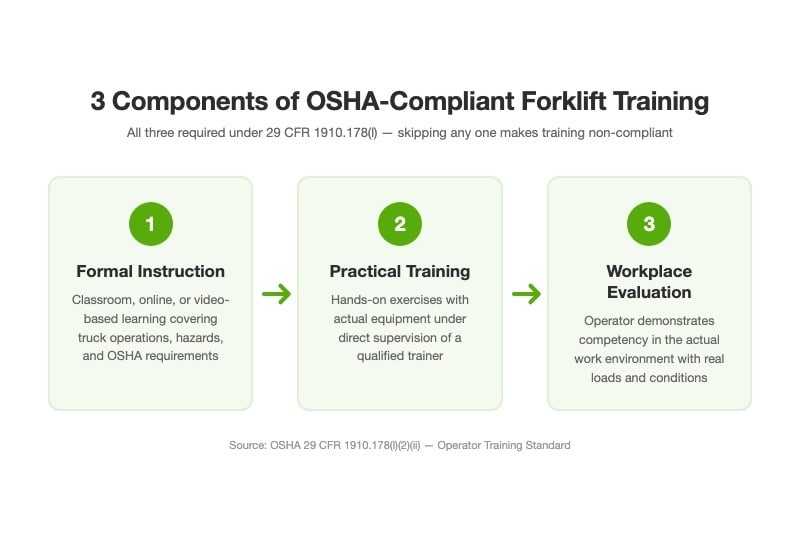
1. Formal Instruction
This is the classroom or theory portion. OSHA accepts lectures, discussions, interactive computer learning, video, and written materials. Online courses from providers like Safety Evolution's LMS cover this component. The formal instruction must address all topics listed in 1910.178(l)(3), which includes:
- Operating instructions and precautions for the specific truck types
- Differences between forklifts and automobiles (rear-wheel steering, elevated centre of gravity)
- Truck controls, instrumentation, and how they work
- Vehicle capacity, stability, and load handling
- Fork and attachment operation and limitations
- Pre-shift inspection requirements
- Refueling and battery charging procedures
Plus workplace-specific topics:
- Surface conditions (indoor, outdoor, ramps, dock plates)
- Load composition and stability for your operation
- Pedestrian traffic patterns in your facility
- Narrow aisles and restricted areas
- Hazardous atmosphere locations (if applicable)
2. Practical Training
This is hands-on time with the actual equipment. The trainer demonstrates proper operation, then the trainee practices under direct supervision. OSHA requires that trainees only operate powered industrial trucks under direct supervision of a qualified person, and only where operation does not endanger the trainee or other employees (1910.178(l)(2)(i)).
Practical training must cover the specific truck type the operator will use on your site. Training on a sit-down counterbalance forklift does not qualify an operator to run a stand-up reach truck or an order picker. Each truck type requires its own practical training.
3. Workplace Performance Evaluation
The trainee must demonstrate competency in the actual workplace where they will operate. This is not the same as the practical training exercise. The evaluation happens in the real work environment with real conditions: actual loads, actual aisles, actual pedestrian traffic, actual surface conditions.
The trainer observes the operator and evaluates their ability to safely operate the truck under normal working conditions. This is the step most commonly missed in OSHA citations, because many employers treat the practical exercise and workplace evaluation as the same thing.
Who Can Be an OSHA Forklift Trainer?
OSHA does not require a specific certification, license, or credential for forklift trainers. The regulation at 1910.178(l)(2)(iii) states that training and evaluation must be conducted by "persons who have the knowledge, training, and experience to train powered industrial truck operators and evaluate their competence."
In practice, this means your forklift trainer needs:
- Knowledge of the specific truck types, OSHA requirements, and safe operating procedures
- Training in how to instruct adults and evaluate operator competency
- Experience operating the types of trucks they are training on
Many employers use a train-the-trainer program to qualify internal employees as forklift trainers. These programs typically cover instructional techniques, evaluation methods, and documentation requirements. A train-the-trainer course does not create an "OSHA-certified" trainer (no such thing exists), but it helps demonstrate the knowledge, training, and experience OSHA requires.
Common options for providing OSHA-compliant forklift training:
| Training Method |
Pros |
Cons |
| In-house trainer (train-the-trainer graduate) |
Lowest per-operator cost, can train on your specific equipment and site conditions |
Requires initial investment in train-the-trainer course, trainer must maintain competency |
| Third-party training provider (on-site) |
Professional instruction, covers all OSHA requirements, handles documentation |
Higher per-operator cost, scheduling constraints |
| Online + in-house practical (blended) |
Flexible scheduling for theory, reduces classroom time |
Still need a qualified person for practical and evaluation |
Safety Evolution's online forklift training courses cover the formal instruction component through an LMS that tracks completion and expiry dates automatically. Your internal trainer or a third-party provider then completes the practical training and workplace evaluation on site.
Not sure if your forklift records would pass inspection today?
Missing proof and scattered documents create compliance risk. Start your 30-Day Free Trial and keep inspection-ready records.
30-Day Free Trial
How Often Does OSHA Require Forklift Training?
OSHA requires a performance evaluation at least every 3 years under 1910.178(l)(4)(iii). This is the minimum. But refresher training is also required whenever any of these situations occur:
- The operator is involved in an accident or near-miss
- An evaluation reveals the operator is not operating safely
- The operator is assigned to a different type of truck
- Workplace conditions change in ways that affect safe operation (new racking, different floor surfaces, layout changes)
The 3-year evaluation does not mean the operator needs to repeat the full initial training program. It is a performance evaluation: the trainer observes the operator in the workplace and confirms they are still operating safely. If the evaluation reveals deficiencies, then refresher training in the relevant topics is required.
The important distinction: there is no forklift "certification" that expires in the US. Unlike some Canadian provinces where training providers issue certificates with specific expiry dates, OSHA's framework is employer-based. The employer is responsible for ensuring ongoing competency. Many training providers market "3-year forklift certification" programs, but what OSHA actually requires is an employer-conducted evaluation every 3 years.
OSHA Forklift Training Documentation Requirements
Under 1910.178(l)(6), employers must certify that each operator has been trained and evaluated. The certification must include:
- Name of the operator
- Date of the training
- Date of the evaluation
- Identity of the person(s) who performed the training or evaluation
OSHA does not prescribe a specific form or format. A signed training record, an LMS completion certificate, or a database entry that captures these four elements all satisfy the requirement. What matters is that you can produce the documentation during an inspection.
Common documentation failures that trigger citations:
- No record of the practical training or workplace evaluation (only the online course completion certificate)
- No record of the 3-year re-evaluation
- Training records that do not identify the trainer
- Training records that do not specify the types of trucks covered
- Records that show a training date after the employee started operating a forklift
OSHA Forklift Violations and Penalties
Powered industrial trucks (29 CFR 1910.178) ranked #6 on OSHA's Top 10 most frequently cited standards in 2024, with 2,248 violations issued across US workplaces. The most common forklift-related citations break down as follows:
| OSHA Section |
Violation |
What It Means |
| 1910.178(l) |
Operator training |
No training provided, incomplete training (missing practical or evaluation), no documentation |
| 1910.178(q)(7) |
Pre-shift inspections |
Forklifts not inspected before each shift |
| 1910.178(p)(1) |
Unsafe equipment removal |
Defective forklifts not taken out of service |
| 1910.178(l)(6) |
Certification records |
Missing or incomplete training documentation |
| 1910.178(l)(4)(iii) |
3-year re-evaluation |
No performance evaluation within the required 3-year cycle |
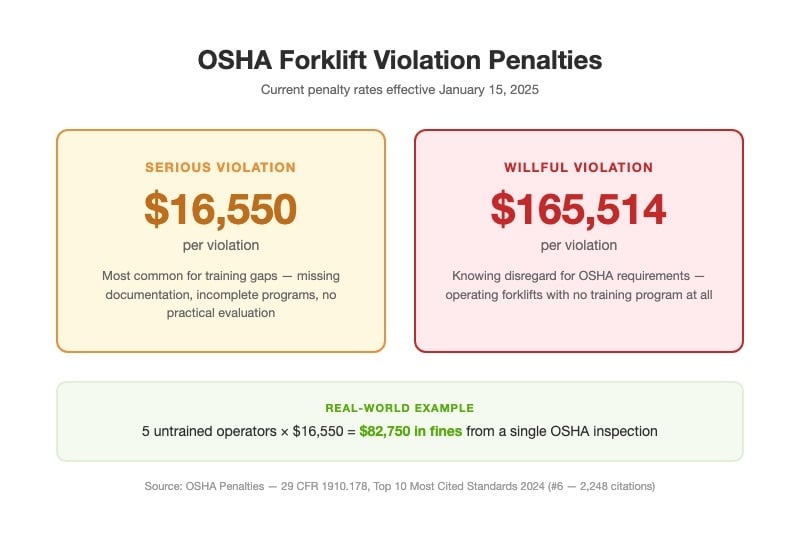
Current OSHA penalty rates (effective January 15, 2025):
- Serious violation: up to $16,550 per violation
- Willful or repeated violation: up to $165,514 per violation
- Failure to abate: up to $16,550 per day past the abatement deadline
Penalty math for a typical forklift training citation: if OSHA finds 5 operators without documented training, that is potentially 5 separate serious violations at $16,550 each, totaling $82,750. If the employer was previously cited and failed to correct the issue, those become willful violations at up to $165,514 each.
OSHA Forklift Training vs Canadian Forklift Certification
If your company operates on both sides of the border, the regulatory frameworks differ significantly:
| Element |
United States (OSHA) |
Canada (Provincial OHS + CSA) |
| Governing standard |
29 CFR 1910.178(l) |
CSA B335-15 + provincial OHS regulations |
| Training responsibility |
Employer |
Employer |
| Government-issued license |
No |
No (except BC requires WorkSafeBC-approved training provider) |
| Re-evaluation frequency |
At least every 3 years |
Varies by province (typically 3 years) |
| Trainer qualifications |
Knowledge, training, and experience (no specific credential required) |
Competent person (varies by province, some require certified instructors) |
| Equipment-specific training |
Required for each truck type |
Required for each truck class (CSA Classes I-VII) |
| Online-only training accepted |
No (theory only, practical required in person) |
No (same requirement for practical evaluation) |
For a detailed guide on Canadian forklift training requirements by province, see our Forklift Training in Canada: Employer Guide.
How to Build an OSHA-Compliant Forklift Training Program
Here is the practical checklist for setting up a forklift training program that meets OSHA 1910.178(l):
Step 1: Inventory Your Equipment
List every powered industrial truck type on your site. Each type needs its own training module. A sit-down counterbalance (Class IV or V) requires different training than a reach truck (Class II) or a pallet jack (Class III).
Step 2: Designate or Hire Qualified Trainers
Decide whether to train an internal employee through a train-the-trainer program or contract with a third-party provider. For companies with 10+ forklift operators, in-house training typically saves $200 to $500 per operator compared to outsourcing each session.
Step 3: Develop Training Content for All Required Topics
OSHA lists 22 specific topics in 1910.178(l)(3) that initial training must cover. Employers can skip topics they can demonstrate are not applicable to their workplace, but the burden of proof is on the employer. Use an LMS with pre-built forklift courses to cover the formal instruction topics, then build site-specific practical training around your actual equipment and work environment.
Step 4: Conduct Training in the Required 3-Part Format
Run the formal instruction (classroom or online), then the practical training (hands-on with the actual truck), then the workplace evaluation (observation in the real work environment). Do not combine the practical and evaluation into one session if your work conditions differ from the training area.
Step 5: Document Everything
For each operator, record: operator name, training date, evaluation date, trainer identity, and truck types covered. Store these records where you can retrieve them during an OSHA inspection. An LMS handles this automatically for the formal instruction component. You need a system for capturing the practical training and evaluation records as well.
Step 6: Schedule 3-Year Re-Evaluations
Set calendar reminders or use a training management system that flags operators approaching their 3-year evaluation deadline. The most common OSHA citation is an expired evaluation that nobody tracked. Build the re-evaluation into your annual safety calendar so it never becomes a surprise.
Be inspection-ready without the last-minute scramble
Run your forklift compliance workflow in one system with a 30-Day Free Trial and close gaps before regulators find them.
30-Day Free Trial
Frequently Asked Questions
Does OSHA require forklift training?
Yes. Under 29 CFR 1910.178(l), every employer must ensure that each powered industrial truck operator completes training that includes formal instruction, practical training, and a workplace performance evaluation before operating a forklift unsupervised. Operators must also be re-evaluated at least every 3 years.
Is online forklift training OSHA-compliant?
Online training can satisfy the formal instruction component of OSHA forklift training, but it cannot replace the required practical training (hands-on operation under supervision) and workplace performance evaluation. A compliant program uses online courses for theory, then completes the practical and evaluation portions in person with the actual equipment.
How often does OSHA require forklift training?
OSHA requires a performance evaluation at least every 3 years under 1910.178(l)(4)(iii). Additionally, refresher training must be provided whenever an operator is involved in an incident, is observed operating unsafely, is assigned to a different truck type, or when workplace conditions change in ways that affect safe operation.
What are the penalties for no forklift training?
As of January 2025, OSHA can assess up to $16,550 per serious violation and up to $165,514 per willful or repeated violation. Each untrained operator can be cited as a separate violation. Five operators without documented training could result in penalties exceeding $82,000.
Can any employee be a forklift trainer under OSHA?
OSHA does not require a specific certification or credential for forklift trainers. However, the trainer must have the knowledge, training, and experience to train operators and evaluate their competence, as stated in 1910.178(l)(2)(iii). Most employers use train-the-trainer programs to prepare internal employees for this role.
Get Weekly Safety Insights
Regulation updates, toolbox talk ideas, and compliance tips. One email per week.