Last updated: April 2026
Forklift training requirements differ by country, by state (US), and by province (Canada). In the United States, OSHA 1910.178(l) sets federal training requirements that apply everywhere. In Canada, each province sets its own rules through provincial OHS legislation, with CSA B335-15 as the national equipment standard. If you run crews on both sides of the border, or across provincial lines, the differences matter.
Quick Answer
US: OSHA requires all forklift operators to complete training (formal instruction + practical + evaluation) before unsupervised operation, with re-evaluation every 3 years. One federal standard applies in all states. Canada: Every province requires employer-provided training, but the specific requirements (hours, documentation, accepted providers) vary. CSA B335-15 is the national equipment standard. Training does not automatically transfer between provinces.
United States: OSHA Forklift Training Requirements
The United States has a single federal standard for forklift training: 29 CFR 1910.178(l). This applies to every employer in every state (including state-plan states, which must adopt requirements at least as protective as federal OSHA).
Key OSHA requirements:
- Three-part training: Formal instruction (classroom/online) + practical training (hands-on) + workplace performance evaluation
- Before unsupervised operation: Operators cannot work without a supervisor until all three components are completed
- Equipment-specific: Training must cover the specific truck types the operator will use
- Qualified trainers: Must have knowledge, training, and experience (no specific credential required)
- 3-year re-evaluation: Performance assessment at least every 3 years
- Documentation: Employer must certify training with operator name, training date, evaluation date, and trainer identity
Unlike Canada's province-by-province approach, OSHA creates one set of rules for all US operations. The complexity comes from state-plan states (28 states) that may add requirements beyond federal OSHA, though most adopt 1910.178 without modification.
For the complete OSHA forklift training breakdown, including penalties, trainer qualifications, and a compliance checklist, see our OSHA Forklift Training: Complete Employer Guide.
Canada: Provincial Forklift Training Requirements
Canada has no single federal forklift training standard. Each province regulates forklift training through its own OHS legislation, with CSA B335-15 (Safety Standard for Lift Trucks) as the referenced equipment standard. The practical impact: training accepted in Alberta may not satisfy BC requirements, and documentation standards vary significantly.
At Safety Evolution, we help contractors navigate cross-provincial compliance every day. Here is a practical breakdown of forklift training requirements by province, so you know exactly where you stand.
⚡ Quick Answer
- Common ground: Every province requires employers to ensure forklift operators are trained and competent
- Key standard: CSA B335-15 is referenced by most provinces as the benchmark for forklift training
- What varies: Specific legislation, enforcement approach, renewal expectations, and documentation requirements
- No national card: There is no federal forklift licence or certification in Canada
- Employer obligation: In every province, the employer (not the operator) is legally responsible for ensuring training is complete and current
Below, we break down forklift training requirements province by province - what each regulator requires, where the rules differ, and what you need to have in place if your crews work across provincial lines.
The One Rule That Applies Everywhere
In every Canadian province, the employer is legally responsible for ensuring forklift operators are trained, competent, and authorized before they operate powered industrial trucks. This is not optional. It is not a suggestion. It is a legal duty under each province's occupational health and safety act.
The employer cannot delegate this responsibility to the operator ("he said he was trained"), to the training provider ("they gave him a card"), or to the previous employer ("he was certified at his last job"). You, as the current employer, must verify and document competency.
This employer duty has three practical implications that many contractors overlook:
- Hiring a certified operator does not end your obligation. Even if a new hire arrives with current, legitimate forklift training from another employer, you must evaluate that training, verify it covers the right equipment class, and provide your own site-specific orientation and authorization.
- Subcontractors are your problem too. If you are a general contractor and your subcontractor's operators are not properly trained, you can share liability in some provinces. Verify your subs' training records as part of pre-qualification.
- Documentation is the evidence. If you cannot prove training happened, from a regulator's perspective, it did not happen. Verbal assurances, handshake confirmations, and wallet cards without supporting records are not enough.
For the full national picture, start with our pillar guide: Forklift Training and Certification in Canada.
British Columbia
Regulator: WorkSafeBC
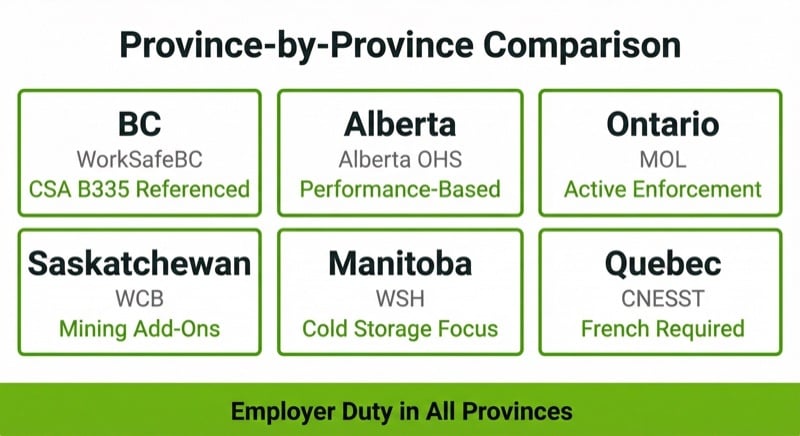
Key legislation: Workers Compensation Act, OHS Regulation Part 16 (Mobile Equipment)
BC is one of the more prescriptive provinces when it comes to forklift training. WorkSafeBC directly references CSA B335-15 as the training standard for powered industrial trucks. This means:
- Training must include classroom theory, practical hands-on operation, and a competency evaluation
- Training must be specific to the type (class) of forklift the operator will use
- Refresher training is recommended every 3 years and required after incidents, unsafe operation, or workplace changes
- The employer must maintain written training records
BC also has specific requirements for operators on construction sites, including proximity to other workers, traffic management, and use of seatbelts.
What BC Employers Get Wrong
The most common compliance gap we see in BC is with equipment class mismatches. An operator trained on a Class 1 electric counterbalance in a warehouse is not authorized to operate a Class 7 rough terrain forklift on a construction site, even if both were trained in BC under CSA B335-15. Each equipment class requires its own training and evaluation. Employers who rent specialized equipment for short-term projects often forget to verify their operators are trained on that specific class.
Another frequent issue is documentation format. WorkSafeBC inspectors expect to see detailed training records, not just a wallet card or a one-page certificate. Records should include the training provider, the curriculum topics covered, the equipment class, the evaluator's name, and the evaluation results. Operators who were trained years ago by providers who have since closed can create documentation headaches.
For more detail: BC Forklift Certification: CSA B335-15 Guide
Not sure if your forklift records would pass inspection today?
Missing proof and scattered documents create compliance risk. Start your 30-Day Free Trial and keep inspection-ready records.
30-Day Free Trial
Alberta
Regulator: Alberta Occupational Health and Safety (Alberta OHS)
Key legislation: Occupational Health and Safety Act, OHS Code Part 40 (Powered Mobile Equipment)
Alberta takes a performance-based approach. The legislation requires employers to ensure operators are competent, but it does not prescribe a specific training curriculum or reference CSA B335-15 as directly as BC does. In practice, this means:
- Employers must ensure operators are competent before they operate equipment
- Competency must be demonstrated through training and evaluation
- There is no legislated expiry date, but the employer's ongoing duty to ensure competency creates an effective renewal requirement
- Industry standard is 3-year renewal
- Training records must be available on site
Alberta OHS officers will look for evidence of both initial training and ongoing competency verification. "He's been doing it for 20 years" is not evidence of competency.
Alberta's COR Connection
If your company holds a Certificate of Recognition (COR) in Alberta, your forklift training program is part of the safety management system that will be audited. COR auditors specifically look for documented training programs, current training records for all operators, and evidence that you track renewal dates. A disorganized or incomplete forklift training program can create audit findings that put your COR status at risk. Since many GCs require COR for prequalification, losing your COR over a training gap has cascading consequences for your ability to bid on work.
Alberta's oil and gas sector also layers additional requirements on top of provincial OHS rules. Clients using ISN, ComplyWorks, or Avetta will verify training records as part of the pre-qualification process, and many require 2-year (rather than 3-year) renewal cycles.
Ontario
Regulator: Ontario Ministry of Labour, Immigration, Training and Skills Development (MOL)
Key legislation: Occupational Health and Safety Act, Industrial Establishments Regulation (O. Reg. 851), Construction Projects Regulation (O. Reg. 213/91)
Ontario has specific forklift training requirements embedded in its regulations:
- Section 51 of O. Reg. 851 requires operators to be trained and to demonstrate competency before operating a lift truck
- Training must address the specific hazards of the workplace and the equipment
- The employer must keep a written record of training
- No legislated expiry, but employers must ensure ongoing competency
- For construction, O. Reg. 213/91 adds requirements around operator training for construction-specific hazards
Ontario's approach puts significant enforcement power behind inspections. MOL inspectors commonly request training records during workplace visits and can issue orders and fines for gaps.
Ontario's Enforcement in Practice
Ontario has the most active forklift-related enforcement of any province, which makes sense given the size of its industrial and warehouse sectors. In the Greater Toronto Area alone, there are thousands of warehousing and distribution operations running forklifts daily. MOL inspectors conduct proactive workplace blitzes focused on specific hazards, and forklift operations are a recurring target.
Fines under Ontario's OHSA can reach $100,000 for individuals and $1,500,000 for corporations per offence. In practice, fines for training-related violations typically fall in the $25,000 to $75,000 range, but they escalate sharply when a violation contributes to an injury. Ontario employers should also be aware of Joint Health and Safety Committee (JHSC) requirements: workplaces with 20 or more workers must have a JHSC, and forklift safety should be a standing agenda item.
Saskatchewan
Regulator: Saskatchewan Workers' Compensation Board (WCB) and Saskatchewan Ministry of Labour Relations and Workplace Safety
Key legislation: Saskatchewan Employment Act, OHS Regulations Part 12
Saskatchewan requires:
- Employers to ensure operators are trained and competent
- Training to cover the specific equipment being operated
- Written training records to be maintained
- Industry standard 3-year renewal cycle
Saskatchewan's mining and potash industries create demand for specialized forklift training beyond standard warehouse or construction scenarios. Operators in these sectors may need training on equipment used in confined or underground environments, with additional ventilation and emergency procedure requirements that general training programs do not cover.
Manitoba
Regulator: Manitoba Workplace Safety and Health
Key legislation: Workplace Safety and Health Act, Workplace Safety and Health Regulation
Manitoba requires employers to provide training on the safe operation of powered industrial trucks, including:
- Equipment-specific training
- Workplace-specific hazard training
- Written competency records
- Ongoing competency verification
Manitoba's manufacturing and food processing sectors are significant forklift users. Employers in cold storage and food processing environments should ensure their training program covers the unique hazards of these settings, including condensation on floors, temperature-related equipment performance changes, and product contamination prevention procedures.
30-Day Free Trial on your forklift training records.
Other Provinces and Territories
The remaining provinces and territories follow similar patterns:
- Quebec: Governed by CNESST. Requires employer to ensure competency. References CSA standards. Quebec has some of the strictest occupational safety enforcement in Canada, and CNESST inspectors are known for thorough documentation reviews. Training delivered in French is expected for francophone operators.
- New Brunswick: OHS Act requires training and competency documentation. The province's forestry and pulp and paper industries create demand for specialized forklift training in mill environments.
- Nova Scotia: Workplace Health and Safety Act. Employer duty to ensure training. Halifax's growing distribution sector has increased demand for forklift training in the province.
- Newfoundland and Labrador: OHS regulations require operator training and competency. Offshore and remote industrial sites add logistical complexity to training delivery.
- PEI, NWT, Yukon, Nunavut: All require employer-provided training and competency verification. Smaller operator populations mean fewer local training providers, which can increase costs and scheduling challenges for employers in these regions.
Regardless of province, the pattern is the same: the employer is responsible, training must be documented, and competency must be verified.
What Happens When You Work Across Provincial Lines?
This is where it gets complicated, and where most contractors make mistakes.
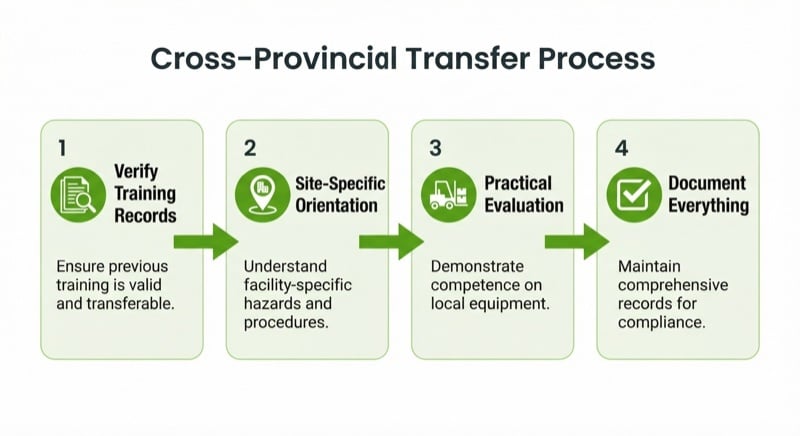
There is no national portability agreement for forklift certification in Canada. A card issued in Alberta is not automatically valid in BC. In practice, most employers will accept training from another province if it meets CSA B335-15 standards, but the receiving employer must still:
- Verify the operator's training records and confirm the training covered the right equipment class
- Conduct a site-specific orientation covering the new workplace's hazards, traffic patterns, and procedures
- Complete a practical evaluation on the equipment the operator will use at the new site
- Document all of the above
The mistake most contractors make is assuming the training card is enough. It is a starting point, not the finish line. The new employer's documentation of competency verification is what matters to a provincial regulator.
Cross-Provincial Compliance Scenarios
Here are three real-world scenarios we deal with regularly:
Scenario 1: Alberta contractor sends crew to a BC project. Your operators are all certified in Alberta under a training program that aligns with CSA B335-15. In BC, the WorkSafeBC inspector will accept that training as a baseline, but you need to document a BC site-specific orientation, evaluate each operator on the BC site equipment, and keep those records on the BC project site. If you cannot produce this documentation in BC, you will get a compliance order, regardless of what your Alberta records show.
Scenario 2: Ontario warehouse hires an operator certified in Saskatchewan. The new hire has a current (less than 3-year-old) certification from a Saskatchewan training provider. The Ontario employer must verify the training covered the specific equipment class the operator will use in Ontario, conduct a site-specific orientation, perform a practical evaluation, and document the results. The Saskatchewan card is a starting point for the operator's file, not the whole file.
Scenario 3: A national company with operators in 4 provinces. The simplest approach is to standardize all training to CSA B335-15, use a single training management system to track certifications across all locations, and ensure site-specific orientation is documented at every location. Safety Evolution's training management platform is designed for exactly this kind of multi-province tracking.
How to Stay Compliant Across Multiple Provinces
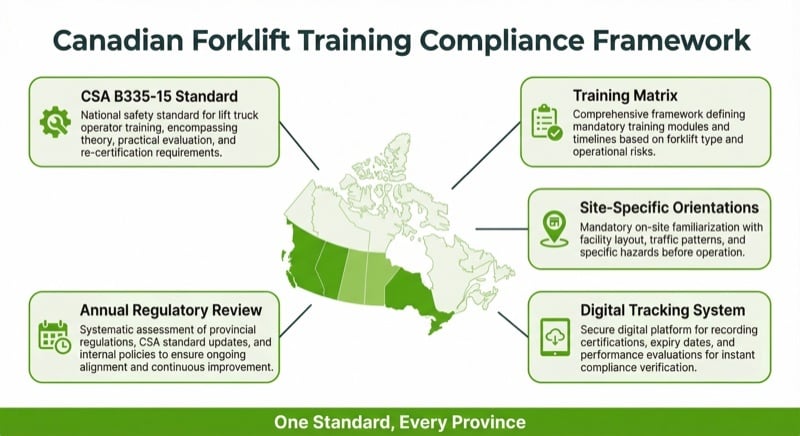
- Standardize your training to CSA B335-15. If your training meets the CSA standard, it provides the strongest foundation for cross-provincial recognition.
- Build a training matrix. Track every operator, every equipment class, every certification date, and every province they are authorized to work in.
- Document site-specific orientations. Every time an operator moves to a new site, document the orientation. This is your evidence of ongoing competency management.
- Use a digital tracking system. Safety Evolution's training management platform can track certifications, expiry dates, and multi-province compliance from one dashboard.
- Budget for provincial differences. If you work in multiple provinces, factor in the additional training and documentation requirements when you budget for forklift training costs.
Multi-Province Employer Checklist
Use this checklist if your company operates in more than one province:
- ☐ Training program standardized to CSA B335-15 across all locations
- ☐ Training matrix includes province column for each operator
- ☐ Site-specific orientation template created for each provincial work location
- ☐ Practical evaluation conducted and documented when operators move between provinces
- ☐ Provincial-specific requirements identified and addressed (e.g., BC construction seatbelt rules, Ontario JHSC integration, Alberta COR requirements)
- ☐ Records stored digitally and accessible from any location
- ☐ Annual review of provincial regulatory changes that may affect training requirements
Be inspection-ready without the last-minute scramble
Run your forklift compliance workflow in one system with a 30-Day Free Trial and close gaps before regulators find them.
30-Day Free Trial
Frequently Asked Questions
Is forklift training a legal requirement in Canada?
Yes. Every province in Canada requires employers to ensure forklift operators are trained and competent before operating powered industrial trucks. The specific legislation varies by province, but the employer obligation is universal.
Is forklift certification transferable between provinces?
There is no formal national portability agreement. Training from one province is generally accepted as a baseline, but the new employer must verify competency, conduct site-specific orientation, evaluate the operator on the equipment they will use, and document everything. The employer in the new province remains legally responsible.
Which Canadian province has the strictest forklift training rules?
British Columbia is generally considered the most prescriptive, as WorkSafeBC directly references CSA B335-15 and actively enforces training requirements during inspections. Ontario also has strong enforcement through MOL inspections. However, all provinces hold employers to a similar standard of ensuring operator competency.
Do all provinces require forklift training records?
Yes. Every province requires employers to maintain documentation of forklift operator training. This includes records of initial training, refresher training, competency evaluations, and site-specific orientations. These records must be available during regulatory inspections.
What is CSA B335-15?
CSA B335-15 is the Canadian Standards Association standard for safety of powered industrial trucks. It establishes requirements for operator training, including classroom instruction, practical hands-on training, and competency evaluation. Most provinces reference this standard in their OHS regulations.
Do I need separate forklift training for construction and warehouse work?
The core forklift operator training applies to both settings, but construction sites have additional hazards, including uneven terrain, proximity to other trades, weather exposure, and different equipment types (often Class 5 and Class 7). Several provinces, including Ontario, have construction-specific regulations (O. Reg. 213/91) that add requirements beyond standard industrial forklift training. Operators moving from warehouse to construction environments should receive additional training covering construction-specific scenarios.
Get Weekly Safety Insights
Regulation updates, toolbox talk ideas, and compliance tips. One email per week.