Last updated: March 2026
If you operate forklifts in British Columbia, your compliance requirements are more specific than in most other provinces. BC is one of the few provinces that directly names CSA B335-15 in its OHS legislation, which means WorkSafeBC inspectors do not need to interpret vague "competency" language. They have a specific, referenced standard to measure your training program against.
At Safety Evolution, we are based in BC and work with contractors across the province. Forklift training compliance is one of the areas where we see the most confusion, especially from employers who bring operators over from Alberta or Ontario and assume their existing certification automatically transfers. It does not work that way in BC.
» Quick Answer
- Governing regulation: WorkSafeBC OHS Regulation Part 16 (Mobile Equipment), Section 16.43
- Required standard: CSA B335-15 (Industrial Lift Truck Operator Training) is directly referenced in BC law
- Training must include: Classroom theory, hands-on practical training, written knowledge test, and practical driving evaluation
- Renewal: Refresher training required at least every 3 years (mandatory in BC, not just recommended)
- Employer responsibility: You must ensure every operator is trained to CSA B335-15 and has passed evaluations before they touch a forklift
Below, we walk through WorkSafeBC's specific requirements, how CSA B335-15 applies in BC, what your training documentation needs to look like, and how to handle operators transferring from other provinces.
What Does WorkSafeBC Require for Forklift Training?
WorkSafeBC requires that every worker who operates a lift truck (forklift) be trained to CSA Standard B335-15 and pass a written and practical evaluation before operating the equipment. This requirement is codified in Part 16 of the BC OHS Regulation, Section 16.43, and is enforced through workplace inspections and incident investigations.
WorkSafeBC is clear on its forklift operator training page: "Workers must be trained to CSA Standard B335-15, Industrial Lift Truck Operator Training, and have passed the test before they can operate a lift truck (forklift)."
Unlike some provinces where the OHS code uses general "competency" language and the CSA standard is referenced only in non-binding guidance, BC has made CSA B335-15 a regulatory requirement. This is not a best practice suggestion. It is the law.
What Is CSA B335-15?
CSA B335-15 is the Canadian Standards Association's safety standard for lift trucks, covering operator training, trainer qualifications, and maintenance requirements. Published in 2015 and reaffirmed in 2024 (designated as B335-15 R2024), it is the nationally recognized benchmark for forklift safety in Canada.
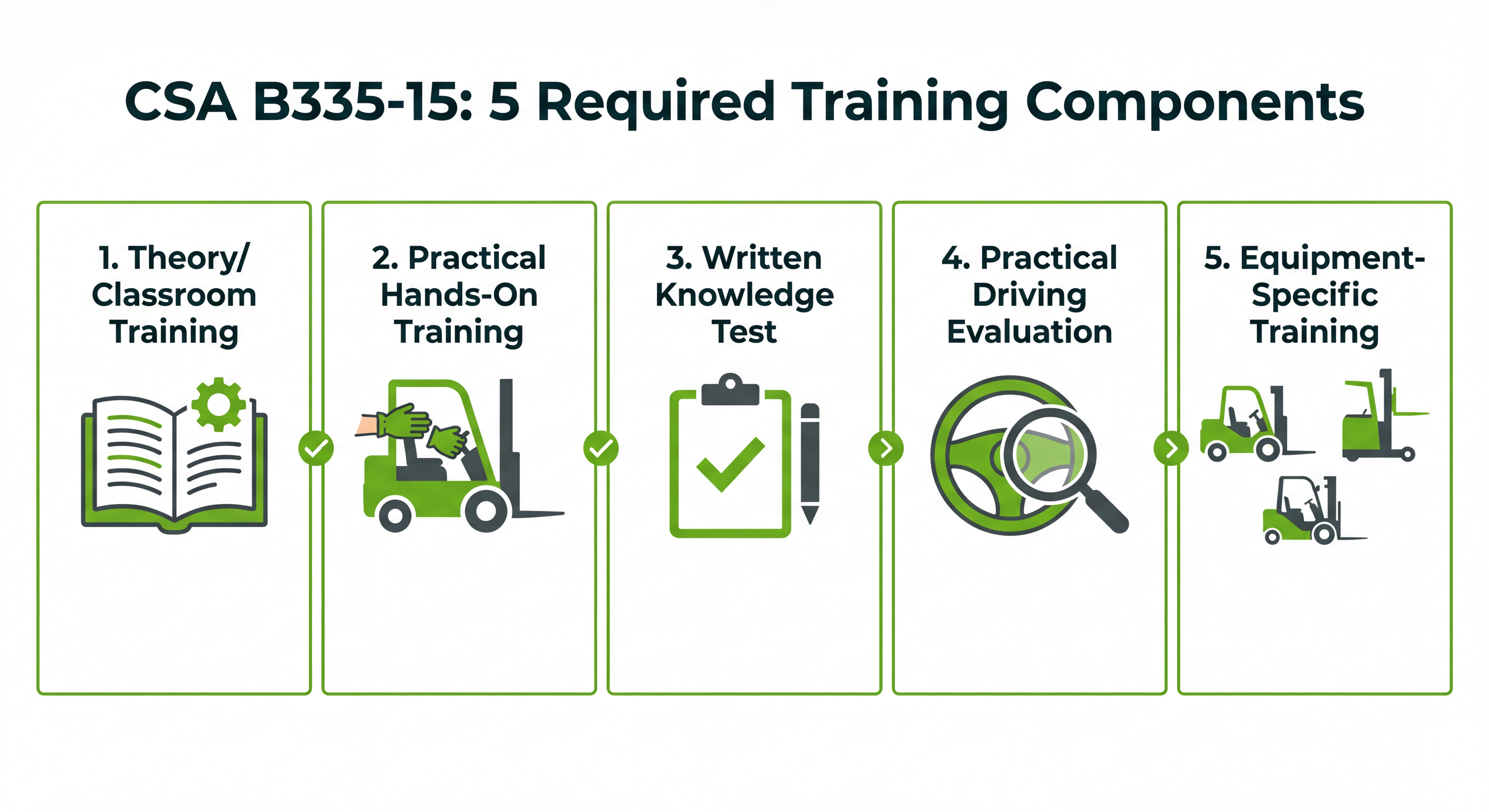
For BC employers, CSA B335-15 requires your forklift training program to include:
- Theory/classroom training covering: forklift stability and the stability triangle, load charts and capacity ratings, pre-operation inspection procedures, hazard recognition (pedestrians, overhead obstructions, ramps, uneven surfaces), refuelling safety (including propane handling if applicable), and relevant OHS regulations
- Practical (hands-on) training on the specific class of forklift the operator will use, covering: forward and reverse travel, load pickup, stacking and unstacking, maneuvering in confined spaces, operating on grades or ramps, and emergency procedures
- Written knowledge evaluation testing understanding of theory concepts
- Practical driving evaluation where a qualified evaluator observes the operator performing tasks and confirms competency
- Equipment-specific training: Operators must be trained on each class of lift truck they will operate. A counterbalance certification does not cover reach trucks or rough terrain forklifts.
Additionally, CSA B335-15 specifies requirements for trainers. Not just anyone can deliver forklift training. The trainer must have demonstrated knowledge of the CSA standard, experience with the equipment, and the ability to evaluate operator competency.
The 3-Year Renewal Requirement
Here is where BC differs from many other provinces. WorkSafeBC enforces the CSA B335-15 recommendation for refresher training as a mandatory requirement, not just a guideline. Operators must receive upgrade (refresher) training at least every 3 years.
This means if your operator was last trained in March 2023, they need refresher training by March 2026. No exceptions. No "we will get to it next month." If a WorkSafeBC inspector finds an operator with an expired certification on a forklift, you are in violation.
Beyond the 3-year cycle, retraining is also required when:
- The operator is involved in a forklift incident or near miss
- The operator is observed operating in an unsafe manner
- The operator has not used a forklift for an extended period of time
- New equipment is introduced to the workplace
- Workplace conditions change significantly (new layout, different surfaces, changed traffic patterns)
Can Employers Train In-House in BC?
Yes. WorkSafeBC states that "Workers can be trained by their employer or a third-party provider." There is no requirement to use a specific accredited provider. However, your in-house training program must meet the full CSA B335-15 requirements.
If you choose to train in-house, you need:
- A qualified trainer who meets CSA B335-15 trainer competency requirements
- A documented training curriculum that covers all required theory and practical elements
- Written and practical evaluation tools
- Training records that document the full program for each operator
- Equipment-specific training for each class of forklift on your site
Many BC employers use a hybrid approach: they send one or two supervisors through a train-the-trainer program with an established provider, then have those supervisors deliver in-house training. This approach typically costs $500 to $1,500 for the train-the-trainer course, then saves money on every subsequent operator trained internally.
Still tracking forklift certifications in spreadsheets?
If cards expire and no one catches it, you carry the risk. Start a 30-Day Free Trial and track operator status in one place before your next audit.
30-Day Free Trial
What About Out-of-Province Certifications?
This is one of the biggest traps for BC employers, especially in construction where crews move between provinces.
An operator shows up on your Vancouver site with a forklift certificate from Alberta. The certificate looks legitimate, lists the right training topics, and is within the 3-year window. Can they start operating a forklift on your BC site?
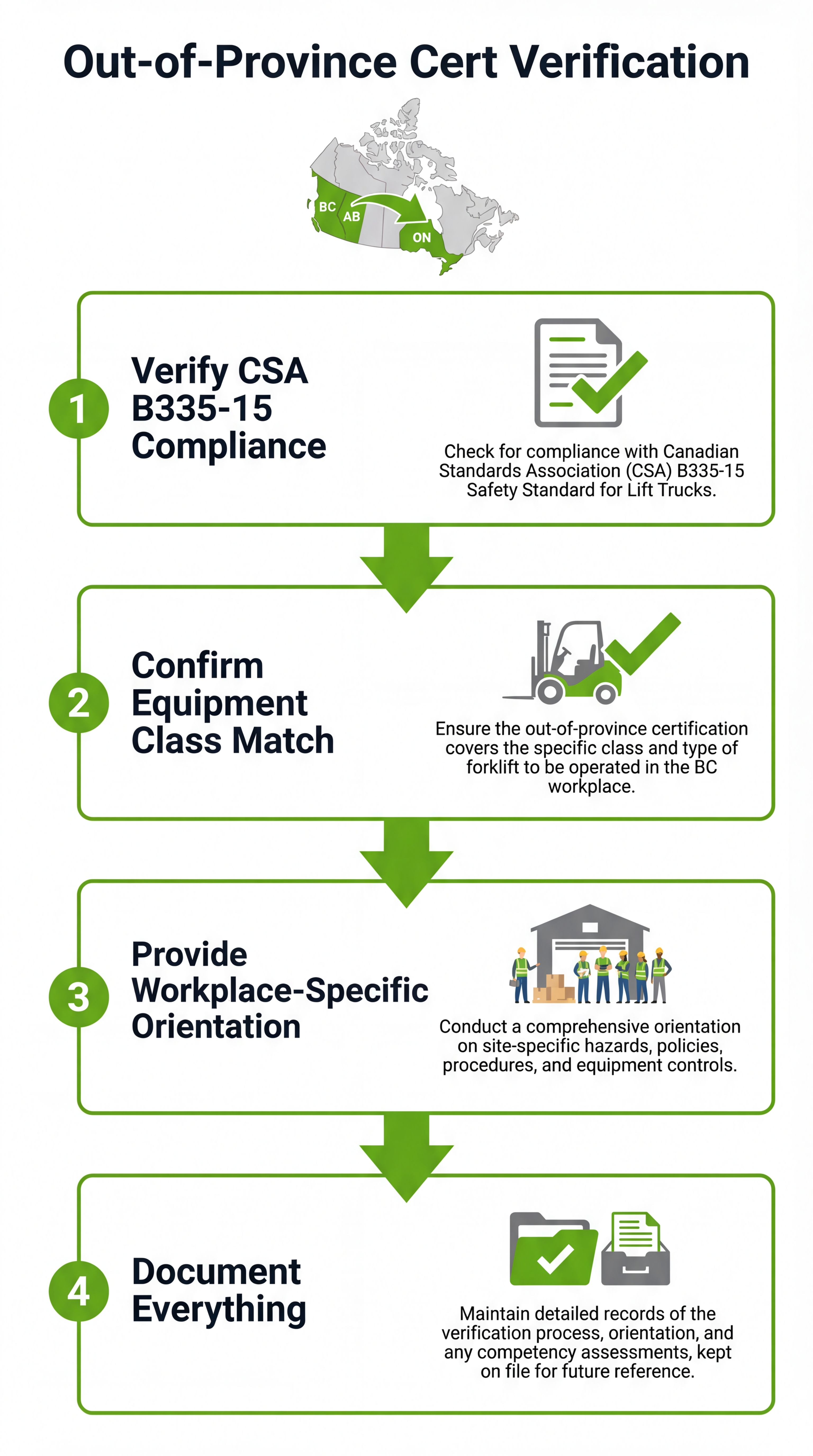
Not automatically. As the BC employer, you must:
- Verify the training was to CSA B335-15. Alberta does not mandate CSA B335-15 in its legislation (it is only in guidance), so the training may not meet the BC standard.
- Confirm the training covered the specific equipment class the operator will use on your BC site.
- Provide workplace-specific orientation covering your site's unique hazards, layout, traffic patterns, and emergency procedures.
- Document everything. Create a record showing you verified the out-of-province training, provided the workplace-specific component, and confirmed the operator's competency.
If the out-of-province training does not meet CSA B335-15, you need to provide supplemental training or full retraining before the operator can work. The safest approach is to always provide at least a half-day orientation and practical assessment for any operator coming from outside BC.
Propane Handling: An Additional BC Requirement
If your forklifts run on propane and the operator needs to transfer propane from one container to another (not just swap pre-filled cylinders), WorkSafeBC requires the operator to also hold a propane handler's certificate. This is separate from the forklift certification and is issued through the Propane Training Institute.
If the operator only changes propane cylinders (removing an empty and replacing with a full one), a separate certificate is not required. But the cylinder change procedure should still be covered in your forklift training program.
What WorkSafeBC Inspectors Look For
During a routine inspection or after a forklift-related incident, a WorkSafeBC officer will ask to see:
- Training records for every operator on site, including the specific training curriculum, evaluation results, and trainer qualifications
- Proof that training followed CSA B335-15 (the standard is named directly, so generic "safety training" records will not satisfy the requirement)
- Evidence that the operator was trained on the specific class of forklift they are operating
- Records of workplace-specific orientation
- Refresher training records within the 3-year window
- Pre-use inspection checklists (a separate requirement under Part 16)
If your documentation is incomplete, expect a compliance order at minimum. After an incident involving an injury, the consequences escalate quickly: administrative penalties (fines), stop-work orders, and potential referral for prosecution.
Why BC Takes Forklift Training Seriously
BC's decision to name CSA B335-15 directly in legislation was not arbitrary. Forklift-related injuries remain one of the most common types of workplace incidents in warehousing, construction, and manufacturing across the province.
Forklift incidents are not just about operators tipping over. The most common incident types include:
- Pedestrian strikes: Forklifts hitting workers on foot in warehouses, loading docks, and construction sites. This is the leading cause of forklift-related fatalities.
- Tip-overs: Overloaded forklifts, operating on slopes, or turning too fast with a raised load
- Falls from elevated positions: Workers standing on forks or pallets to reach high shelves
- Crushing injuries: Workers pinned between a forklift and a wall, racking, or another vehicle
- Load falls: Improperly secured loads falling off forks during transport or stacking
Every one of these incident types is addressed in CSA B335-15 training. The theory component covers hazard recognition and prevention. The practical component tests an operator's ability to handle real-world scenarios safely. The 3-year refresher keeps skills current and addresses bad habits that develop over time.
When WorkSafeBC investigates a forklift incident, the first question is always about training records. If your training program does not meet CSA B335-15, you are exposed. If it does, you have a strong due diligence defense.
Connecting Forklift Training to Your COR Program
If your BC company holds or is pursuing a Certificate of Recognition through BCCSA (BC Construction Safety Alliance), your forklift training records are part of what auditors review. Equipment operator training is a core element of a health and safety management system.
Common COR audit findings related to forklift training include:
- Missing or incomplete training records for one or more operators
- No evidence of practical evaluation (only classroom training documented)
- Expired certifications with no refresher training scheduled
- Training records that do not specify which equipment class was covered
- No workplace-specific orientation documented
Getting your forklift training documentation right is not just a WorkSafeBC compliance issue. It directly supports your COR audit preparation and demonstrates the kind of systematic safety management that auditors want to see.
BC Forklift Certification Costs
Typical costs for forklift training in BC (per operator, as of 2025/2026):
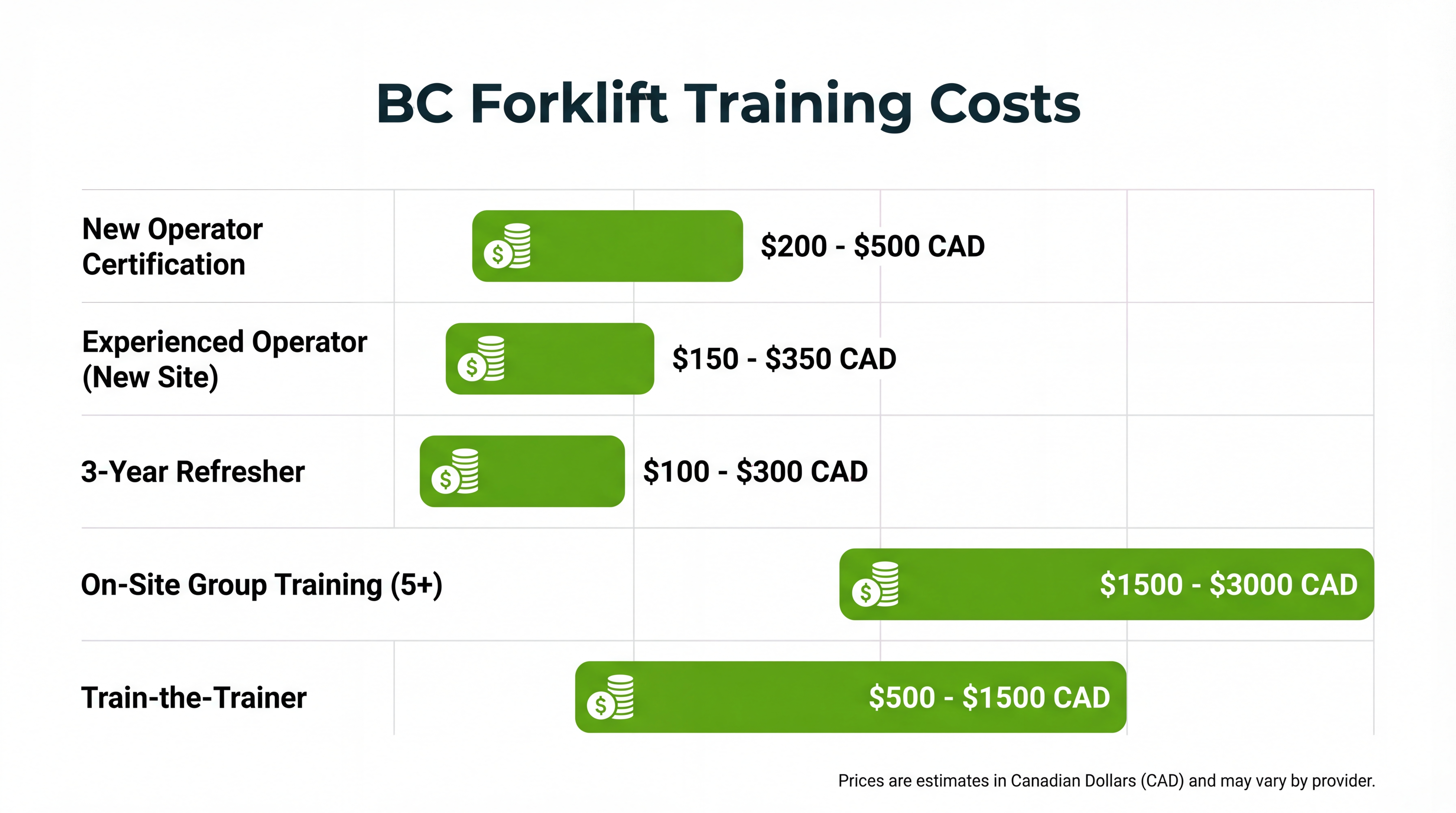
| Training Type |
Cost Range |
| New operator certification | $200 to $500 |
| Experienced operator (new site/class) | $150 to $350 |
| 3-year refresher | $100 to $300 |
| On-site group training (5+ operators) | $1,500 to $3,000 total |
| Train-the-trainer | $500 to $1,500 |
For a full national pricing comparison, see our guide: How Much Does Forklift Training Cost in Canada?
How to Stay Compliant: BC Employer Checklist
- Ensure every forklift operator is trained to CSA B335-15 before operating equipment
- Use qualified trainers (in-house or third-party) who meet CSA B335-15 requirements
- Train operators on each specific class of forklift they will use
- Include written and practical evaluations in every training program
- Provide workplace-specific orientation for every operator, including those from out of province
- Maintain complete training records (curriculum, evaluation results, trainer qualifications, dates)
- Schedule refresher training every 3 years (track expiry dates proactively)
- Retrain after incidents, near misses, or observed unsafe behaviour
- Ensure pre-use inspection checklists are completed daily
- Verify propane handler certification where required
Need help building or auditing your forklift training program? 30-Day Free Trial against CSA B335-15 and WorkSafeBC requirements and flag exactly where the gaps are.
For the complete national picture, read our pillar guide: Forklift Training and Certification in Canada: The Complete Employer Guide. For clarity on the license vs certification distinction, see Forklift License vs Certification: What Canadian Employers Need to Know.
Get ahead of forklift recertification risk
Stop finding gaps after an incident or inspection. Use a 30-Day Free Trial to monitor training, expiries, and compliance actions across your crew.
30-Day Free Trial
Frequently Asked Questions
What standard governs forklift training in BC?
CSA B335-15 (Industrial Lift Truck Operator Training) is directly referenced in WorkSafeBC's OHS Regulation Part 16, Section 16.43. BC is one of the few provinces that names the CSA standard directly in legislation rather than just in guidance documents. All forklift training in BC must meet this standard.
How often do you need to renew forklift certification in BC?
Refresher training is required at least every 3 years in BC. This is a mandatory requirement enforced by WorkSafeBC, not just a recommendation. Additional retraining is required after incidents, near misses, extended periods of non-use, or when workplace conditions change significantly.
Can I use an out-of-province forklift certificate in BC?
Not automatically. The BC employer must verify that the out-of-province training was to CSA B335-15, confirm the training covers the specific equipment class being operated, and provide workplace-specific orientation. If the previous training does not meet CSA B335-15, supplemental training or full retraining is required before the operator can work in BC.
How much does forklift certification cost in BC?
Third-party forklift training in BC typically costs $200 to $500 per operator for initial certification, $100 to $300 for refresher training, and $1,500 to $3,000 for on-site group training (5 or more operators). Train-the-trainer programs cost $500 to $1,500.
Do I need a propane handler certificate for forklift operators in BC?
Only if the operator needs to transfer propane between containers (not just swap pre-filled cylinders). If your forklift runs on propane and the operator refuels by transferring propane, they need a separate propane handler's certificate from the Propane Training Institute, in addition to their forklift certification.
Get Weekly Safety Insights
Regulation updates, toolbox talk ideas, and compliance tips. One email per week.