Last updated: March 2026
You search "forklift training online" and get dozens of results promising quick, affordable certification from your laptop. Some charge as little as $50. Some claim you will be certified in 4 hours. If it sounds too good to be true, you are right to be suspicious. But that does not mean online training is worthless. The truth is more nuanced than the ads suggest.
Safety Evolution helps contractors sort through the noise. Here is what actually counts when it comes to online forklift training in Canada, and what will leave you exposed during an inspection.
⚡ Quick Answer
- Online theory: Yes, the classroom component can be delivered online
- Online-only certification: No. CSA B335-15 requires hands-on practical training and in-person evaluation that cannot be done online
- Hybrid approach: Online theory + in-person practical is legitimate and used by many training providers
- Red flag: Any provider offering complete forklift certification entirely online is not meeting Canadian standards
- Employer responsibility: Even with online theory, the employer must ensure hands-on evaluation is completed
Below, we break down which parts of forklift training can be done online, which parts cannot, how to evaluate online training providers, and what the hybrid approach looks like in practice.
What Part of Forklift Training Can Be Done Online?
The classroom theory component of forklift training can be delivered online. This covers the foundational knowledge operators need: equipment types, stability principles, load capacity, hazard identification, pre-operation inspection procedures, and relevant regulations.

Online theory works well because:
- Operators can complete it at their own pace, reducing scheduling conflicts
- Content is standardized and can include video, animations, and interactive elements
- It is accessible from anywhere, which is valuable for remote operations
- It can be more cost-effective for the theory portion
However, online theory is only one of three required components under CSA B335-15. Completing the theory portion online does not make you "forklift certified." Two additional components must happen in person.
What Good Online Theory Looks Like
Not all online theory courses are equal. The best programs include:
- Interactive content: Video demonstrations, animated diagrams showing stability principles, and clickable scenarios rather than static text slides
- Progress tracking: The system prevents operators from skipping sections and verifies they spent adequate time on each module. A course that can be completed in 45 minutes by clicking "next" repeatedly is not providing genuine learning.
- Knowledge checks throughout: Quizzes embedded at the end of each module, not just a single test at the end. This reinforces learning and identifies weak areas early.
- Equipment-class specific content: The best courses let you select which equipment class the operator will use and tailor the content accordingly, rather than delivering generic material that covers all classes superficially.
- Canadian regulatory content: The course must cover CSA B335-15 and Canadian provincial regulations, not US standards. Any course that references OSHA or US-specific rules is not designed for the Canadian market.
- Completion certificate with details: The certificate should include the operator's name, the date, the course content covered, the time spent, and the quiz results. A generic "congratulations" certificate is not useful documentation.
What Cannot Be Done Online?
CSA B335-15 requires two components that cannot be replicated through a screen:
Practical Hands-On Training
Operators must physically operate the specific class of forklift they will use, under the supervision of a qualified instructor. This includes maneuvering, stacking, loading and unloading, obstacle navigation, and real-world scenarios. You cannot learn to safely operate a 5,000-pound machine through video.
The practical component develops muscle memory, spatial awareness, and the ability to judge distances, loads, and clearances in real time. These are physical skills that require physical practice. An operator who has only completed online theory will know the rules, but they will not have the skills to apply them safely under real-world conditions.
Competency Evaluation
A qualified evaluator must observe the operator performing a set of tasks and confirm they can safely operate the equipment. This is a practical driving test, and it must happen on the actual equipment (or an identical model) in a real or simulated work environment.
Any provider that claims you can be fully forklift certified entirely online is either misinformed or misleading you. This matters because an online-only certificate will not hold up during a regulatory inspection, and it certainly will not hold up during an incident investigation.
30-Day Free Trial to confirm your approach meets regulatory requirements.
How the Hybrid Approach Works
The most practical approach for many employers is a hybrid model: online theory followed by in-person practical training and evaluation.
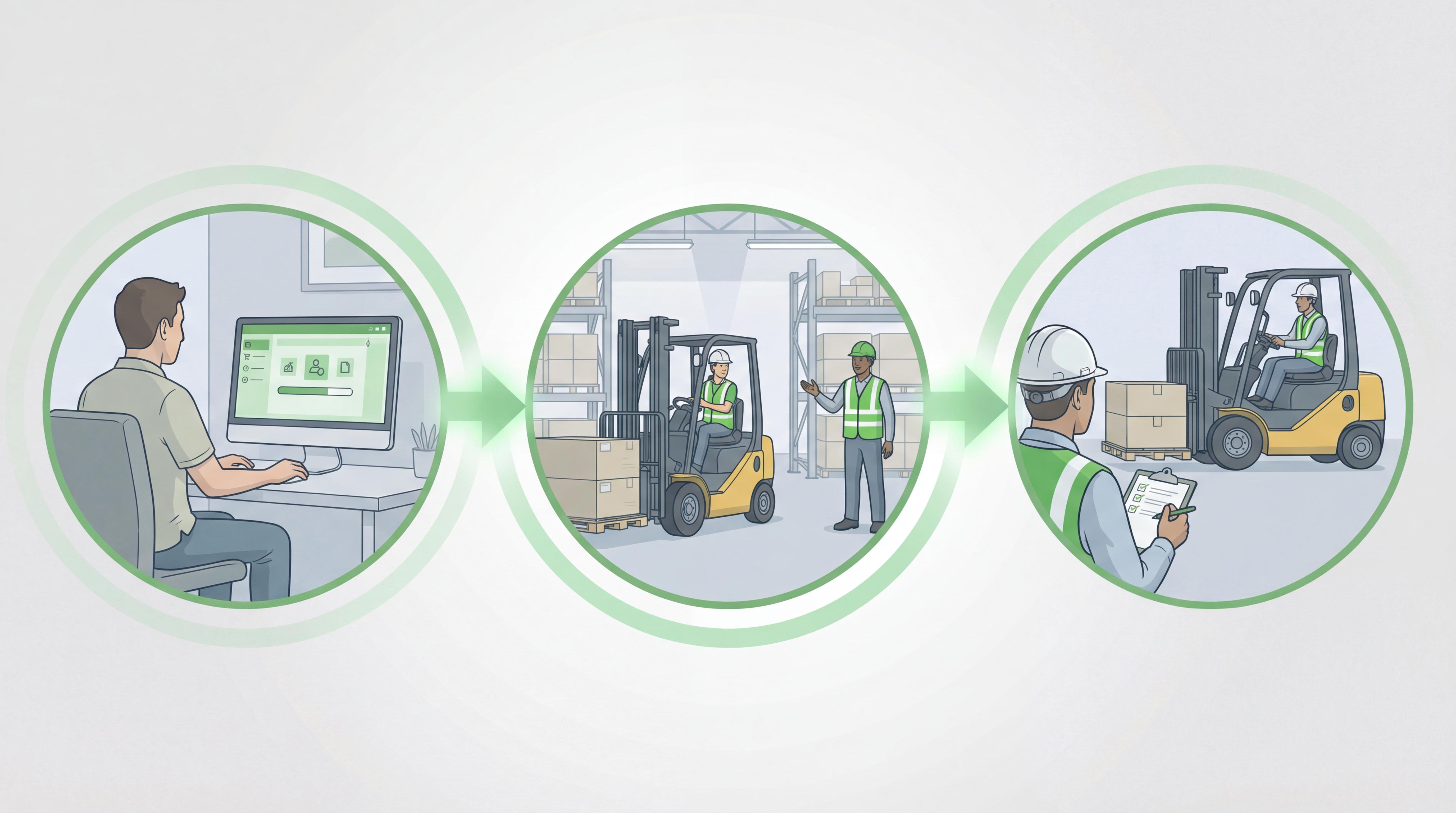
- Online theory (4 to 8 hours): Operator completes the classroom portion online, on their own schedule. Covers equipment knowledge, safety rules, and regulations.
- In-person practical (4 to 16 hours): Operator completes hands-on training with a qualified instructor on the actual equipment. Duration depends on experience level.
- In-person evaluation (1 to 2 hours): Evaluator assesses competency through a practical driving test and written knowledge check.
This approach combines the flexibility of online learning with the safety-critical hands-on component. It often reduces the total in-person training time because operators arrive with the theory already covered.
Cost Breakdown: Hybrid vs Traditional
Many employers choose the hybrid model expecting significant cost savings. The reality is more nuanced:
- Online theory cost: $30 to $100 per operator
- In-person practical and evaluation: $100 to $250 per operator
- Total hybrid cost: $130 to $350 per operator
- Total traditional (all in-person) cost: $200 to $400 per operator
The cost savings are modest, typically $50 to $100 per operator. The real value of the hybrid model is not cost savings; it is scheduling flexibility. Operators can complete theory on evenings or weekends without affecting project schedules, and the in-person portion can be compressed into a shorter on-site session. For employers with operators in remote locations or on rotating shifts, this flexibility is worth more than the per-operator savings.
Still tracking forklift certifications in spreadsheets?
If cards expire and no one catches it, you carry the risk. Start a 30-Day Free Trial and track operator status in one place before your next audit.
30-Day Free Trial
Red Flags to Watch For
Not all online forklift training providers are equal. Here is what should make you walk away:
- "Complete certification in 2 hours online." The theory portion alone takes 4 to 8 hours to cover properly. A 2-hour course is cutting critical content.
- "No in-person component required." This directly contradicts CSA B335-15 and provincial OHS regulations. A certificate from this provider is not worth the PDF it is printed on.
- "OSHA compliant." OSHA is a US agency. If you are operating in Canada, you need CSA B335-15 compliance, not OSHA compliance. A provider advertising OSHA compliance for Canadian operations does not understand the regulatory landscape.
- "Lifetime certification." Forklift certification should be renewed every 3 years. A provider offering lifetime certification is ignoring the renewal requirements of CSA B335-15.
- No mention of hands-on or evaluation components. If the provider's website does not clearly state that practical training and evaluation are required, they are either omitting it or do not understand the requirements.
How to Vet an Online Provider
Before you pay for an online forklift theory course, run through this checklist:
- ☐ Website explicitly mentions CSA B335-15 (not just OSHA or generic "safety standards")
- ☐ Course content is specific to Canada (references provincial legislation, not US federal rules)
- ☐ Course duration is at least 4 hours for the theory component
- ☐ Provider clearly states that hands-on practical and evaluation are still required
- ☐ Completion certificate includes detailed information (topics covered, time spent, quiz results)
- ☐ Provider offers or partners with an in-person practical training option
- ☐ Provider has verifiable Canadian references or reviews from Canadian employers
If any of these boxes are unchecked, look elsewhere. The $30 you save on a substandard course is meaningless if the certificate does not hold up during an inspection.
What Employers Must Do Regardless of Training Format
Whether your operators complete theory online or in person, these employer obligations remain:
- Verify the training covered the right equipment class. A generic online course may not address the specific class your operators need. See forklift classes explained for the 7 equipment types.
- Ensure practical evaluation is completed. If the online provider does not arrange this, the employer must.
- Provide site-specific training. Workplace hazards, traffic patterns, equipment layout, and emergency procedures specific to your site.
- Document everything. Online completion certificates, practical evaluation records, site-specific training, and operator authorization.
- Track renewals. Use Safety Evolution's training management platform to track expiry dates across your team.
Who Benefits Most From the Online Theory Approach?
The hybrid model is not equally valuable for every employer. Here is who gets the most benefit:
- Employers with operators on rotating shifts: When your crew works rotating shifts, pulling operators off the floor for a full day of classroom training creates scheduling headaches. Online theory lets operators complete the classroom portion on their own time, between shifts, or on days off.
- Remote operations: If your work site is 4 hours from the nearest training centre, the travel time and costs for classroom training add up quickly. Online theory eliminates those costs for the classroom component, and you only need to bring in an instructor for the hands-on portion.
- Employers with high turnover: In sectors like warehousing and distribution where operator turnover is high, having an online theory option lets new hires begin their training immediately rather than waiting for the next scheduled classroom session.
- Multi-language workforces: Some online providers offer theory content in multiple languages with built-in translation or language selection. For operators whose first language is not English or French, this can improve comprehension significantly compared to a classroom lecture delivered in a language they are not fully comfortable with.
Online Training for Refreshers vs Initial Certification
The hybrid model works differently depending on whether the operator is getting their initial certification or renewing an existing one:
Initial Certification (New Operators)
For new operators with no prior experience, online theory is a useful foundation, but the in-person practical portion will be extensive (8 to 24 hours). The theory prepares them mentally, but the real learning happens on the equipment. Do not expect to significantly shorten the total training time for a new operator by using online theory. You are shifting hours from the classroom to the operator's own time, not eliminating them.
Renewal and Refresher Training
This is where online theory delivers the most value. Experienced operators who are renewing their certification every 3 years already have the practical skills. The theory refresher updates their knowledge on regulatory changes, reinforces safety principles that may have slipped, and covers any new equipment or procedures. Completing this theory online, followed by a shorter in-person practical evaluation (2 to 4 hours), is efficient and effective for experienced operators.
For the complete certification process: How to Get Forklift Certified in Canada.
For cost comparisons: How Much Does Forklift Training Cost in Canada?
Provincial Perspectives on Online Theory
Provincial regulators have varying levels of comfort with the online theory component:
- British Columbia: WorkSafeBC references CSA B335-15, which does not prohibit online delivery of the classroom component. The key is that the hands-on and evaluation components must be in-person. BC inspectors will accept online theory completion certificates as documentation for the classroom portion, provided the overall training program meets the standard.
- Alberta: Alberta's performance-based approach focuses on the outcome (competent operators) rather than the delivery method. Online theory is accepted, but the employer must still demonstrate that the operator completed adequate practical training and evaluation. Alberta OHS officers look for evidence of competency, not a specific training format.
- Ontario: The MOL requires that operators be trained and demonstrate competency. Online theory is accepted as part of a hybrid program. Ontario's large training provider market means many established providers offer hybrid options with both online theory and scheduled in-person practical sessions across the GTA and other major centres.
- Saskatchewan and Manitoba: Both provinces accept online theory as part of a comprehensive training program. The smaller training provider market in these provinces makes the hybrid approach particularly valuable, as operators may have limited access to nearby classroom training facilities.
Regardless of province, the principle is the same: online theory is a legitimate delivery method for the classroom component, but it does not replace hands-on training or in-person evaluation.
Get ahead of forklift recertification risk
Stop finding gaps after an incident or inspection. Use a 30-Day Free Trial to monitor training, expiries, and compliance actions across your crew.
30-Day Free Trial
Frequently Asked Questions
Can you get forklift certified online in Canada?
You can complete the classroom theory portion of forklift training online, but you cannot be fully certified online. CSA B335-15 requires hands-on practical training and an in-person competency evaluation that must be completed with a qualified instructor on real equipment.
Is online forklift training accepted by employers?
Many employers accept online theory as the classroom component, followed by in-person practical training and evaluation. However, most employers and general contractors will not accept an online-only certificate as proof of forklift certification because it does not meet CSA B335-15 requirements.
How much does online forklift training cost?
Online theory courses range from $30 to $100 for the classroom component. However, you must add the cost of in-person practical training and evaluation, which typically runs $100 to $250 more. The total cost of a hybrid approach (online theory + in-person practical) is similar to traditional all-in-person training.
Does OSHA apply to forklift training in Canada?
No. OSHA is a United States regulatory agency. Forklift training in Canada is governed by provincial occupational health and safety legislation, with CSA B335-15 as the referenced national standard. Some online providers advertise OSHA compliance for Canadian operators, which indicates they may not understand the Canadian regulatory requirements.
Can forklift refresher training be done online?
The theory portion of a refresher can be completed online. However, CSA B335-15 still requires an in-person practical evaluation, even for experienced operators renewing their certification. The practical evaluation confirms the operator's skills have not degraded since their last certification. A fully online refresher does not meet Canadian standards.
Get Weekly Safety Insights
Regulation updates, toolbox talk ideas, and compliance tips. One email per week.