Last updated: March 2026
A trench collapses in under a second. One cubic yard of soil weighs roughly 3,000 pounds, about the weight of a mid-size pickup truck landing on a worker's chest with zero warning. Over the past decade, hundreds of workers have died in preventable trench cave-ins across North America. The reality is uncomfortable: most of these deaths happened on sites where the protective equipment was either sitting unused nearby or never brought to the job at all.
If you run a crew that digs in Canada, this is not optional reading. It is the difference between going home at the end of the shift and not. At Safety Evolution, we build safety programs for contractors every week, and excavation safety is one of the areas where the gap between "we know the rules" and "we actually follow them" gets people killed.
⚡ Quick Answer: Excavation & Trenching Safety for Canadian Contractors
- Depth trigger: In BC, any excavation over 1.2 metres (4 feet) deep requires a protective system unless cut entirely in stable rock (WorkSafeBC Part 20). Alberta's OHS Code Part 32 requires shoring, sloping, or other protective measures based on soil conditions and depth.
- Protective systems: Sloping, shoring, or shielding (trench boxes) are the three approved options across all Canadian jurisdictions
- Competent person: Required on every excavation site, every day, with authority to shut down unsafe work
- Daily inspections: Mandatory before each shift and after any rain, vibration, or changed conditions
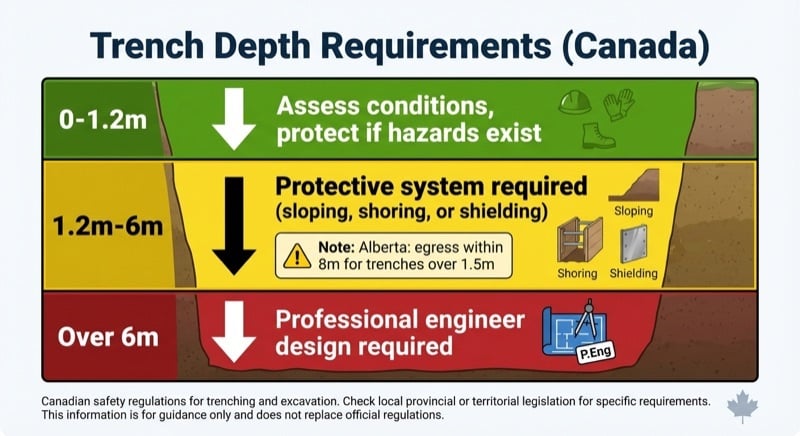
- Egress: Alberta requires a safe entry/exit point within 8 metres of any worker in a trench deeper than 1.5 metres
- Soil classification: Must be assessed before anyone enters the trench. Soil conditions determine which protective system is required.
Why Are Trench Cave-Ins So Deadly?
A trench cave-in is the single most lethal type of construction incident by ratio of occurrence to fatality. Unlike a fall where a worker might survive with injuries, a cave-in buries a person under thousands of pounds of soil in seconds. Rescue is extremely difficult because digging someone out risks triggering a secondary collapse. A worker trapped in a trench collapse has a survival window measured in minutes, not hours.
Here is the part that should make every GC uncomfortable: businesses where workers die from trench cave-ins have often been previously cited for the exact same violations. These are not freak accidents. They are repeat failures to follow basic rules that have existed for decades.
If your crew does any excavation work, a solid understanding of your provincial safety training requirements is not a nice-to-have. It is the baseline.
What Depth Triggers Excavation Safety Requirements in Canada?
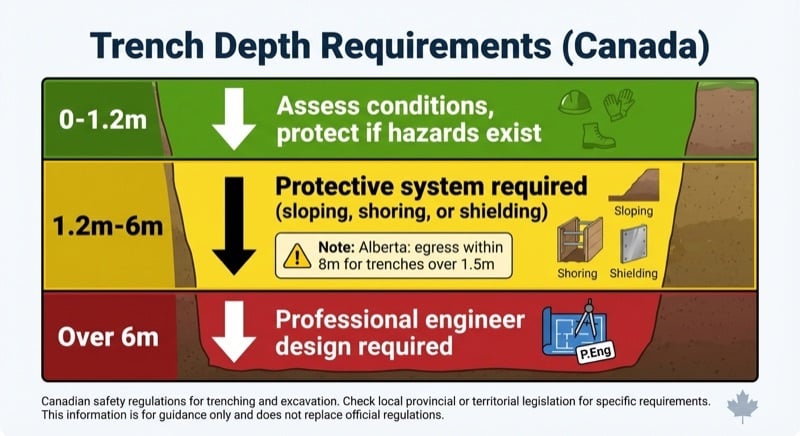
The depth thresholds vary by province, but the core principle is consistent: once a trench reaches a certain depth, protective systems are mandatory.
Alberta (OHS Code Part 32)
Alberta's OHS Code Part 32 (Excavating and Tunnelling, sections 441-464) requires employers to identify soil types, stabilize excavations with shoring or sloping, and clearly mark excavation zones. Key Alberta-specific requirements:
- Shoring or sloping is required based on soil conditions and trench depth. The competent worker must assess soil conditions and select appropriate protective measures.
- Egress: A worker in a trench deeper than 1.5 metres must have a safe means of entry and exit within 8 metres of their work location.
- Spoil pile setback: Excavated materials and equipment must be kept at least 1 metre from the edge of the excavation.
- Underground utilities: Alberta requires contacting Alberta One-Call (1-800-242-3447) before any excavation to locate underground utilities.
British Columbia (WorkSafeBC OHS Regulation Part 20)
BC's regulations under Part 20 (Construction, Excavation and Demolition) are explicit about the depth trigger:
- Over 1.2 metres (4 feet): Before a worker enters any excavation over 1.2 metres deep, the employer must ensure the sides are sloped, shored, or otherwise supported to prevent cave-in.
- Shoring specifications: Shoring must extend at least 30 cm (1 foot) above ground level and reach to within 60 cm (2 feet) of the trench bottom.
- Trench width: BC defines a trench as an excavation where the bottom width does not exceed 3.7 metres (12 feet).
Ontario (O. Reg. 213/91, sections 222-242)
Ontario's Construction Projects regulation mandates soil identification and appropriate controls including sloping, shoring, or engineered systems. Professional engineer design is required for complex excavations.
Most contractors think shallow trenches are safe. They are wrong. A trench just 1.2 metres deep can bury a worker up to their waist. Once the soil pins your legs, the pressure on your chest makes breathing impossible within minutes. There is no such thing as a "quick" unprotected trench.
Missing Excavation Documentation Gets Crews Pulled Off Site
SE-AI checks your excavation safety records for missing soil assessments, shoring plans, and compliance gaps that would trigger a stop-work order.
Get Early Access →
How Does Soil Classification Work?
Soil classification is the process of testing and categorizing the earth your crew is digging into, which directly determines what protective system you need. Your competent worker must assess soil conditions before any worker enters the excavation.
While the specific classification systems vary between Canadian provinces, the general categories align with industry practice:
- Stable Rock: Natural solid mineral matter that can be excavated with vertical sides and remain intact while exposed. This is rare on most job sites.
- Firm/cohesive soils (e.g., clay, silty clay): The most stable soil types. Can support steeper cut angles, but still require protection at depth.
- Medium-stability soils (e.g., angular gravel, silt): Require moderate sloping angles or shoring.
- Loose/granular soils (e.g., gravel, sand, loamy sand): The least stable and most common soil on urban and suburban sites. Requires the shallowest sloping angles or full shoring systems.
Here is a blunt truth most safety trainers will not tell you: the majority of soil on real construction sites in Canadian urban areas is granular or previously disturbed. That means steep vertical cuts without protection are almost never safe, regardless of depth. If your crew is cutting vertical walls in anything other than stable rock, you likely need a protective system in place.
Soil conditions also change. Rain, vibration from equipment, nearby traffic, freeze-thaw cycles (a major factor across Canada), and even adjacent excavation can destabilize soil overnight. That is why daily re-evaluation is not just a good idea; it is a regulatory requirement in every province.
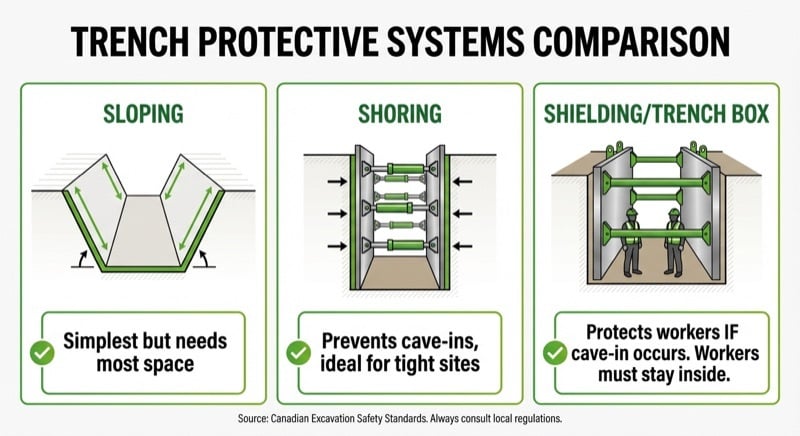
What Are the Three Protective Systems for Trenches?
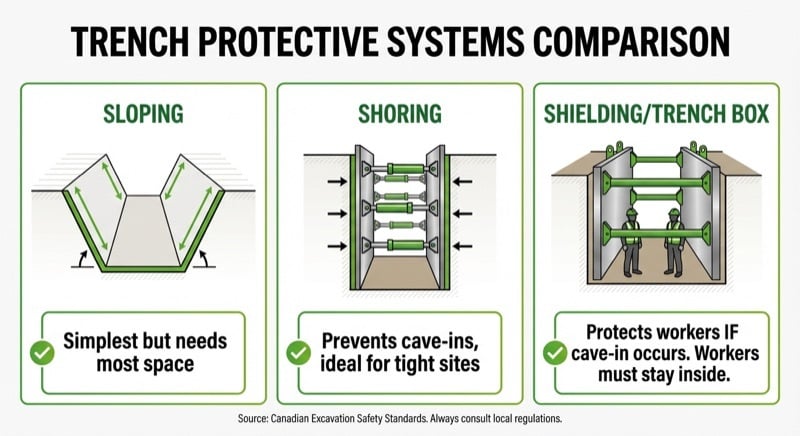
Once the competent worker assesses the soil and determines protection is needed, three options are available across all Canadian jurisdictions. Each has specific use cases, and the right choice depends on soil type, trench depth, site constraints, and how long the trench will be open.
Sloping
Sloping means cutting the trench walls back at an angle to prevent collapse. The angle depends entirely on the soil type. Looser soils require shallower angles (more ground disturbed). Sloping is the simplest protective method but requires the most real estate. A deep trench in loose soil can require walls sloped back significantly on each side. On a tight site next to an existing structure, that may not be physically possible.
Shoring
Shoring uses hydraulic, mechanical, or timber supports to brace trench walls and prevent them from collapsing inward. Aluminum hydraulic shoring is the most common on construction sites because it is lightweight, adjustable, and can be installed from outside the trench. Shoring is ideal for deeper trenches on constrained sites where sloping is not feasible. In BC, shoring must extend at least 30 cm above ground level and to within 60 cm of the trench bottom.
Shielding (Trench Boxes)
Trench shields, also called trench boxes, are prefabricated steel or aluminum structures placed inside the trench to protect workers. An important distinction: trench shields do not prevent cave-ins. They protect workers inside the shield if a cave-in occurs. Workers must never be in the trench outside the shielded area. Trench boxes can be used in conjunction with backfill to support trench walls, but their primary purpose is worker protection during a collapse.
Understanding protective systems is part of a broader approach to managing risk on site. If you are building or improving your construction safety management program, excavation procedures should be a documented, trained, and enforced component.
What Does a Competent Person Do on an Excavation Site?
A competent worker on an excavation site is someone capable of identifying existing and predictable excavation hazards and who has the authority to take immediate corrective action. In Alberta, the OHS Code uses the term "competent worker." In BC, WorkSafeBC requires a "qualified person" for excavation oversight. Regardless of what your province calls the role, the expectation is the same: someone trained, present on site, and empowered to stop work.
The competent worker is responsible for:
- Assessing soil conditions using visual observation and, where necessary, manual testing before excavation begins
- Selecting the appropriate protective system based on soil type and trench depth
- Conducting daily inspections before each shift and after any event that could change conditions (rain, vibration, freeze-thaw cycles)
- Monitoring for hazardous atmospheres in trenches where gas, oxygen deficiency, or water accumulation could occur
- Ensuring egress points (ladders, ramps, or stairways) are within the required distance for any worker in the trench (8 metres in Alberta for trenches over 1.5 metres deep)
- Ordering immediate evacuation when hazardous conditions are identified
- Inspecting protective systems for signs of damage or shifting before work resumes
Daily inspections are not paperwork exercises. They are the last line of defense. If your competent worker is not physically walking the trench edge before every shift, you are running on luck. A proper field-level hazard assessment (FLHA) should be completed before any worker enters the trench.
What Happens When You Get Cited for Excavation Violations?
Excavation violations are not cheap. In Alberta, OHS administrative penalties can reach $10,000 per violation per day the violation continues. Multiple violations from a single inspection (no competent person, no shoring, no egress, spoil pile too close) stack up fast. If a violation is prosecuted under the OHS Act, fines for a first offence can reach up to $500,000 for a corporation.
In BC, WorkSafeBC administrative penalties are based on payroll and violation severity. Excavation violations, particularly where incidents occur, can result in six-figure penalties.
But fines are the least of your problems. Excavation violations frequently result in:
- Stop-work orders that shut down your entire project, not just the trench
- Increased insurance premiums and difficulty getting bonded for future work
- Criminal prosecution in cases involving fatalities where willful negligence is established (Canada's Bill C-45 makes organizational leaders personally liable)
- Loss of bidding eligibility with GCs who check your safety record
If a stop-work order from a GC or regulator sounds like something that would tank your schedule and your reputation, you are right. Prevention is not just the safer option. It is the cheaper one.
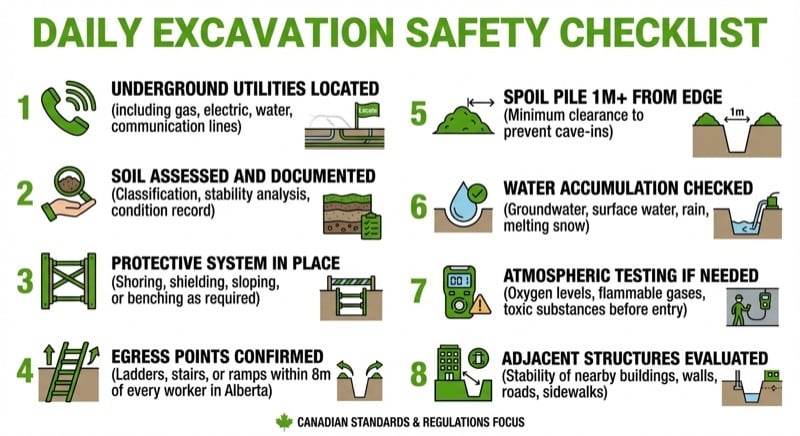
Daily Excavation Safety Checklist
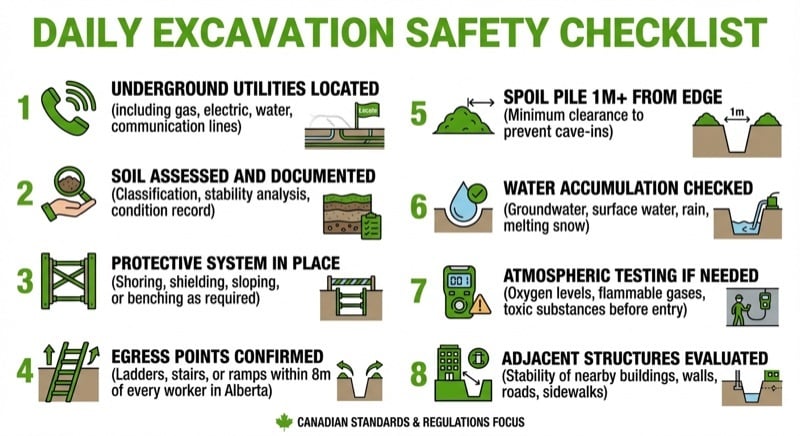
Your competent worker should verify the following before any worker enters a trench:
- Underground utilities located and marked. Contact your provincial one-call service before any digging. Alberta One-Call: 1-800-242-3447. BC 1 Call: 1-800-474-6886. Expose utilities by hand digging or hydro excavation before using mechanical equipment.
- Soil assessed. Perform visual and (where necessary) manual assessment. Document the findings.
- Protective system in place and inspected. Verify the system matches the soil conditions and trench depth. Check for damage, shifting, or undermining.
- Egress confirmed. Ladders, ramps, or stairways within the required distance for every worker in the trench (8 metres in Alberta for trenches over 1.5 metres).
- Spoil pile setback verified. Excavated materials and equipment must be at least 1 metre from the edge of the excavation (Alberta OHS Code).
- Water accumulation assessed. Check for standing water and ensure pumping equipment is available if needed.
- Atmospheric testing conducted if there is any possibility of hazardous gases, oxygen deficiency, or toxic fumes.
- Adjacent structures evaluated. Check for undermining of nearby foundations, sidewalks, roads, or utility poles.
Document everything. If it is not written down, it did not happen. An incident investigation system that captures near-misses in and around excavations gives you the data to fix problems before they become fatalities.
Need ready-made safety meeting content for your crew? Our free toolbox talk package includes excavation and trenching topics you can run in 5 minutes before a shift.
How to Build Excavation Safety Into Your Program
If excavation is a regular part of your work, trenching safety should not be an afterthought bolted onto a generic safety program. It needs to be a documented, trained, and enforced component with these elements:
- Written excavation procedures specific to the types of work your crew performs
- Competent person training and designation with clear authority documented in writing
- Soil assessment protocols including testing methods and documentation requirements
- Protective system inventory with inspection schedules for trench boxes, shoring equipment, and related gear
- Site-specific excavation plans for jobs involving deep trenches or complex soil conditions
- Emergency rescue procedures specific to cave-in response, because calling 911 is not a rescue plan
Building a comprehensive construction safety program that includes excavation protocols is what separates contractors who win bids from those who get shut down. Safety Evolution builds these programs for contractors across Canada, from 10-person utility crews to 100-person GCs.
If your crew does new hire onboarding, make sure your construction safety orientation package includes excavation safety procedures. Workers should know the rules before they step near a trench.
Would Your Excavation Safety Program Pass an Inspection Today?
SE-AI analyses your excavation and trenching safety documentation for compliance gaps. It flags missing soil classification records, incomplete shoring specifications, and excavation procedures that do not meet provincial OHS requirements.
Get Early Access to SE-AI →
Frequently Asked Questions
How deep does a trench have to be before it needs a protective system in Canada?
In British Columbia, any excavation over 1.2 metres (4 feet) deep requires a protective system (sloping, shoring, or shielding) unless cut entirely in stable rock (WorkSafeBC OHS Regulation Part 20). Alberta's OHS Code Part 32 requires protective measures based on soil conditions and depth, with specific egress requirements for trenches over 1.5 metres. Even in shallow trenches, a competent worker must assess conditions and implement protection if hazards exist.
What is a competent person in excavation safety?
A competent worker (Alberta) or qualified person (BC) is someone capable of identifying existing and predictable excavation hazards and who has the authority to take immediate corrective action. They must be able to assess soil conditions, select protective systems, conduct daily inspections, and order evacuation when unsafe conditions are present. This role requires specific training and cannot be informally assigned to whoever happens to be on site.
What is the difference between shoring and shielding in a trench?
Shoring uses supports (typically hydraulic aluminum jacks or timber bracing) to actively prevent trench walls from collapsing. Shielding uses a prefabricated trench box placed inside the trench to protect workers if a collapse occurs. The key difference: shoring prevents cave-ins, while shielding protects workers during a cave-in. Workers must stay inside the shielded area at all times when using trench boxes.
How often must trenches be inspected?
A competent worker must inspect trenches daily before each shift begins and as conditions change throughout the day. Additional inspections are mandatory after rainstorms, vibration events, freeze-thaw cycles, or any other occurrence that could affect trench stability. Both Alberta and BC require these ongoing inspections. Each inspection should be documented with the date, inspector, findings, and any corrective actions taken.
What are the penalties for excavation violations in Alberta?
Alberta OHS administrative penalties can reach $10,000 per violation per day. Multiple violations from a single inspection can result in cumulative fines of $40,000 or more. If prosecuted under the OHS Act, fines for a first offence can reach up to $500,000 for corporations and $100,000 for individuals. Beyond fines, violations commonly result in stop-work orders, increased WCB premiums, criminal liability under Bill C-45 in fatality cases, and loss of bidding eligibility.
Do I need to call before I dig in Canada?
Yes. Every Canadian province has a one-call utility locate service that must be contacted before any excavation. In Alberta, call Alberta One-Call at 1-800-242-3447. In BC, call BC 1 Call at 1-800-474-6886. In Ontario, call Ontario One Call at 1-800-400-2255. Failing to locate utilities before digging can result in OHS violations, utility damage penalties, and potentially fatal contact with buried gas or electrical lines.
Get Weekly Safety Insights
Regulation updates, toolbox talk ideas, and compliance tips. One email per week.