Last updated: May 2026
If your crew only touches the JHA sheet once, then works from memory, the document is not protecting anyone. A job hazard analysis (JHA) is a step-by-step pre-task planning process that breaks work into steps, identifies hazards at each step, and assigns controls before work starts. On active construction sites, this is how foremen turn "be careful" into specific controls people can actually follow.
⚡ Quick Answer
- Core process: Select the task, break it into steps, identify hazards, set controls, and brief the crew before work starts (CCOHS).
- Step depth: Most jobs can be described in fewer than 10 steps (CCOHS practical benchmark).
- Update trigger: Revise the JHA when equipment, materials, process, or site conditions change (CCOHS).
- Canada anchor: WorkSafeBC requires an OHS program at 20+ workers in moderate/high hazard workplaces, or 50+ workers overall, plus regular inspections.
- US anchor: OSHA requires instruction on recognition and avoidance of unsafe conditions (29 CFR 1926.21(b)(2)) and PPE duties where hazards exist (29 CFR 1926.95).
What Is a Job Hazard Analysis in Construction?
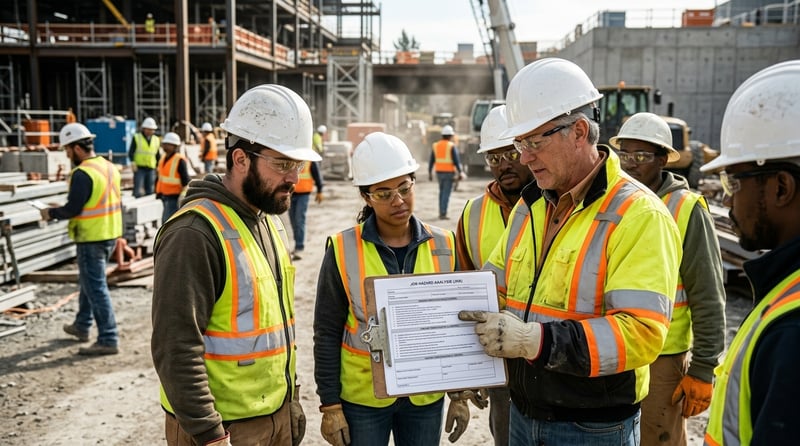
A construction JHA is a pre-task planning tool used before and during work to prevent injuries, incidents, and rework. It is not a form you complete after the shift to satisfy an auditor. It is a live workflow that ties each step of work to real hazards and controls.
The CCOHS job safety analysis guidance treats JHA and JSA as equivalent terms in practice. What matters most is consistency: one method, one format, and one crew briefing rhythm that supervisors actually enforce.
JHA vs JSA terminology
Most field teams use JHA and JSA interchangeably. Some clients treat JSA as a narrower task-level sequence and JHA as broader hazard planning. The blunt truth is this: if crews are confused by your terminology, your process is weaker before the work even starts.
When to run a JHA on a construction site
Run the JHA before non-routine tasks, high-risk work, and any task with changing site conditions. A common failure pattern is completing one JHA at mobilization and reusing it unchanged for weeks. If weather shifts, access changes, or tools change, the JHA must change before work continues.
For practical implementation patterns, see this field level hazard assessment example.
How to Conduct a Job Hazard Analysis Step by Step
Use this sequence from CCOHS guidance and apply it in field language your crews already use.
1) Select the task
Prioritize tasks with high consequence, high frequency, or known incident history. Start where failure hurts most.
2) Break the task into clear steps
List observable actions in order. CCOHS notes most jobs can be described in fewer than 10 steps. If your list has 20 micro-steps, crews will stop using it.
3) Identify hazards at each step
Review hazards by worker action, equipment interaction, stored energy, environmental conditions, and adjacent work groups. Use CCOHS hazard identification guidance as a backstop so obvious categories are not missed.
4) Assign controls using hierarchy
Apply controls in order: eliminate, substitute, engineering, administrative, then PPE. Most people think PPE is the first control. They are wrong. PPE is the last layer when stronger controls are not feasible.
5) Brief the crew before work starts
Confirm each worker understands step hazards, controls, and stop-work triggers. Require questions. Silent nods are not understanding.
6) Monitor and update when conditions change
If materials, equipment, sequence, or environment changes, revise the JHA first. One messy but common site reality: a weather delay pushes a day task into night work and access routes change. If the JHA does not update, risk rises immediately.
Concrete field example: slab edge formwork near active lifts
On a 14-person concrete crew in Edmonton, the foreman planned slab edge formwork beside an active telehandler route. Mid-shift, wind gusts increased and the telehandler staging point moved 20 metres closer to the edge. The original JHA listed dropped-object risk but did not cover lift-path conflict at the new staging point. Before restart, the crew updated the JHA to add a spotter, hard barricade line, revised exclusion zone, and radio call protocol for every pick. Work resumed only after a five-minute re-brief and sign-off from the foreman and operator.
Paper JHAs do not help if crews never use them
If hazard plans are getting signed and ignored, move your workflow into the field with clear ownership, live updates, and supervisor visibility in one place.
Start Your 30-Day Free Trial →
Related workflows: digital field level hazard assessments and how to get crews to own hazard assessments.
JHA vs JSA, What Is the Difference and When Should You Use Each?
In practice, many companies use the terms as synonyms. Operationally, teams often apply JHA to broader hazard planning and JSA to a task-sequenced safety breakdown. Either can work if your team uses one internal standard and maps external wording for clients or prequalification packages.
Side-by-side comparison
| Dimension |
JHA |
JSA |
| Typical scope |
Hazards and controls across a task |
Step-by-step safety sequence for a task |
| Timing |
Before work, updated on change |
Before task execution, often same shift |
| Owner |
Supervisor or competent lead with crew input |
Supervisor or task lead with worker participation |
| Output |
Hazard-control plan tied to work steps |
Task safety sequence and controls |
Which term should you use in bid packages and client docs?
Use the term requested by the client template, then standardize execution internally. If a package says JSA and your system says JHA, include both terms once and proceed with one workflow. For practical alignment patterns, see digital field level hazard assessments.
Compliance Requirements, In Canada vs In the US
Requirements differ by jurisdiction, but disciplined planning, communication, and updates are expected in both markets.
In Canada
CCOHS JSA guidance sets a clear process: select the job, break it into steps, identify hazards, determine controls, and communicate. CCOHS also emphasizes revising the analysis when equipment, materials, process, or environment changes.
In British Columbia, WorkSafeBC requires an occupational health and safety program for employers with a workforce of at least 20 in moderate or high hazard workplaces, or a workforce of at least 50 overall (OHS Regulation 3.1). WorkSafeBC also requires regular inspections to prevent unsafe conditions (OHS Regulation 3.5).
For supervisor-level execution support, use this live resource: conducting a field level hazard assessment example.
In the US
For construction, OSHA requires instruction in the recognition and avoidance of unsafe conditions and the regulations that apply to the work environment (29 CFR 1926.21(b)(2)). That means your JHA process has to translate into real worker instruction, not just completed paperwork.
OSHA also requires protective equipment where hazards are present, including proper provision, fit, and maintenance (29 CFR 1926.95). When hazards are identified in a JHA, controls and PPE obligations need to be reflected in field execution immediately.
How to Document a JHA So Crews Actually Use It
A usable JHA form is short, specific, and tied to ownership. Overbuilt templates fail in the field because crews cannot run them at production pace.
Minimum fields for a construction-ready JHA form
Task and location
Step-by-step work sequence
Hazards per step
Controls per step (hierarchy applied)
Responsible person for each control
Crew briefing sign-off and date/time
For form execution patterns and crew adoption methods, use these live references: digital field level hazard assessment and how to get crews to own field-level hazard assessments.
Daily update triggers before work continues
Update when crew composition changes, new equipment arrives, access routes change, weather shifts, or work sequencing changes. If controls are no longer realistic for the actual task setup, stop and revise.
Paper vs digital workflows for multi-crew jobs
Paper can work for simple, stable tasks. Multi-crew and fast-changing environments usually need digital workflows for revision control, visibility, and accountability. If crews and supervisors cannot confirm the current version in seconds, execution quality will drift.
For related implementation patterns, see this field-level hazard assessment example.
Common Mistakes That Make JHAs Useless
Most weak JHAs fail in the same ways: generic hazards, unclear control ownership, no update triggers, and no meaningful briefing loop. Auditors and clients spot this quickly.
Red flags auditors and clients notice first
Identical hazards copied across unrelated tasks
Controls listed with no assigned owner
No evidence of revision after scope changes
Sign-off present but no proof of worker understanding
Quick fix checklist for supervisors
Cut each task to clear, observable steps
Map one primary hazard and one control per step minimum
Assign control owners by role, not by department
Re-brief when conditions change and record the revision
Standardize JHAs across crews before the next scope change
If your current process breaks when crews, tools, or site conditions shift, use one system to standardize JHA quality, revisions, and field accountability from day one.
Start Your 30-Day Free Trial →
Frequently Asked Questions
What is the difference between a job hazard analysis and a job safety analysis?
In many construction environments, JHA and JSA are used interchangeably. Some teams use JHA for broader hazard planning and JSA for task-sequenced execution. The key is to standardize one internal method and apply it consistently.
How many steps should a construction JHA include?
CCOHS guidance notes that most jobs can be described in fewer than 10 steps. Keep steps clear and observable so crews can apply controls in real time without overcomplicating the form.
When should a JHA be updated on a job site?
Update the JHA whenever equipment, materials, process, or site conditions change. If scope changes and the old controls no longer fit, revise and brief before work continues.
Is a JHA required by OSHA for construction work?
OSHA does not use one universal "JHA form" requirement for all construction tasks, but it does require worker instruction on recognition and avoidance of unsafe conditions under 29 CFR 1926.21(b)(2), and PPE duties where hazards exist under 29 CFR 1926.95.
What should be included in a job hazard analysis form?
At minimum, include task steps, hazards for each step, controls, responsible person, and briefing sign-off with date/time. The form should support revision tracking when site conditions change.
Should Canadian and US JHA compliance guidance be handled differently?
Yes. Keep Canadian and US compliance guidance in separate sections. Use Canadian sources such as CCOHS and provincial regulators for Canadian requirements, and OSHA construction standards for US requirements.
Get Weekly Safety Insights
Regulation updates, toolbox talk ideas, and compliance tips. One email per week.