Confined Space vs Restricted Space
Confined space vs restricted space: learn the legal definitions, compliance requirements, and how Alberta OHS Code distinguishes between the two.
What is a confined space? Learn the legal definition under Canadian regulations, common examples by industry, and a contractor identification checklist.
Last updated: March 2026
A confined space is any area that was not designed for continuous human occupancy, has restricted entry and exit, and could expose workers to serious hazards. Understanding the exact definition matters because it determines what safety requirements apply to your crew before anyone sets foot inside.
A confined space is any enclosed or partially enclosed area that was not designed for people to work in continuously, has limited ways to get in or out, and could expose your crew to serious hazards. Think tanks, manholes, vaults, silos, and crawl spaces. They show up on almost every construction, oil and gas, manufacturing, and mining site in Canada.
If you run a 10- to 100-person contracting crew, you have probably walked past a confined space this week without flagging it. That matters because the regulations around confined spaces carry real teeth. Missing one can mean stop-work orders, fines, or worse. This guide breaks down the confined space definition under Canadian law, explains how to identify these spaces on your jobsite, and gives you practical examples by industry so nothing slips through the cracks.
There is no single national definition that applies everywhere. The rules depend on whether your work falls under federal or provincial jurisdiction, and each province uses slightly different language. Here is what the key regulators say.
Under the amended Part XI of the COHSR, a confined space is an enclosed or partially enclosed space that:
The federal regulations also distinguish between a regular confined space and a hazardous confined space, which is a confined space where the hazards have been confirmed through testing or assessment. This matters because the entry requirements for a hazardous confined space are more stringent, including mandatory entry permits and rescue plans.
Federal rules apply to workplaces under the Canada Labour Code: interprovincial transport, telecommunications, federal Crown corporations, and First Nations. If your jobsite is provincially regulated (most construction and oil and gas operations), your provincial OHS code is what applies.
Alberta takes a layered approach. The OHS Code defines two categories:
Restricted space: An enclosed or partially enclosed space, not designed or intended for continuous human occupancy, that has a restricted, limited, or impeded means of entry or exit because of its construction.
Confined space: A restricted space that may become hazardous to a worker entering it because of:
In Alberta, every confined space is first a restricted space. It becomes a confined space once a hazard potential is identified. That distinction drives the level of controls. Restricted spaces still require a hazard assessment, but confined spaces require a full code of practice, entry permits, and dedicated safety procedures.
Ontario defines a confined space as a fully or partially enclosed space that:
Ontario's definition is narrower than Alberta's or BC's because it focuses specifically on atmospheric hazards. Physical hazards like engulfment or entrapment alone do not trigger the confined space regulation in Ontario, though they are still covered under the general duty clause of the OHSA.
WorkSafeBC defines a confined space as an area, other than an underground working, that:
BC's definition is notable because it does not require a hazard to be present for a space to qualify as confined. If it meets the four physical criteria above, it is a confined space under Part 9 regardless of atmospheric conditions. Hazard classification (low, moderate, or high hazard atmosphere) comes later and determines the level of controls required.
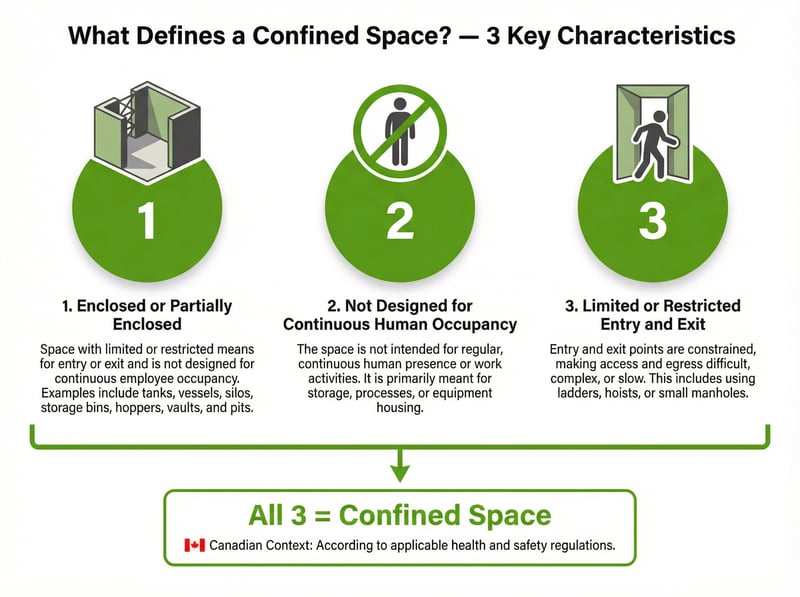
Despite the differences in wording across jurisdictions, every Canadian confined space definition comes back to three core characteristics. If a space checks all three boxes, you are almost certainly dealing with a confined space:
The space has walls, a floor, and a ceiling (or some combination) that restrict airflow and create a contained environment. It does not need to be fully sealed. A pit with an open top can still qualify if the walls are deep enough to trap gases or restrict air movement.
The space was built for storing material, housing equipment, moving fluids, or some other purpose that is not "people working here all day." A mechanical room with ventilation, lighting, and exits built to building code standards is designed for human occupancy. A storage tank is not.
Getting in and out is not straightforward. Maybe the opening is a manhole cover. Maybe you need a ladder. Maybe the only way out is the same way in. If entry or exit could slow down rescue or evacuation, this criterion is met.
When you are standing on site wondering what is considered a confined space, run through these three questions. If the answer to all three is yes, treat it as a confined space until a proper assessment says otherwise.
Take the Guesswork Out of Confined Spaces
Are you struggling to keep track of which rules apply to which spaces? Build your baseline safety program digitally, standardize your hazard assessments, and ensure every entry is compliant.
30-Day Free Trial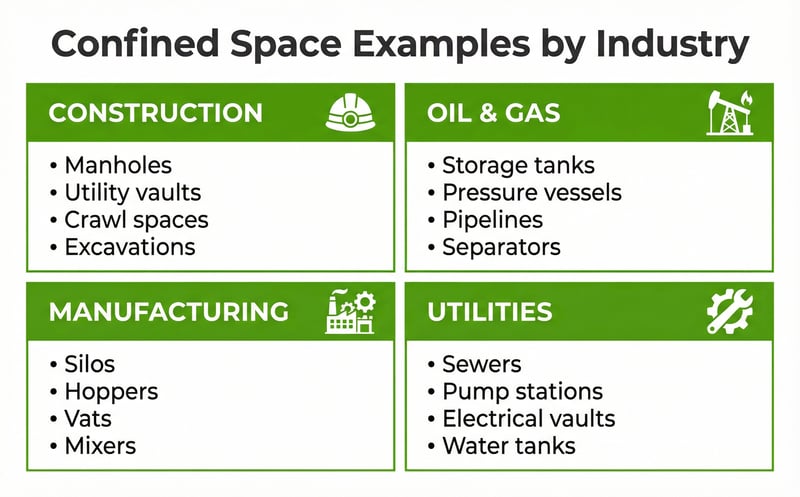
Confined spaces are not always obvious. Here are common examples grouped by the industries where Canadian contractors encounter them most often.
When doing your job hazard assessment, walk the site with this list in mind. If a space shows up that looks like it fits, flag it for a formal confined space assessment.
Knowing what is a confined space also means knowing what is not. These are the misconceptions that trip up contractors most often:
A mechanical room, storage closet, or basement workshop with normal doors, lighting, and ventilation is designed for human occupancy. It might be cramped, but "small" does not equal "confined" under the regulations. The key question is whether the space was designed and constructed for people to work in continuously.
A common misconception is that a space needs to be fully enclosed to qualify. A deep pit, an open-top tank, or a below-grade vault can absolutely be a confined space if gases can accumulate, access is restricted, and it was not designed for continuous occupancy.
If the space meets building code requirements for ventilation, egress, and lighting, and it was designed for people to occupy continuously, it is not a confined space. This is true even if the space feels enclosed or has limited windows.
In some provinces (like BC), certain crawl spaces and attics in non-industrial buildings may be excluded from confined space rules if specific criteria are met, including clean air, natural ventilation, and no potential for hazardous atmospheres. But this exclusion requires a formal evaluation. Do not assume.
If a worker cannot physically enter the space (the opening is too small for a person's body to pass through), it typically does not qualify as a confined space under the regulations. However, any work involving reaching into such spaces still falls under general OHS duty-of-care requirements.
If you do not have a dedicated safety manager, use this practical checklist to evaluate spaces on your site. Run through it for every space your crew might need to enter.
Keep your confined space inventory current. New spaces can appear as construction progresses, equipment gets installed, or site conditions change. Review it at the start of every new project phase.
If you work in Alberta, you have probably heard both terms. Here is the quick distinction:
In practical terms, a restricted space still requires a hazard assessment, worker training, and precautions. But a confined space triggers the full set of requirements: written code of practice, entry permits, atmospheric testing, attendants, rescue plans, and emergency equipment.
Ontario uses the terms differently. Under O. Reg. 632/05, "restricted space" appears only in the healthcare facilities regulation (O. Reg. 67/93) and refers to spaces with restricted egress. It is a separate concept from the confined space definition.
BC does not use the term "restricted space" in its confined space regulation at all. If it meets the four criteria in Part 9, it is a confined space, and the hazard classification (low, moderate, or high) determines what controls apply.
| Criteria | Federal (COHSR) | Alberta | Ontario | BC |
|---|---|---|---|---|
| Enclosed or partially enclosed | Yes | Yes (via restricted space) | Yes | Yes |
| Not for continuous human occupancy | Yes | Yes | Yes | Yes |
| Restricted entry/exit | Yes | Yes | Not specified | Yes |
| Hazard must be present | May contain hazard | Yes (hazard potential required) | Atmospheric hazard risk | No (physical criteria only) |
| Hazard types covered | All (atmospheric, engulfment, etc.) | All (atmospheric, physical) | Atmospheric only | Classified after identification |
| Two-tier system | Yes (confined vs hazardous confined) | Yes (restricted vs confined) | No | No (but 3-tier hazard classification) |
If your crews work across provinces, do not assume that a space classified one way in Alberta will be classified the same way in Ontario. The definitions are close but not identical. Always check the local regulations before starting work.
Take the Guesswork Out of Confined Spaces
Are you struggling to keep track of which rules apply to which spaces? Build your baseline safety program digitally, standardize your hazard assessments, and ensure every entry is compliant.
30-Day Free TrialConfined spaces are generally grouped into three categories based on hazard type: atmospheric hazard spaces (toxic gases, oxygen depletion, flammable vapours), physical hazard spaces (engulfment, entrapment, moving parts), and combined hazard spaces where both atmospheric and physical hazards are present. In BC, WorkSafeBC classifies confined spaces by atmosphere risk level: low hazard, moderate hazard, and high hazard.
It depends. A room that was designed and constructed for continuous human occupancy, with proper ventilation, lighting, and exits built to building code standards, is generally not a confined space. However, a room like an unventilated pump room, a below-grade electrical vault, or a windowless chemical storage area could qualify if it meets the criteria in your province's regulations.
In many cases, yes. A deep trench (typically deeper than 1.2 metres) with limited exit points can qualify as a confined space, especially if atmospheric hazards could develop from nearby utility lines, soil conditions, or work being performed inside. Some provinces exclude certain excavations from confined space rules if they meet specific criteria, but this requires a formal evaluation.
In Alberta, yes. Every confined space entry requires a valid entry permit signed by a competent person. In Ontario, you need a written confined space program and entry plan. In BC, the permit requirement depends on the hazard classification of the space. Regardless of province, no worker should enter any identified confined space without proper authorization, atmospheric testing, and safety procedures in place.
Under federal regulations (COHSR Part XI), a confined space becomes a hazardous confined space once hazards have been confirmed through assessment or testing. The distinction triggers more stringent entry requirements. Alberta uses a similar two-tier approach with "restricted space" and "confined space." The key takeaway: the more hazards confirmed, the more controls required before anyone enters.
Every province in Canada requires employers to have a written program or code of practice for confined space work. In Alberta, it is a written code of practice under Part 5 of the OHS Code. In Ontario, it is a written program under O. Reg. 632/05. In BC, it is a confined space entry program under Part 9. If your workers may enter confined spaces, you need a written program. No exceptions.
Understanding the confined space definition is the first step. From here, the practical work begins:
If your safety program does not have a confined space section yet, Safety Evolution software can analyse your existing records to identify which spaces qualify as confined and what documentation you need for each one.
Get Weekly Safety Insights
Regulation updates, toolbox talk ideas, and compliance tips. One email per week.
Confined space vs restricted space: learn the legal definitions, compliance requirements, and how Alberta OHS Code distinguishes between the two.
Confined space hazards explained: atmospheric dangers (O2, H2S, CO, LEL), physical risks, testing thresholds, and control measures for contractors.
Confined space kills more construction workers than you think. Canadian rules for permits, atmospheric testing, rescue plans, and penalties.