Asbestos kills more Canadian workers than any other hazard. Here's what contractors must know about identification, compliance, and protecting your crew.
Your crew just started demolition on a 1970s office building downtown. The timeline is tight, the GC is breathing down your neck, and then a worker pulls back drywall and finds crumbling white insulation packed around the pipes. Everyone on site freezes. That insulation might contain asbestos, and what happens in the next 10 minutes determines whether your crew goes home safe, your project stays on schedule, or both fall apart.
At Safety Evolution, we help contractors build safety programs that handle exactly these situations. We've walked dozens of contractors through asbestos hazard management, from first identification to clearance testing. This guide covers what you actually need to know as an employer: where asbestos hides, what the law requires, and how to keep your crew safe while keeping your project moving.
Quick Answer
What: Asbestos is a group of naturally occurring minerals used in thousands of building products before 1990. When disturbed, it releases microscopic fibres that cause fatal lung diseases.
Who's at risk: Anyone who renovates, demolishes, or maintains buildings constructed before 1990, including contractors, plumbers, electricians, and carpenters.
Employer duties: Identify potential asbestos before work begins, hire a qualified person to survey and test, develop an exposure control plan, and ensure workers are trained.
BC update: As of January 1, 2024, asbestos abatement contractors in BC must be licensed and workers must hold WorkSafeBC-issued certification.
Exposure limit: 0.1 fibres per cubic centimetre (f/cc) across all Canadian jurisdictions.
Asbestos remains the single largest cause of workplace death in Canada, killing approximately 2,000 Canadians every year through mesothelioma, asbestosis, and asbestos-related lung cancer. Despite a national ban on new asbestos products since 2018, the material is still present in thousands of buildings constructed before 1990, and every renovation, demolition, or maintenance project on older structures carries exposure risk.
This guide covers everything Canadian employers need to know about asbestos safety: where it's found, what the regulations require, how to protect your workers, and what to do when you encounter it on a job site.
What Is Asbestos and Why Is It Still a Problem?
Asbestos is a group of six naturally occurring silicate minerals that were widely used in Canadian building materials from the 1930s through the late 1980s. The three most common forms are chrysotile (white asbestos, which accounts for roughly 95% of commercial use), amosite (brown), and crocidolite (blue). Asbestos was valued for its heat resistance, tensile strength, and insulating properties.
Canada banned the manufacture, import, sale, and use of asbestos and asbestos-containing products on December 30, 2018, under the Prohibition of Asbestos and Products Containing Asbestos Regulations. But here's the problem that every contractor deals with: the ban only stops new asbestos from entering the market. It does nothing about the asbestos already embedded in millions of existing buildings across the country.
If your work takes you into any building constructed before 1990, you should assume asbestos-containing materials (ACMs) are present until a qualified person confirms otherwise. That's not paranoia. That's what the regulations require.
And the consequences of getting it wrong are not abstract. Asbestos exposure is Canada's leading cause of workplace death. According to the Occupational Cancer Research Centre, approximately 80% of mesothelioma cases in Canada are attributable to occupational asbestos exposure, with the greatest risks among construction workers. The diseases asbestos causes (asbestosis, lung cancer, mesothelioma, pleural thickening) take years to decades to develop after exposure, which means workers exposed today may not show symptoms for 20 or 30 years.
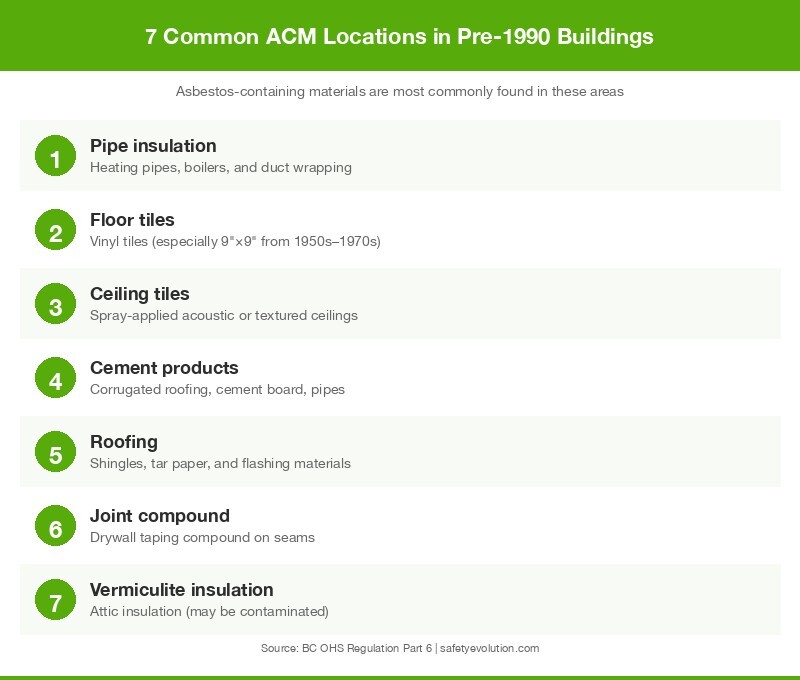
Common locations of asbestos-containing materials in pre-1990 buildings
Where Does Asbestos Hide in Buildings?
Most contractors think they'd recognize asbestos if they saw it. They're wrong. You cannot visually identify asbestos. Only laboratory analysis of samples collected by a qualified person can confirm the presence of asbestos-containing materials. The fibres are microscopic, and ACMs look identical to their asbestos-free counterparts.
That said, knowing where to look helps you plan work safely. In buildings constructed before 1990, asbestos-containing materials are commonly found in:
Pipe insulation, boiler insulation, and duct insulation (often the crumbly white or grey wrap around heating systems)
Vinyl floor tiles (the classic 9"x9" tiles from the 1950s-1970s are almost always ACMs)
Ceiling tiles (especially spray-applied acoustic or textured ceilings)
Drywall joint compound (the tape mud used on seams between sheets)
Vermiculite insulation (commonly found in attics, sometimes contaminated from Libby, Montana ore)
Here's the blunt truth most safety guides won't tell you: the age of the building is a better predictor than what the material looks like. A 15-person electrical crew in Edmonton recently pulled a renovation permit on a 1982 strip mall. The project scope was "just" upgrading the electrical panels. But the wall cavities behind those panels were packed with pipe insulation that tested positive for chrysotile asbestos. What started as a 3-week electrical job turned into 6 weeks with abatement, and the GC nearly pulled their contract for the delay.
The lesson: any renovation or demolition project in a pre-1990 building needs an asbestos assessment before your crew touches anything. Not after. Before.
What Are Your Legal Duties as an Employer?
Every province in Canada requires employers to identify and manage asbestos hazards. The specifics vary by jurisdiction, but the core employer duties are consistent across the country:
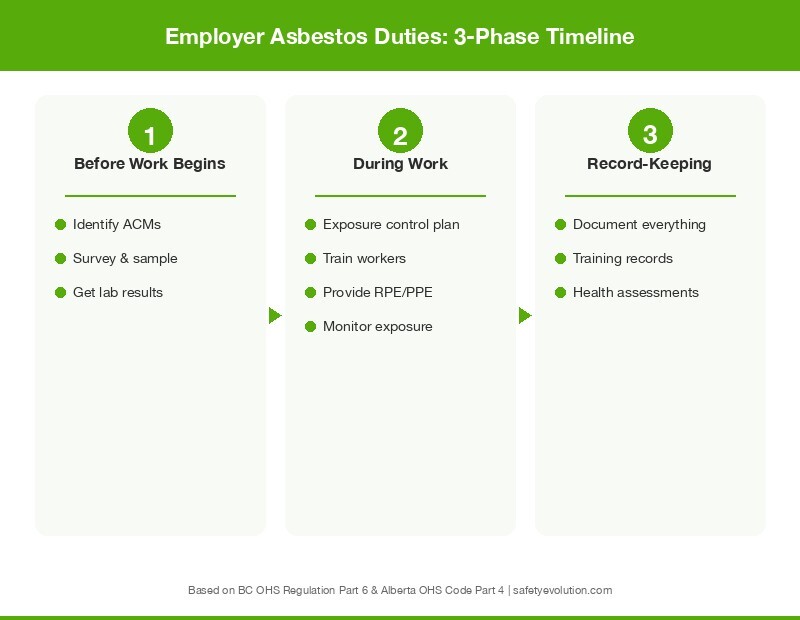
Before work begins
Identify potential asbestos. Before any renovation, demolition, or maintenance work on a building constructed before 1990, you must determine whether ACMs are present.
Hire a qualified person to survey and sample. A "qualified person" is defined in OHS regulation, and it means someone with the training and experience to identify, sample, and assess asbestos hazards. You cannot do this yourself unless you meet that definition.
Get lab results before starting work. Bulk samples go to an accredited lab for analysis. If the results come back positive, you need an abatement plan before work resumes.
During work
Develop an exposure control plan if workers are or may be exposed to potentially harmful levels of asbestos. In BC, this is required under OHS Regulation section 6.3 (referencing section 5.54).
Train your workers. Workers must understand the hazards of asbestos, how to recognize potential ACMs, what protective measures to use, and what to do if they suspect asbestos is present.
Provide respiratory protection and PPE. When asbestos exposure cannot be eliminated, workers need fit-tested respirators and protective clothing. This is the last line of defense, not the first.
Monitor exposure levels. Air monitoring during and after asbestos work ensures that fibre concentrations stay below the occupational exposure limit of 0.1 fibres per cubic centimetre (f/cc).
Record-keeping
Document asbestos in the workplace. In BC, OHS Regulation section 6.2.2 requires employers to record details of asbestos in the workplace. In Alberta, the OHS Code Part 4 requires a code of practice for handling asbestos-containing materials.
Maintain training records. Keep records of who received asbestos training, when, and what the training covered.
Keep health assessment records. Alberta requires health assessments for workers exposed to asbestos (OHS Code Part 4). Workers must have baseline and periodic health assessments.
Employer asbestos duties across three phases of work
An Incomplete Asbestos Program Puts Your Licence at Risk
SE-AI checks your safety program for asbestos management gaps and flags where your documentation, training records, and procedures fall short.
How Does Asbestos Regulation Differ Across Canada?
The short answer: every province regulates asbestos, but BC has gone further than anyone else. Here's what matters for contractors operating in Alberta and BC (Safety Evolution's primary service regions).
British Columbia
BC has the strongest asbestos regulatory framework in Canada. The BC OHS Regulation Part 6 covers substance-specific requirements for asbestos, and the province made headlines in 2024 with a first-of-its-kind licensing program:
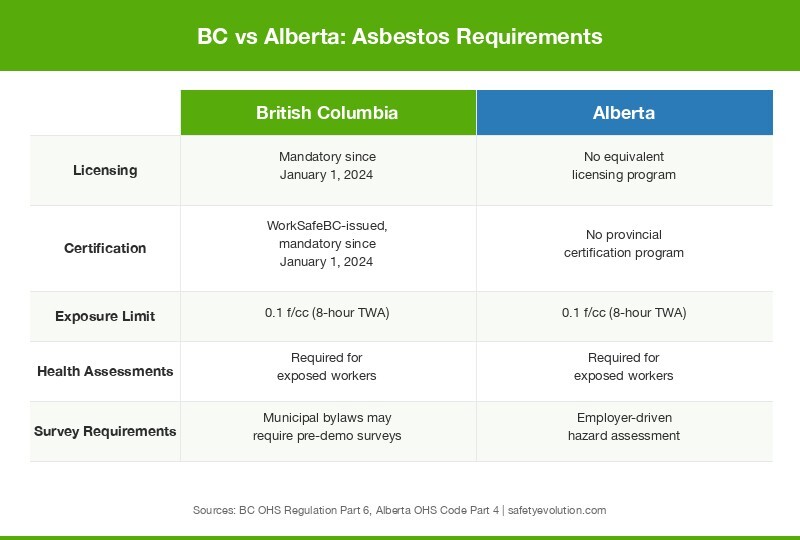
Contractor licensing (mandatory since January 1, 2024): Asbestos abatement contractors in BC must hold a licence issued by WorkSafeBC. BC is the first jurisdiction in Canada to implement a formal asbestos abatement licensing requirement. WorkSafeBC began accepting licence applications in September 2023.
Worker certification (mandatory since January 1, 2024): Anyone performing asbestos abatement work in relation to buildings in BC must hold WorkSafeBC-issued certification. Workers must complete training from an approved provider.
Notice of project: A notice of project must be submitted to WorkSafeBC for all asbestos abatement work.
Municipal requirements: Several BC municipalities (Vancouver, Coquitlam, Saanich, Nanaimo, Port Coquitlam) require asbestos surveys before demolition permits are issued. Check your local bylaws.
If you're an abatement contractor in BC without a licence, or your workers don't have certification, you're already out of compliance. WorkSafeBC publishes an online registry of licensed asbestos abatement contractors so GCs and building owners can verify your credentials.
Alberta
Alberta regulates asbestos under the OHS Code Part 4 (Chemical Hazards, Biological Hazards and Harmful Substances). There is no equivalent licensing program to BC's, but employer duties are still significant:
Hazard assessment: Employers must assess worksites for existing and potential hazards, including asbestos, before work begins (OHS Code Part 2).
Code of practice: A code of practice is required for the storage, handling, use, and disposal of asbestos-containing material.
Health assessments: Workers exposed to asbestos must receive baseline and periodic health assessments (OHS Code Part 4, section 40).
Exposure limit: The 8-hour occupational exposure limit for all forms of asbestos is 0.1 fibres per cubic centimetre (f/cc).
Federal
For federally regulated workplaces, the Canada Labour Code's Canada Occupational Health and Safety Regulations (COHSR Part 10) applies. The federal government also has a Standard on Asbestos Management for federal properties, and the Prohibition of Asbestos and Products Containing Asbestos Regulations (December 30, 2018) prohibit the import, sale, and use of asbestos and asbestos-containing products with limited exclusions.
BC vs Alberta asbestos requirements comparison
How Should You Handle Suspected Asbestos on Site?
You're mid-project, and someone finds material that might contain asbestos. Here's the step-by-step:
Stop work immediately in the affected area. Do not disturb the material. Don't sweep it, don't move it, don't let anyone near it without proper protection.
Isolate the area. Keep workers away and post warning signs. Restrict access to anyone without appropriate PPE and training.
Call a qualified asbestos professional. They will assess the situation, collect samples if needed, and recommend next steps. In BC, this means a qualified person as defined in the OHS Regulation.
Get laboratory confirmation. Bulk samples are sent to an accredited lab. Results typically take 2-5 business days, though rush services are available.
If confirmed positive, hire a licensed abatement contractor. In BC, the contractor must hold a WorkSafeBC-issued licence. The abatement scope depends on the type, condition, and quantity of ACMs. For details on the abatement process itself, see our guide: Asbestos Removal Safety: A Guide for Contractors.
Air monitoring and clearance testing. After abatement, a qualified person must verify that airborne fibre levels are safe before workers re-enter the area.
Document everything. Record the suspected ACM, lab results, abatement work, clearance testing, and any worker exposures. This goes in your safety program records.
One thing contractors consistently underestimate: the time this process adds to a project. From discovery to clearance, even a small abatement job can add 1-3 weeks. For larger commercial projects, it can be months. That's why pre-project asbestos surveys are not just a compliance box to check; they're a scheduling tool. If you know what you're dealing with before demo starts, you can plan around it instead of scrambling.
What Training Do Your Workers Need?
There are two distinct levels of asbestos training, and which one your workers need depends on what they're doing:
Asbestos awareness training
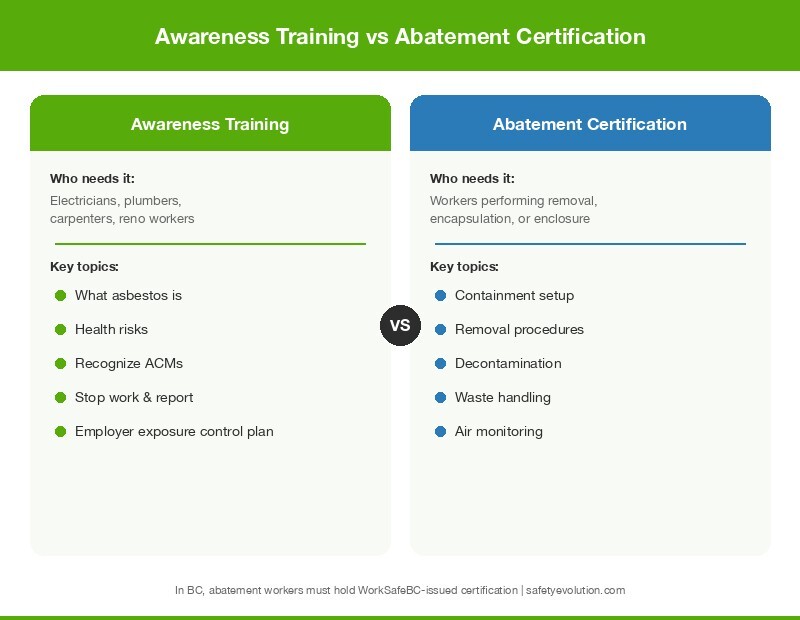
This is for any worker who might encounter asbestos during their normal work but is NOT performing abatement. Think: electricians pulling wire in older buildings, plumbers working around insulated pipes, carpenters doing reno work. Awareness training covers:
What asbestos is and where it's commonly found
Health risks of exposure
How to recognize potential ACMs
What to do if you suspect asbestos (stop work, report, don't disturb)
Your employer's exposure control plan
Asbestos abatement training and certification
This is for workers who actually perform asbestos removal, encapsulation, or enclosure work. In BC, this training must come from an approved provider, and workers must hold WorkSafeBC-issued certification. Abatement training covers containment setup, removal procedures, decontamination, waste handling, air monitoring, and respiratory protection.
For a detailed breakdown of BC's certification requirements, training providers, and the licensing process, see our spoke guide on asbestos removal and abatement safety.
Most contractors in Alberta and BC need awareness training for their general crew, plus abatement certification for specialized abatement workers (if they do that work in-house). If you subcontract abatement, your crew still needs awareness training so they know what to do when they encounter it.
Asbestos awareness training vs abatement certification
How Do You Build an Asbestos Management Program?
If your company works in older buildings regularly, you need more than one-off reactions to asbestos discoveries. You need a systematic approach. Here's what a solid asbestos management program includes:
Policy statement. A written commitment that your company identifies and manages asbestos hazards on every project involving buildings constructed before 1990.
Pre-project assessment protocol. A standard process for determining whether a building survey is needed before work starts. This should be part of your field-level hazard assessment process.
Exposure control plan. BC employers must have a plan meeting the requirements of OHS Regulation section 5.54 if workers may be exposed to harmful asbestos levels. Alberta requires a code of practice.
Training matrix. Which workers need awareness training? Which need abatement certification? When do refreshers happen? Track it all.
Emergency response procedures. What happens if asbestos is unexpectedly disturbed? Who do workers call? How do you isolate the area? This should be documented and practiced.
Record-keeping system. Asbestos surveys, lab results, training records, health assessments, abatement reports, clearance certificates. Digital safety management tools make this significantly easier than paper filing systems.
Subcontractor management. If you hire abatement subcontractors, verify their credentials. In BC, check that they hold a valid WorkSafeBC licence. For general guidance on managing sub safety, see our subcontractor safety management guide.
If your company holds COR or is working toward it, documented hazard management for asbestos is an audit requirement. Auditors look for evidence that you identify hazards (including asbestos), control them, and train your workers. A well-structured asbestos management program feeds directly into your COR maintenance documentation.
This distinction matters because it determines the level of risk and the type of abatement required:
Friable asbestos is material that can be crumbled, pulverized, or reduced to powder by hand pressure. Examples: spray-applied insulation, pipe wrap that's deteriorating, damaged acoustic ceiling texture. Friable ACMs are the highest risk because they release fibres easily when disturbed.
Non-friable asbestos is material where the asbestos fibres are bound into a solid matrix. Examples: intact vinyl floor tiles, cement board siding, roofing shingles in good condition. Non-friable ACMs are lower risk when undisturbed, but become a hazard when you cut, grind, sand, or break them.
Here's the practical takeaway for contractors: non-friable does not mean "safe to ignore." If your work involves cutting, drilling, or demolishing non-friable ACMs, you're releasing fibres just the same. The difference is in the abatement procedures and containment requirements, not in whether you need to manage the hazard.
Does Your Asbestos Program Cover Every Regulatory Requirement?
SE-AI analyses your asbestos management documentation for compliance gaps. It flags missing exposure assessments, undocumented abatement procedures, workers without current asbestos training, and safety program sections that do not address asbestos-containing materials.
You cannot visually identify asbestos. If the building was constructed before 1990, assume asbestos-containing materials may be present. The only way to confirm is through laboratory analysis of samples collected by a qualified person. Before any renovation or demolition work, hire a qualified asbestos professional to conduct a survey and collect bulk samples for testing.
What is the asbestos exposure limit in Canada?
The occupational exposure limit (OEL) for all forms of asbestos in Canadian jurisdictions is 0.1 fibres per cubic centimetre (f/cc), measured as an 8-hour time-weighted average. This aligns with the ACGIH Threshold Limit Value. Employers must ensure worker exposure stays below this limit through engineering controls, work practices, and respiratory protection.
Do I need an asbestos abatement licence in BC?
Yes, if you perform asbestos abatement work in British Columbia. As of January 1, 2024, asbestos abatement contractors must be licensed by WorkSafeBC, and workers performing abatement must hold WorkSafeBC-issued certification. BC is the first jurisdiction in Canada to require formal asbestos abatement licensing. Check the WorkSafeBC registry to verify contractor credentials.
Does Alberta require asbestos training for workers?
Alberta does not have a formal licensing program like BC, but the Alberta OHS Code Part 4 requires employers to manage chemical hazards including asbestos. Employers must ensure workers are trained on asbestos hazards and safe work procedures. Workers exposed to asbestos must also receive baseline and periodic health assessments. While there is no provincial certification requirement, industry best practice is to provide documented asbestos awareness training for all workers who may encounter ACMs.
When was asbestos banned in Canada?
Canada's Prohibition of Asbestos and Products Containing Asbestos Regulations came into force on December 30, 2018, under the Canadian Environmental Protection Act. The regulations prohibit the import, sale, and use of asbestos, as well as the manufacture, import, sale, and use of products containing asbestos, with limited exclusions. However, the ban applies to new products only. Asbestos already installed in existing buildings remains in place and must be managed according to provincial OHS regulations.
What health problems does asbestos exposure cause?
Breathing in asbestos fibres can cause asbestosis (scarring of lung tissue), lung cancer, mesothelioma (a cancer of the lining of the lungs or abdomen), and pleural thickening. These diseases take years to decades to develop after exposure, which is why many workers exposed decades ago are still being diagnosed today. Approximately 80% of mesothelioma cases in Canada are attributable to occupational asbestos exposure, with the greatest risks among construction workers.
Get Weekly Safety Insights
Regulation updates, toolbox talk ideas, and compliance tips. One email per week.