Last updated: March 2026
You just landed a renovation contract on a 1980s commercial building. Your crew is ready to start demo, the GC is pushing for a tight timeline, and then someone finds crumbling insulation behind the walls. Everything stops. That insulation might contain asbestos, and suddenly your crew, your schedule, and your bid are all at risk.
At Safety Evolution, we help contractors build safety programs that handle exactly these situations: the ones where a missed step can shut down your entire project. Asbestos shows up on Canadian job sites more often than most people expect, especially in buildings constructed before 1990.
⚡ Quick Answer: Asbestos Removal & Abatement Safety
- What: Asbestos abatement is the safe identification, removal, encapsulation, or enclosure of asbestos-containing materials (ACMs) to prevent fibre release
- Cost: Estimated $5 to $50 per square foot (CAD), depending on material type, risk level, and accessibility
- OEL: 0.1 fibres per cubic centimetre (8-hour TWA) across all Canadian provinces
- Key rule: Buildings constructed before 1990 must be surveyed for asbestos before any renovation or demolition
- Why it matters: Improper removal exposes workers to mesothelioma, asbestosis, and lung cancer. Fines for non-compliance can reach tens of thousands of dollars per violation
What Is Asbestos Abatement, and Why Does It Matter on Your Job Site?
Asbestos abatement is the process of safely identifying, removing, encapsulating, or enclosing asbestos-containing materials (ACMs) in buildings to prevent airborne fibre release. It covers everything from the initial hazard survey through containment setup, physical removal, decontamination, air monitoring, and proper disposal at approved facilities.
Here is the part most contractors get wrong: they think asbestos is a problem that disappeared decades ago. Canada banned the import and use of asbestos products under the Prohibition of Asbestos and Asbestos Products Regulations, but that ban only stops new material from entering the market. It does nothing about the asbestos already sitting in thousands of buildings across the country. If your crew is doing renovation, demolition, or even routine maintenance on a structure built before 1990, there is a real chance you will encounter ACMs in insulation, floor tiles, drywall compound, ceiling tiles, pipe wrap, or stucco.
The health consequences are not theoretical. Asbestos exposure causes mesothelioma, lung cancer, and asbestosis. These diseases often take 20 to 50 years to develop, which means a worker exposed today might not show symptoms until long after the project is finished. There is no safe level of asbestos exposure. That is why every province in Canada sets the occupational exposure limit (OEL) at 0.1 fibres per cubic centimetre of air, measured over an 8-hour time-weighted average.
If your safety program does not include asbestos awareness and abatement procedures, you are leaving your crew exposed and your company open to regulatory action. Not sure where your program stands? SE-AI can scan your safety documentation and show you exactly what is missing.
How Are Asbestos Abatement Projects Classified?
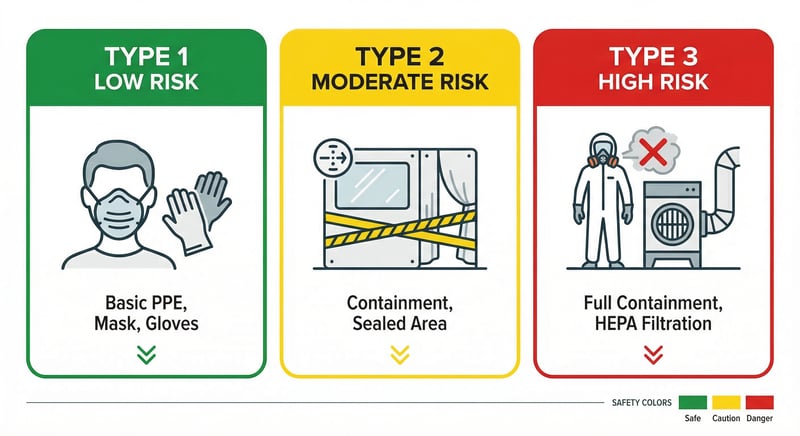
Not all asbestos removal is the same. Canadian regulations classify abatement work into risk categories based on the type of material, its condition (friable vs. non-friable), and the likelihood of fibre release. Understanding these categories determines everything: the PPE your crew wears, the engineering controls you need, and the notifications required before work begins.
Type 1: Low Risk
Involves non-friable ACMs where fibre release is unlikely if proper procedures are followed. Examples include removing intact vinyl floor tiles or undamaged cement board siding. Workers still need basic respiratory protection and awareness training, but full containment is typically not required.
Type 2: Moderate Risk
Involves work where some fibre release is possible. Examples include removing drywall with asbestos-containing joint compound or cutting through asbestos cement products. This level requires a contained work area, HEPA vacuums, wet methods to suppress dust, and more stringent PPE including half-face respirators with P100 (HEPA) filters.
Type 3: High Risk
Involves friable ACMs where significant fibre release is expected. This includes removing spray-applied fireproofing, pipe insulation, or heavily damaged materials. Type 3 requires full negative-pressure containment with HEPA-filtered air units, three-stage decontamination chambers, full-face respirators (or supplied-air respirators in extreme cases), continuous air monitoring, and workers who hold specific asbestos abatement training certificates.
A common and costly mistake: treating a Type 3 job like a Type 2. We have seen a 12-person drywall crew in Calgary start demolishing a 1970s office building without a pre-demolition survey. They hit friable pipe insulation behind the walls. The project got shut down for three weeks, cost them $40,000 in abatement and remediation, and earned them an OHS order. The survey that would have caught it upfront? About $2,000.
What Steps Are Required for Safe Asbestos Removal?
Asbestos abatement is not a task you improvise. Each step exists because skipping it has led to real exposures and real fines on real job sites. Here is the process from start to finish.
Step 1: Pre-Renovation or Pre-Demolition Survey
Before any renovation or demolition work begins on a building constructed before 1990, a qualified professional must conduct an asbestos survey. This involves taking bulk material samples from suspected ACMs and sending them to an accredited lab for analysis. The survey identifies what contains asbestos, where it is, what condition it is in, and the risk classification for removal.
This is not optional. Canadian OHS regulations across all provinces mandate this survey before you disturb building materials in pre-1990 structures. Skipping it does not just risk your crew's health; it can result in stop-work orders, fines, and project delays that cost far more than the survey itself.
If your team is handling hazard assessments on site, make sure they understand how to conduct a proper field-level hazard assessment as part of the daily pre-work process.
Step 2: Develop an Abatement Plan
Based on the survey results, a qualified abatement professional develops a written plan that covers:
- Scope of work and risk classification (Type 1, 2, or 3)
- Containment and engineering controls required
- PPE selection for each task
- Decontamination procedures for workers and equipment
- Air monitoring plan (required for moderate and high-risk work)
- Waste handling, packaging, and disposal procedures
- Emergency response procedures in case of containment breach
This plan becomes part of your site-specific safety documentation. It should integrate with your broader health and safety management system, not exist as a standalone document that nobody reads after day one.
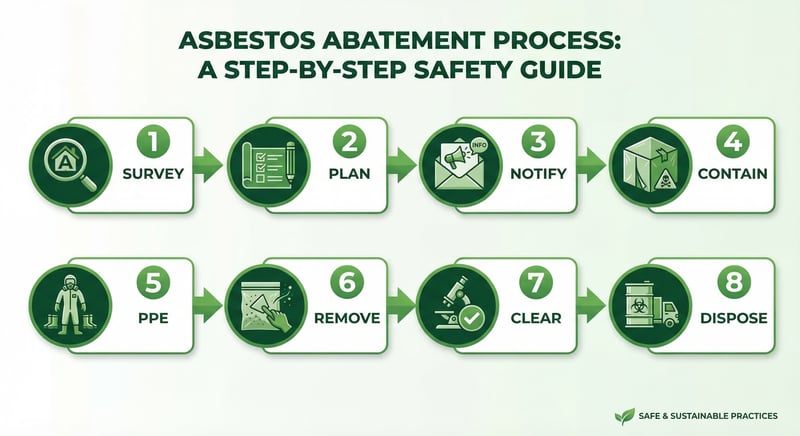
Step 3: Regulatory Notification
This is where the province-specific requirements come in, and where many contractors trip up.
In Alberta: Employers must notify Alberta OHS at least 72 hours before beginning any work that may release asbestos fibres. This notification is submitted through the Alberta Asbestos Notification Portal. It applies to all asbestos abatement, demolition, or renovation projects involving ACMs. Miss this step, and you are starting the project in violation.
In British Columbia: As of January 1, 2024, BC became the first province in Canada to require formal licensing for asbestos abatement contractors. Under the amended Workers Compensation Act, asbestos abatement employers must hold a WorkSafeBC-issued licence, and every worker performing abatement work must complete mandatory training and obtain certification from an approved provider. BC also requires a Notice of Project (NOP) for asbestos abatement work. This licensing requirement is new and actively enforced.
Both provinces (and all others) require that workers handling asbestos hold valid training certificates from government-approved training providers before entering any asbestos work area. SE-AI monitors certification expiry dates across your workforce and alerts you before any ticket lapses.
Step 4: Set Up Containment
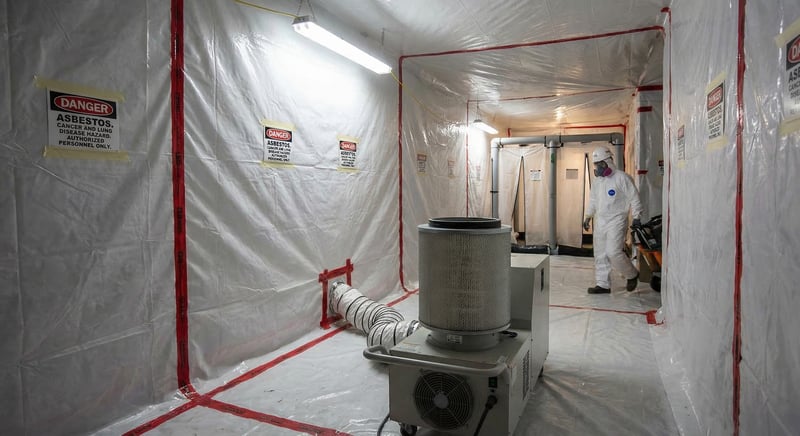
For moderate and high-risk abatement, the work area must be physically isolated from the rest of the building to prevent fibre migration. This means:
- Sealing the area with polyethylene sheeting (typically 6-mil poly, double-layered for high risk)
- Shutting down and isolating HVAC systems that serve the work area
- Setting up negative air pressure units with HEPA filtration to keep contaminated air from escaping
- Establishing a three-stage decontamination unit (equipment room, shower room, clean room) at the entry/exit point for high-risk work
- Posting warning signs and restricting access
The friction here is real. Setting up proper containment for a Type 3 job takes hours. It is expensive. It feels like wasted time when the GC is breathing down your neck about the schedule. But a containment breach during active removal means fibre release into occupied areas of the building, and that turns a controlled abatement project into an uncontrolled environmental incident with far bigger consequences.
What If Your Asbestos Abatement Records Were Always Audit-Ready?
SE-AI tracks worker training, exposure monitoring, medical surveillance, and abatement project documentation. Ask “which workers need asbestos refresher training?” and get the answer in seconds.
Be the First to Try It →
Before entering any containment area, your crew should complete a field-level hazard assessment specific to the asbestos work being performed that day.
Step 5: PPE and Respiratory Protection
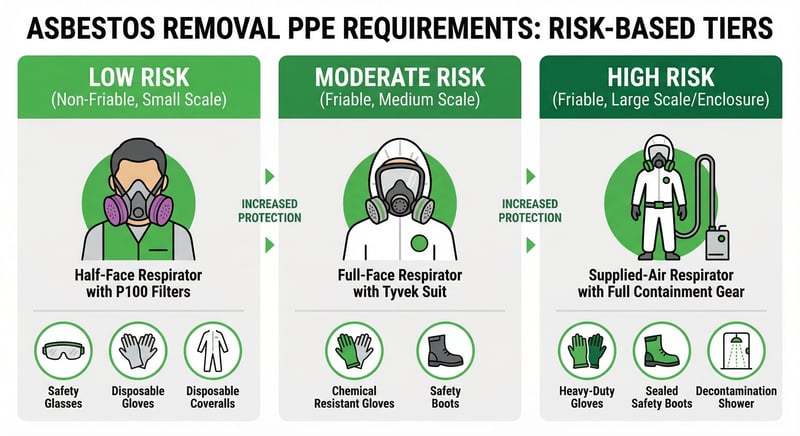
The PPE requirements scale with the risk level:
- Type 1 (Low Risk): Disposable coveralls and a minimum half-face respirator with P100 (HEPA) filters
- Type 2 (Moderate Risk): Disposable Tyvek-style coveralls with hood and boots, half-face or full-face respirator with P100 filters, sealed seams (taped wrists, ankles, and zipper)
- Type 3 (High Risk): Full-face respirator with P100 filters (or powered air-purifying respirator/supplied-air respirator depending on conditions), disposable coveralls, gloves, boot covers, and complete seal. In extreme exposure scenarios, self-contained breathing apparatus (SCBA) may be required
Critical point: standard N95 dust masks do NOT protect against asbestos fibres. Any worker in an asbestos work area needs a minimum P100-rated respirator that has been properly fit-tested. Your respiratory protection program is not a nice-to-have; it is the barrier between your workers and a cancer-causing mineral. Make sure your broader PPE program covers asbestos-specific requirements.
Step 6: Removal, Wet Methods, and Air Monitoring
During removal, workers use wet methods (spraying ACMs with amended water) to suppress fibre release. Materials are carefully removed, avoiding breakage where possible, and immediately placed in labelled, sealed 6-mil poly bags or wrap.
For Type 2 and Type 3 work, air monitoring is conducted throughout the removal process. Samples are collected and analyzed to confirm that airborne fibre concentrations stay below the OEL of 0.1 f/cc. In BC, employers must make air sample results available to workers within 24 hours of collection.
Step 7: Decontamination and Clearance
After removal is complete, the contained area is thoroughly cleaned using HEPA vacuums and wet wiping. All surfaces inside the containment are cleaned until no visible debris remains. Then a clearance air test is performed by an independent third party. The containment stays in place until clearance results confirm the area is safe.
This is where impatient crews create problems. Pulling down containment before clearance results come back is one of the fastest ways to contaminate a "clean" area and restart the entire process.
Step 8: Disposal at Approved Facilities
Asbestos waste must be double-bagged in sealed 6-mil polyethylene bags, clearly labelled as asbestos waste, and transported to an approved disposal facility. In BC, materials must be taken to landfills that accept asbestos waste, often by appointment. In Alberta, asbestos waste disposal follows provincial guidelines, and while manifesting is no longer required within the province, proper packaging and labelling are mandatory.
Improper disposal is not just an environmental violation; it creates future exposure risk for anyone who encounters the waste.
What Are the Biggest Mistakes Contractors Make with Asbestos?
Most contractors think asbestos is only a problem for demolition companies or environmental consultants. But if your safety program doesn't address hazardous materials, you're exposed. They are wrong. If you are doing any renovation, maintenance, or demo work on older buildings, asbestos is your problem too. Here are the mistakes we see most often:
- Skipping the pre-demolition survey: "The building doesn't look that old" is not a risk assessment. If the structure was built before 1990, get the survey done.
- Assuming non-friable means safe: Non-friable ACMs become friable the moment you start cutting, grinding, or breaking them. Intact vinyl tiles are low risk. The same tiles being jackhammered off a concrete floor? High risk.
- Using the wrong respirator: Dust masks and N95s do not protect against asbestos. Period. Your crew needs P100/HEPA-rated respirators that have been fit-tested.
- Not training workers before they need it: Asbestos training is not something you arrange after you find ACMs on site. Every worker who might encounter asbestos should have awareness training before they set foot on a pre-1990 job site.
- Missing the notification deadline: In Alberta, that 72-hour OHS notification is mandatory. In BC, you need both a Notice of Project and a valid abatement licence. Starting work without these is starting in violation.
If you are looking at this list and realizing your safety program has gaps, that is exactly what SE-AI is designed to catch. It scans your program, identifies what is missing, and shows you the gaps before an inspector does.
How Much Does Asbestos Abatement Cost?
Cost is the first question most contractors ask, and the honest answer is that it varies significantly. Here are estimated ranges based on industry experience across Canada:
- Asbestos survey/testing: $500 to $3,000+ depending on building size and number of samples
- Type 1 (Low Risk) removal: Estimated $5 to $15 per square foot
- Type 2 (Moderate Risk) removal: Estimated $10 to $25 per square foot
- Type 3 (High Risk) removal: Estimated $20 to $50+ per square foot
- Encapsulation (alternative to removal): Estimated $2 to $6 per square foot
These are estimates based on typical project costs, not official fee schedules. Your actual cost depends on the material type, accessibility, building location, project size, and local disposal fees. Get at least three quotes from licensed abatement contractors before committing to a project.
The number that matters most, though, is the cost of getting it wrong. A stop-work order from OHS can idle your entire crew for weeks. Fines for asbestos violations regularly reach $10,000 to $100,000+ per offence. And the long-term liability from worker exposure claims can follow your company for decades.
How Should You Build Asbestos Safety into Your Safety Program?
Asbestos awareness should not be a one-off training event that your crew forgets by next month. SE-AI tracks who has completed asbestos awareness training and flags when refreshers are due. It needs to be built into your core safety programs and your broader health and safety management system as a permanent element. Here is what that looks like in practice:
- Asbestos awareness training for all workers who may encounter ACMs (not just abatement specialists)
- Pre-project hazard assessments that specifically check building age and flag asbestos survey requirements
- Documented safe work procedures for asbestos encounters, including stop-work authority if suspected ACMs are found
- Respiratory protection program with fit-testing for all workers who may need P100 respirators
- Toolbox talks covering asbestos identification, proper response procedures, and reporting. Safety Evolution's free toolbox talk package includes asbestos-related topics you can deliver to your crew in 10 minutes
- Incident reporting procedures for suspected asbestos exposures, with clear escalation protocols. Make sure your team knows how to document and report using a proper incident reporting process
- Records management for training certificates, survey reports, air monitoring results, and disposal manifests
If you are working toward COR or SECOR certification, asbestos management is part of demonstrating an effective health and safety management system. SE-AI connects your asbestos training records, project documentation, and exposure monitoring into one audit-ready view. Your auditor will want to see that your program addresses hazardous materials, and asbestos is at the top of that list for any contractor working on older buildings.
Safety Evolution builds audit-ready safety programs for contractors across Canada. We do not just hand you templates; we build your program, manage your documents, and make sure your crew knows exactly what to do when they hit asbestos on site. SE-AI can show you exactly where your program stands.
Alberta vs. BC: Key Differences for Contractors
While the core safety requirements for asbestos abatement are similar across Canada, Alberta and BC have specific regulatory differences that contractors need to know:
| Requirement |
Alberta |
British Columbia |
| Regulator |
Alberta OHS (Labour and Immigration) |
WorkSafeBC |
| Contractor Licensing |
No specific asbestos abatement licence required |
Mandatory WorkSafeBC licence required since January 1, 2024 |
| Worker Certification |
Government-approved asbestos training certificate required |
Mandatory certification from approved training provider (Level 1 or Level 2) |
| Pre-Work Notification |
72-hour notification to Alberta OHS via the Asbestos Notification Portal |
Notice of Project (NOP) to WorkSafeBC |
| OEL |
0.1 f/cc (8-hour TWA) |
0.1 f/cc (8-hour TWA) |
| Key Reference |
Alberta Asbestos Abatement Manual (ASB001) |
OHS Regulation Part 6 + Workers Compensation Act amendments |
If you operate in both provinces, your safety program needs to account for both sets of requirements. The BC licensing regime is stricter and newer, and WorkSafeBC has been actively conducting planned inspections targeting asbestos abatement compliance, particularly in residential renovation and demolition.
What If You Could Just Ask?
“Are all our asbestos workers current on training?” “Which project sites had Type 3 removals this quarter?” Get answers from your own safety records instantly.
Be the First to Try It →
Frequently Asked Questions
Do I need an asbestos survey before renovating a building?
Yes. Canadian OHS regulations require that buildings constructed before 1990 be surveyed for asbestos-containing materials before any renovation or demolition work begins. A qualified professional must collect bulk samples of suspected materials and have them analyzed by an accredited laboratory. This survey identifies the presence, location, condition, and risk level of any ACMs in the project area.
How much does asbestos removal cost in Canada?
Asbestos removal costs in Canada are estimated at $5 to $50+ per square foot (CAD), depending on the risk level, material type, accessibility, and project size. Low-risk removal of non-friable materials like vinyl tiles may cost $5 to $15 per square foot, while high-risk removal of friable insulation can exceed $20 to $50 per square foot. Initial testing and surveys typically cost $500 to $3,000+. Always get multiple quotes from licensed abatement contractors.
What training do workers need for asbestos abatement in Alberta?
In Alberta, all workers who enter an asbestos restricted area must hold a valid asbestos worker certificate from a government-approved training provider. The training covers asbestos identification, health hazards, safe work procedures, PPE use, decontamination, and waste disposal. Employers are also responsible for ensuring all workers receive the training necessary to perform their specific tasks safely.
Does BC require a licence for asbestos removal?
Yes. As of January 1, 2024, British Columbia became the first Canadian province to require formal licensing for asbestos abatement contractors. Employers performing asbestos abatement work must hold a WorkSafeBC-issued licence, and every worker performing this work must complete mandatory training from an approved provider and obtain certification. This applies to all asbestos abatement work in relation to buildings.
What PPE is required for asbestos removal?
At minimum, workers need a half-face respirator equipped with P100 (HEPA) filters and disposable coveralls. For high-risk (Type 3) work involving friable asbestos, full-face respirators, powered air-purifying respirators, or supplied-air respirators may be required. All respirators must be fit-tested. Standard N95 dust masks do not provide adequate protection against asbestos fibres. Additional PPE includes sealed Tyvek-style coveralls, gloves, boot covers, and eye protection.
What is the occupational exposure limit for asbestos in Canada?
The occupational exposure limit (OEL) for all forms of asbestos across Canadian provinces is 0.1 fibres per cubic centimetre of air (f/cc), measured as an 8-hour time-weighted average (TWA). There is no recognized safe level of asbestos exposure. This limit applies to all workplace activities involving asbestos-containing materials, and employers must implement controls to keep worker exposure below this threshold.
Asbestos abatement is one of the highest-stakes safety challenges in Canadian construction. The regulations exist because cutting corners has real, permanent health consequences. Whether you are a 10-person reno crew or a 100-person general contractor, your safety program needs to address asbestos before your crew encounters it on site.
Safety Evolution builds complete, audit-ready safety programs for Canadian contractors. We handle the documentation, the training coordination, the procedures, and the ongoing management so your crew stays safe and your company stays compliant. Try SE-AI and see where your asbestos safety program stands in seconds.
Get Weekly Safety Insights
Regulation updates, toolbox talk ideas, and compliance tips. One email per week.