Last updated: March 2026
A demolition crew opens up a wall in a 1970s commercial building. Grey, crumbly insulation flakes off a pipe run and drifts into the air. Nobody on site is wearing respiratory protection because nobody checked what was in the walls before the work started.
That single mistake can trigger a WorkSafeBC stop-work order, a six-figure cleanup bill, and worst of all, a health consequence that will not show up for another 20 to 30 years. Asbestos-related diseases are the number one cause of workplace death in Canada. The fibres are invisible, the exposure is silent, and the damage is irreversible.
If you are a contractor, building owner, or employer running renovation, demolition, or maintenance work on any structure built before 1990, this is the guide you need. We will cover where asbestos hides, how to confirm it, what the law requires of you, and when you need a licensed contractor to handle it. If your crew already works in older buildings and you do not have an asbestos management plan, you are behind.
Quick Answer: What Employers Need to Know About Asbestos
- What it is: Asbestos is a group of naturally occurring mineral fibres used in thousands of building products before 1990. It causes fatal lung diseases with a latency period of 20 to 50 years.
- Where it hides: Pipe insulation, floor tiles, ceiling tiles, drywall joint compound, vermiculite insulation, cement products, roofing materials, textured coatings.
- Your legal duty: Maintain an inventory of asbestos-containing materials (ACMs), conduct a risk assessment before any work that could disturb ACMs, and develop an exposure control plan.
- BC licensing (since Jan 1, 2024): Asbestos abatement contractors must hold a WorkSafeBC licence. Workers doing abatement must be certified.
- Critical rule: You cannot identify asbestos by sight. Lab testing is the only confirmation.
Asbestos awareness is the foundational knowledge every employer and worker needs before setting foot in a building that might contain asbestos-containing materials (ACMs). In Canada, awareness training is the minimum regulatory requirement: if your workers could encounter asbestos on the job, they need to know what it looks like, where it hides, and what to do if they disturb it.
This guide covers what employers must know about asbestos awareness: where ACMs are commonly found, the health risks of exposure, your training obligations by province, and the difference between awareness and abatement-level work.
What Is Asbestos and Why Is It Dangerous?
Asbestos is a group of six naturally occurring silicate minerals made up of fine, durable fibres that resist heat, fire, and chemical damage. Those properties made it an ideal building material for decades. It was woven into insulation, mixed into cement, sprayed onto structural steel, and pressed into floor tiles across Canada from the 1930s through the late 1980s.
The problem is what happens when those materials are disturbed. Cut into a floor tile, sand a textured ceiling, or pull apart old pipe insulation, and you release microscopic fibres into the air. Those fibres are small enough to pass through your lungs' natural defences and lodge deep in the tissue. Your body cannot break them down. They sit there for decades, causing scarring and eventually triggering disease.
The three primary asbestos-related diseases are:
- Asbestosis: Chronic scarring of the lung tissue that reduces breathing capacity. Progressive and incurable.
- Lung cancer: Significantly elevated risk, especially when combined with smoking. Average latency of 20 to 30 years after first exposure (CCOHS).
- Mesothelioma: An aggressive cancer of the lining around the lungs, abdomen, or heart. Almost exclusively caused by asbestos exposure. Latency of 30 to 40 years (CCOHS). Median survival after diagnosis is 12 to 18 months.
Canada banned the manufacture, import, sale, and use of asbestos and products containing asbestos in 2018 under the Prohibition of Asbestos and Products Containing Asbestos Regulations (SOR/2018-196). But the ban only stops new asbestos from entering the supply chain. It does nothing about the millions of tonnes already installed in existing buildings. If you are working on a structure built before 1990, the asbestos is still there, and managing it is your responsibility.
Where Does Asbestos Hide in Buildings?
Most employers who get caught off guard by asbestos are not in denial about the hazard. They simply did not know what to look for. Asbestos was mixed into over 3,000 commercial products, and many of them look completely ordinary.
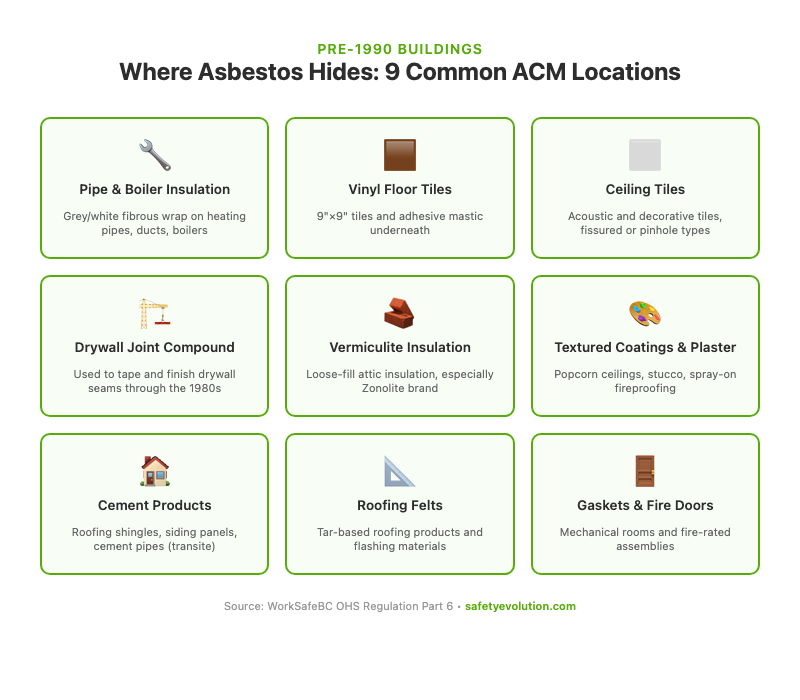
If your crew works in buildings constructed before 1990, here are the most common locations where asbestos-containing materials (ACMs) are found:
- Pipe and boiler insulation: Often a grey or white fibrous wrap around heating pipes, ductwork, and boilers. This is one of the most common and most dangerous sources because it is frequently friable (crumbles easily by hand).
- Vinyl floor tiles and sheet flooring: 9-inch by 9-inch floor tiles are a classic indicator. The adhesive (mastic) underneath often contains asbestos too.
- Ceiling tiles: Acoustic and decorative ceiling tiles, particularly the older fissured or pinhole types.
- Drywall joint compound: Used to tape and finish drywall seams. Widely used in Canadian construction through the 1980s.
- Textured coatings and plasters: Popcorn ceilings, stucco finishes, and spray-on fireproofing frequently contained asbestos.
- Vermiculite insulation: Loose-fill attic insulation, particularly the Zonolite brand, often contaminated with asbestos from the Libby, Montana mine.
- Cement products: Roofing shingles, siding panels, and cement pipes (transite) used asbestos for strength and fire resistance.
- Roofing felts and flashing: Tar-based roofing products commonly contained asbestos fibres.
- Gaskets, packings, and fire doors: Mechanical rooms and fire-rated assemblies are common locations.
Here is the part that trips up even experienced contractors: you cannot identify asbestos by looking at it. A floor tile that looks identical to a non-asbestos tile could test positive. Pipe insulation that looks like fibreglass might actually be chrysotile. The only way to confirm the presence of asbestos is laboratory analysis by a qualified person using approved analytical methods (NIOSH 9000/9002 or EPA 600/R-93/116, as specified in WorkSafeBC OHS Regulation Section 6.1).
If you suspect a material contains asbestos but cannot confirm it through testing, WorkSafeBC requires you to treat it as asbestos-containing material until proven otherwise (Section 6.4(2)).
When Is an Asbestos Survey Required?
Most contractors think they only need to worry about asbestos during major demolitions. That is wrong. Any work that could disturb materials in a pre-1990 building should trigger an asbestos assessment. That includes renovations, mechanical upgrades, electrical work that involves opening walls or ceilings, and even routine maintenance on older pipe systems.
WorkSafeBC OHS Regulation Section 6.6(2) states it clearly: the employer must ensure that a risk assessment has been conducted by a qualified person before any demolition, alteration, or repair of machinery, equipment, or structures where asbestos-containing material may be disturbed.
In practice, this means:
- Before renovations: If you are opening walls, removing flooring, disturbing ceilings, or working on mechanical systems in a pre-1990 building, get a survey.
- Before demolition: A full hazardous materials survey is required before demolition. Several BC municipalities, including Vancouver, Coquitlam, Saanich, Nanaimo, and Port Coquitlam, require a completed asbestos survey as part of the demolition permit application.
- Before purchasing or leasing: Due diligence on older commercial or industrial properties should include an asbestos inventory.
- When planning maintenance: Routine work on boilers, pipes, or HVAC systems in older buildings can disturb ACMs if they are present in insulation or sealing compounds.
An asbestos survey is conducted by a qualified person who collects representative samples of suspect materials and has them analysed by an accredited laboratory. The qualified person then prepares an inventory documenting the location, condition, and type of every ACM found. Costs vary depending on the building size and complexity; expect $300 to $3,000 or more for a thorough survey of a commercial building.
One thing to keep in mind: your municipality may have additional requirements beyond what WorkSafeBC mandates. Check with your local building department before starting demolition or renovation permits. Requirements vary between jurisdictions.
What Are Your Legal Duties as an Employer?
WorkSafeBC OHS Regulation Part 6 is specific about employer duties when asbestos is or may be present in the workplace. These are not suggestions. They are enforceable requirements, and violations can result in stop-work orders, penalties, and prosecution.
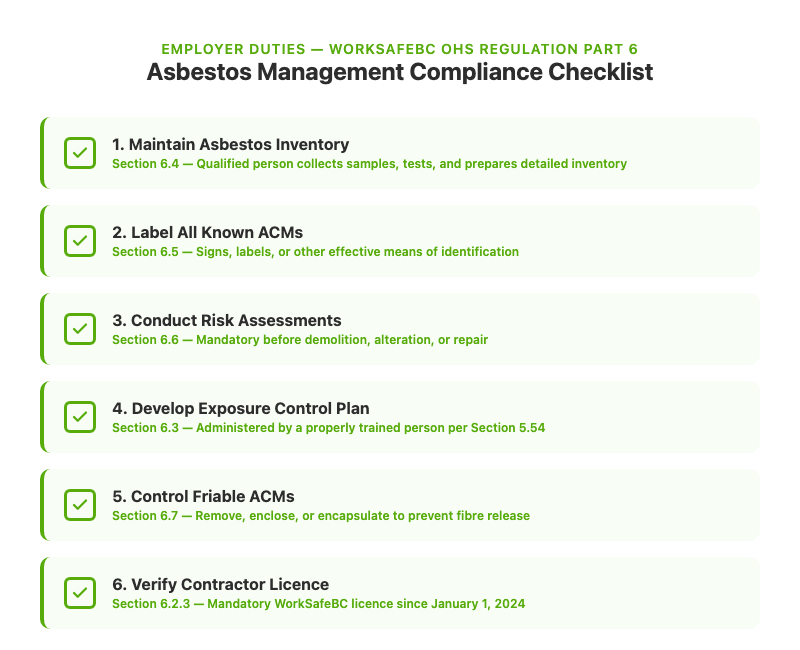
Here are the key duties you need to know:
1. Maintain an Asbestos Inventory (Section 6.4)
You and the building owner must ensure a qualified person collects samples of suspect materials, has them tested, and prepares a detailed inventory. That inventory must include the specific location of each ACM, the type of asbestos, the percentage of asbestos content, and whether the material is accessible to workers. The inventory must be kept current, readily available at the workplace, and retained until all ACMs are removed.
2. Label All Known ACMs (Section 6.5)
Every asbestos-containing material in the workplace must be identified with signs, labels, or other effective means. Your crew needs to know where the hazards are before they start work.
3. Conduct Risk Assessments (Section 6.6)
A qualified person must assess each ACM based on its condition, friability, accessibility, and potential for fibre release. Before any demolition, alteration, or repair that could disturb ACMs, a risk assessment is mandatory. The qualified person must classify the planned work activity as low risk, moderate risk, or high risk.
4. Develop an Exposure Control Plan (Section 6.3)
If workers are or may be exposed to potentially harmful levels of asbestos, you must develop and implement an exposure control plan that meets the requirements of Section 5.54. The plan must be administered by a properly trained person.
5. Control Friable ACMs (Section 6.7)
All friable asbestos-containing materials (those that can be crumbled by hand pressure) must be controlled by removal, enclosure, or encapsulation to prevent the release of airborne fibres. You must not allow any work that would disturb ACMs unless necessary precautions are in place.
6. Verify Abatement Contractor Licensing (Section 6.2.3)
Before permitting an asbestos abatement contractor to work at your site, you and the prime contractor must ensure they hold a valid WorkSafeBC licence. This has been mandatory in BC since January 1, 2024.
These duties apply to all employers, not just demolition or abatement contractors. If you are a GC running a renovation on an older building, an industrial employer maintaining a facility, or a property manager overseeing tenant improvements, these requirements apply to you. GCs who hire sub-trades for work in older buildings should also review our subcontractor safety management guide to understand your oversight obligations. If you want help building your exposure control plan or setting up an asbestos management system, Safety Evolution's consulting team works with contractors across Canada to get these programs right.
Missing Asbestos Awareness Training Means Uncontrolled Exposure Risk
SE-AI checks your training records for asbestos awareness coverage and flags projects and sites where asbestos management documentation is missing.
Get Early Access →
How Are Asbestos Work Activities Classified?
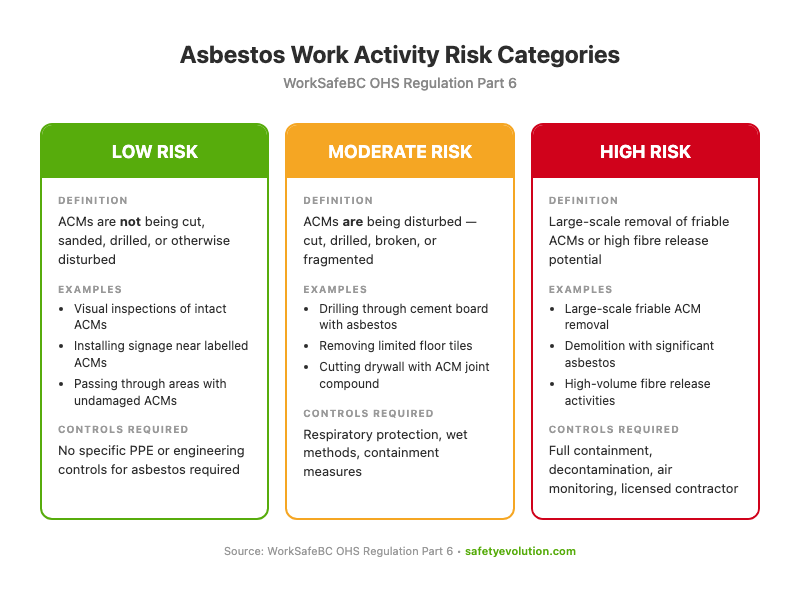
WorkSafeBC divides asbestos work into three risk categories. The category determines what controls, equipment, and procedures you need. Getting this wrong is one of the fastest ways to trigger an enforcement action.
Low Risk Work Activities
Work where the ACM is not being cut, sanded, drilled, broken, ground down, or otherwise disturbed in a way that releases airborne fibres. No personal protective equipment or engineering controls are required specifically for asbestos. Examples: visual inspections of intact ACMs, installing signage near labelled ACMs, or passing through an area where undamaged ACMs are present.
Moderate Risk Work Activities
Work where ACMs are being disturbed (cut, drilled, broken, or otherwise fragmented), or where PPE and engineering controls are needed to prevent exposure. Examples: drilling through a small section of cement board that contains asbestos, removing a limited number of floor tiles, or cutting into drywall with asbestos-containing joint compound. Moderate risk work requires proper respiratory protection, wet methods to suppress dust, and containment measures.
High Risk Work Activities
Work requiring the highest level of control to prevent worker exposure. This includes large-scale removal of friable ACMs, demolition of structures with significant asbestos content, or any activity where a high volume of airborne fibres could be released. High risk work requires full containment, decontamination facilities, air monitoring, clearance sampling, and workers who hold valid asbestos certificates. In BC, the abatement contractor must hold a WorkSafeBC licence.
The classification is not a judgment call you make in the field. A qualified person must assess and classify the work activity before it begins (Section 6.6(3)). If you are unsure whether planned work qualifies as low, moderate, or high risk, hire a qualified person to make the determination. The cost of a professional assessment is a fraction of what a stop-work order or exposure incident will cost you.
For detailed guidance on removal procedures and contractor requirements, see our complete guide to asbestos removal safety for contractors.
What Changed in BC on January 1, 2024?
British Columbia became the first jurisdiction in Canada to require licensing for asbestos abatement contractors. The changes, introduced through Bill 5 amendments to the Workers Compensation Act and B.C. Reg. 204/2023, added three significant requirements:
- Contractor licensing: Asbestos abatement contractors must hold a valid licence issued by WorkSafeBC to operate in BC. You can verify a contractor's licence status through WorkSafeBC's online search tool.
- Worker certification: Anyone performing asbestos abatement work must hold a valid asbestos certificate issued by WorkSafeBC or an acceptable training provider. Employers must verify certification before allowing a worker to perform abatement.
- Employer record-keeping: Employers must record the details of every asbestos certificate held by workers performing abatement at their workplace (Section 6.2.2(2)).
For employers who are not abatement contractors, the key takeaway is this: before you hire anyone to remove or manage asbestos at your site, verify their licence. You can search for licensed contractors on the WorkSafeBC licensed contractor directory. If you hire an unlicensed contractor, both of you are in violation.
These requirements apply specifically to abatement work (removal, encapsulation, enclosure of ACMs). General awareness, identification, and inventory duties under Part 6 have been in place for much longer and apply to all employers. Asbestos is one of several regulated workplace hazardous substances that employers must manage, and the documentation requirements overlap with your broader health and safety program.
What Asbestos Awareness Training Do Your Workers Need?
Even if your crew is not doing abatement, they need to know enough about asbestos to avoid accidentally disturbing it. A renovation electrician drilling into a wall, a plumber cutting into old pipe insulation, or a labourer pulling up flooring can all release asbestos fibres if they do not know what they are working around.
WorkSafeBC OHS Regulation Section 6.11 requires employers to provide education and instruction to workers who may be exposed to asbestos. At a minimum, your awareness training should cover:
- What asbestos is and why it is dangerous
- Common building materials that may contain asbestos
- How to read and understand the asbestos inventory for the worksite
- What to do if they encounter suspected ACMs during work (stop work, report, do not disturb)
- Proper use of any required PPE
- The exposure control plan and their responsibilities under it
This is separate from the formal asbestos certificate required for abatement workers. Awareness training is about recognition and avoidance. Your crew does not need to know how to remove asbestos; they need to know how to recognize it and stop before they create a problem. If your safety program does not have a formal training matrix yet, start with our guide to workplace safety training and build asbestos awareness into it.
Make this part of your toolbox talks when starting work on older buildings. A five-minute conversation before the shift can prevent a catastrophic exposure. Safety Evolution's online training platform includes asbestos awareness modules that your crew can complete before they set foot on site.
What Should You Do If You Find Asbestos?
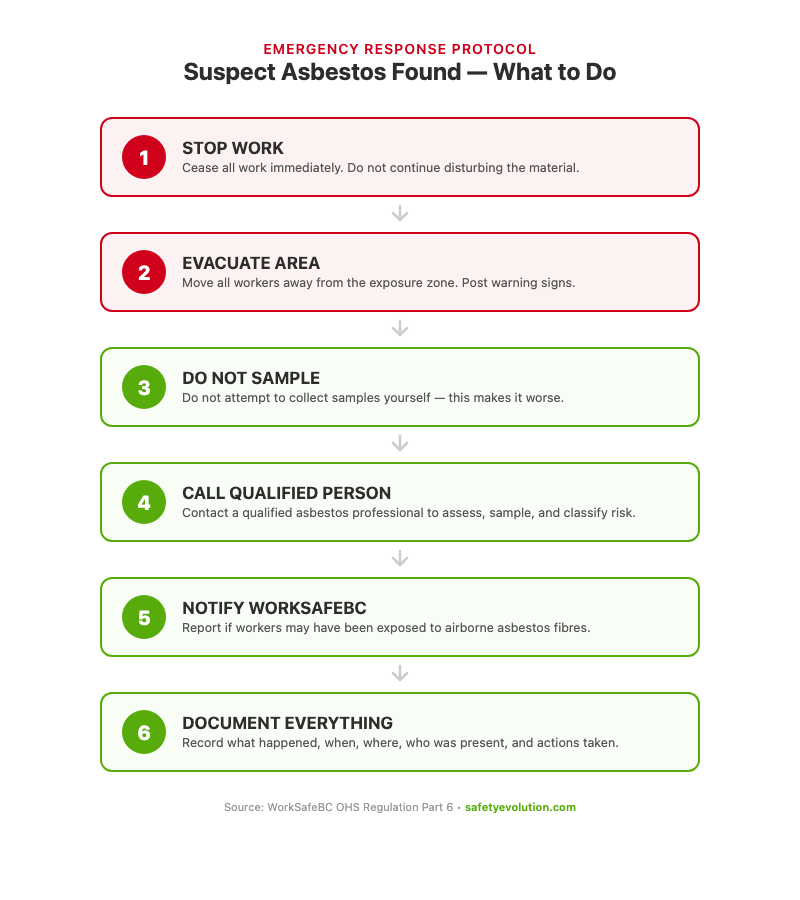
You are mid-renovation. A worker pulls back a section of ceiling and finds crumbly, greyish insulation that does not look like anything modern. What now?
- Stop work immediately. Do not continue disturbing the material. Do not try to clean it up.
- Evacuate the immediate area. Move workers away from the potential exposure zone. Post warning signs to prevent re-entry.
- Do not attempt to sample it yourself. Disturbing suspected ACMs without proper training and equipment makes the problem worse.
- Contact a qualified person. Have a qualified asbestos professional collect samples and assess the situation. They will determine whether the material is ACM and classify the risk level.
- Notify WorkSafeBC if required. If workers may have been exposed to airborne asbestos fibres, report it. WorkSafeBC requires notification of incidents involving exposure to designated substances.
- Document everything. Record what happened, when, where, who was present, and what actions were taken. This documentation is part of your exposure control plan requirements.
The worst decision you can make is to ignore it and keep working. A single uncontrolled asbestos release can contaminate an entire building, require professional decontamination, and expose everyone on site. The cost of stopping work for a day while you get a professional assessment is nothing compared to the cost of a full-scale asbestos incident.
Not sure if your renovation or maintenance project needs an asbestos management plan? SE-AI can check your project documentation and flag where asbestos management controls need to be in place before your crew starts work.
Is Asbestos Still Legal in Canada?
Sort of. Canada banned the manufacture, import, sale, and use of asbestos and products containing asbestos through the Prohibition of Asbestos and Products Containing Asbestos Regulations (SOR/2018-196), which took full effect on December 30, 2018. The regulations include a limited number of exclusions for specific industrial uses.
But here is the critical distinction: the ban applies to new asbestos entering the supply chain. It does not require the removal of asbestos already installed in existing buildings. That means the asbestos in the pipe insulation, floor tiles, and joint compound of every pre-1990 building across Canada is still there, still legal to leave in place, and still your responsibility to manage if workers could be exposed.
The occupational exposure limit (OEL) for asbestos in BC is 0.1 fibres per cubic centimetre (f/cc) as an 8-hour time-weighted average (TWA). This is aligned with the ACGIH Threshold Limit Value and the federal OEL. There is no safe level of asbestos exposure. The OEL represents the maximum allowable concentration, not a safe threshold.
Do Your Workers Know When They Might Encounter Asbestos?
SE-AI analyses your training records and hazard assessments for asbestos awareness gaps. It flags workers who have not received asbestos awareness training, sites where pre-renovation asbestos surveys are not documented, and projects where asbestos-containing materials may be disturbed without proper controls.
Get Early Access to SE-AI →
Frequently Asked Questions
How do I know if my building has asbestos?
You cannot identify asbestos by sight alone. If your building was constructed before 1990, there is a significant chance it contains asbestos-containing materials in insulation, floor tiles, ceiling tiles, drywall joint compound, or other building products. The only way to confirm is to have a qualified person collect samples and send them to an accredited laboratory for analysis. WorkSafeBC requires that any material suspected of containing asbestos be treated as ACM until testing proves otherwise.
Do I need an asbestos survey before renovating?
If the building was constructed before 1990 and your renovation could disturb materials that may contain asbestos, yes. WorkSafeBC OHS Regulation Section 6.6(2) requires a risk assessment by a qualified person before any demolition, alteration, or repair where asbestos-containing material may be disturbed. Several BC municipalities, including Vancouver and Coquitlam, also require an asbestos survey as part of the demolition permit application. Check with your local building department for specific requirements.
What should I do if I find asbestos during renovation work?
Stop work immediately and evacuate the area. Do not attempt to clean up or sample the material yourself. Contact a qualified asbestos professional to assess the situation, collect samples, and determine the risk level. If workers may have been exposed to airborne asbestos fibres, notify WorkSafeBC. Document everything: what happened, when, where, and who was present.
Is asbestos banned in Canada?
Canada banned the manufacture, import, sale, and use of asbestos and products containing asbestos in 2018 under the Prohibition of Asbestos and Products Containing Asbestos Regulations (SOR/2018-196). However, the ban does not require removal of asbestos already installed in existing buildings. Asbestos in pre-1990 buildings remains in place and must be managed by employers according to provincial OHS regulations.
Do asbestos abatement contractors need a licence in BC?
Yes. As of January 1, 2024, asbestos abatement contractors must hold a valid licence issued by WorkSafeBC to operate in British Columbia. Workers performing abatement must also hold a valid asbestos certificate. Employers hiring abatement contractors are required to verify the contractor's licence before work begins. BC is the first Canadian jurisdiction to implement this licensing requirement.
What is the asbestos exposure limit in Canada?
The occupational exposure limit for all forms of asbestos is 0.1 fibres per cubic centimetre (f/cc) as an 8-hour time-weighted average (TWA). This limit is consistent across WorkSafeBC, Alberta OHS, and the federal Canada Labour Code. The limit is based on the ACGIH Threshold Limit Value. There is no safe level of asbestos exposure; the OEL represents the maximum allowable workplace concentration, not a safe threshold.
Get Weekly Safety Insights
Regulation updates, toolbox talk ideas, and compliance tips. One email per week.