WHMIS Training Requirements: What Employers Must Know
WHMIS training requirements include two mandatory parts: generic education and workplace-specific training. Who needs it, how often, and employer obligations.
WHMIS training is a legal requirement for every Canadian worker who handles or could be exposed to hazardous products on the job. But getting it right is harder than most employers realize. Your crew is on site. A new sub just showed up with a truck full of solvents, adhesives, and concrete sealants. Someone asks where the Safety Data Sheets are. Nobody knows. And the worker spraying the product? He finished a generic WHMIS course three years ago but has never been trained on a single product he is using today.
That is not a training gap. That is a ticking fine. In Alberta alone, OHS penalties for failing to provide proper WHMIS training can reach hundreds of thousands of dollars. Federally, non-compliance with the Hazardous Products Act can trigger fines up to $5 million. More importantly, your crew is exposed to real health risks every shift without the right knowledge.
At Safety Evolution, we help hundreds of contractors build WHMIS training programs that actually hold up on site, not just in a binder. Here is what WHMIS training requirements look like in 2026 and what you need to do to stay compliant.
⚡ Quick Answer: WHMIS Training Requirements
Who needs it: Every worker who uses, handles, stores, or could be exposed to a hazardous product at work
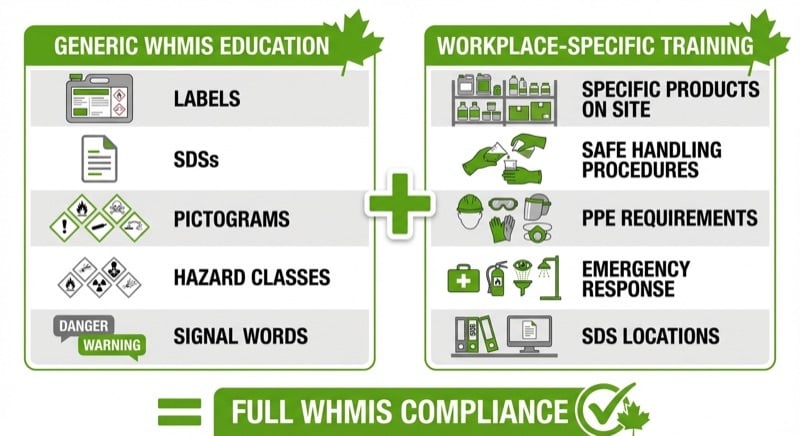
Two parts required: Generic WHMIS education (labels, SDSs, pictograms) PLUS workplace-specific training (your site, your products, your procedures)
Who pays: The employer. Always. WHMIS training must be provided at no cost to workers, during paid time
How often: No legislated expiry, but best practice is annual refresher plus retraining whenever new products or conditions change
Key update: The December 2022 amendments to the Hazardous Products Regulations are now fully in effect. The three-year transition period ended December 14, 2025. All suppliers must comply, and your training materials must reflect the updated system
🎬 Watch: Free WHMIS Training Course
Our complete WHMIS training video covers all 10 pictograms, labels, Safety Data Sheets, and your rights as a worker. Use it for crew onboarding or as a refresher.
Why Is WHMIS Training Important?
WHMIS (Workplace Hazardous Materials Information System) is Canada's mandatory national system for classifying hazardous products and communicating hazard information to workers through labels, Safety Data Sheets (SDSs), and training. WHMIS training is required in every province and territory, enforced through occupational health and safety legislation. For a complete breakdown of every WHMIS component, see our WHMIS basics guide.
WHMIS training is the mandatory education and workplace-specific instruction that Canadian employers must provide to every worker who handles or could be exposed to hazardous products.
For construction, WHMIS training matters more than most contractors realize. Your average job site does not look like a chemistry lab, but the hazardous product exposure is constant. Think about what your crew touches daily: concrete sealants, epoxy adhesives, spray foam, paint thinners, silica-generating materials, fuel, propane, and cleaning solvents. Every one of those products falls under WHMIS.
If your workers cannot read a WHMIS label, do not understand the pictograms on a container, or have never seen the Safety Data Sheet for the product they are spraying, you have a compliance problem and a safety problem at the same time. WHMIS training is the legal mechanism that closes this gap.
Safety Evolution's WHMIS training courses cover both generic and workplace-specific components, with instant certificates and expiry tracking built in.
What Are the Two Parts of WHMIS Training?
Most contractors think running their crew through an online WHMIS course covers them. They are wrong. That is only half the requirement.
WHMIS training has two mandatory components, and both are required by law in every Canadian jurisdiction:
1. Generic WHMIS Education
This is the "portable" part. It covers the universal WHMIS system itself and applies regardless of workplace:
How WHMIS works and the rights it gives workers
Hazard classes and categories (including the new classes added by the December 2022 amendments)
How to read supplier and workplace labels
How to find and use Safety Data Sheets (SDSs) and what the 16 sections contain
This part can be delivered through online courses, in-person classes, or a combination. It is the same for every workplace.
2. Workplace-Specific Training
This is where most contractors fall short. Workplace-specific training must cover the actual hazardous products on your site and the specific procedures your crew needs to follow:
The specific hazardous products present on your site (product names, hazard classes, locations)
Safe use, handling, storage, and disposal procedures for each product
Required PPE for specific products
Emergency and spill response procedures
Ventilation requirements and exposure controls
Where SDSs are located and how to access them quickly
An online WHMIS course or WHMIS certificate does not replace workplace-specific training. It never has. Completing a WHMIS course online covers the generic education, but your employer still needs to walk your crew through every hazardous product they might encounter and make sure they know the procedures. According to the Canadian Centre for Occupational Health and Safety (CCOHS), the employer is responsible for providing both components. A WHMIS certification from any course provider only proves the worker completed the generic education portion.
Who Needs WHMIS Training?
The short answer: anyone who works with or could be exposed to a hazardous product. On a construction site, that is almost everyone.
WHMIS training must be provided to all workers who:
Use, store, handle, or dispose of a hazardous product
May be exposed to a hazardous product during normal work activities
Supervise or manage workers handling hazardous products
Are involved in emergency response on site
Perform maintenance on equipment that contains hazardous products
Notice that list includes supervisors and managers, not just the crew doing the hands-on work. If you are a site supervisor on a project where hazardous products are present (which is virtually every construction project), you need WHMIS training too.
For GCs managing multiple subs, here is the blunt truth: you cannot just assume your subcontractors have trained their people. If their crew is working on your site with hazardous products and something goes wrong, the GC's safety program is also under scrutiny. Many GCs now require proof of WHMIS training as part of their construction safety orientation before a sub steps on site.
Generic Online WHMIS Courses Aren't Enough
By law, you must provide "workplace-specific" WHMIS training covering the exact chemicals on your site. Don't rely on basic online modules—deliver and track site-specific chemical training directly to your workers' phones.
What Changed with the December 2022 WHMIS Amendments?
If your training materials still reference "WHMIS 2015," it is time to update. The system has changed, and the transition period is over. For background on what changed when Canada adopted GHS, see our WHMIS 2015 explained guide.
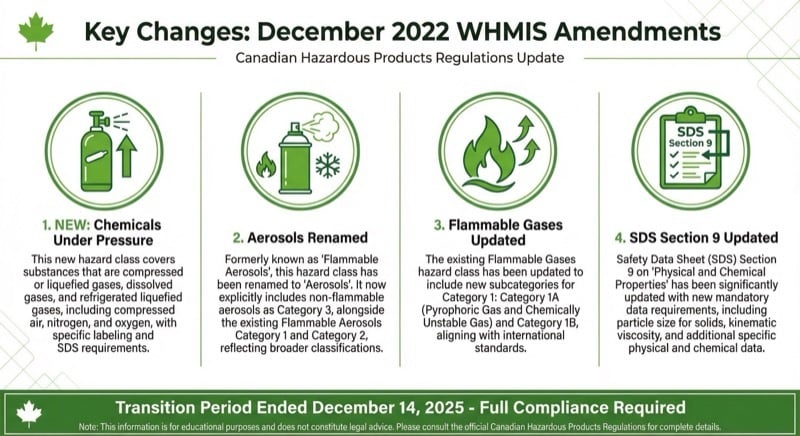
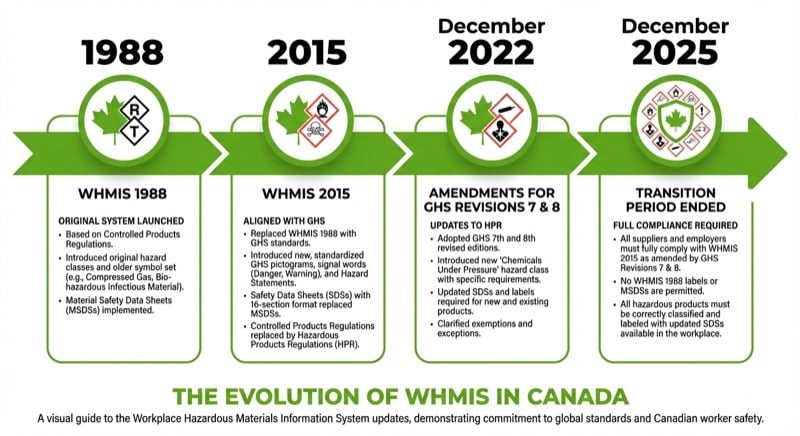
In December 2022, Health Canada amended the Hazardous Products Regulations (HPR) to align with Revisions 7 and 8 of the Globally Harmonized System of Classification and Labelling of Chemicals (GHS). Suppliers were given a three-year transition period to comply. That period ended on December 14, 2025. All product labels and SDSs should now reflect the updated requirements.
Here is what changed and why it matters for your training program:
New Hazard Class: Chemicals Under Pressure
This is a brand-new physical hazard class covering gases or liquids packaged under pressure that do not meet the definitions for compressed, liquefied, or dissolved gases. Products in this class use both the flame and gas cylinder pictograms (for Categories 1 and 2) or just the gas cylinder pictogram (for Category 3). Your crew needs to recognize this new classification on labels and SDSs.
"Flammable Aerosols" Renamed to "Aerosols"
The old "Flammable Aerosols" hazard class is now simply called "Aerosols." A new Category 3 was added for non-flammable aerosol products. Category 3 aerosols do not require a pictogram but still carry a signal word and hazard statement. This means some aerosol products your crew uses may now appear in the WHMIS system for the first time, even if they are not flammable.
Flammable Gases Subcategorized
Flammable gases are now divided into Category 1A and Category 1B. Category 1A includes pyrophoric gases and chemically unstable gases. "Pyrophoric Gases" is no longer a separate hazard class; it has been folded into Flammable Gases Category 1A. If your crew works with welding gases, propane, or other flammable gases on site, your training materials need to reflect these updated categories.
Updated SDS Requirements
Section 9 of the SDS (Physical and Chemical Properties) now includes additional required data points. There is also a new option for suppliers to include combustible dust hazard information. If your workers rely on Section 9 when assessing physical hazards, they need to know what the new data points mean.
Other Technical Changes
The amendments also updated classification criteria for water-activated toxicants and Reproductive Toxicity Category 2. While these are more technical, they affect how certain products are classified and labelled. The bottom line: if your training content was built before 2023, it is outdated.
The system is no longer called "WHMIS 2015." It is simply "WHMIS." If your training program still teaches the old content without the 2022 updates, your workers may not recognize new hazard classes or updated label information on products arriving at site.
There are 10 pictograms used under WHMIS, each representing a different type of hazard. Nine use the red diamond GHS border, while the tenth is the Canada-specific biohazardous infectious materials symbol. Your crew needs to recognize all of them on sight.
What Are Employer Obligations Under WHMIS?
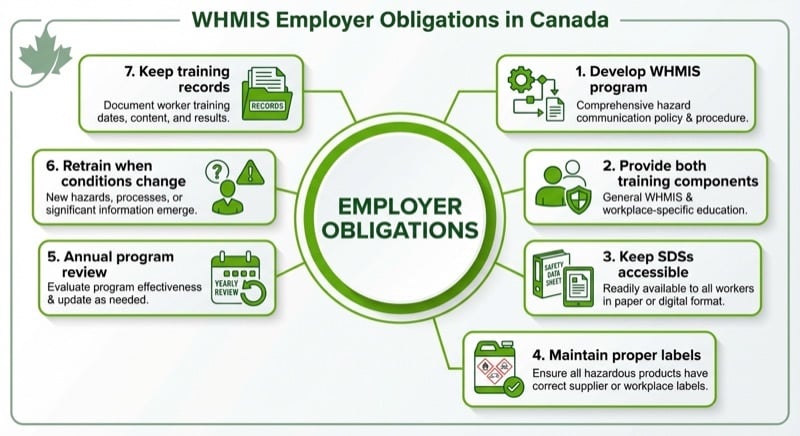
The legislation is clear: the employer carries the primary responsibility for WHMIS. This is not optional, and it is not something you can hand off entirely to a third-party training provider.
Every employer must:
Develop and maintain a WHMIS program that includes education, training, labelling, and SDS management
Provide both generic education and workplace-specific training at no cost to workers, during paid work hours
Ensure SDSs are readily available for every hazardous product on site (within easy access, not locked in the trailer)
Maintain proper labels on all hazardous product containers, including workplace labels for decanted products
Review the training program at least annually in consultation with the health and safety committee or representative
Retrain workers whenever new products are introduced, work conditions change, or new hazard information becomes available
Keep training records documenting who was trained, when, and on what products
Update training to reflect the December 2022 amendments now that the transition period has ended; workers need to understand the new hazard classes and updated classifications
Here is one that catches contractors off guard: if you import a hazardous product from outside Canada and the supplier has not provided WHMIS-compliant labels and SDSs, you become the responsible party. The importer takes on the supplier's obligations under the Hazardous Products Act. For specialty construction products ordered from US suppliers, this matters.
How Often Does WHMIS Training Need to Be Renewed?
This is the question every contractor asks, and the answer frustrates most of them: there is no legislated expiry date for WHMIS training or WHMIS certification in Canada. No province or territory sets a specific renewal period in their regulations.
But that does not mean "train once and forget it." The absence of a hard WHMIS expiry does not remove the employer's obligation to keep training current. The legislation requires employers to review their WHMIS program at least annually and retrain workers under specific conditions.
Retraining is required when:
A new hazardous product is introduced to the workplace
Work conditions or processes change
New hazard information becomes available for an existing product
A worker moves to a new role or site with different chemical exposures
After an incident or near-miss involving a hazardous product
Regulations change (like the December 2022 amendments, now fully in force)
Industry best practice on WHMIS expiry: Even without a legislated WHMIS expiry date, most safety professionals recommend a full WHMIS refresher every 1 to 3 years, with annual reviews being the gold standard. For construction, where your crew moves between sites and product inventories change constantly, an annual refresher combined with site-specific orientations for each new project is the standard that holds up during an audit. Not sure if your current program meets that standard? Safety Evolution helps track your WHMIS training records and show you exactly where the gaps are.
Many GCs now require annual WHMIS refreshers as part of their safety prequalification requirements. If you are a sub bidding on work, check the GC's requirements. Expired or outdated WHMIS records can cost you a bid before the conversation even starts.
We helped a 20-person mechanical contractor in Red Deer get their WHMIS house in order last year. They had generic certificates from 2019 and zero workplace-specific documentation. Their foreman had been handling isocyanate-based sealant for months with no product-specific training, no fit-tested respirator, and no idea the product required a supplied-air system in confined spaces. Nobody was trying to cut corners. They just did not know what they did not know. That is the gap workplace-specific training is designed to close.
Can You Get WHMIS Certified Online?
WHMIS certification is not a single, nationally recognized credential. There is no government-issued WHMIS certificate that covers all workplaces. When people search for "WHMIS certification," they are usually looking for the generic education component, which is one half of the two-part WHMIS training requirement. Online WHMIS courses can deliver that half. But it is important to understand what you are actually getting.
What Online WHMIS Courses Actually Cover
A WHMIS online course covers the generic education component: hazard classes, how to read labels and Safety Data Sheets, the meaning of all 10 pictograms, signal words, and worker rights. When you complete it, you get a certificate of completion from that provider. That certificate proves you finished the generic education. It does not prove you have been trained on the specific hazardous products at your workplace.
This is the part most workers and employers miss. An online WHMIS certificate alone does not make you "WHMIS certified" in any legally complete sense. Your employer still must provide workplace-specific training covering the actual products, procedures, PPE, and emergency response at your site. Both parts together are what the law requires.
Free vs. Paid WHMIS Training Online
You will find both free WHMIS training online and paid options. Free courses exist from several providers and can be a reasonable starting point for the generic education component. Paid courses (typically $20 to $30 per worker) often include better tracking, printable certificates, and updated content reflecting the December 2022 amendments.
Here is what to look for in any WHMIS online training provider:
Content updated to include the 2022 amendments (new hazard classes, updated classifications)
Coverage of all 10 WHMIS pictograms, SDS format, and both label types
A certificate with the worker's name, completion date, and provider name
A quiz or knowledge check to verify understanding
Whether you choose free or paid, the certificate only proves generic education. It is not a replacement for workplace-specific training from your employer.
Where Safety Evolution Fits
Safety Evolution's WHMIS training courses cover both the generic education and the framework for workplace-specific training. You get instant certificates, automatic expiry tracking, and course content updated for the 2022 amendments. If your crew needs WHMIS training that actually holds up during an audit, not just a checkbox, that is what we built it for.
WHMIS on Construction Sites: The Reality
Construction presents unique WHMIS challenges that office-based programs do not address. Here is what makes it harder:
Rotating sites and products. Your crew does not work in one building with a fixed chemical inventory. They move between job sites where the products change. A framing crew might go from a residential project using standard adhesives to a commercial site with industrial-grade sealants, spray coatings, and concrete admixtures. Each new site needs its own workplace-specific training component.
Multiple trades, multiple chemical inventories. On any given day, there could be painters, plumbers, electricians, and concrete finishers on site, each with their own hazardous products. As a GC, you need to know what is coming onto your site and make sure your site orientation covers the shared exposure risks.
Field conditions. Products get decanted into smaller containers. Labels get damaged by weather. SDSs are sitting in a binder in the trailer while the crew is working 200 metres away. These real-world conditions are exactly what workplace-specific training needs to address: where to find the SDS, what to do when a label is unreadable, and how to properly label a transfer container.
Construction workers are exposed to hazardous products constantly: silica dust from cutting concrete, solvents in paints and coatings, isocyanates in spray foam, lead in older structures, and respirable crystalline silica across nearly every demolition and concrete operation. WHMIS training is not a box to check. It is how your crew knows what they are breathing, touching, and working with every day.
How to Build a WHMIS Program That Works
A compliant WHMIS program is not just a certificate in a file. Here is what a solid program looks like for a construction contractor:
Maintain a current hazardous products inventory. List every product on site, updated whenever new products arrive. Include product name, supplier, hazard class, and location. With the December 2022 amendments now in effect, check that your inventory reflects updated classifications for aerosols, flammable gases, and any new "chemicals under pressure" products
Keep SDSs accessible. Digital systems work better than binders on construction sites. Workers need to access SDSs from their phones, not trek back to the trailer. Safety Evolution's mobile safety app can put SDSs in every worker's pocket
Deliver generic WHMIS education through a recognized WHMIS course (online or in-person) for every new hire before they handle any hazardous product. When choosing a WHMIS course provider, make sure the course content covers the 2022 amendments, including new hazard classes. Look for courses that issue a WHMIS certification with a completion date you can track
Deliver workplace-specific training during site orientation. Cover the specific products, procedures, PPE, and emergency response for that site
Document everything. Record who was trained, the date, the products covered, and the trainer. Keep these records accessible for audits. Safety Evolution's investigation and documentation tools help you keep records organized
Review annually. Update your product inventory, check SDS currency (SDSs must be no more than 3 years old), and refresh training materials. Consult your health and safety committee during the review. Use WHMIS as a toolbox talk topic to reinforce key concepts between formal refreshers
WHMIS is a national system, but each province enforces it through their own OHS legislation. The core requirements are the same everywhere, but there are differences worth knowing:
Alberta: The OHS Act requires employers to develop and implement a WHMIS program. Alberta does not prescribe a specific training renewal period, but employers must maintain training effectiveness on an ongoing basis. Alberta OHS officers can and do check for current WHMIS records during site inspections
British Columbia: WorkSafeBC requires employers to ensure workers are trained and educated in WHMIS. BC also has specific regulations around worker exposure to certain chemical agents that go beyond basic WHMIS, including exposure limits for substances like respirable crystalline silica
Ontario: Regulation 860 under the OHSA sets out WHMIS requirements. Ontario employers are legally obligated to provide and fund WHMIS training. The Ministry of Labour, Immigration, Training and Skills Development (MLITSD) can enforce the Hazardous Products Act directly in the workplace
Saskatchewan: The OHS Regulations require WHMIS training for all workers who handle or may be exposed to hazardous products. Employers must have a written WHMIS program
Regardless of province, the fundamentals do not change: provide both components of training, keep SDSs current and accessible, maintain labels, and document your program. If you operate across multiple provinces, your WHMIS program needs to meet the requirements in every jurisdiction where you have workers.
Worker Rights Under WHMIS
WHMIS is built on three foundational worker rights:
The right to know about hazards in the workplace, including full access to labels, SDSs, and training on every hazardous product they may encounter
The right to participate in identifying and resolving health and safety issues through the joint health and safety committee
The right to refuse unsafe work if they believe a hazardous product poses a serious risk and they have not received adequate training or protection
If a worker has not been trained on a hazardous product and is asked to use it, they have the legal right to refuse. For a contractor who needs that crew working, a work refusal stops production and triggers an investigation. Proper training prevents that scenario entirely.
At Safety Evolution, we work with construction contractors across Canada to build WHMIS programs that hold up during audits and keep your crew safe on site. If you are not sure where to start, or if your current program would survive an inspector's visit, 30-Day Free Trial and flag what needs fixing.
Stop Chasing Expired WHMIS Tickets
Manually tracking when hundreds of workers need WHMIS retraining leads to lapsed tickets and liability. Automate your training matrix to get instant alerts before a worker's certification expires.
There is no legislated WHMIS expiry date in any Canadian province or territory. WHMIS certification does not have a set expiration. However, employers must review their WHMIS program at least annually and retrain workers whenever new hazardous products are introduced, work conditions change, or new hazard information becomes available. In Alberta, OHS officers check for current WHMIS records during inspections. In BC, WorkSafeBC expects employers to maintain training effectiveness on an ongoing basis. In Ontario, the MLITSD enforces the same. Best practice across all provinces is a full WHMIS refresher every 1 to 3 years, with annual refreshers recommended for construction.
Who needs WHMIS training?
Every worker who uses, handles, stores, or could be exposed to a hazardous product at work needs WHMIS training. This includes supervisors and managers, not just hands-on workers. On construction sites, that means nearly everyone: the crew handling products directly, supervisors overseeing the work, emergency responders, and maintenance staff. If hazardous products are present on site, WHMIS training is required.
How often should WHMIS training be renewed?
While no province sets a mandatory WHMIS renewal period, best practice is annual refresher training. Retraining is specifically required when new hazardous products are introduced, work conditions change, regulatory updates occur (such as the December 2022 amendments), or after an incident involving a hazardous product. For construction workers who move between job sites regularly, annual generic refreshers plus site-specific training at each new project is the standard that holds up during audits.
Why is WHMIS training important?
WHMIS training protects workers from injuries and illnesses caused by hazardous products, including chemical burns, respiratory damage, and long-term health effects. It is also a legal requirement: employers who fail to provide WHMIS training face fines that can reach hundreds of thousands of dollars provincially, and up to $5 million federally under the Hazardous Products Act. Beyond compliance, proper WHMIS training reduces incidents, prevents work refusals, satisfies GC prequalification requirements, and supports your COR or SECOR audit.
Can you do WHMIS training online?
You can complete the generic WHMIS education component online through an accredited WHMIS course provider. Online courses cover hazard classes, labels, pictograms, signal words, and Safety Data Sheets. However, an online WHMIS certificate only covers half the requirement. The employer must still provide workplace-specific training covering the actual hazardous products, safe handling procedures, PPE, and emergency response for each work site. Safety Evolution offers WHMIS training courses that include both components.
Is an online WHMIS certificate enough to be compliant?
No. An online WHMIS certificate only covers the generic education component: hazard classes, labels, pictograms, and SDSs. Employers are still required to provide workplace-specific training covering the actual hazardous products on site, safe handling procedures, PPE requirements, and emergency response. Both components are mandatory for full WHMIS compliance.
Get Weekly Safety Insights
Regulation updates, toolbox talk ideas, and compliance tips. One email per week.