Last updated: March 2026
You just found out a GC wants a copy of your workplace harassment policy before they'll approve your sub package. You don't have one. Or worse, you have something a previous safety coordinator slapped together three years ago that hasn't been touched since.
You're not alone. We work with contractors across Canada who run solid crews and take safety seriously on site, but when it comes to written harassment policies, most are either missing one entirely or working off something that wouldn't survive a regulator's review. The gap between "we don't tolerate that stuff" and a legally compliant written policy is bigger than most employers realize.
A workplace harassment policy is a written document that defines what constitutes harassment in your workplace, outlines how workers report incidents, describes how the employer will investigate complaints, and states the consequences for violations. In Canada, having one isn't optional. Federal, provincial, and territorial legislation all require employers to maintain a workplace harassment policy, though the specific requirements vary by jurisdiction.
Quick Answer: What Your Harassment Policy Needs
- Legal requirement: Every Canadian jurisdiction requires some form of workplace harassment or violence prevention policy
- Key sections: Definitions, scope, reporting procedures, investigation process, consequences, anti-retaliation protections, training, review schedule
- Province-specific: Ontario requires both a policy AND a program (Bill 168/132). Alberta requires a consolidated violence and harassment prevention plan (updated March 2025). BC requires bullying and harassment procedures under WorkSafeBC. Federal workplaces fall under Bill C-65.
- Review frequency: At minimum annually, or when incidents indicate a review is needed. Alberta mandates review at least every 3 years.
A workplace harassment policy is the foundational document that sets out your company's rules for preventing, reporting, and responding to harassment at work. In Canada, having a written harassment policy isn't optional: Alberta, BC, Ontario, and federal regulations all require employers to have one, and COR auditors will ask to see it.
This guide provides a harassment policy template built for Canadian contractors, with the specific elements each province requires and practical language your workers will actually read.
Why Do Canadian Employers Need a Written Harassment Policy?
Most contractors think a verbal understanding is enough. "My crew knows I won't put up with that." It's the most common thing we hear, and it's the fastest way to end up exposed when something goes wrong.
Here's the blunt truth: a verbal commitment means nothing when an investigator shows up. Without a written policy, you have no evidence that you took reasonable steps to prevent harassment. And in every Canadian jurisdiction, "reasonable steps" is the legal standard you'll be held to.
A written workplace harassment policy does three things:
- Legal compliance. Every province and territory requires employers to address harassment. The specifics vary, but the core obligation is the same: you need a written policy, and most jurisdictions require a program to back it up.
- Protection for your business. If a harassment complaint ends up in front of a labour board or tribunal, the first question will be: "Did the employer have a policy? Was it communicated? Was it followed?" If the answer to any of those is no, you're already losing.
- Protection for your workers. A clear policy gives workers a path to report. And it tells potential harassers there are documented consequences.
If you are not sure whether your current documentation meets the standard, against your provincial requirements and flag every gap. If you are working toward COR certification, a harassment policy is part of the psychosocial hazard documentation that auditors specifically look for.
What Laws Require a Workplace Harassment Policy in Canada?
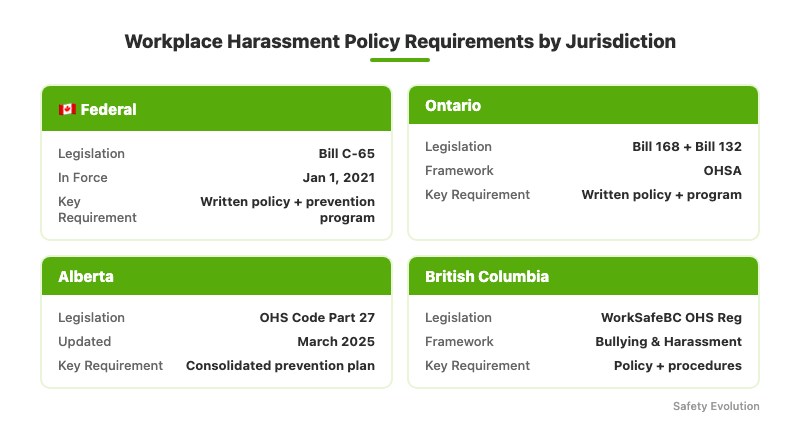
The legal landscape is layered. You need to know which jurisdiction applies to your business, because the requirements aren't identical.
Federal: Bill C-65 and the Canada Labour Code
Bill C-65 came into force on January 1, 2021, amending the Canada Labour Code Part II. It applies to federally regulated workplaces: banks, telecommunications, interprovincial transportation, and federal government employers. The law defines harassment and violence as "any action, conduct or comment, including of a sexual nature, that can reasonably be expected to cause offence, humiliation or other physical or psychological injury or illness to an employee." Under the Work Place Harassment and Violence Prevention Regulations, employers must develop a workplace harassment and violence prevention policy, conduct workplace assessments, provide training, and establish resolution procedures.
Ontario: Bill 168 and Bill 132 (OHSA)
Ontario has some of the most specific requirements in Canada. Bill 168 amended the Occupational Health and Safety Act in 2010, requiring all employers to develop both a workplace harassment policy and a workplace harassment program. Bill 132 expanded the definition in 2016 to specifically address workplace sexual harassment. Employers must post the policy in a conspicuous place, provide training, and ensure complaints are investigated "appropriate in the circumstances."
If you operate in Ontario, against OHSA requirements and flag what needs updating.
Alberta: OHS Act, Part 27 (Updated March 2025)
Alberta updated its violence and harassment prevention requirements effective March 31, 2025. The biggest change: employers now maintain one consolidated violence and harassment prevention plan instead of separate policies for violence and harassment. The plan must include hazard identification and control measures, procedures for reporting and investigating complaints, confidentiality provisions, and worker training. Reviews are required at least every three years, or sooner if triggered by an incident, workplace change, or committee request.
British Columbia: WorkSafeBC OHS Regulation
BC uses the term "bullying and harassment." Under WorkSafeBC regulations, employers must develop and implement procedures for preventing and responding to bullying and harassment. This includes defining how and when investigations will be conducted, clarifying roles and responsibilities, and documenting investigations and maintaining records.
Need a Complete Safety Program?
Stop starting from scratch. Download our Free Construction Health & Safety Manual to get compliant fast.
Download the Free Manual →
What Must a Workplace Harassment Policy Include?
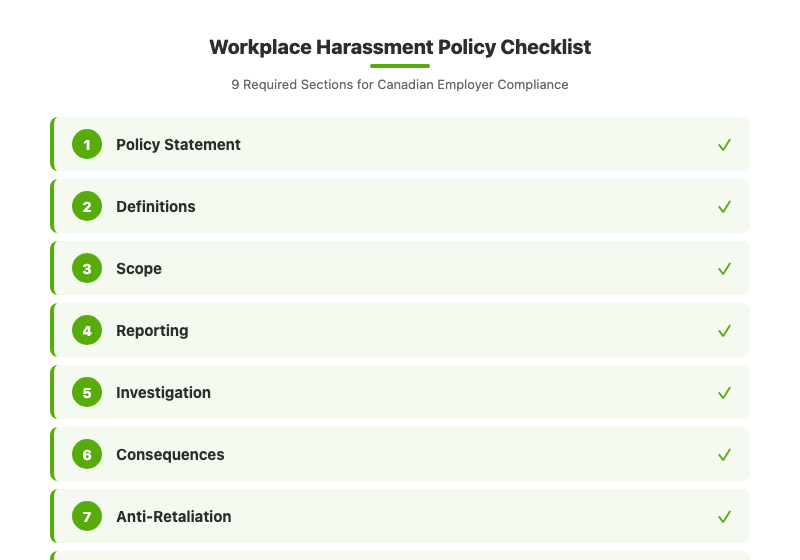
Regardless of your province, a compliant workplace harassment policy needs to cover certain core elements. Here's the framework, section by section.
1. Policy Statement and Commitment
A clear statement from senior management committing to a harassment-free workplace. This follows the same structure as your broader health and safety policy: name the most senior person accountable, state that the policy applies to everyone (employees, supervisors, managers, contractors, and visitors), and include the date of adoption and most recent review.
2. Definitions
Define harassment, violence, sexual harassment, bullying, and discrimination using the exact language from your applicable legislation, then add plain-language examples. For example, Alberta's OHS Act defines workplace harassment as "any single incident or repeated incidents of objectionable or unwelcome conduct, comment, bullying or action by a person that the person knows or ought reasonably to know will or would cause offence or humiliation to a worker, or adversely affects the worker's health and safety." Include the "reasonable management action" exclusion so managers don't become paralyzed about giving performance feedback.
3. Scope
Define where and when the policy applies: all work sites, offices, vehicles, company-controlled locations, work-related travel and events, and digital communications. Cover interactions involving workers, supervisors, clients, suppliers, and visitors. Domestic violence that spills into the workplace is covered under most provincial legislation, including Alberta and Ontario.
4. Reporting Procedures
This is where most contractor policies fall apart. A policy that says "report harassment to your supervisor" is useless when the supervisor is the one doing the harassing. Your procedures need at least two independent reporting channels (e.g., direct supervisor AND a designated person such as a senior manager or external contact), clear instructions for how to submit a report, and a statement that workers will not be penalized for making a good-faith report.
If your operation doesn't have an HR department (most 10-50 person contractors don't), designate someone by name and title. The point is that workers know exactly who to go to.
5. Investigation Process
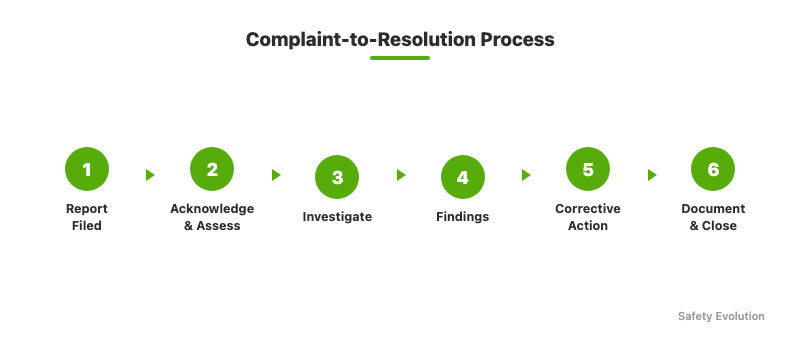
Describe who conducts investigations, the timeline for initiating them, the rights of both complainant and respondent, confidentiality protections, how findings are communicated, and documentation requirements. In Ontario, investigations must be "appropriate in the circumstances," meaning the scope should match the severity. Our free incident investigation kit includes templates that apply to harassment complaints as well.
6. Consequences and Corrective Action
State that substantiated harassment will result in corrective action up to and including termination. List the range: verbal warning, written warning, mandatory training, suspension, termination, reporting to authorities. Include consequences for knowingly false complaints.
7. Anti-Retaliation Protections
State explicitly that workers who report harassment in good faith are protected from retaliation, including termination, demotion, reduced hours, or reassignment. Workers won't use the reporting process if they believe they'll face consequences for speaking up.
8. Training Requirements
Specify training during onboarding and orientation, annual refreshers, additional training for supervisors, training whenever the policy is updated (Alberta specifically requires this), and documented sign-offs. If you're using Safety Evolution's online training platform, harassment policy training can be assigned, tracked, and documented automatically.
9. Review Schedule
Ontario: At least annually (OHSA requirement). Alberta: At least every three years, or sooner if triggered by an incident, workplace change, or committee request. BC: Regularly; annual is best practice. Federal: As part of your annual workplace assessment. Document every review, even if no changes were made.
Common Mistakes That Make Harassment Policies Useless
- Copy-pasting a generic template without adapting it to your jurisdiction. An Ontario template won't cover Alberta's consolidated plan requirement. A BC template won't use Ontario's mandatory definitions.
- Only one reporting path. If the only option is "tell your supervisor," you've built a policy that fails the moment the supervisor is the problem.
- No investigation procedure. Stating "we take all complaints seriously" without describing how you actually investigate them is a compliance gap every regulator will catch.
- Never updating the document. A policy from 2018 doesn't reflect Alberta's March 2025 changes, Bill C-65 (in force since 2021), or Bill 132's expanded sexual harassment definitions. If you're pursuing COR certification, an outdated harassment policy will flag in your audit.
- No training records. You can have the best policy in the country, but if you can't prove workers were trained on it, you've got a document that sits in a binder while your crew doesn't know it exists.
We see a version of this every week: a contractor who runs a tight, safe operation but gets flagged because the paperwork doesn't match the reality. A 20-person drywall sub in Edmonton had a solid safety culture but no written harassment policy. When a complaint surfaced, the owner handled it fairly, but there was no documented process, the outcome wasn't recorded, and when the worker went to OHS, the employer couldn't demonstrate that reasonable steps were taken. That's the gap this template closes.
Free Workplace Harassment Policy Template Outline
Below is the workplace harassment policy template outline you can use to build your document. Adapt the legal definitions and review timelines to match your province.
| Section |
What to Include |
Required By |
| 1. Policy Statement |
Commitment to a harassment-free workplace; signed by senior management; date of adoption |
All jurisdictions |
| 2. Definitions |
Harassment, violence, sexual harassment, bullying; use legislative definitions plus plain-language examples; reasonable management action exclusion |
All jurisdictions |
| 3. Scope |
All worksites, vehicles, events, digital communications; all workers, supervisors, contractors, visitors |
All jurisdictions |
| 4. Reporting Procedures |
Minimum 2 reporting channels; verbal and written options; acknowledgment timelines; contact information |
All jurisdictions |
| 5. Investigation Process |
Who investigates; timelines; rights of both parties; confidentiality; findings communication; documentation |
All jurisdictions |
| 6. Consequences |
Range from verbal warning to termination; consequences for false complaints |
All jurisdictions |
| 7. Anti-Retaliation |
Protection for good-faith reporters; definition of retaliation; consequences for retaliatory actions |
All jurisdictions |
| 8. Training |
Onboarding training; annual refreshers; supervisor training; training on updates; documented sign-offs |
All jurisdictions (AB requires training on plan updates) |
| 9. Review Schedule |
ON: annually. AB: every 3 years minimum. BC: annually (best practice). Federal: annually. |
All jurisdictions (intervals vary) |
This is the framework. Your finished policy will be longer, with your company name, specific contact information, your jurisdiction's exact legal definitions, and your internal procedures. If you want help turning this outline into a finished policy, against provincial requirements and flag what is missing. At Safety Evolution, we build safety programs that hold up to audits and inspections.
Ensure Total Policy Compliance Across Your Crew
Regulatory policies require strict documentation and worker acknowledgment. Use Safety Evolution to distribute policy updates, track sign-offs, and maintain a bulletproof digital paper trail.
30-Day Free Trial
Frequently Asked Questions
What should a workplace harassment policy include?
A compliant workplace harassment policy should include nine core sections: a policy commitment statement signed by senior management, definitions of harassment and violence using your jurisdiction's legislative language, scope of coverage, reporting procedures with at least two independent channels, investigation procedures, consequences for violations, anti-retaliation protections, training requirements, and a documented review schedule.
Is a workplace harassment policy legally required in Canada?
Yes. Every Canadian jurisdiction requires employers to address workplace harassment through written policies, programs, or prevention plans. In Ontario, the OHSA (amended by Bill 168) requires both a policy and a program. In Alberta, Part 27 of the OHS Code requires a consolidated violence and harassment prevention plan. In BC, WorkSafeBC regulations require bullying and harassment prevention procedures. Federally regulated employers must comply with Bill C-65.
How often should a workplace harassment policy be updated?
Ontario requires annual review under the OHSA. Alberta mandates review at least every three years, or sooner if triggered by an incident, workplace change, or committee request. BC and the federal government recommend regular reviews, with annual being best practice. You should also update your policy whenever relevant legislation changes, which happened most recently with Alberta's March 2025 OHS Code amendments.
Who signs off on the workplace harassment policy?
The most senior person in the organization should sign the policy: typically the owner or general manager for contractors, or the CEO for larger organizations. The signature demonstrates leadership commitment, which regulators and auditors specifically look for. If you have a joint health and safety committee, they should also be involved in reviewing the policy before sign-off.
What is the difference between a harassment policy and a harassment program?
A harassment policy is the written statement of your organization's commitment and rules. A harassment program is the set of procedures that implement the policy: reporting mechanisms, investigation processes, training schedules, risk assessments, and corrective actions. Ontario specifically requires both under the OHSA. Alberta combines these into a single consolidated prevention plan since March 2025.
Get Weekly Safety Insights
Regulation updates, toolbox talk ideas, and compliance tips. One email per week.